Romania.
România
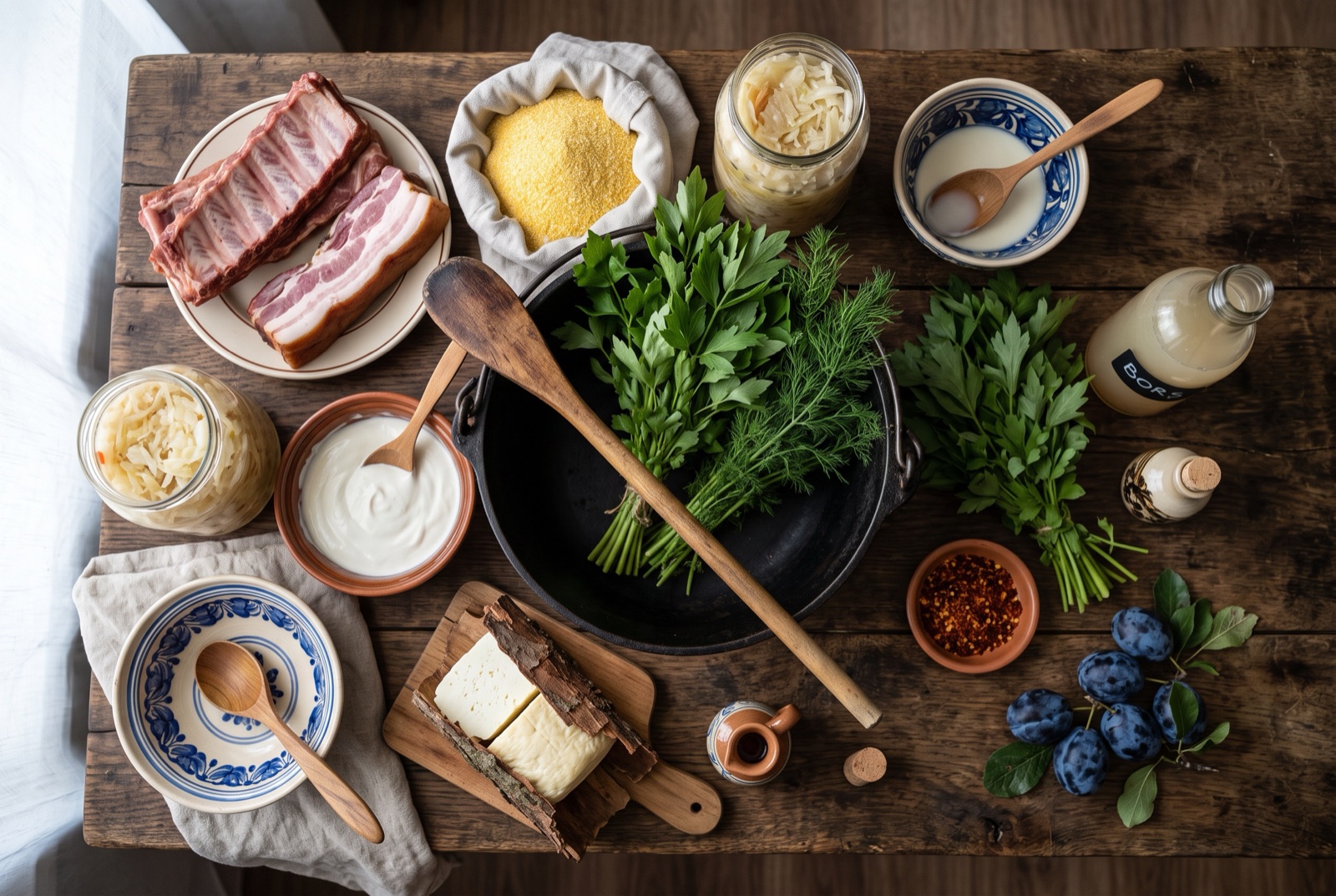
Romanian food is built around three things a farmhouse could produce without a shop: a pig, a barrel of pickles, and a sack of cornmeal. Pork is used from snout to trotter, most of it smoked over beech or plum wood in an autumn ritual that still sets the calendar in villages. Cabbage, cucumbers and green tomatoes go into brine rather than vinegar, and the sour liquid they throw off is treated as a seasoning in its own right. Cornmeal becomes mămăligă, the stiff polenta that stands in for bread beside stews, cheeses and fried eggs. Layered over that base are the borrowings of a country that sat between three empires: Turkish stuffed vegetables and syrup-soaked pastries, Austrian schnitzels and yeasted cakes, Balkan grilled meats, Russian sour soups. What holds it together is sourness — from brine, vinegar, lemon or fermented wheat bran — used the way other cuisines use chilli, to keep rich food from becoming heavy.

- Continent
- EuropeEastern Europe
- Recipes in atlas
- 10
- Must-try dishes
- 3
- Pantry staples
- 10
Start with the classics.
Must tryThe dishes that explain the Romania kitchen fastest — if you cook only a few things from this page, cook these.
Inside the Romania kitchen.
The single most Romanian flavour is sour, and it has its own vocabulary. Ciorbă means a soured soup, as distinct from supă, which is not soured; the souring agent is borș, traditionally a cloudy liquid fermented from wheat bran, and in its absence lemon juice, vinegar, sauerkraut brine, unripe grapes or fermented cabbage juice. A ciorbă is soured at the end, off the boil, and tasted repeatedly — too little and it tastes flat, too much and it tastes like a mistake. Almost every household soup follows this shape: a broth, root vegetables, a protein, a fistful of lovage or dill, and a final sharp correction.
Pork drives the savoury kitchen. The traditional December pig slaughter, Ignat, produces a year of smoked knuckle, ribs, bacon, sausages and lard, plus fresh dishes eaten immediately. Smoked pork is not an occasional ingredient here — it is the default way to season beans, cabbage and soups, contributing salt, fat and smoke in one move. Lard, not oil, is the historical cooking fat, and a spoonful of it in a bean stew tastes noticeably different from the sunflower oil most home cooks now use.
Mămăligă is the other pillar. Coarse cornmeal is rained into salted boiling water, beaten with a wooden stick called a făcăleț until it pulls away from the pot, then turned out as a single dome and cut with a thread rather than a knife. Corn arrived from the Americas and replaced millet porridge so completely that mămăligă became shorthand for peasant food itself. It carries salty sheep cheeses — brânză de burduf matured in pine bark, telemea in brine, urdă the fresh whey cheese — and a spoonful of smântână, the thick sour cream that finishes most Romanian plates.
Preserving shapes the autumn calendar. Cabbages go whole into barrels with salt and dill stalks for winter sarmale; peppers, aubergines and tomatoes are fire-roasted and cooked down into zacuscă, then jarred by the dozen; plums become magiun, a sugarless jam boiled for hours, or țuică, the clear brandy poured before rather than after dinner. Households still measure a good year by how full the pantry shelves are in November.
Regional lines are real. Transylvania cooks with Hungarian and Saxon habits — paprika, sour cream, layered bakes, richer pastries. Moldavia is the region of delicate soups, poached dumplings and the country's best-known sweet breads. Wallachia and the south lean Balkan and Ottoman: grilled meats, aubergine salads, stuffed vegetables, syrupy desserts. Dobrogea, on the Black Sea, cooks fish, Turkish and Tatar pastries, and mutton.
Signature pantry.
10 staplesThe ingredients this cuisine cannot function without.
- smoked pork
- cornmeal for mămăligă
- sauerkraut and its brine
- smântână (sour cream)
- brânză de burduf (matured sheep cheese)
- lovage
- dill
- borș (fermented wheat bran souring liquid)
- paprika
- plums
How people eat in Romania.
A proper meal opens with țuică or palincă, plum brandy drunk before the food rather than after, usually with something salty to chew on. Soup comes next and is taken seriously — many people eat ciorbă daily, with hot chillies and raw onion on the table for those who want them. The main course lands with mămăligă or bread and a bowl of smântână that everyone spoons from. Hospitality runs to insistence: refusing a second helping is heard as politeness rather than an answer, and guests are expected to give in at least once. Fasting matters too. Orthodox fasting periods cover a large share of the year, so most households keep a repertoire of de post dishes — bean spreads, zacuscă, stuffed cabbage with rice and mushrooms — that are vegan by rule, not by trend.
Regional kitchens.
Romania cooks 4 distinctly different ways depending on where you stand — here is what changes between them.
- R1Transylvania
- Centuries of Hungarian and Saxon settlement left paprika, sour cream and layered baked dishes in the local repertoire. Varză à la Cluj and rich yeasted pastries belong here.
- R2Moldavia
- The north-east is soup country, home to delicate poached dumplings, mushroom cooking and the best-known versions of cozonac. Its cooks are credited with Romania's lightest sweet breads.
- R3Wallachia and Bucharest
- The southern plain shows the deepest Ottoman imprint: grilled mici, aubergine salads, stuffed vegetables and syrup-soaked pastries, plus the beer-garden food culture of the capital.
- R4Dobrogea and the Black Sea
- Between the Danube delta and the coast, the cooking turns to carp and other river fish, Tatar and Turkish pastries, and mutton dishes rarely seen elsewhere in the country.
All Romania recipes.
10 recipes and counting
Romania10 hr 50 min
Ciolan Afumat cu Fasole
Smoked Pork Knuckle with Beans
Romania3 hr 25 min
Ciorbă de Burtă
Romanian Sour Cream Tripe Soup
Romania4 hr 40 min
Cozonac
Romanian Sweet Walnut Swirl Bread
Romania30 min
Mămăligă cu Brânză
Romanian Polenta with Sheep Cheese
Romania12 hr 37 min
Mici
Romanian Grilled Garlic Meat Rolls
Romania1 hr 15 min
Papanași
Romanian Fried Cheese Doughnuts with Sour Cherry
Romania4 hr 30 min
Sarmale
Romanian Sour Cabbage Rolls with Polenta
Romania1 hr 30 min
Tochitură
Romanian Pork Stew with Polenta and Egg
Romania1 hr 35 min
Varză à la Cluj
Transylvanian Layered Cabbage Bake
Romania2 hr 50 min
Zacuscă
Romanian Roasted Aubergine and Pepper Spread
Keep traveling.
Romania sits in Eastern Europe, and its kitchen shares borders as well as ingredients with Albania and Austria.
 Albania
 Austria