Senegal.
Sénégal
Senegalese cooking runs on one organising idea: build a deeply seasoned sauce first, then cook the starch in that sauce so nothing is wasted and everything on the plate tastes of the same pot. The country sits where the Sahel meets the Atlantic, and both show up at lunch — millet, cowpeas and groundnuts from the dry interior, and an extraordinary quantity of fish from a coastline that has fed Saint-Louis and Dakar for centuries. Three flavour anchors recur across almost every savoury dish: onions cooked far past sweetness until they collapse, fermented seasonings that supply the savoury backbone, and a deliberate sour note from tamarind, lime or lemon. Chilli is present but usually kept whole in the pot or served on the side, so the food reads as fragrant and layered rather than hot. French bread, mustard and stock cubes arrived with colonisation and were absorbed without apology; Senegalese cooks treat them as local ingredients now, because after a century and a half they are.

- Continent
- AfricaWest Africa
- Recipes in atlas
- 10
- Must-try dishes
- 3
- Pantry staples
- 10
Start with the classics.
Must tryThe dishes that explain the Senegal kitchen fastest — if you cook only a few things from this page, cook these.
Inside the Senegal kitchen.
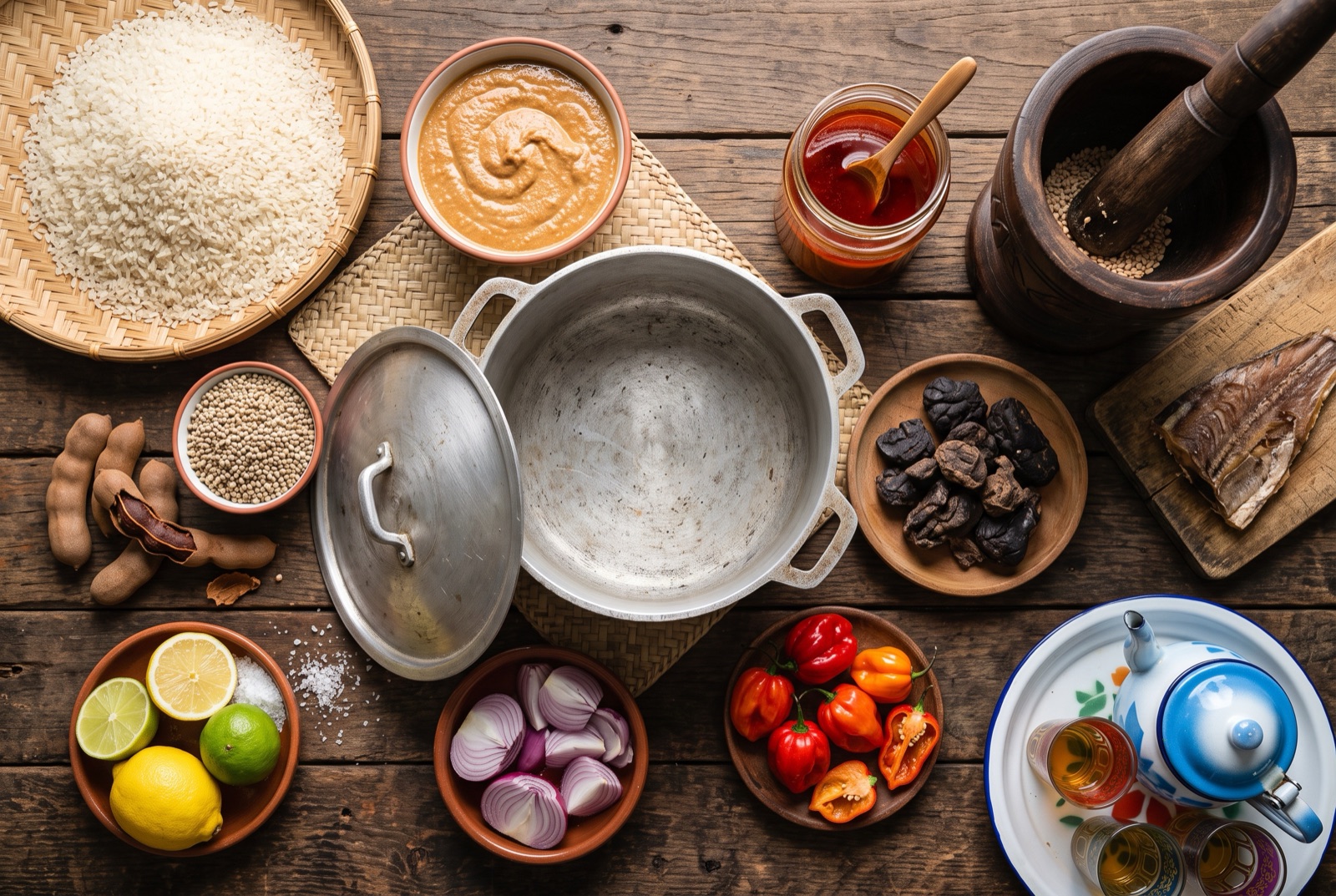
Rice is the axis of the Senegalese table, and not just any rice — riz brisé, the broken grains that arrived through colonial trade and stayed because cooks came to prefer them. Broken rice drinks up sauce in a way whole grains resist, which is exactly what a ceeb dish demands: the grain is never boiled in plain water but finished in the broth left behind by the fish or meat. Every ceeb follows the same architecture — cook the protein and vegetables in a heavily reduced onion-and-tomato base, lift them out, then cook the rice in what remains until the pot is dry and the bottom layer has caught into a toasted crust. That crust, xoon, is fought over.
The savoury backbone comes from fermentation. Nététou, the fermented seeds of the néré tree, goes in as pea-sized lumps that smell aggressive in the jar and turn round and meaty in the pot. Guedj is dried fermented fish, used as a seasoning rather than a protein, and yet — fermented sea snail — does a similar job with a sharper, muskier edge. Fresh aromatics arrive as pastes: rof, a green pounded mix of parsley, garlic, scallion and chilli that is stuffed into slashes cut in whole fish, and nokoss, the all-purpose onion, garlic and pepper paste many households keep a jar of in the fridge.
Fats carry the regional signature. Groundnut oil and thick unsweetened groundnut paste come from the peanut basin and give mafé its weight. Red palm oil, unrefined and deeply orange, is the mark of southern and coastal cooking and turns okra stew glossy. Sourness is never an afterthought: tamarind pulp in the fish broth, lemon by the litre in yassa, lime squeezed over fried fish and turnovers. That acid is what keeps rich, oily food from going heavy, and its absence is the most common fault in a home version.
Beyond rice, the grain map is millet. Steamed millet couscous — thiéré, finer and darker than semolina — carries lamb and vegetables at celebrations, and the same grain shows up sweetened in yoghurt for dessert or loosened into breakfast porridge. Mornings, though, mostly belong to the baguette: split and filled with bean stew, fried egg or leftover sauce, eaten standing up on the way to work. Street food follows the same logic of frying and folding — fataya turnovers, grilled meat at a dibiterie, fried fish and chips of cassava.
Regional differences are real but gentle. The north around Saint-Louis is the fish-and-rice heartland; Casamance in the humid south leans on palm oil, seafood and the lemon-mustard yassa method; the peanut basin around Kaolack sends groundnut paste to the entire country; and the Fulani herding areas of the Fouta contribute soured milk and dairy in a cuisine that is otherwise almost dairy-free.
Signature pantry.
10 staplesThe ingredients this cuisine cannot function without.
- broken rice
- groundnut paste
- red palm oil
- nététou (fermented locust bean)
- guedj (dried fermented fish)
- tamarind
- onions
- lemon and lime
- millet
- scotch bonnet chilli
How people eat in Senegal.
Lunch is the main meal and it is communal: one wide bowl set on a mat, everyone seated around it, each person eating the wedge directly in front of them and never reaching across. The host or the eldest breaks up the fish and meat and pushes pieces outward towards the others, and taking the best cut for yourself is the clearest breach of manners there is. Most people eat with the right hand, pressing rice into a ball against the palm; spoons are common in cities and carry no stigma. Guests are added to the bowl rather than announced in advance, which is what teranga, the Senegalese idea of hospitality, means in practice. Afterwards comes ataya, strong green tea brewed and poured three times, each round sweeter and shorter than the one before it.
Regional kitchens.
Senegal cooks 4 distinctly different ways depending on where you stand — here is what changes between them.
- R1Saint-Louis and the Senegal River
- The old colonial capital at the river mouth, and the acknowledged birthplace of thieboudienne. Cooking here is fish-first, sour with tamarind, and precise about how rice is finished in the broth.
- R2Dakar and the Petite Côte
- The peninsula where Atlantic landings meet city appetite: grilled fish at Soumbédioune, dibiteries smoking after dark, and a baguette-and-bean breakfast culture that belongs to no other part of the country.
- R3Casamance
- Green, humid and cut off from the rest of Senegal by Gambia. Red palm oil, okra, oysters from the mangroves and the lemon-and-onion yassa method that spread from here to the rest of West Africa.
- R4The Peanut Basin and Sine-Saloum
- Groundnut country around Kaolack and Fatick, the source of the paste that thickens mafé, plus millet fields that feed the couscous and porridge side of the cuisine.
All Senegal recipes.
10 recipes and counting
Senegal1 hr 55 min
Bissap
Senegalese Hibiscus Iced Drink

Senegal2 hr 50 min
Dibi
Senegalese Charcoal-Grilled Lamb with Onions
Senegal1 hr 45 min
Fataya
Senegalese Fried Fish Turnovers
Senegal2 hr 5 min
Mafé
Senegalese Peanut Butter Stew

Senegal9 hr 30 min
Ndambé
Senegalese Bean Stew Sandwich
Senegal5 hr 20 min
Poulet Yassa
Senegalese Lemon and Onion Chicken
Senegal1 hr 20 min
Soupou Kandia
Senegalese Okra and Palm Oil Stew

Senegal2 hr 40 min
Thiakry
Senegalese Millet Couscous Yogurt Dessert

Senegal2 hr 20 min
Thieboudienne
Senegalese Fish and Broken Rice
Senegal2 hr 5 min
Thiéré Bassi Salté
Senegalese Millet Couscous with Lamb
Keep traveling.
Senegal sits in West Africa, and its kitchen shares borders as well as ingredients with Algeria and Cameroon.
 Algeria
 Cameroon