Singapore.
Singapura
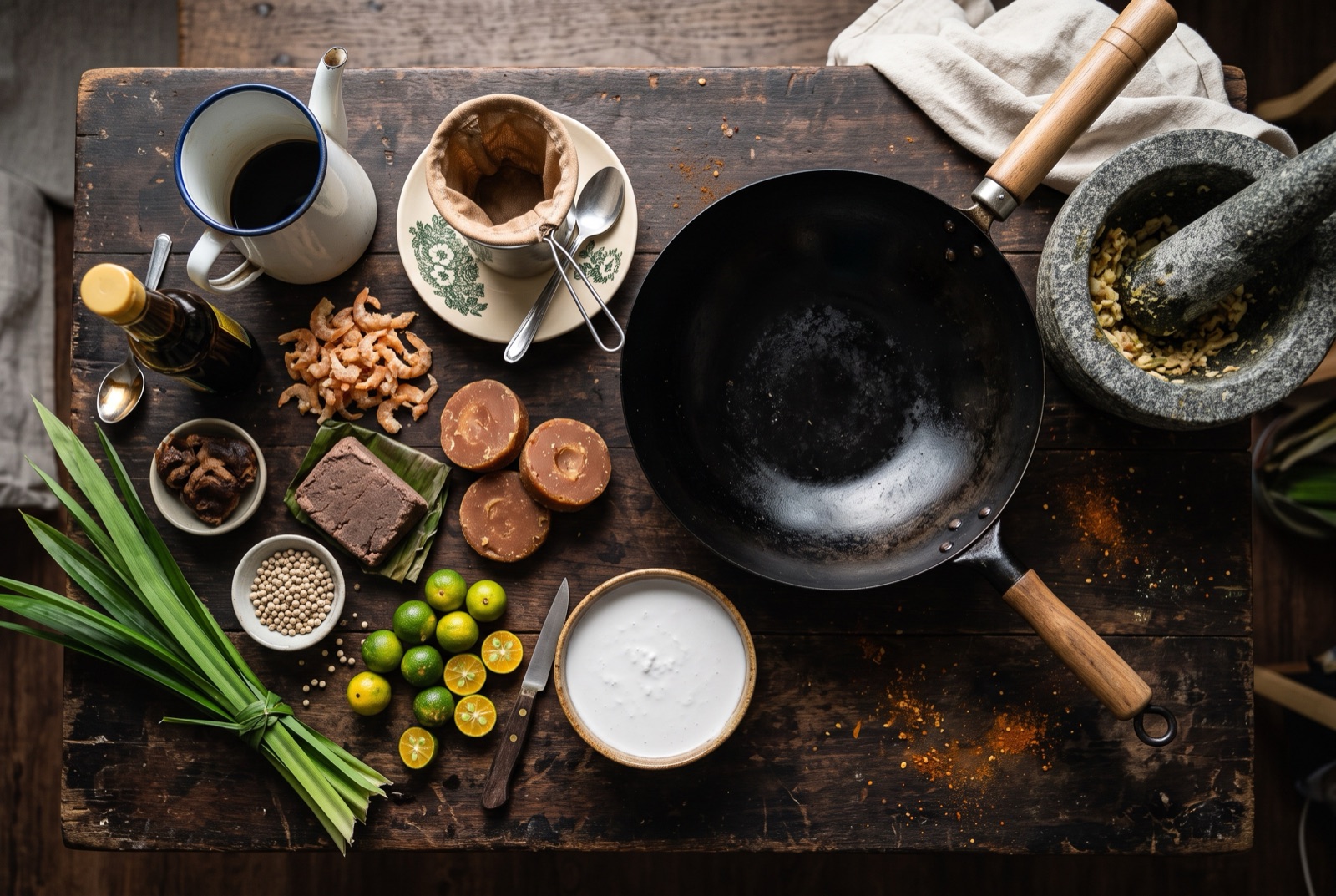
Singapore cooks like the port it has always been. Four kitchens share the island and have been stealing from each other for more than a century: southern Chinese in its Hokkien, Teochew, Cantonese and Hainanese dialects; Malay; Tamil and other South Indian; and the Peranakan kitchen that grew out of Chinese men marrying local Malay women, which fuses the two into something neither would recognise alone. What holds it together is not a shared pantry but a shared discipline of specialisation. The stall cook makes one dish, every day, for thirty years, and is judged on it by people who have eaten a thousand versions. That produces food of terrifying consistency and very little improvisation: the rice must be this grain, the chile sauce that sharp, the noodles cut to that length. Flavour runs to the pungent end — fermented shrimp paste, dried shrimp, fish sauce, white pepper — always braced with something sour, usually calamansi lime or tamarind.

- Continent
- AsiaSoutheast Asia
- Recipes in atlas
- 10
- Must-try dishes
- 3
- Pantry staples
- 9
Start with the classics.
Must tryThe dishes that explain the Singapore kitchen fastest — if you cook only a few things from this page, cook these.
Inside the Singapore kitchen.
The savoury backbone of Singaporean cooking is fermented seafood. Belacan, the compressed shrimp paste that anchors every Malay and Peranakan rempah, is toasted until it smells aggressively of the sea, then pounded with dried chiles, shallots, garlic, lemongrass, galangal and candlenut into a paste that is fried in oil until it darkens and the oil breaks out red at the edges. Dried shrimp does similar work in laksa and popiah; fish sauce and salted fish season Chinese stir-fries where soy alone would be flat. On the Chinese side the equivalent foundation is stock — prawn shell and pork bone for hokkien mee, poached chicken for chicken rice, garlic and white pepper for bak kut teh — and stalls are as protective of their stockpot as any French kitchen.
Technique divides along the same lines. Chinese stalls work the wok: extreme heat, tiny batches, and the scorched-metal aroma called wok hei that no domestic burner fully reproduces. Malay and Peranakan cooking is slower and built on the mortar — pounding a rempah by hand releases oils a blender shears off — followed by long simmers in coconut milk. Indian Singapore contributes the tandoor and the griddle: roti prata pulled and slapped into flaky rounds, dosa batters fermented overnight, and the curries that made fish head curry possible in the first place.
The island runs on the sweet-salt-sour triangle. Palm sugar (gula melaka) is the sweetener of choice, smoky and caramel-heavy rather than clean like cane sugar. Sourness comes from tamarind, calamansi, and the sharp assam of Peranakan gravies. Chile is used for fragrance as often as heat, and almost every table dish arrives with a saucer of sambal or cut chiles in soy so each eater sets their own level.
A meal is structured around a single dish, not courses. Hawker food is one-plate food: a plate of rice with something on it, or a bowl of noodles, complete in itself and eaten in fifteen minutes. Home cooking is the opposite — several dishes at once around a communal pot of rice, a soup, a vegetable, a fish, a sambal — but the hawker centre is where the national cuisine is defined and defended.
Regional variation here is really community and neighbourhood variation, and it is fiercely tracked. Katong laksa is a different dish from Penang assam laksa. Singapore hokkien mee is prawn-stock and pale; the Kuala Lumpur dish of the same name is black with dark soy. Bak kut teh in Singapore is Teochew — clear, garlicky and loaded with white pepper — while the Klang version across the causeway is dark and herbal. These are not trivia; ordering the wrong one is how arguments start.
Signature pantry.
9 staplesThe ingredients this cuisine cannot function without.
- belacan (fermented shrimp paste)
- gula melaka (palm sugar)
- calamansi lime
- pandan leaf
- white peppercorns
- dried shrimp
- coconut milk
- dark sweet soy sauce
- tamarind
How people eat in Singapore.
Eating happens in hawker centres at every hour, and alone is normal. Seats are reserved by leaving a packet of tissues on the table — the practice is called choping, and the packet is respected. You order one dish per person from separate stalls, pay at each, and eat as the food arrives rather than waiting for the table. Drinks come from a dedicated stall with its own compressed vocabulary: kopi is coffee with condensed milk, kopi o is black with sugar, kopi c uses evaporated milk, and adding kosong means no sugar at all. Chopsticks or fork and spoon are standard for Chinese food; Malay and Indian dishes are eaten with the right hand where trays and washbasins allow. Since 2021 clearing your own tray is not just polite but law.
Regional kitchens.
Singapore cooks 4 distinctly different ways depending on where you stand — here is what changes between them.
- R1Chinatown and the Hokkien-Teochew core
- Where the southern Chinese dialect kitchens concentrated: Teochew porridge and steamed fish, Hokkien noodles fried in lard, Cantonese roast meats. Peppery bak kut teh and hokkien mee both belong to this lineage.
- R2Katong and Joo Chiat
- The Peranakan east coast, where Chinese and Malay cooking merged into the Nyonya kitchen. Home of the spoon-only Katong laksa and of popiah rolled at a communal table, plus pastel shophouses that make the neighbourhood instantly recognisable.
- R3Little India and Tekka
- Tamil Singapore, and the birthplace of fish head curry — a South Indian gravy adapted for Chinese customers who prized the head. Banana-leaf rice, roti prata and overnight-fermented dosa batters all live here.
- R4Geylang Serai and Kampong Glam
- The Malay-Muslim heart of the island: nasi padang counters, satay grilled over charcoal, mee rebus in thick sweet-potato gravy, and the rempah-pounding tradition that underpins half of Singapore's sambals.
All Singapore recipes.
10 recipes and counting
Singapore2 hr
Bak Kut Teh
Peppery Pork Rib Broth
Singapore9 hr 40 min
Chai Tow Kway
Singaporean Fried Radish Cake
Singapore1 hr 50 min
Hainanese Chicken Rice
Poached Chicken with Stock Rice
Singapore1 hr 45 min
Hokkien Mee
Singapore Prawn Stock Fried Noodles
Singapore3 hr 20 min
Ice Kachang
Singaporean Shaved Ice with Beans and Syrups
Singapore1 hr 35 min
Katong Laksa
Singapore Coconut Curry Noodle Soup
Singapore1 hr
Kaya Toast
Singaporean Coconut Jam Toast with Soft Eggs
Singapore1 hr 50 min
Popiah
Singaporean Fresh Spring Roll with Braised Turnip
Singapore55 min
Singapore Chilli Crab
Crab in Sweet Chili Tomato Gravy
Singapore1 hr 5 min
Singapore Fish Head Curry
Snapper Head in Tamarind Curry
Keep traveling.
Singapore sits in Southeast Asia, and its kitchen shares borders as well as ingredients with Armenia and Bangladesh.
 Armenia
 Bangladesh