Sri Lanka.
ශ්රී ලංකා
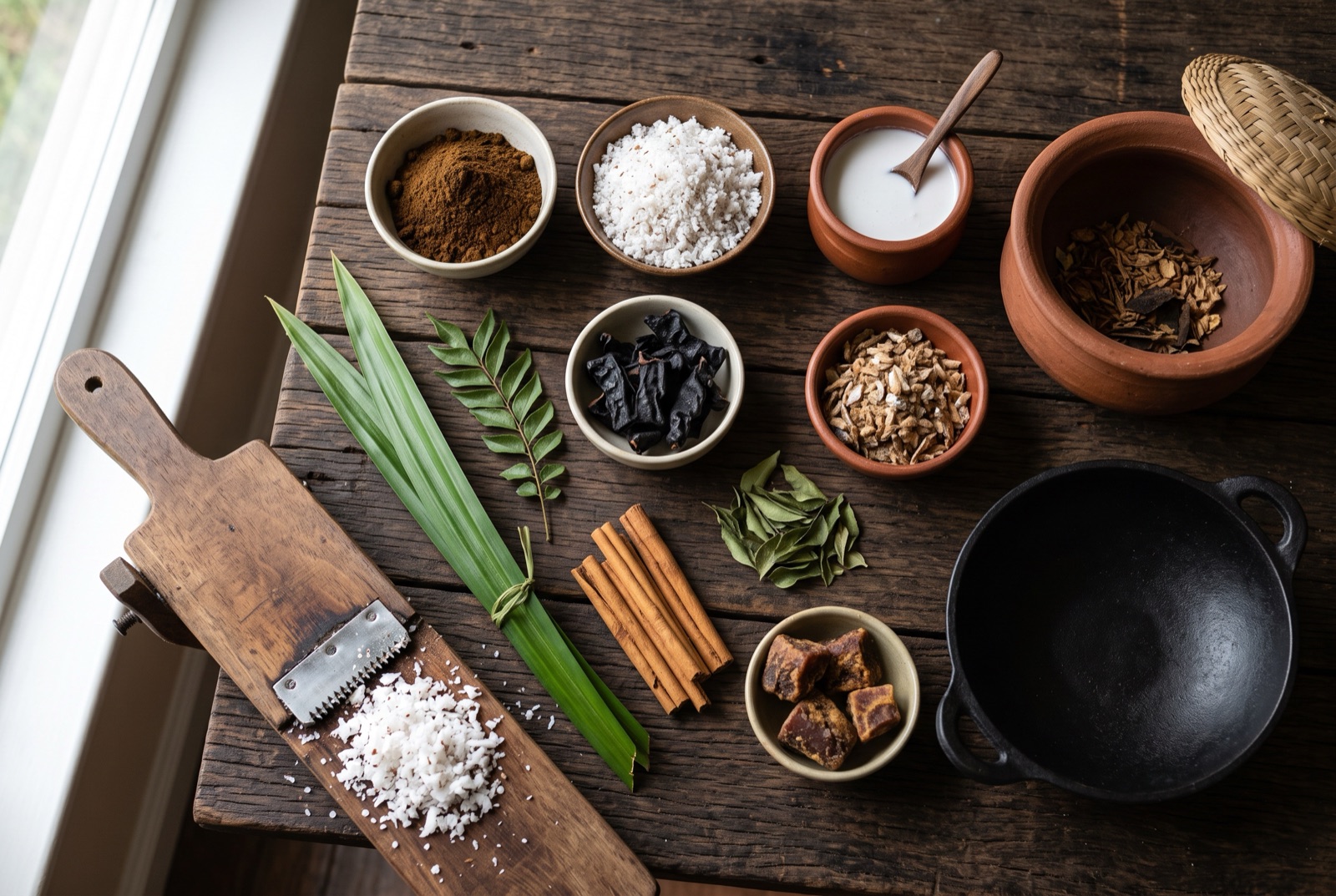
Sri Lankan food gets filed under "South Indian" by people who have not eaten it, and one mouthful corrects the filing. The defining move is roasting: coriander, cumin, fennel and often a little raw rice are dry-toasted in a pan until they turn from tan to coffee-brown before they are ground, so the base note of a Sri Lankan curry is dark, smoky and faintly bitter rather than bright and raw. The second is coconut, used in three separate forms within a single meal — freshly scraped white flesh pounded into sambols, thin and thick milk pressed from that flesh for gravies, and coconut oil in the pan. The third is a bundle of aromatics that grows on the island and rarely appears together anywhere else: pandan leaf, curry leaf, lemongrass, quills of true Ceylon cinnamon, and goraka, a black sour fruit that does a job no tamarind quite copies. Chile heat here is real rather than decorative, and a meal is assembled as many small dishes around rice, never as one curry standing alone.

- Continent
- AsiaSouth Asia
- Recipes in atlas
- 10
- Must-try dishes
- 3
- Pantry staples
- 10
Start with the classics.
Must tryThe dishes that explain the Sri Lanka kitchen fastest — if you cook only a few things from this page, cook these.
Inside the Sri Lanka kitchen.
Start with the spice tin, because everything follows from it. Sri Lankan kitchens keep at least two curry powders. Unroasted powder — coriander, cumin, fennel, turmeric, sometimes fenugreek — goes into pale coconut-milk curries of fish, egg or vegetables, keeping them yellow and gentle. Roasted powder, thuna paha, is the same spices toasted until dark before grinding, and it is what makes chicken, beef and pork curries taste unmistakably Sri Lankan: bitter-edged, savoury, almost coffee-like. Push the roasting further, add toasted rice and cloves, and you get the near-black powder behind kalu pol and black pork curry. Nothing in the Indian repertoire behaves quite like it, which is why Sri Lankan curry and Indian curry are cousins rather than siblings.
Coconut is the second pillar and it is treated with real precision. A cook scrapes fresh coconut on a hiramanaya, a bench-mounted serrated blade, and the shreds go three ways. Raw, they are pounded with chile and lime into pol sambol. Squeezed with a little warm water they give thick first milk, kiri, which is stirred in at the very end because boiling it hard makes it split. Squeezed again with more water they give thin second milk, used to actually cook the curry. Coconut oil fries everything else. A curry that tastes flat almost always got its thick milk too early or boiled after it went in.
The daily format is rice and curry, and the word "curry" is misleading because there are five or six of them. A plate carries red or white rice in the middle, one meat or fish curry, two or three vegetable curries cooked in different registers — one wet, one dry-fried, one mallung of finely chopped greens tossed with scraped coconut — plus a fiery sambol, a spoon of chutney or pickle and a papadam. The point is contrast: you build each mouthful yourself, cooling a chile hit with dhal, cutting coconut richness with something sour.
Sourness is its own discipline. Goraka, the dried black rind of Garcinia, is soaked and pounded into fish curries where it both sours and preserves — the reason ambul thiyal survived on the southern coast without refrigeration. Tamarind handles lighter souring, lime is squeezed at the table, and vinegar arrives in the Portuguese-descended pickles and black pork curries. Sweetness answers back through kithul jaggery, tapped from the fishtail palm and used in everything from wambatu moju to watalappan.
Finally, the island is not one kitchen. Sinhalese Buddhist cooking leans vegetarian and coconut-rich; Tamil cooking in the north builds the famously hot Jaffna curry powder and crab curries thickened with roasted spice; Muslim and Malay communities brought biryani, watalappan and the pastry-heavy short-eats culture; and Dutch Burgher families kept lamprais, breudher and love cake. Street food runs on its own clock — hoppers and string hoppers at dawn and dusk, kottu roti clanging on griddles late into the night.
Signature pantry.
10 staplesThe ingredients this cuisine cannot function without.
- roasted curry powder (thuna paha)
- fresh scraped coconut
- thick coconut milk
- pandan leaf (rampe)
- curry leaves
- goraka (Malabar tamarind)
- Maldive fish
- Ceylon cinnamon
- kithul jaggery
- red rice
How people eat in Sri Lanka.
Rice and curry is eaten with the right hand, and doing it properly is a skill: you mix a small area of rice with two or three curries, gather it with the fingertips and push it in with the thumb, so no two mouthfuls taste identical. Everything arrives at once rather than in courses, and helping yourself to a little of each dish is expected — leaving a curry untouched reads as a comment on it. Sambol is a condiment, not a side, taken in small fiery smears. Lunch is the big meal; breakfast may be hoppers, string hoppers or kiribath, and dinner is often lighter or bought from a street griddle. A guest is fed before anything else is discussed, and refusing a second serving usually takes two attempts.
Regional kitchens.
Sri Lanka cooks 4 distinctly different ways depending on where you stand — here is what changes between them.
- R1Colombo and the West Coast
- The island's street-food engine, where kottu roti griddles clang past midnight and Muslim-owned hotels sell short eats by the tray. Also the home of the most cosmopolitan cooking — Malay, Burgher and Tamil kitchens overlapping in one city.
- R2Jaffna and the North
- Sri Lankan Tamil country, defined by its own scorching curry powder heavy on chile and roasted spice, crab curry thickened with roasted rice, and the palmyra palm that yields sweet toddy and bitter kilangu tubers.
- R3The South Coast
- From Galle to Tangalle the cooking is fish-first and sour: ambul thiyal blackened with goraka, tuna and skipjack curries, and a strong Portuguese and Dutch pastry inheritance left behind in the fort towns.
- R4Kandy and the Hill Country
- Cooler upland kitchens working with jackfruit, ash plantain, breadfruit and hill vegetables, alongside the tea estates that gave the island its export identity and the plantation Tamil food that grew up around them.
All Sri Lanka recipes.
10 recipes and counting
Sri Lanka1 hr 15 min
Ambul Thiyal
Sri Lankan Sour Fish Curry

Sri Lanka2 hr 30 min
Kalu Uru Mas
Sri Lankan Black Pork Curry
Sri Lanka45 min
Kottu Roti
Sri Lankan Chopped Flatbread Stir-Fry
Sri Lanka1 hr 5 min
Kukul Mas Curry
Sri Lankan Roasted-Spice Chicken Curry
Sri Lanka2 hr 35 min
Lamprais
Dutch Burgher Banana Leaf Rice Parcel
Sri Lanka35 min
Parippu
Sri Lankan Red Lentil Coconut Curry
Sri Lanka15 min
Pol Sambol
Sri Lankan Coconut Chili Relish

Sri Lanka7 hr 45 min
Sri Lankan Hoppers
Appa, Bowl-Shaped Coconut Pancakes
Sri Lanka2 hr 55 min
Wambatu Moju
Sri Lankan Pickled Eggplant
Sri Lanka3 hr 15 min
Watalappan
Sri Lankan Coconut Jaggery Custard
Keep traveling.
Sri Lanka sits in South Asia, and its kitchen shares borders as well as ingredients with Armenia and Bangladesh.
 Armenia
 Bangladesh