Taiwan.
臺灣
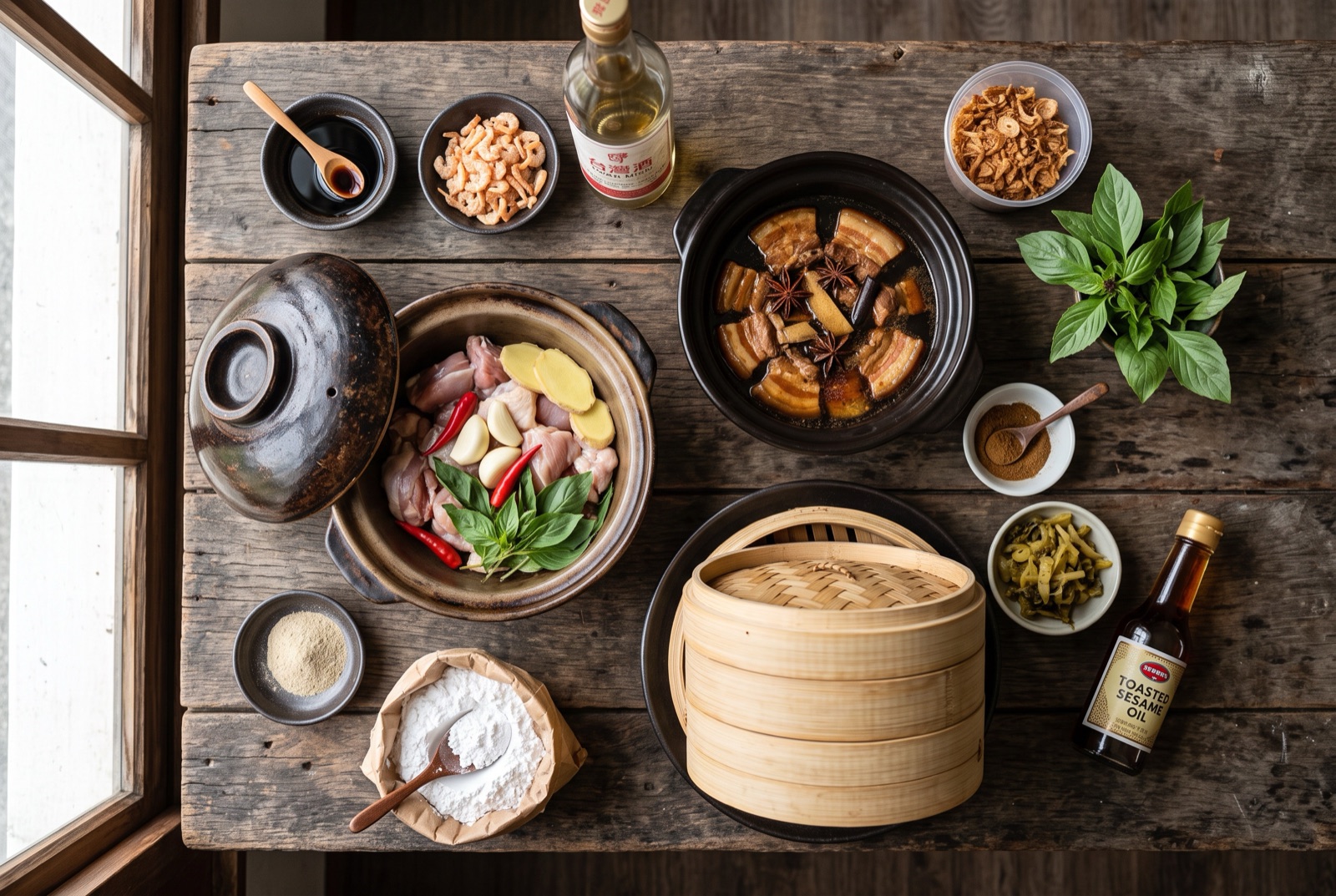
Taiwanese food is a Hokkien island kitchen that absorbed fifty years of Japanese administration, then took in cooks from every mainland province at once after 1949, on top of Indigenous and Hakka traditions that were already here. The result is layered rather than fused, and its governing instinct is restraint. The core seasoning kit is small — soy sauce, rice wine, toasted sesame oil, white pepper, fried shallots and a measured amount of sugar — and it is used to make an ingredient taste more like itself, not to bury it. Braising is the national verb: pork, beef, tofu, eggs and bamboo all spend time in a dark, faintly sweet soy liquid. Chile is usually optional and offered on the side rather than cooked in. And Taiwan eats out relentlessly, so the night market stall is not a tourist novelty but the island's real dinner infrastructure, where a whole meal is assembled from four or five small bowls bought from four or five different vendors.

- Continent
- AsiaEast Asia
- Recipes in atlas
- 10
- Must-try dishes
- 3
- Pantry staples
- 10
Start with the classics.
Must tryThe dishes that explain the Taiwan kitchen fastest — if you cook only a few things from this page, cook these.
Inside the Taiwan kitchen.
Start with the pantry, because Taiwanese flavour is unusually consistent from one dish to the next. Soy sauce does the heavy lifting, often two kinds — a saltier light one for seasoning and a thicker, darker one for colour. Rice wine (michiu) goes into almost everything with meat in it; toasted sesame oil arrives late, off the heat, or is used as the actual cooking fat in the sesame-oil chicken dishes of winter. Rock sugar rounds the salt without reading as dessert. White pepper, not black, is the default warm note, and fried shallots — crisp, sold in tubs, scattered on rice at the last second — are the single ingredient most home cooks reach for to make plain food taste Taiwanese.
The preserved shelf matters just as much. Fermented mustard greens turn up as suan cai in beef noodle soup and as sour, salty strands folded into steamed buns. Dried radish (cai pu) goes into omelettes, dried baby shrimp and flat dried squid rehydrate into stir-fries and broths, and pickled cucumber or bamboo comes free with breakfast congee. These are not garnishes: they are the acid and the salt spike that keep rich braises from flattening out.
Technique splits three ways. Long braising in a soy master liquid — the lu pot — produces lu rou fan, tea eggs, braised tofu and the deep-brown pork belly that fills gua bao. Fast wok work covers Hakka stir-fries and the three-cup method, where sesame oil, soy and rice wine reduce onto meat in an open clay pot until barely any liquid is left. Steaming handles buns, fish and glutinous rice. Then there is texture: Taiwanese cooks chase what they call Q — a springy, resilient chew — using sweet potato starch and tapioca in oyster omelettes, meatballs and tapioca pearls, and it is judged as seriously as seasoning.
A home meal is rice plus several shared dishes and a soup on the table at the same time, not in courses. Breakfast is its own institution, eaten out: hot or cold soy milk, savoury soy curd, egg crêpes, rice rolls, sesame flatbread. Late in the day the night market takes over with xiaochi — literally small eats — meant to be sampled in quantity rather than ordered as one plate.
Regionally, Tainan cooks noticeably sweeter and holds the oldest street-food canon; Taipei inherited the mainland restaurant traditions that arrived with the Nationalist government; the Hakka hill counties of Hsinchu and Miaoli cook saltier, oilier, more preserved food built for farm labour; and the east coast and offshore islands lean on seafood and on Indigenous ingredients like mountain pepper (maqaw), millet and wild greens that mainstream Taiwanese cooking is only now taking seriously.
Signature pantry.
10 staplesThe ingredients this cuisine cannot function without.
- soy sauce
- rice wine (michiu)
- fried shallots
- toasted sesame oil
- five-spice powder
- white pepper
- sweet potato starch
- pickled mustard greens (suan cai)
- Thai basil
- dried baby shrimp
How people eat in Taiwan.
Dishes arrive together and belong to the table, not to one person; each diner keeps a personal bowl of rice and takes a few bites at a time from the shared plates with chopsticks. Soup sits on the table throughout rather than opening the meal, and it is drunk from a bowl, sipped between mouthfuls of rice. Never stand chopsticks upright in rice — that is how food is offered to the dead. At night markets the etiquette inverts: you buy one small item per stall, eat it standing or walking, and keep moving, which is why portions are deliberately tiny. Tipping is not expected anywhere, and reaching for the bill aggressively is normal politeness among friends.
Regional kitchens.
Taiwan cooks 4 distinctly different ways depending on where you stand — here is what changes between them.
- R1Tainan and the South
- The island's oldest city and the deepest street-food archive: danzai noodles, milkfish congee, coffin bread and shrimp rolls. Southern cooking is openly sweeter, and locals will tell you the sugar is the point, not an accident.
- R2Taipei and the North
- Where the post-1949 mainland kitchens landed and merged with local food, producing beef noodle soup, Jiangzhe and Sichuan restaurants, and the country's densest night-market culture around Shilin, Raohe and Ningxia.
- R3The Hakka Hills (Hsinchu and Miaoli)
- Salty, oily, preserve-heavy farm cooking: dried squid and pork belly stir-fries, pickled mustard greens, stuffed tofu and pounded lei cha tea. Frugal by design, and the strongest regional identity on the island.
- R4The East Coast and Offshore Islands
- Hualien, Taitung and Penghu, where the food turns to seafood, millet, wild mountain greens and Indigenous seasonings such as maqaw pepper — the part of Taiwanese cooking least represented in city restaurants.
All Taiwan recipes.
10 recipes and counting
Taiwan1 hr 50 min
Danzai Mian
Tainan Peddler's Noodles
Taiwan2 hr 55 min
Feng Li Su
Taiwanese Pineapple Shortcake
Taiwan4 hr
Gua Bao
Taiwanese Steamed Pork Belly Bun
Taiwan4 hr 40 min
Kejia Xiao Chao
Hakka Stir-Fry with Dried Squid
Taiwan2 hr
Lu Rou Fan
Taiwanese Braised Pork Rice
Taiwan3 hr 40 min
Niu Rou Mian
Taiwanese Braised Beef Noodle Soup
Taiwan35 min
O-a-tsian
Taiwanese Oyster Omelette
Taiwan45 min
San Bei Ji
Taiwanese Three-Cup Chicken
Taiwan1 hr 50 min
Taiwanese Cong You Bing
Crushed Flaky Scallion Pancake
Taiwan1 hr 5 min
Zhen Zhu Nai Cha
Taiwanese Bubble Milk Tea
Keep traveling.
Taiwan sits in East Asia, and its kitchen shares borders as well as ingredients with Armenia and Bangladesh.
 Armenia
 Bangladesh