Thailand.
ประเทศไทย
Thai cooking is an act of balancing. Almost every dish negotiates between salty, sour, sweet and hot — fish sauce against lime, palm sugar against chiles — and a cook is judged by how those forces are tuned, not by any single flavor winning. The seasoning is loud but the structure is precise: pounded pastes of lemongrass, galangal and garlic build the base, herbs go in at the end and stay vivid, and rice anchors everything. It is also a profoundly social cuisine — dishes land in the middle of the table and everyone spoons them over their own rice, so a meal is composed like a chord: one curry, one soup, one stir-fry, something crisp. And what the world knows as Thai food is mostly Bangkok's version; the north, the northeast and the south each cook noticeably differently.

- Continent
- AsiaSoutheast Asia
- Recipes in atlas
- 10
- Must-try dishes
- 3
- Pantry staples
- 9
Start with the classics.
Must tryThe dishes that explain the Thailand kitchen fastest — if you cook only a few things from this page, cook these.
Inside the Thailand kitchen.
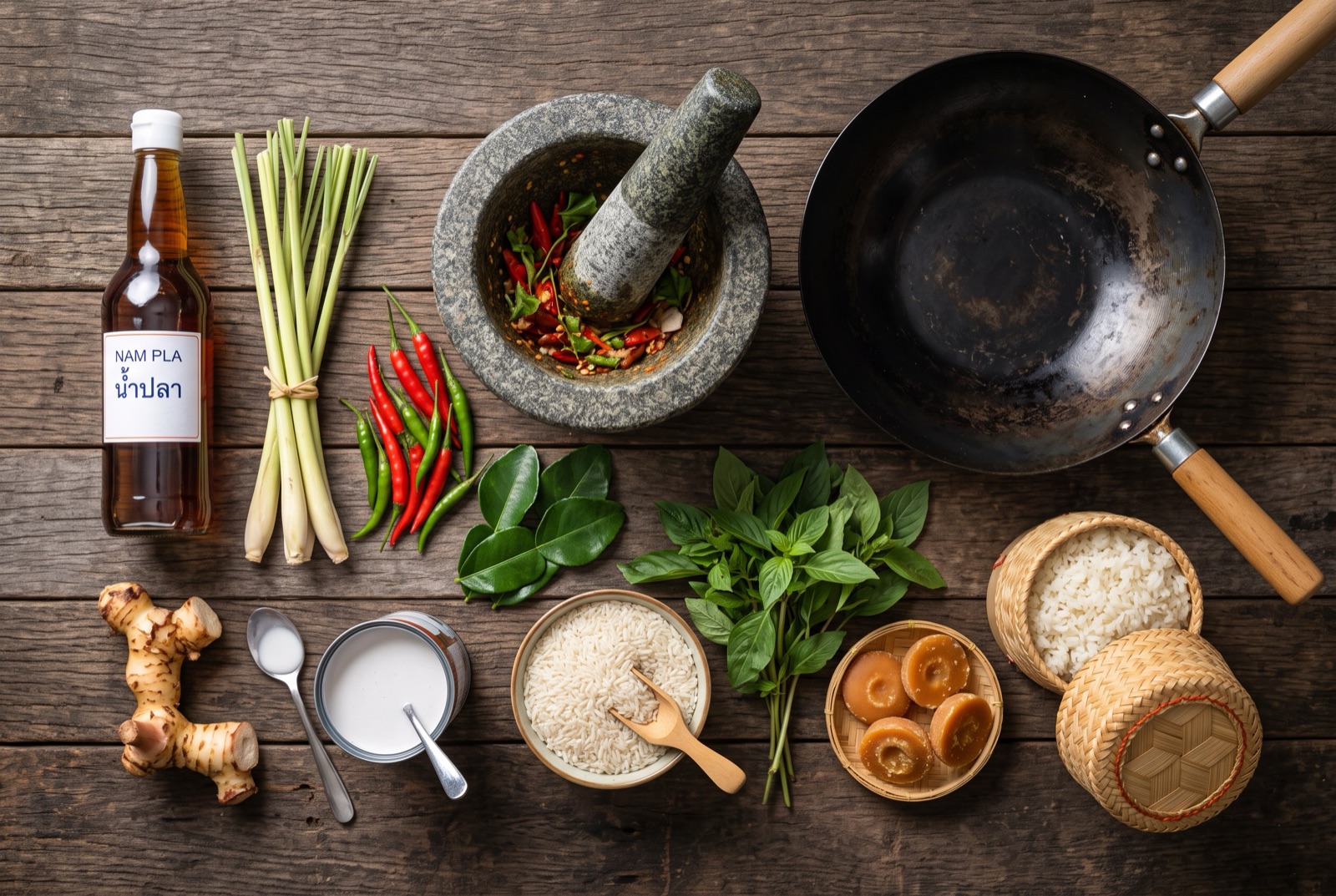
The backbone of the cuisine is fermented seafood: fish sauce (nam pla) for salt and depth in nearly everything, and shrimp paste (kapi) pounded into curry pastes and relishes. Thai cooks salt with fish sauce the way European cooks salt with salt, and its funk disappears into a finished dish, leaving only savoriness behind. The second pillar is the mortar and pestle — the krok. Curry pastes, the nam prik chile relishes at the center of traditional meals, and the dressing for som tam are all pounded, because pounding ruptures lemongrass, galangal, chiles and garlic in a way no blender blade quite matches.
Rice divides the country. The center and south eat fragrant jasmine rice, steamed and spooned under curries and stir-fries; the north and the northeast (Isaan) eat glutinous sticky rice, rolled into balls by hand and used to pinch up grilled meats and pungent salads. Noodles — rice noodles above all — arrived with Chinese migrants along with the wok, and noodle dishes remain a one-plate, chopsticks-and-street-stall category distinct from the shared rice meal.
Technique-wise, two moves define the repertoire. For curries, coconut cream is simmered until its oil separates or "cracks", the paste is fried in that oil until fragrant, and only then does coconut milk loosen it into a sauce — skip the frying and the curry tastes flat and raw. For stir-fries, a wok over ferocious heat delivers the faint smokiness Thais call the "breath of the wok", inherited from Chinese kitchens and made Thai with fish sauce, chiles and holy basil.
Seasoning is never considered finished when the dish leaves the kitchen. Noodle shops set out a four-jar caddy — fish sauce, sugar, dried chile, chiles in vinegar — and adjusting your own bowl is expected, not insulting. Street food is not a snack tier but the daily engine of Thai eating; many Bangkok households barely cook, because the stall downstairs does one dish and has done it for thirty years. Regional kitchens pull in their own directions: Isaan toward fermented fish, lime and raw heat; the north toward milder, pork-rich curries without coconut; the south toward turmeric, intense chile heat and the Malay-influenced flavors of the peninsula.
Signature pantry.
9 staplesThe ingredients this cuisine cannot function without.
- fish sauce
- lemongrass
- galangal
- makrut lime leaves
- bird's eye chiles
- coconut milk
- jasmine rice
- thai basil
- palm sugar
How people eat in Thailand.
Thais eat with a spoon and fork — the spoon in the right hand does the eating, the fork only pushes food onto it — and knives never appear at the table because everything arrives cut. Chopsticks are reserved for noodle dishes, mostly at Chinese-style shops. A proper meal is shared: several contrasting dishes in the center, each person with their own plate of rice, taking a spoonful or two at a time rather than loading the plate. Seasoning your own food from the table caddy is normal and expected. Sticky-rice regions eat by hand, pressing a small ball of rice into a scoop for grilled chicken or som tam.
Regional kitchens.
Thailand cooks 4 distinctly different ways depending on where you stand — here is what changes between them.
- R1Central Thailand & Bangkok
- The royal-court and river-delta kitchen the world knows best: coconut-milk curries, refined balance of sweet and salty, jasmine rice, and Bangkok's street-food scene — the proving ground where pad thai and tom yum became national dishes.
- R2Isaan (Northeast)
- Sticky rice country on the Lao border: grilled meats (gai yang, moo ping), som tam pounded to order, larb, and a bold palate of lime, fish sauce, fermented fish and serious chile heat — Thailand's most influential regional kitchen.
- R3The North (Chiang Mai)
- Cooler highlands with Burmese and Yunnanese threads: khao soi's curried noodles, pork-forward curries made without coconut milk, herbal sausages and sticky rice — gentler heat, deeper earthiness.
- R4The South
- The peninsula between two seas: intense turmeric-yellow curries, abundant seafood, fierce chile heat and Malay-influenced dishes like massaman — generally the hottest food in the country.
All Thailand recipes.
10 recipes and counting
Thailand15 min
Khai Jiao
Thai Deep-Fried Puffy Omelette over Rice
Thailand4 hr 50 min
Khao Niao Mamuang
Thai Mango Sticky Rice
Thailand1 hr 5 min
Khao Soi Gai
Chiang Mai Coconut Curry Noodle Soup
Thailand35 min
Larb Gai
Isan Minced Chicken Salad with Toasted Rice
Thailand8 hr 42 min
Moo Ping
Thai Grilled Coconut Pork Skewers
Thailand20 min
Pad Kra Pao Moo
Thai Holy Basil Stir-Fry with Fried Egg
Thailand40 min
Pad Thai
Tamarind Rice Noodle Stir-Fry
Thailand20 min
Som Tam Thai
Green Papaya Salad Pounded in a Mortar
Thailand50 min
Thai Green Curry with Chicken
Gaeng Keow Wan
Thailand35 min
Tom Yum Goong
Hot and Sour Shrimp Soup
Keep traveling.
Thailand sits in Southeast Asia, and its kitchen shares borders as well as ingredients with Armenia and Bangladesh.
 Armenia
 Bangladesh