Tunisia.
تونس
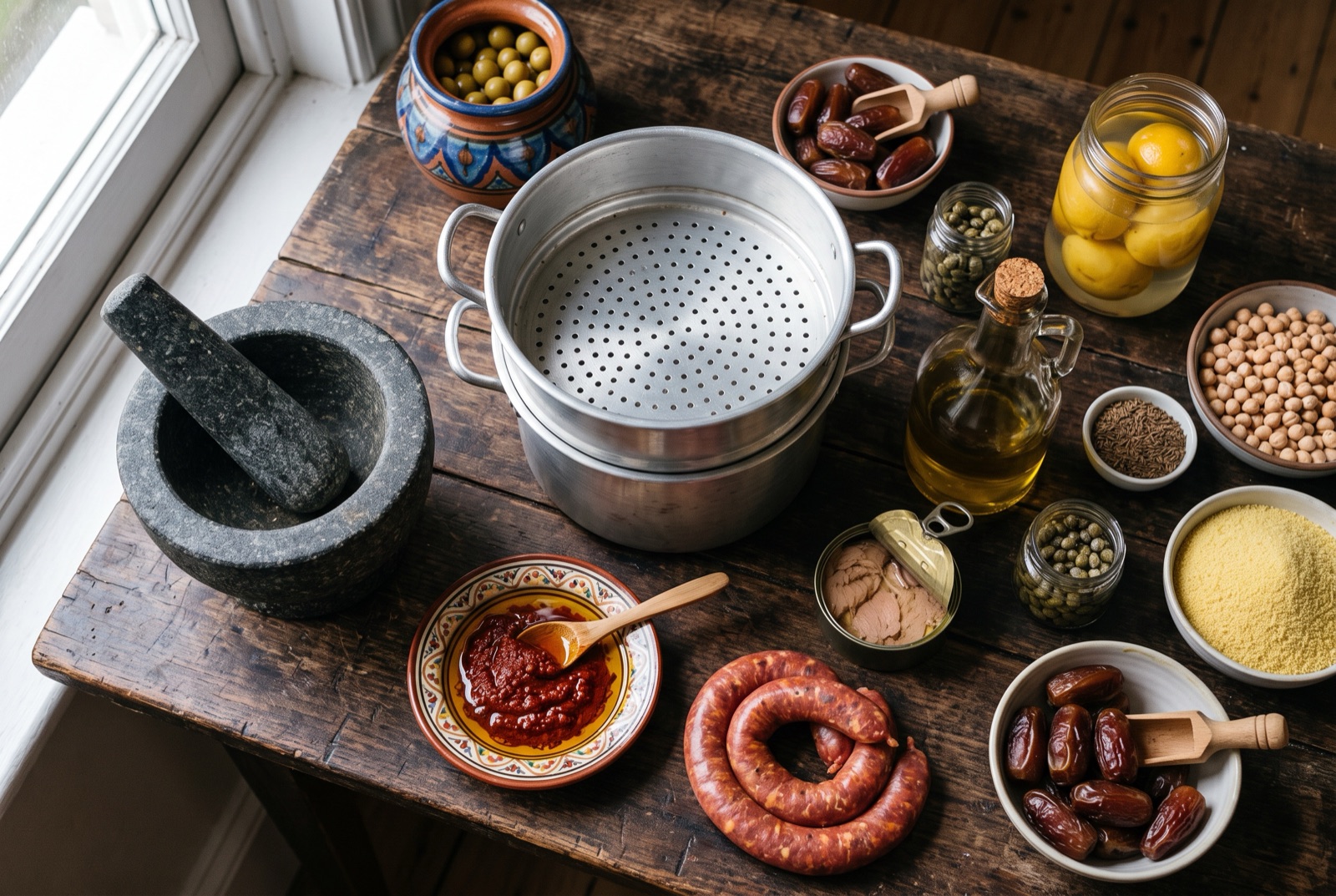
Tunisian food is the hottest of the Maghreb kitchens, and it is unapologetic about it. Where Moroccan cooking leans sweet and Algerian cooking leans mild, Tunisia builds almost everything on harissa — sun-dried chillies pounded with garlic, caraway and coriander seed — and on olive oil, pressed here in quantities that put the country among the world's largest producers. The result is a repertoire of red sauces, cumin-heavy broths and salads chopped fine by hand, punctuated by tuna, capers, olives and preserved lemon from a coastline more than a thousand kilometres long. Eggs turn up constantly, usually as the closing move: cracked into a pepper stew, sealed inside fried pastry, poached over a bowl of chickpeas. Nothing is refined into quietness. A Tunisian plate is supposed to taste of chilli, garlic and the sea all at once, and the bread on the table exists to keep up with it.

- Continent
- AfricaMaghreb
- Recipes in atlas
- 10
- Must-try dishes
- 3
- Pantry staples
- 10
Start with the classics.
Must tryThe dishes that explain the Tunisia kitchen fastest — if you cook only a few things from this page, cook these.
Inside the Tunisia kitchen.
Harissa is the spine of the cuisine, and understanding it explains most Tunisian cooking. Ripe chillies — traditionally the local baklouti variety — are split, dried in the sun until leathery, then rehydrated and pounded with garlic, salt, caraway and coriander seed and sealed under oil. Caraway is the giveaway: it is what makes Tunisian chilli paste taste Tunisian rather than simply hot. A spoonful is fried into the oil at the start of a stew, whisked into a vinaigrette, spread inside a sandwich, or set out neat in a saucer so each person can adjust their own bowl. Alongside it sits tabil, a ground blend of coriander seed, caraway, garlic and dried chilli that seasons meat and vegetable dishes across the country.
The second pillar is olive oil, used with a generosity that surprises visitors. It is the frying fat, the salad dressing, the preservative poured over harissa and cheese, and the finishing drizzle. Tunisia's olive groves stretch across the Sahel around Sfax and Sousse in plantations so vast they are visible from the air, and the oil goes into everything from breakfast to dessert dough.
Seafood defines the coast. Tuna is the national protein, canned in oil and folded into salads, sandwiches, pastry and even pizza; grouper, sea bream, sardines and octopus fill the markets of Bizerte, Mahdia and Sfax. Inland, lamb and merguez — the thin, chilli-red sausage shared with Algeria and Morocco — dominate, along with chickpeas, broad beans, freekeh and the durum wheat that becomes couscous, semolina bread and pasta shapes found nowhere else in North Africa.
A proper meal begins with kemia, a spread of small plates: mechouia salad, olives, tuna, chopped salad, brik. The main course is usually one substantial dish shared from a central platter, with bread torn to scoop. Couscous is Friday food and celebration food, steamed over the broth it will later be soaked with rather than boiled in water. Dessert is often just fruit, with sweets like makroudh and zlabia belonging to Ramadan, weddings and the pastry shop rather than the daily table.
Regional differences are real. The north around Tunis and Cap Bon is greenest and most French-influenced, home of the fricassé roll and the ubiquitous chilli fields. The Sahel is olive and fish country. Kairouan, the inland holy city, is famous for date sweets. The south around Gabès and Djerba cooks with more dried spice, dates and camel meat, and Djerba's long-established Jewish community developed a parallel kitchen — its own briks, its own tajines, its own way with fish — that still shapes what Tunisians eat.
Signature pantry.
10 staplesThe ingredients this cuisine cannot function without.
- harissa
- olive oil
- caraway
- tuna
- chickpeas
- semolina
- merguez
- capers
- preserved lemon
- dates
How people eat in Tunisia.
Meals open with kemia — little dishes of olives, tuna, chopped salad and mechouia that people pick at with bread while the main course finishes. Bread is not a side but the utensil: a piece torn from a round loaf does the work of a fork, and the table is not cleared until the last of the sauce is wiped up. Harissa usually arrives on its own saucer, thinned with oil, so nobody is forced to eat at somebody else's heat level. Brik must be picked up by hand and bitten at the corner first, and everyone will tell you so. Mint tea, often poured over pine nuts or almonds, closes the meal and stretches the sitting well past the eating.
Regional kitchens.
Tunisia cooks 4 distinctly different ways depending on where you stand — here is what changes between them.
- R1Tunis and Cap Bon
- The capital and the chilli-growing peninsula east of it, where harissa is made in bulk and orange blossom is distilled around Nabeul. Street food is at its most French-inflected here — fricassé rolls, baguette sandwiches, pastry shops.
- R2The Sahel (Sousse, Monastir, Sfax)
- Endless olive groves running down to a working fishing coast. Sfax cooks the sharpest seafood in the country and puts cumin and chilli on almost everything that comes out of the water.
- R3Kairouan and the interior
- Dry inland plains and Tunisia's oldest Islamic city, known nationally for makroudh and other date-and-semolina sweets, and for lamb cooked simply over embers.
- R4The South and Djerba
- Date-palm oases around Gabès and Tozeur, heavier use of dried spice and camel meat, and the island of Djerba, whose long-established Jewish community shaped a distinct branch of Tunisian home cooking.
All Tunisia recipes.
10 recipes and counting
Tunisia30 min
Brik à l'Oeuf
Tunisian Crisp Pastry with a Runny Egg
Tunisia1 hr 55 min
Couscous bil Hout
Tunisian Fish Couscous
Tunisia2 hr 35 min
Fricassé
Tunisian Fried Roll with Tuna and Potato
Tunisia9 hr 40 min
Lablabi
Tunisian Chickpea and Bread Soup
Tunisia1 hr 35 min
Makroudh
Kairouan Date-Filled Semolina Diamonds
Tunisia40 min
Ojja Merguez
Tunisian Eggs in Spicy Pepper Sauce
Tunisia1 hr 5 min
Slata Mechouia
Tunisian Grilled Pepper and Tomato Salad
Tunisia1 hr 30 min
Tajine Malsouka
Tunisian Baked Egg and Cheese Casserole
Tunisia1 hr 55 min
Tunisian Chorba Frik
Freekeh and Lamb Soup
Tunisia55 min
Tunisian Harissa
Sun-Dried Chilli Paste
Keep traveling.
Tunisia sits in Maghreb, and its kitchen shares borders as well as ingredients with Algeria and Cameroon.
 Algeria
 Cameroon