Alloco.
Ivorian Fried Ripe Plantain
Alloco · say it: ah-loh-KOH
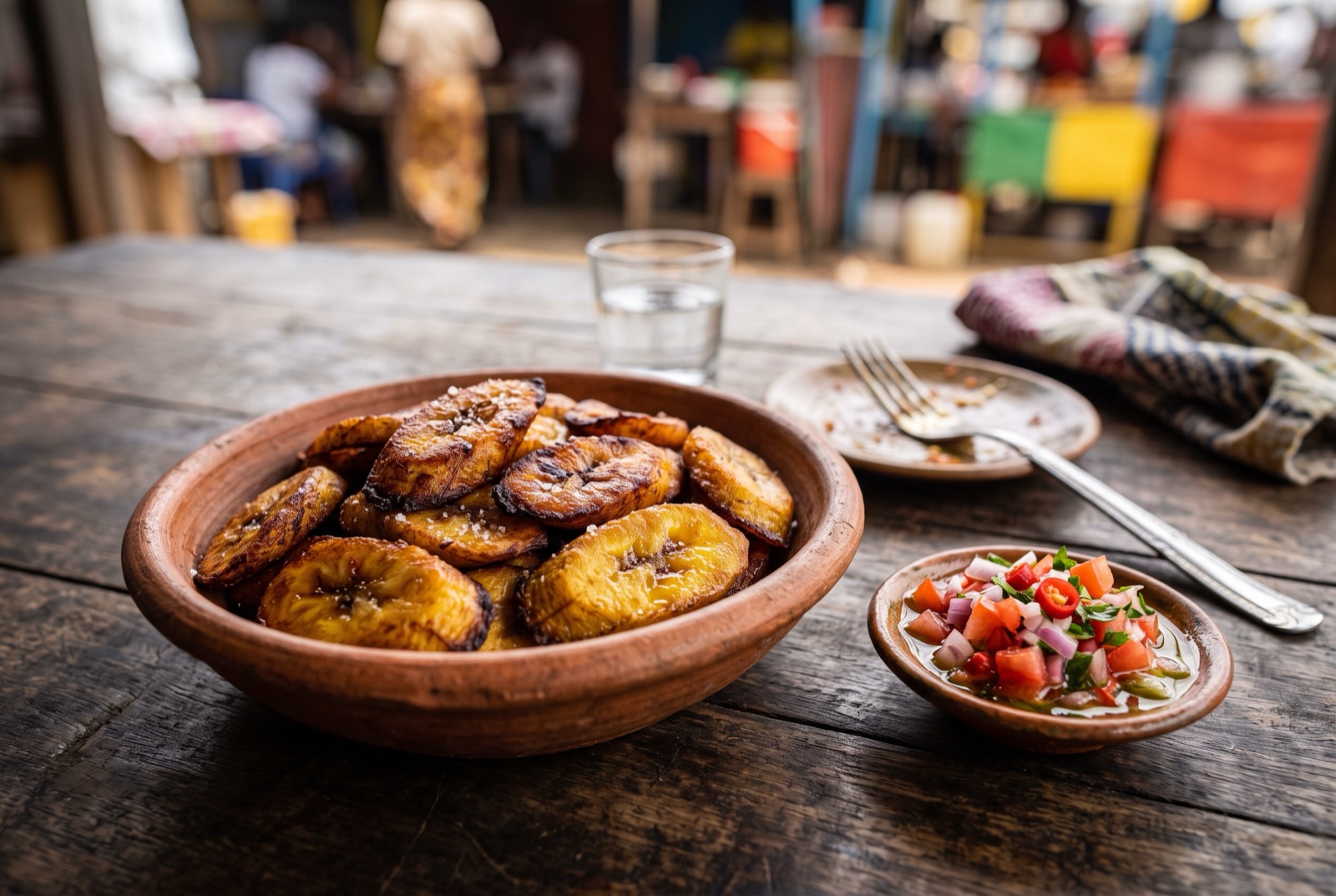
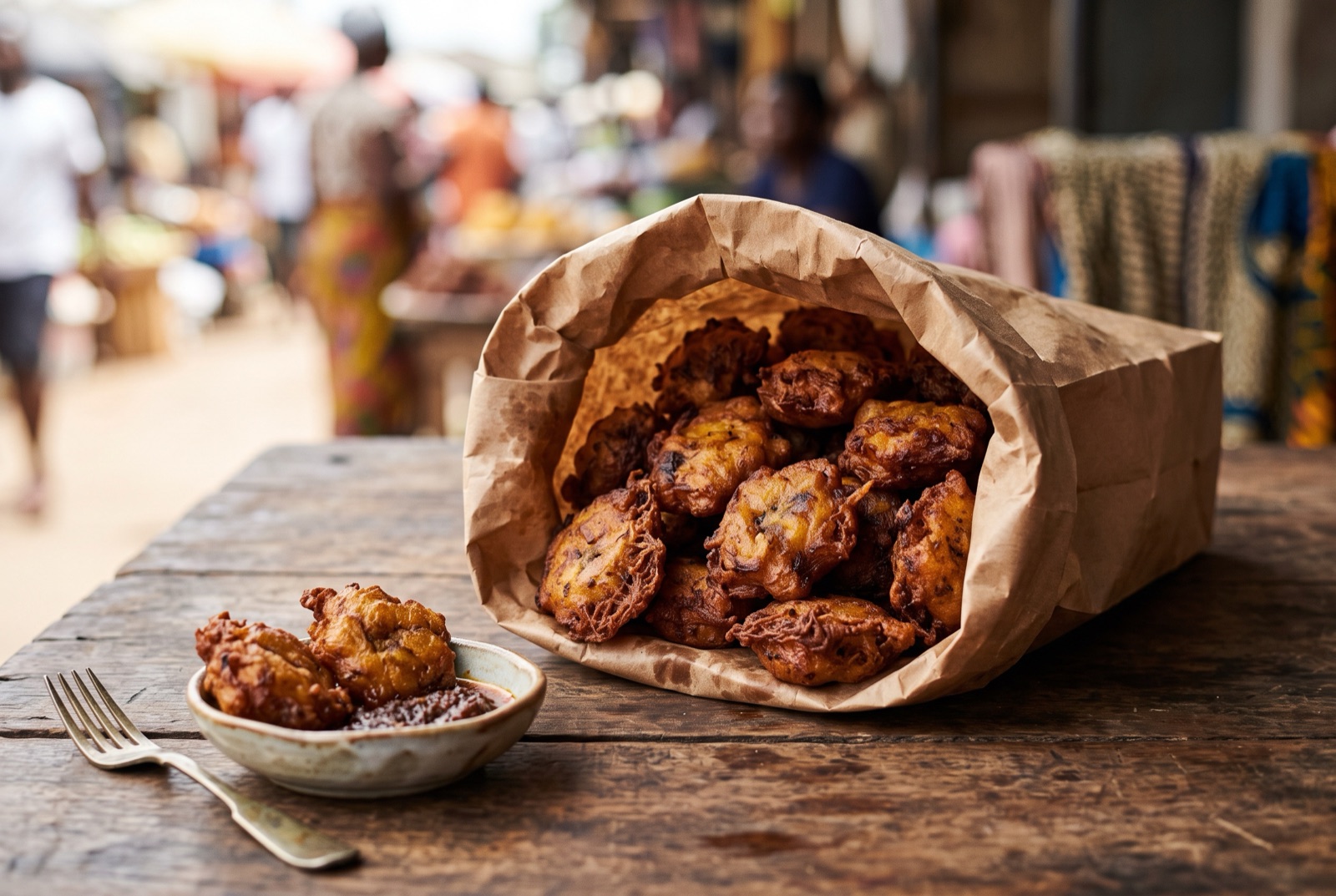
Alloco is very ripe plantain, cut thick, fried in hot oil until the sugars catch at the edges and the inside goes soft and almost creamy, then eaten hot with a sharp raw onion and chilli relish. The contrast is the whole appeal: sweet, dark, slightly sticky plantain against cold acidic onion and a hit of pepper. It takes fifteen minutes and three ingredients, and in Abidjan it is sold on every other corner at dusk, scooped into paper or a plastic bag with a spoonful of sauce on top. At home it works as a side to grilled fish or chicken, as a snack in its own right, or as the thing you make when the plantains on the counter have gone too far to do anything else with.

- Gate
- Ivory CoastAbidjan
- Prep
- 15 min
- Cook
- 20 min
- Total time
- 35 min
- Serves
- 4
- Status
- Easy
- Nutrition / serving · estimated
- Calories 350 kcal
- Protein 3 g
- Carbs 54 g
- Fat 15 g
- Fiber 4 g
- Sugar 26 g
- Sodium 480 mg
Why this recipe works.
- Insists on properly black plantain, which is the single factor that decides whether alloco is good or bland.
- Fries at a moderate temperature so the inside cooks through before the sugary outside burns.
- Includes the raw onion relish that Ivorians actually serve with it, not a generic dipping sauce.
- Ready in under half an hour with three core ingredients and no special equipment.
Ingredients.
8 itemsFor frying
For the relish
Equipment
- Deep frying pan or wok
- Slotted spoon
- Kitchen paper or a rack
Instructions.
Mix the relish
Combine the chopped onion, tomato and chilli in a bowl with the lemon juice, a pinch of salt and the crumbled stock cube if using. Set it aside while you fry — after 15 minutes the onion loses its harsh edge and the tomato releases enough juice to make it spoonable.
Prepare the plantain
Trim the ends off 4 of plantains, score the skin lengthways with a knife tip and peel it away in strips. Cut each one on the diagonal into pieces about 2 cm thick, so every piece has a broad face to sit against the pan.
Tip Ripe skin lifts off in one pull. If you are fighting it, the plantain is not ripe enough for alloco.
Heat the oil
Pour the oil into a deep pan to a depth of about 4 cm and bring it to 170°C. Test it with one plantain piece: it should sizzle steadily around the edge and rise to the surface within a few seconds, not spit violently.
Fry in batches
Lower in a single uncrowded layer and fry for 3 to 4 minutes a side, until the flat faces are deep amber with darker caramelised patches at the edges. A skewer should meet no resistance at all through the middle.
Tip Turn once, not repeatedly. Every flip knocks the browning back.
Drain and salt
Lift the pieces onto kitchen paper or a rack, scatter with salt straight away, and let the oil temperature climb back to 170°C before starting the next batch.
Serve immediately
Pile the hot plantain onto a plate and spoon the cold relish over one side rather than tossing it through, so the pieces keep their crisp edges. Eat with fingers or a cocktail stick while the middles are still soft.
Tips from our kitchen.
- The skin should be black or almost entirely black, and the fruit should give under a light squeeze. Yellow plantain with a few spots is not ripe enough and fries up starchy and dull.
- Cut thick — two centimetres, on a slight diagonal. Thin slices lose all their moisture and turn into chips instead of staying custardy in the middle.
- Keep the oil around 170°C, not hotter. Ripe plantain is full of sugar and will blacken on the outside long before the centre is soft if the oil runs too hot.
- Salt the pieces the second they come out of the pan, while the surface is still wet enough to hold it.
- Fry in batches with space between the pieces. Crowding drops the oil temperature and the plantain steams and sticks together instead of colouring.
- Make the relish first and let it sit while you fry, so the onion softens slightly and the tomato juices loosen it into something spoonable.
Substitutions.
- Red palm oil → Neutral vegetable oil or groundnut oil
- Street sellers use both. Palm oil gives a deeper orange colour and a faint fruity note; neutral oil gives a cleaner, lighter result.
- Scotch bonnet → Habanero, bird's eye chilli, or a pinch of cayenne in the relish
- The relish is meant to be genuinely hot. If serving to a mixed table, keep the chilli in a small bowl on the side.
- Deep frying → Shallow fry in a centimetre of oil, turning once
- Works well and uses far less oil. You will need to turn each piece, and the edges brown less evenly.
Variations.
- Alloco with eggs
- Topped with two fried eggs and extra relish — a common late-night plate at Abidjan roadside stalls.
- Spiced alloco
- Plantain tossed with ginger, chilli powder and a pinch of salt before frying, which brings it close to Ghanaian kelewele.
- Alloco poisson
- Served under or beside a whole grilled fish with the same onion relish, turning a snack into a full meal.
Storage & reheating.
Alloco is at its best within ten minutes of leaving the pan and does not keep well — the sugars set and the pieces turn leathery in the fridge. If you must, refrigerate up to 2 days and revive in a hot dry pan or an air fryer for 4 minutes; a microwave turns them limp. The onion relish keeps 3 days refrigerated and is better on day two. Never freeze fried plantain.
Serve with
Grilled fish, chicken kedjenou, or on its own with the relish and a cold drink.
The story behind Alloco.
The name is Ivorian but the practice is not exclusive: fried ripe plantain is eaten across West Africa and the Caribbean under a dozen names — kelewele in Ghana when it is spiced, dodo in Nigeria, maduros in the Spanish-speaking Caribbean, amado further along the coast. What Côte d'Ivoire has made distinctive is the context rather than the technique. Alloco is street food with a specific ritual around it: the alloco seller, almost always a woman, works a wide pan of oil at a roadside table from late afternoon, and the plantain arrives with a raw onion-tomato-chilli relish that is much sharper than the ketchup or nothing served in some neighbouring versions.
Plantain and cassava are the two starch anchors of the southern Ivorian diet, and the same fruit does several different jobs depending on ripeness. Green and hard, it is pounded into foutou. Half-ripe, it is boiled or grilled. Fully black, sweet enough that the skin peels away in strips, it becomes alloco or is mashed into fritters. Nothing is wasted, and the plantain vendor sells all three stages at once from the same stall.
Alloco also shows up in a couple of standard combinations that are worth knowing. Ordered with grilled or fried fish it becomes a full meal; with fried eggs on top it is a common late-night plate; and alongside a portion of attiéké it turns into the kind of casual dinner that fills maquis tables in the evening. Traditionally it is fried in red palm oil, which contributes colour and a faint fruitiness, though plenty of sellers now use neutral vegetable oil because it is cheaper and lighter. Both are honest versions, and the difference shows more in the colour of the finished pieces than in the taste.
Questions, answered.
How ripe should plantain be for alloco?
Very ripe — the skin mostly or entirely black, the fruit soft enough to dent under a thumb but not collapsing. At that stage the starch has converted to sugar, which is what gives alloco its caramelised edges and soft centre. Yellow plantain with green tips is still starchy and belongs in foutou or boiled dishes instead.
Why is my plantain hard in the middle?
Either the fruit was underripe or the oil was too hot. Sugar on the surface browns fast, so if the oil is above about 180°C the outside darkens in a minute while the centre stays firm. Drop the heat, give each piece three to four minutes a side, and check that a fork slides through with no resistance.
What is the sauce served with alloco?
A raw relish of finely chopped onion, tomato and hot chilli, seasoned with salt and often a crumbled stock cube, sometimes sharpened with a squeeze of lemon. It is not cooked. The point is cold, sharp and pungent against hot sweet plantain, so it is closer to a salsa than to a dipping sauce.
Is alloco the same as Nigerian dodo or Ghanaian kelewele?
They are close cousins. Dodo is essentially the same thing under a Yoruba name and often unspiced; kelewele is Ghanaian and is marinated in ginger and chilli before frying, so it is spicier and drier. Alloco is defined less by the plantain than by the raw onion relish served with it and by its role in Ivorian street food.
Can I bake or air-fry alloco instead?
You can, and it is a reasonable everyday compromise. Toss the pieces in a tablespoon of oil and cook at 200°C for about 20 minutes, turning halfway. The flavour is close but the texture is drier, since deep frying is what produces the glassy caramelised edge and the soft interior in the same few minutes.
You might also like.
All recipes →
Keep exploring Ivory Coast.
Ivory Coast has 9 more dishes in the atlas — Attiéké and Claclo, and 7 more.
All Ivory Coast recipes Plantain recipes Onion recipes Tomato recipes street foodsideveganvegetariangluten freedairy freenut freeRecipe by The DishRoute Kitchen · published August 20, 2026 · updated August 20, 2026