Spas.
Armenian Yogurt and Wheat Soup
Սպաս · say it: spahs
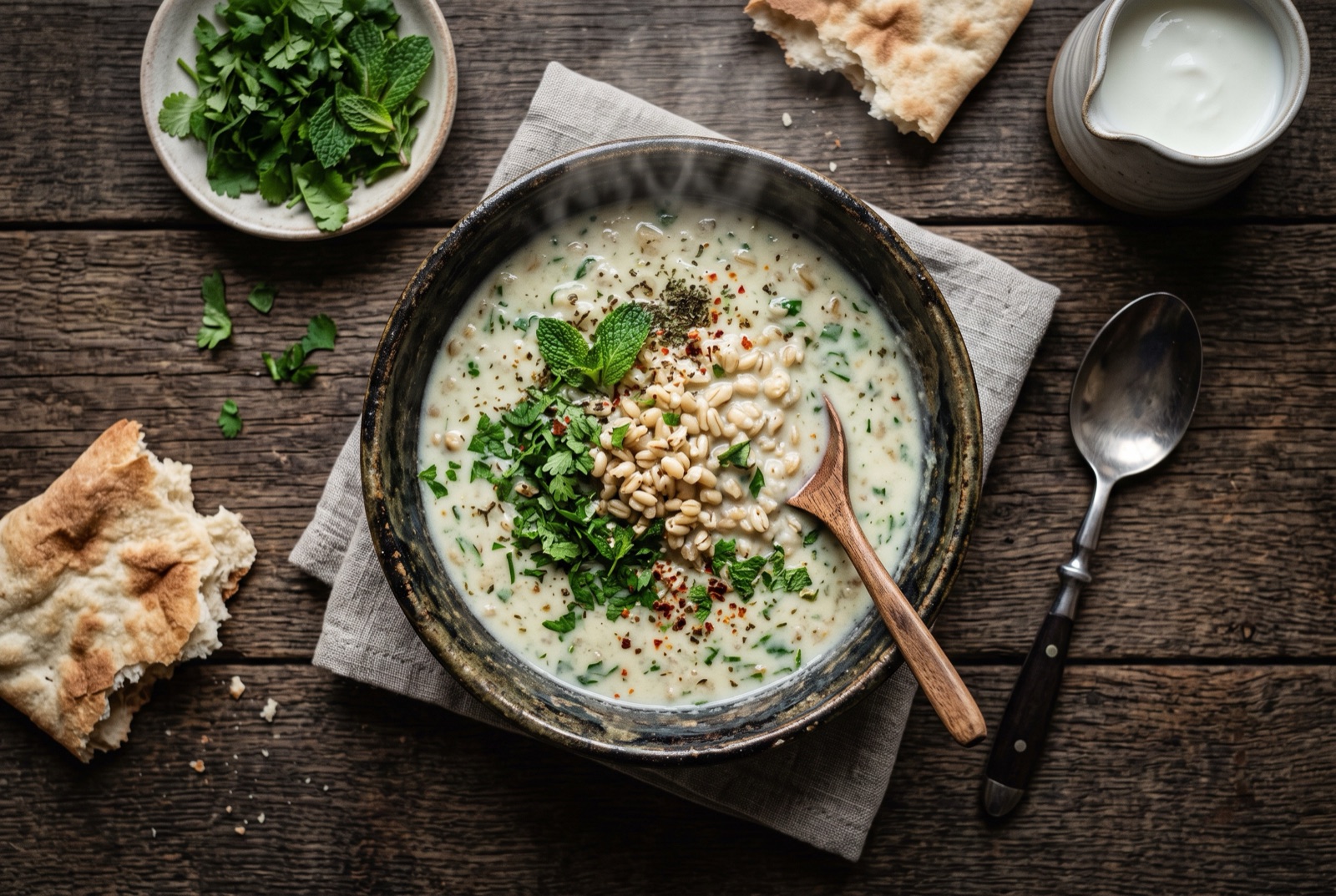
Spas is a soup made almost entirely of yogurt. Matsun is whisked with egg and flour, brought slowly up to heat while being stirred constantly so it thickens instead of curdling, then loosened with the starchy water from cooked hulled wheat and finished with a heap of chopped coriander and dried mint. It tastes sharply sour, faintly grainy, and much lighter than its whiteness suggests — closer to a savoury drinking yogurt with body than to a cream soup. Armenians eat it hot when it is cold outside and cold when it is hot, which makes it one of the few dishes on the table twelve months a year.

- Gate
- ArmeniaNationwide
- Prep
- 15 min
- Cook
- 1 hr
- Total time
- 1 hr 15 min
- Serves
- 4
- Status
- Easy
- Nutrition / serving · estimated
- Calories 290 kcal
- Protein 15 g
- Carbs 32 g
- Fat 11 g
- Fiber 4 g
- Sugar 14 g
Why this recipe works.
- The stabilising method explained step by step, so the yogurt thickens smoothly instead of splitting into curds.
- Uses the wheat cooking water rather than plain water, which gives the soup body without extra flour.
- Herb quantities that are actually Armenian — measured in handfuls, not as a garnish.
- Works hot or chilled from the same pot, with the adjustment each version needs.
Ingredients.
12 itemsFor the grain
For the soup
To finish
Equipment
- Heavy-based saucepan
- Balloon whisk
- Wooden spoon
Instructions.
Cook the wheat
Drain the soaked wheat, cover it with the water, and simmer for about 45 minutes until the grains are tender and split open but still distinct. Do not drain it — the starchy cooking liquid is the base of the soup.
Soften the onion
Melt the butter in a small pan and cook the chopped onion over low heat for about 10 minutes until it is completely soft and translucent with no colour at all. Set it aside.
Stabilise the yogurt
Whisk the yogurt, egg and flour together in a bowl while everything is still cold, working until there is not a single lump and the mixture pours in a smooth ribbon. This step is what keeps the soup from splitting.
Tip Push the mixture through a sieve if you can still see flecks of flour after a minute of whisking.
Bring it up slowly
Pour the yogurt mixture into a heavy pan over the lowest heat and stir constantly in one direction with a wooden spoon for 10 to 12 minutes. It will gradually thicken and turn glossy, and steam will rise before any bubble appears.
Tip Do not stop stirring and do not raise the heat. Both do the same damage.
Combine with the wheat
Ladle the hot wheat and its cooking liquid into the thickened yogurt a little at a time, stirring after each addition, until the soup is the consistency of thin cream. Stir in the softened onion and salt.
Finish with herbs
Let the soup sit at a bare simmer for 5 minutes, then take it off the heat and stir in the coriander and the dried mint, rubbing the mint between your palms as it falls in. Grind over black pepper and taste for salt.
Serve hot or chill
Ladle into bowls immediately for the hot version, with extra herbs on top and lavash alongside. For the summer version, cool the pot completely, refrigerate for at least 3 hours, and thin with cold water before serving.
Tips from our kitchen.
- Whisk the egg and flour into the cold yogurt before any heat is involved. Adding them to warm yogurt guarantees lumps.
- Stir in one direction, without stopping, the entire time the pot is coming up to temperature. This is a ten-minute job you cannot walk away from.
- Never let it boil hard. A few lazy bubbles at the edge is the maximum; a rolling boil splits it even with the egg in there.
- Full-fat yogurt is much more forgiving than low-fat, which breaks easily and tastes thin.
- Add the dried mint at the very end, off the heat, rubbing it between your palms as it goes in so the oils release.
- If you plan to serve it cold, make it slightly thicker than you want — it loosens as it chills and the sourness reads stronger.
Substitutions.
- Hulled wheat (dzavar) → Pearl barley, or short-grain rice
- Barley behaves almost identically. Rice cooks faster and gives a softer soup; add it about 20 minutes before the end.
- Matsun → Full-fat plain yogurt with a squeeze of lemon
- Matsun is sharper than most commercial yogurt. A little lemon juice gets closer to the acidity, but add it at the end, not before heating.
- Egg → An extra tablespoon of flour slaked in cold water
- This is the fasting-season version and is fully traditional. It needs even more careful stirring, since flour alone is a weaker stabiliser than egg.
Variations.
- Cold summer spas
- Chilled thoroughly, thinned with cold water or ice, and served with extra herbs and cucumber — halfway between a soup and the yogurt drink tan.
- Spas with fried onion
- A spoonful of onion softened in butter until deeply golden stirred through each bowl, adding sweetness against the sourness.
- Chickpea spas
- Cooked chickpeas in place of some of the wheat, which makes the soup substantial enough to be a full meal on its own.
Storage & reheating.
Spas keeps 3 days refrigerated and thickens considerably as it sits — loosen it with water or milk when reheating. Warm it gently over low heat with constant stirring, exactly as when you made it, because a fast reheat splits it just as readily as a fast cook. It does not freeze: the yogurt separates irreversibly on thawing and no amount of whisking brings it back. Cold leftovers are genuinely good straight from the fridge with extra herbs stirred in.
Serve with
Warm lavash, a plate of raw herbs, and a dish of salty white cheese for tearing into the bowl.
The story behind Spas.
Soured milk soups are the shared inheritance of the whole region, from Iranian ash-e mast to Turkish yayla çorbası to the Georgian matsvnis supi, and they all solve the same technical problem: yogurt breaks when it meets heat, so you have to give it something to hold onto. Armenians solve it with egg and a little flour, whisked in cold and warmed up gradually with continuous stirring. Get it right and the soup is smooth and pourable; get it wrong and you have a pot of grainy curds floating in whey, which is a mistake every Armenian cook makes exactly once.
The grain in spas is what varies by household and region. Hulled wheat — dzavar or korkot — is the most traditional and gives the best body, but rice, pearl barley and even chickpeas all appear, and in some villages the soup is thickened with nothing but flour. The herbs are less negotiable: coriander in quantity, dried mint rubbed between the palms, and often a little tarragon or dill. The proportion of green to white should be high enough that the finished soup looks flecked rather than plain.
Spas also carries a role beyond dinner. It is standard convalescent food, given to people recovering from illness or from a long night, and standard fasting-season food when made without egg. Cold spas in summer, thinned further and served with ice, doubles as a drink and shades into the same territory as tan, the salted yogurt drink poured at every khorovats. In a cuisine that stores so much of its food in soured milk, spas is what that store tastes like when it is warmed up.
Questions, answered.
Why did my yogurt soup curdle?
Almost certainly heat, speed, or both. Yogurt proteins separate when they hit high temperature quickly, which is why the egg and flour go in cold and the pot comes up slowly with constant stirring. If it splits, take it straight off the heat and blitz it with a stick blender — it will not be perfect, but it will be smooth enough to serve.
Can I make spas without egg?
Yes. The fasting version uses only flour slaked in cold water as the stabiliser, and it is completely traditional. It is less forgiving, so stir continuously and keep the heat lower than you think necessary. Use about a tablespoon and a half of flour in place of each egg.
Is spas served hot or cold?
Both, depending on the season. Hot spas is winter and convalescent food, served steaming with bread. Cold spas is a summer dish, thinned with water or ice and eaten almost like a drinkable yogurt with herbs. The same pot can go either way — just make it slightly thicker if you intend to chill it.
What is matsun and do I need it?
Matsun is the Armenian cultured milk — thicker and noticeably more sour than most supermarket yogurt, cultured with different bacteria. Full-fat plain yogurt works as a substitute, and a small squeeze of lemon added at the end brings the acidity closer. Avoid Greek-style strained yogurt on its own, which is too dense and needs thinning first.
Do I have to soak the wheat overnight?
It helps a great deal. Soaked hulled wheat cooks in about 45 minutes; unsoaked it can take well over an hour and often stays chalky at the centre. If you forget, use pearl barley instead, which cooks reliably in 40 minutes without any soaking.
You might also like.
All recipes →

Keep exploring Armenia.
Armenia has 9 more dishes in the atlas — Armenian Harissa and Eetch, and 7 more.
Recipe by The DishRoute Kitchen · published August 20, 2026 · updated August 20, 2026