Gimbap.
Korean Seaweed Rice Rolls, Not Sushi
김밥 · Gimbap · say it: KIM-bap
Gimbap is a roll of short-grain rice and cooked fillings wrapped in a sheet of dried seaweed and cut into thick coins. Every part of it separates it from sushi. The rice is dressed with toasted sesame oil and salt, never rice vinegar and sugar, so it smells nutty and savory rather than sharp. Nothing inside is raw: the egg is fried into a sheet, the spinach is blanched and squeezed and seasoned, the carrot is stir-fried, the beef is cooked in soy sauce and garlic. It is served at room temperature, eaten with fingers or chopsticks without any dipping sauce, and built to travel — which is exactly what Koreans use it for.


- Gate
- South KoreaNationwide
- Prep
- 40 min
- Cook
- 25 min
- Total time
- 1 hr 20 min incl. 15 min rest
- Serves
- 4
- Status
- Medium
- Nutrition / serving · estimated
- Calories 490 kcal
- Protein 24 g
- Carbs 71 g
- Fat 13 g
- Fiber 4 g
- Sodium 940 mg
Why this recipe works.
- Seasons the rice the Korean way — sesame oil, salt and sesame seeds — and explains why vinegar would be wrong here.
- Each filling is cooked and seasoned on its own, which is the actual technique and the reason a good roll tastes like six things rather than one.
- Gives you the rolling mechanics that matter: how tight, where to leave the border, and why the seam has to sit under the roll while it settles.
- Covers the slicing problem honestly, including the wiped blade that separates clean coins from a squashed mess.
Ingredients.
17 itemsFor the rice
For the fillings
To roll and finish
Equipment
- Bamboo rolling mat (gimbal)
- Rice cooker or heavy pot with a lid
- Wide frying pan for the egg sheet
- Very sharp knife and a damp cloth
Instructions.
Cook and season the rice
Rinse 360 g of rice until the water runs nearly clear, drain 10 minutes, then cook with the 400 ml of water — slightly less than usual, so the grains stay firm. Tip the hot rice into a wide bowl, add the sesame oil, sesame seeds and salt, and fold it through with a cutting motion until every grain is glossy. Leave it uncovered to cool to just above room temperature.
Tip Fold, never stir. Stirring smashes the grains and the rice turns gluey under the rolling mat.
Cook the beef
Toss the beef strips with the soy sauce, garlic and sugar and leave 10 minutes. Stir-fry over high heat in a dry hot pan until the liquid has cooked away and the meat is glazed and just starting to catch at the edges, about 4 minutes. Tip onto a plate.
Make the egg sheet
Wipe a wide pan with oil and set it over low heat. Pour in the beaten eggs, tilt to cover the base, and cook without stirring until the top is just set and no longer wet, about 3 minutes. Slide it out flat, let it cool, then roll it up and cut across into 1 cm strips.
Tip Low and slow. Any browning makes the egg brittle and it cracks when the roll is squeezed.
Blanch the spinach and fry the carrot
Drop the spinach into boiling salted water for 30 seconds, then straight into cold water. Squeeze it dry in two goes, twisting hard, and toss with a pinch of salt and a few drops of sesame oil. In the same pan, stir-fry the carrot matchsticks with a pinch of salt for 2 minutes, until bright and bendy but still with a bite.
Roll
Lay a seaweed sheet shiny-side down on the bamboo mat with the long edge toward you. Spread about 200 g of rice over the near two-thirds in a thin layer that still shows the seaweed through it, leaving the far 3 cm completely bare. Line up egg, spinach, carrot, danmuji, cucumber and beef in a tight row a third of the way up.
Seal and settle
Lift the near edge of the mat over the fillings, tuck it down firmly behind them, then roll forward while pulling the mat back toward you to tighten. Press along the whole length, dab a few grains of rice onto the bare strip to glue the seam, and rest the roll seam-side down for a minute. Repeat for four rolls.
Brush and slice
Brush each roll all over with sesame oil and scatter with sesame seeds. Cut into rounds about 1.5 cm thick with a very sharp knife, wiping the blade on a damp cloth every two or three cuts, and lay them cut-side up so the mosaic shows. Serve at room temperature, no sauce needed.
Tips from our kitchen.
- Cook the rice slightly firmer than usual — about 10 percent less water — because soft rice turns to paste under the pressure of rolling.
- Season the rice while it is warm but let it cool to just above room temperature before rolling. Hot rice steams the seaweed limp from the inside.
- Squeeze the blanched spinach hard, in two goes. Water left in the greens will soak into the rice overnight and make the roll soggy at the center.
- Leave a bare 3 cm strip of seaweed at the far edge. That is the flap that seals the roll, and covering it with rice is why rolls come apart.
- Brush the finished roll with sesame oil before slicing and wipe the knife with a damp cloth between every two or three cuts — dry blades drag and crush.
- Never refrigerate gimbap. Cold makes short-grain rice hard and chalky; keep it at cool room temperature and eat it within about six hours.
Substitutions.
- Danmuji (yellow pickled radish) → Long strips of daikon quick-pickled in rice vinegar and sugar, or a crunchy dill pickle cut into batons
- Danmuji is the crunch and the acidity in a roll where nothing else is sour. Whatever you use has to be firm and sharp — a soft pickle contributes nothing.
- Seasoned beef → Strips of ham, imitation crab stick, tinned tuna mixed with mayonnaise, or seasoned fried tofu
- All of these are standard in Korea rather than compromises. For a vegetarian roll, tofu or extra egg plus burdock covers the savory job the beef was doing.
- Gim (Korean seaweed sheets) → Japanese nori sheets, untoasted and unseasoned
- Close enough to work. Gimbap gim is usually slightly thicker and less brittle than nori sold for sushi, so handle nori a bit more gently when you roll.
Variations.
- Chungmu gimbap
- From the port of Tongyeong: tiny rolls of plain rice and seaweed with nothing inside, served with spicy squid and radish kimchi on the side. Invented so the rolls would not spoil in the heat.
- Nude gimbap
- Rolled inside out with the rice on the outside and the seaweed hugging the fillings, then rolled in toasted sesame seeds. Softer to bite and less likely to tear.
- Kimchi gimbap
- Squeezed, chopped kimchi stir-fried until the liquid is gone, used in place of the danmuji. Sour, spicy and much punchier than the classic roll.
Storage & reheating.
Gimbap is a same-day food. Keep it at cool room temperature, wrapped loosely in baking paper rather than sealed plastic so it does not sweat, and eat within about six hours. Refrigeration is the thing to avoid — cooked short-grain rice goes hard and dry in the cold, and a refrigerated roll never fully recovers even at room temperature. If you have leftovers the next morning, do not eat them cold: dip the slices in beaten egg and pan-fry them in a little oil until golden on both cut faces. This is gyeran gimbap, it is a genuine Korean way of using up yesterday's rolls, and it is arguably better than the original.
Serve with
A bowl of instant ramyeon is the standard pairing in Korea; danmuji slices and a cup of barley tea also come with almost every order.
The story behind Gimbap.
Gim, the paper-thin sheets of dried laver, have been eaten in Korea for centuries; they appear in old records as a coastal product and were harvested along the southern shore long before anyone rolled rice in them. Where the roll itself comes from is genuinely contested. One account holds that gimbap descends from Japanese futomaki, arriving during the colonial period from 1910 to 1945 and then being reworked to Korean taste. Another traces it to older Korean habits of wrapping rice in gim, related to bokssam, the practice of eating rice wrapped in seaweed at the first full moon of the lunar year. Both positions have serious people behind them, and the honest answer is that the modern rolled form and the older Korean seaweed-and-rice tradition are both part of the story. What is clear is where it ended up: over a few decades the seasoning shifted decisively to sesame oil and salt, the fillings became fully cooked, and the result stopped resembling its possible ancestor.
What gimbap really is, culturally, is the food of the day out. It is what a Korean parent packs for a school field trip, what goes into the cooler for a mountain hike, what gets eaten on a train. Because it needs no reheating, no sauce and no cutlery, and because it is arranged so the cut face is a small mosaic of color, it carries a certain amount of parental pride with it — a lunchbox of neatly aligned rolls says something about the person who got up early to make them.
Since the 1990s it has also been fast, cheap restaurant food. Chains built around gimbap, most famously the twenty-four-hour Gimbap Cheonguk, sell rolls for pocket change alongside noodles and stews, and the filling permutations have exploded: tuna and mayonnaise, cheese, kimchi, spicy pork, or nude gimbap with the rice on the outside. The classic roll with egg, spinach, carrot, danmuji and beef remains the reference version everyone measures the others against.
Questions, answered.
What is the difference between gimbap and sushi?
The rice is the clearest difference: gimbap rice is seasoned with toasted sesame oil and salt, while sushi rice is seasoned with rice vinegar, sugar and salt. Gimbap fillings are always cooked or pickled rather than raw, the roll is eaten at room temperature with no soy sauce or wasabi, and the outside of the roll is usually brushed with sesame oil. They look similar in cross-section and taste nothing alike.
Why does my roll fall apart when I slice it?
Usually the roll was not compressed enough, or the rice layer was too thick. After rolling, rest the roll seam-side down for a minute and squeeze along its length with both hands to compact it. Spread the rice thinly enough that you can still see the seaweed through it, and always leave the far 3 cm of the sheet bare so it can seal. A blunt or dry knife will also tear a perfectly good roll.
Can I make gimbap the night before?
Not really, and it is the one thing worth planning around. The rice hardens in the fridge and the seaweed goes soft and leathery at room temperature overnight. What you can do is prepare every filling a day ahead and keep them covered in the fridge, then cook fresh rice in the morning and roll in about fifteen minutes. Slicing can also wait — roll the night of, slice just before serving.
How much rice goes on each sheet?
About 200 grams of cooked rice per full sheet, spread in a thin, even layer over roughly two-thirds of it. It should look sparse, almost too thin — a translucent layer where the dark seaweed still shows through. Most people use far too much rice on their first attempts, which gives a fat, starchy roll where the fillings are lost.
Do I need a bamboo rolling mat?
It helps a great deal but is not essential. A bamboo mat lets you apply even pressure along the whole roll, which is exactly what a tight gimbap needs. Without one, use a sheet of baking paper or a clean tea towel laid flat and roll with the same tucking motion, pulling the edge back toward you to tighten as you go.
You might also like.
All recipes →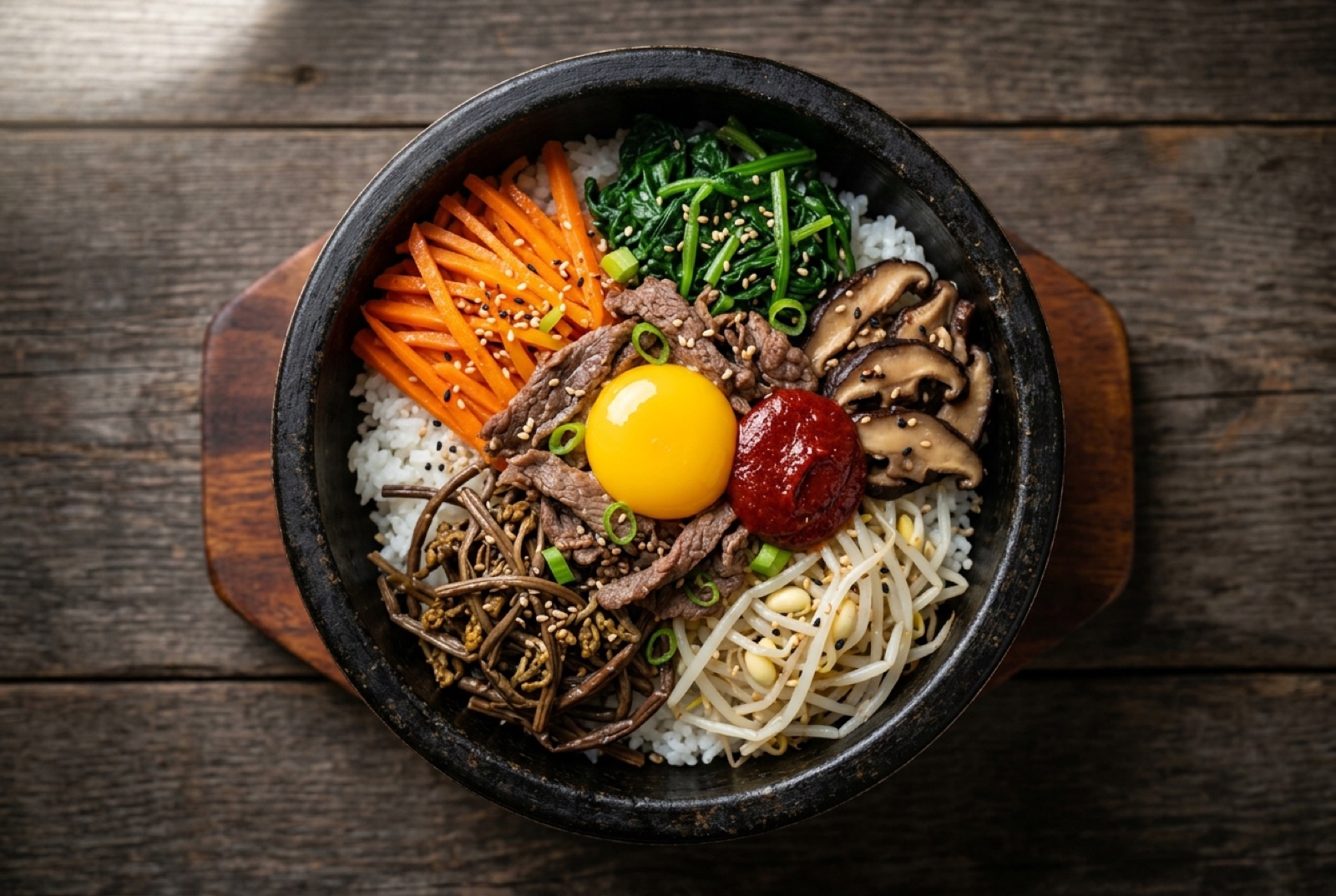


Keep exploring South Korea.
South Korea has 9 more dishes in the atlas — Bibimbap and Bulgogi, and 7 more.
All South Korea recipes Short-grain rice recipes Carrot recipes Spinach recipes snackstreet fooddairy freeRecipe by The DishRoute Kitchen · published August 19, 2026 · updated August 19, 2026