Gule Ærter.
Danish Yellow Split Pea Soup with Pork
Gule ærter · say it: GOO-leh AIR-tuh
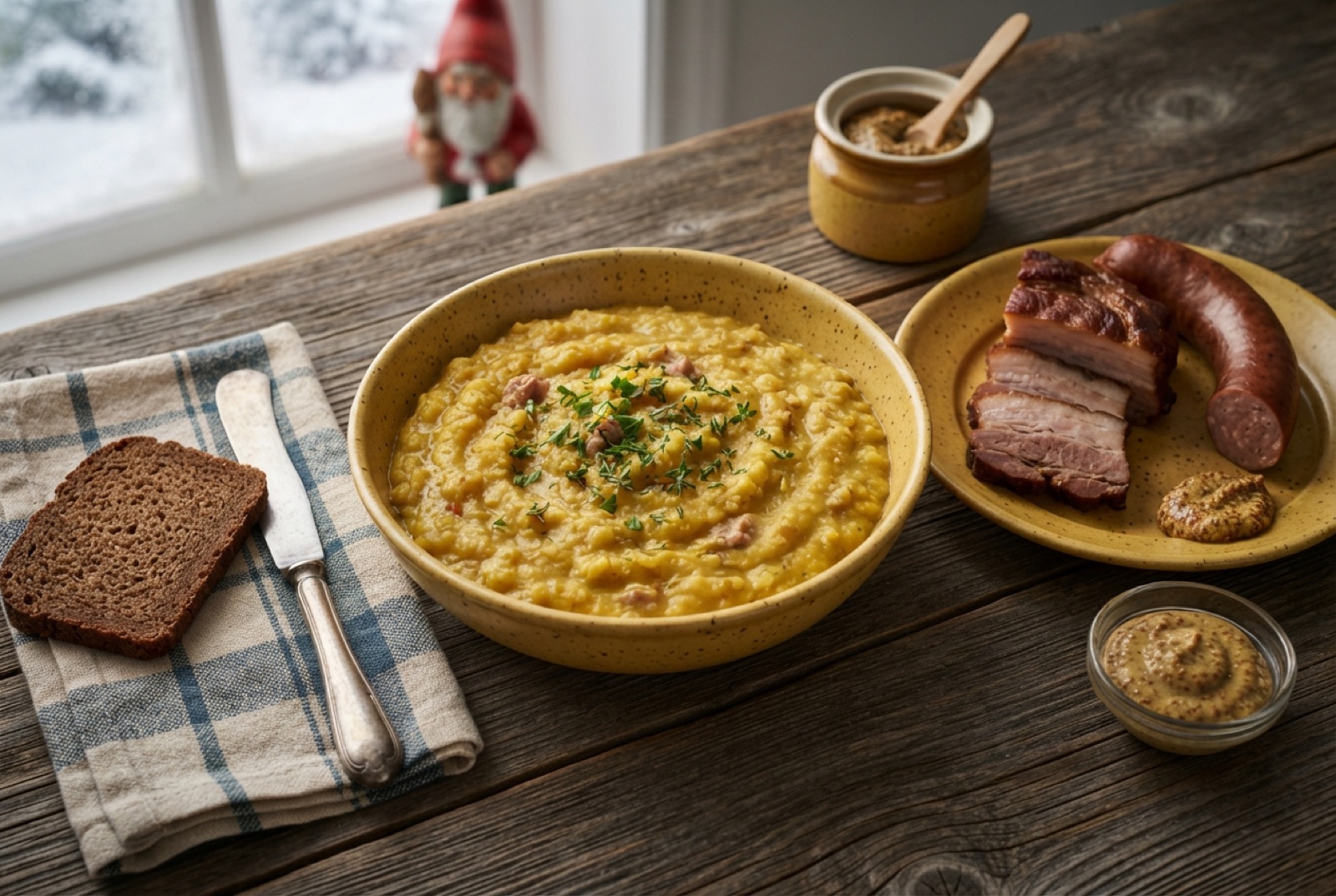
Gule ærter is Denmark's deep-winter soup: yellow split peas cooked down with carrot, celeriac and leek until they collapse into a thick, savoury purée, taking their flavour from a piece of salted pork boiled in the same pot. The trick that makes it a meal rather than a bowl of soup is the serving: the pork and a coarse pork sausage come out of the pot, get sliced onto a separate plate, and are eaten alongside the soup with strong mustard, pickled beetroot and dark rye bread. Sweet peas, salty meat and sharp mustard in the same mouthful — that contrast is the whole design.

- Gate
- Denmark
- Prep
- 20 min
- Cook
- 2 hr
- Total time
- 10 hr 20 min incl. 8 hr rest
- Serves
- 6
- Status
- Medium
- Nutrition / serving · estimated
- Calories 620 kcal
- Protein 38 g
- Carbs 52 g
- Fat 28 g
- Fiber 15 g
- Sodium 1300 mg
Why this recipe works.
- The peas are cooked properly far — well past soft — so the soup thickens itself and needs no flour or blending.
- Meat cooked in the pot but served on a separate plate, which is the actual Danish way and makes both parts taste better.
- Root vegetables added in two stages, so some dissolve into the base and some stay recognisable in the bowl.
- Uses one pot and cheap ingredients, and it is better on the second day, which makes it good cooking for a cold weekend.
Ingredients.
13 itemsThe soup
To serve
Equipment
- Large heavy pot or Dutch oven
- Ladle
- Slotted spoon for lifting the meat
Instructions.
Soak the peas
Cover the split peas with plenty of cold water and leave them overnight, or at least 8 hours. They will swell to roughly double and the water will go cloudy — drain and rinse them before cooking.
Start the pot
Put the drained peas, the piece of salted pork, the quartered onions, thyme and bay into the pot with the cold water. Bring slowly to a boil and skim off the grey foam that gathers on the surface for the first ten minutes.
Tip Start from cold water rather than boiling. It draws more flavour out of the pork and produces a cleaner broth.
Simmer until the peas collapse
Turn the heat to a bare simmer, half-cover the pot and cook for about 1 hour, stirring the base every ten minutes. The peas are ready when they have lost their shape completely and the liquid has thickened enough to hold a spoon track.
Add the root vegetables
Lift out the pork and set it aside. Add the carrots, celeriac, leeks and potatoes to the pot and simmer for a further 25–30 minutes, until the potatoes are soft enough to crush against the side of the pot but the carrot still has some bite.
Cook the sausage
Lower the sausage into the soup and poach it gently for 15 minutes — do not let the pot boil hard or the skin splits and the fat leaks into the soup. Lift it out and keep it warm with the pork.
Season the soup
Taste the soup now, not before. Depending on how salty the pork was it may need nothing; correct with salt and a heavy grind of black pepper, and loosen with hot water if it has gone claggy while the meat cooked.
Carve and serve on two plates
Slice the pork and the sausage onto a warm platter. Ladle the soup into deep bowls and bring the meat to the table separately with mustard, pickled beetroot and buttered rye, so everyone alternates between spoonfuls of soup and bites of meat.
Tips from our kitchen.
- Soak the split peas overnight in plenty of cold water. Unsoaked peas can take twice as long and sometimes refuse to break down at all if they are old stock.
- Do not add salt until the peas have completely softened. Salt early can keep the skins firm, and the salted pork is already seasoning the pot heavily.
- Skim the grey foam that rises in the first ten minutes. Left in, it makes the finished soup taste muddy and look dull.
- Stir the bottom of the pot every ten minutes once the peas start thickening — a pea purée catches and scorches very easily, and burnt pea cannot be rescued.
- Taste before you salt at the end. Depending on how heavily cured your pork was, the soup may need nothing at all.
- Keep the cooking liquid if you take the meat out early. That salty broth is where the flavour lives, and adding water back later dilutes everything.
Substitutions.
- Salted pork belly or hock → Smoked ham hock, or unsalted pork belly plus 2 tsp salt
- Danish gule ærter traditionally uses lightly salted, not smoked, pork. Smoked meat makes a good soup but pushes it toward the German Erbsensuppe end of the family.
- Medisterpølse → Any coarse, mildly spiced fresh pork sausage — Polish kielbasa, Bratwurst or Cumberland
- Medisterpølse is a long coiled Danish pork sausage seasoned mainly with allspice and pepper. Avoid anything heavily herbed or chilli-spiced, which fights the peas.
- Celeriac → Two extra carrots and a parsnip
- Celeriac gives the soup its slightly bitter, earthy backbone. Parsnip is sweeter, so cut back the carrot if you swap.
Variations.
- Vegetarian gule ærter
- Built on a strong vegetable stock with extra celeriac, leek and a bay leaf, finished with mustard and a spoon of butter. The mustard and rye still carry it, though the salted depth is genuinely missed.
- With a smoked hock
- Replace the salted pork with a smoked ham hock for a darker, bacon-scented soup. Common in southern Jutland, where German influence on the pantry runs deep.
- Next-day thickened version
- Danes often eat the leftovers thicker than soup, almost a purée, spread over rye bread with mustard and cold sliced sausage on top.
Storage & reheating.
Gule ærter keeps 4 days refrigerated and genuinely improves overnight as the peas continue to swell and the salt distributes. It thickens dramatically when cold — expect to add 100–200 ml of water per portion when reheating, stirring over low heat until it loosens. Store the sliced meat separately in a little of the broth so it does not dry out. The soup freezes well for 3 months; the sausage does not, so freeze the base alone and cook fresh sausage when you serve it. Reheat slowly and stir often, because a thick pea soup scorches at the base within a minute over high heat.
Serve with
Dark rye bread with butter, strong Danish mustard, pickled beetroot, and a shot of aquavit for anyone who has been outdoors.
The story behind Gule Ærter.
Dried peas kept through a Scandinavian winter when almost nothing else did, and pea soup with salted pork is one of the oldest continuously eaten dishes in the Nordic region. In Denmark it became winter food in the most literal sense: something cooked in a large pot on a cold day, eaten by people who had been outside, and traditionally associated with the period around Christmas and the dark weeks after it. Neighbouring Sweden and Finland eat their own version every Thursday, with pancakes afterwards; Denmark never adopted the fixed day, but the dish itself is close kin.
The Danish version distinguishes itself in two ways. The peas are cooked much further than in the Swedish ärtsoppa, until they lose their shape entirely and the soup is thick enough to hold the mark of a spoon. And the meat is deliberately taken out and served separately, so nobody eats a soup with lumps of pork floating in it. The full traditional spread involves several cuts at once — salted pork belly, a piece of ham hock, medisterpølse, sometimes a smoked sausage — sliced onto a communal platter for people to help themselves between spoonfuls.
Mustard is not a garnish here. Strong Danish mustard is put on the table in a bowl and applied to the meat by everyone, and the soup would taste flat without something sharp in the same bite. Pickled beetroot and rye bread do the same job from other directions. The whole plate follows the logic that runs through Danish cooking: something fat and something salt, always with something sour or sharp set against it.
Questions, answered.
Do I have to soak the split peas overnight?
Not strictly, but it saves an hour and gives a far more reliable result. Unsoaked peas take around two hours to break down, and older dried peas sometimes never soften properly at all. If you forget, cover them with boiling water and leave them for one hour before cooking.
Why is the meat served on a separate plate?
Because that is how the dish is built in Denmark: the soup gets its flavour from the pork during cooking, then the pork is lifted out and sliced onto a platter to be eaten alongside with mustard and rye bread. It also lets each person control how much meat, mustard and pickle goes into each mouthful.
My soup burned on the bottom — can I save it?
Only if you catch it immediately. Pour the unburnt soup into a clean pot without scraping the base, taste it, and if there is no scorched flavour carry on. If the burn has already gone through the whole pot, the bitterness is permanent and there is no fixing it.
How thick should the finished soup be?
Thick enough that a spoon dragged across the surface leaves a track that closes slowly. It should pour, but only just. If it is still watery after the peas have softened, simmer uncovered and stir often; if it has gone to paste, whisk in hot water or reserved broth.
What kind of mustard should I serve with it?
A strong, coarse Danish-style mustard, or any sharp brown mustard with real heat. Mild yellow mustard is too sweet to do the job, which is to cut through the salt and fat of the pork. Put it on the table in a small bowl and let people help themselves.
You might also like.
All recipes →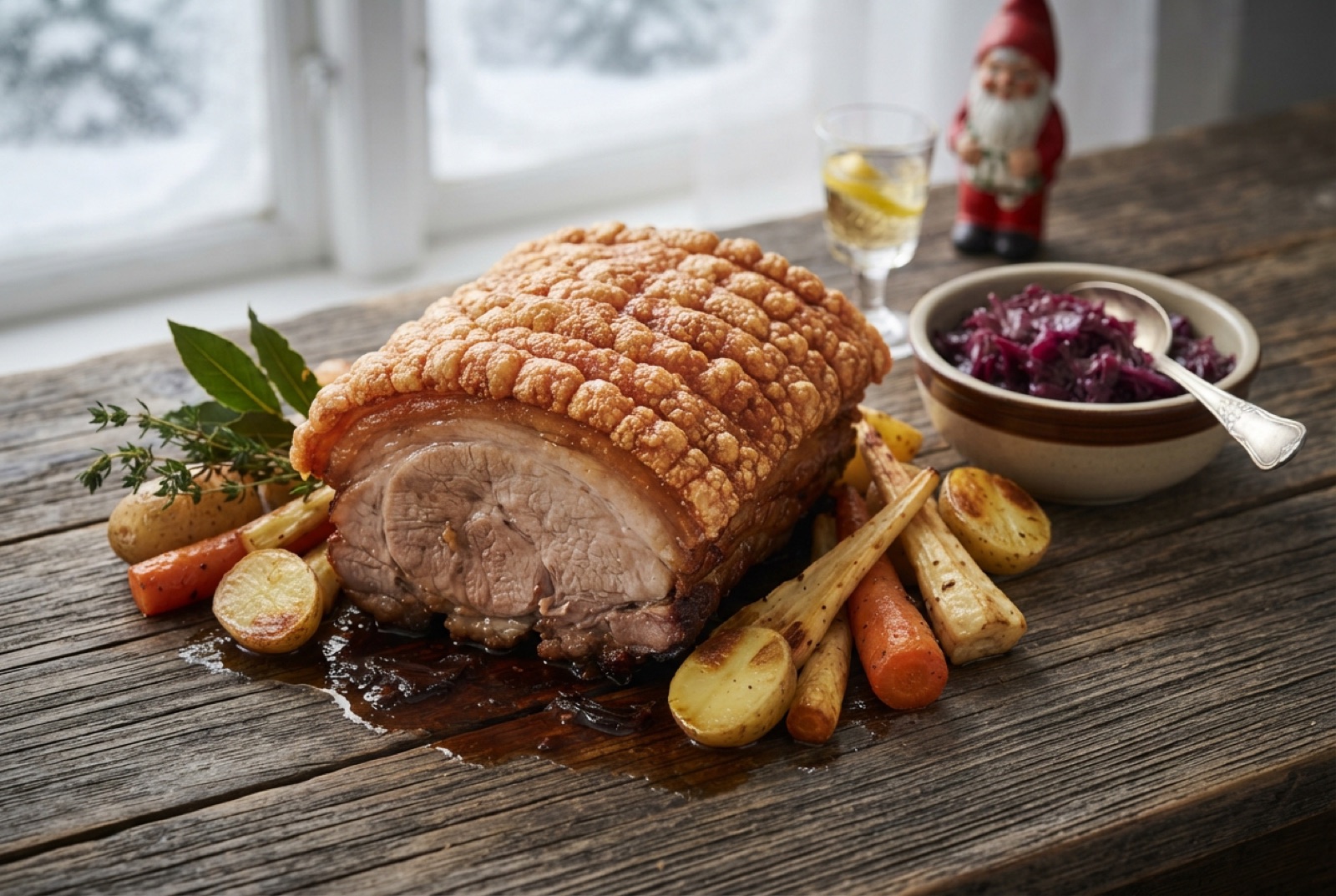
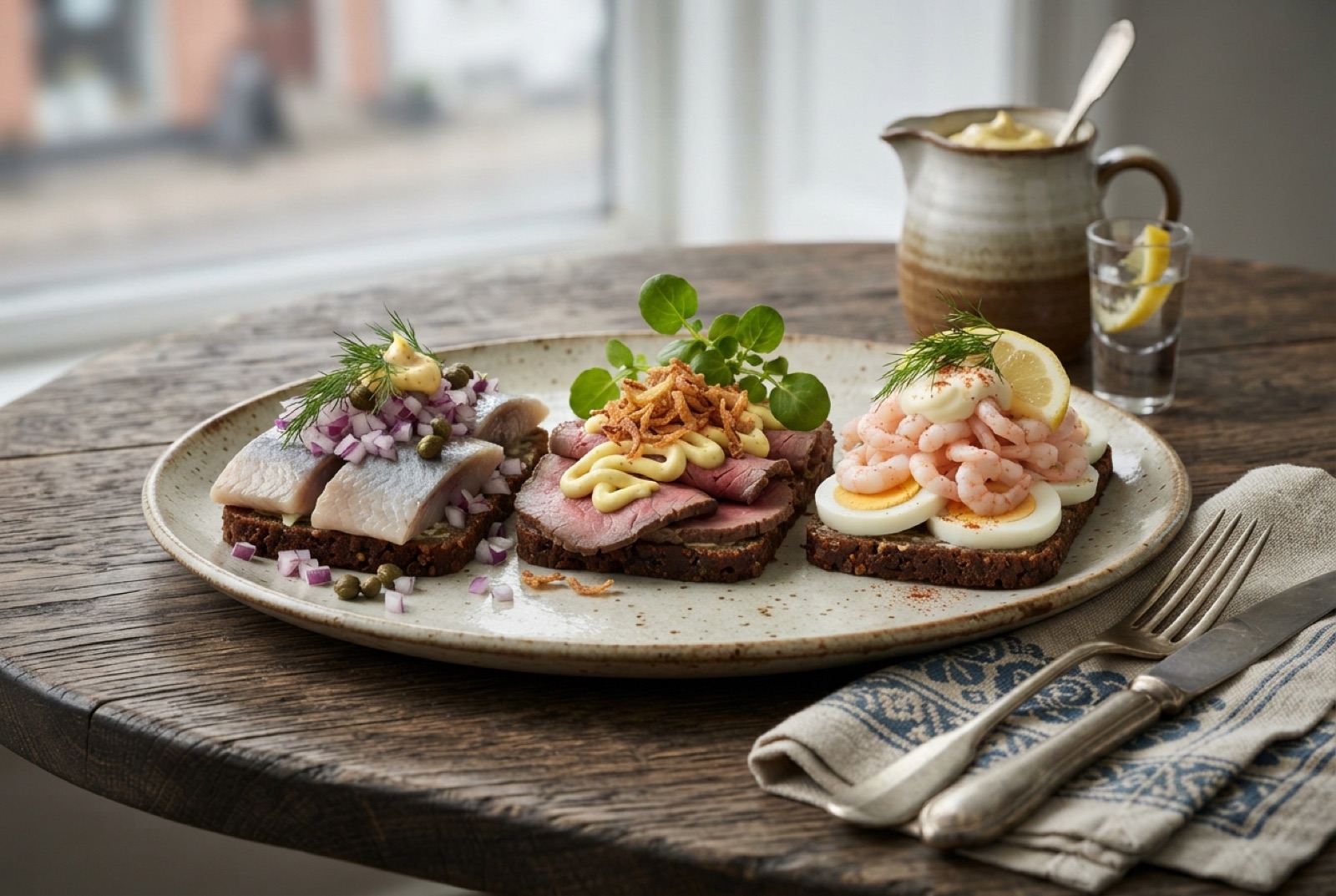
Keep exploring Denmark.
Denmark has 9 more dishes in the atlas — Æbleskiver and Flæskesteg, and 7 more.
Recipe by The DishRoute Kitchen · published August 19, 2026 · updated August 19, 2026