Malabi.
Rosewater Milk Pudding with Red Syrup
מלבי · Malabi · say it: mah-lah-BEE
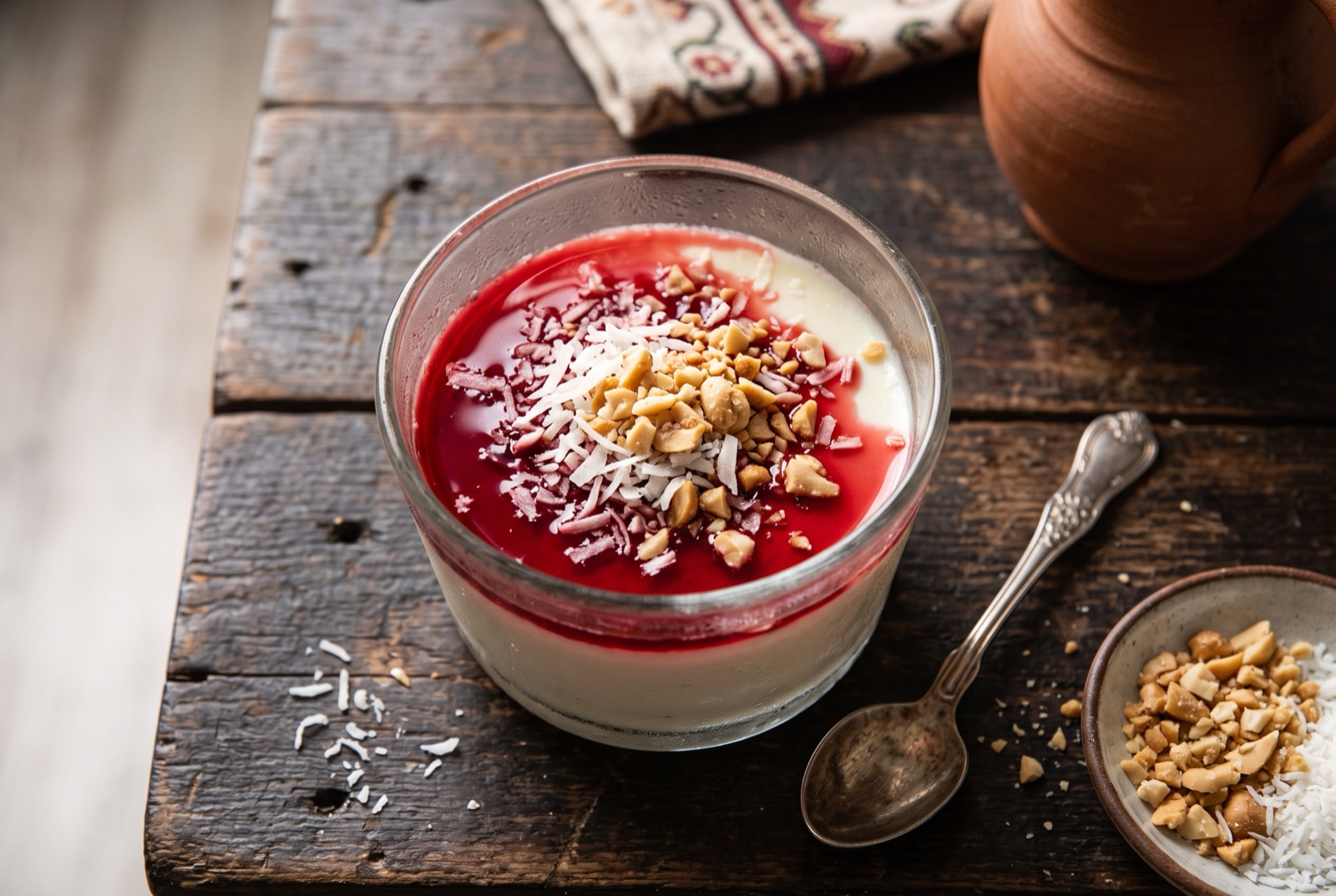
Malabi is a cold milk pudding thickened with cornstarch rather than eggs or gelatin, which gives it a texture closer to loose panna cotta than to custard: it holds its shape in the cup but collapses the moment a spoon goes in. Rose water carries the flavour, and the amount matters — enough to perfume the milk, not enough to taste like a bathroom cabinet. Over the top goes a bright red syrup, a scatter of desiccated coconut and a handful of crushed salted peanuts, and that contrast is the whole point: cold and soft underneath, sticky and sweet on top, crunchy and faintly salty at the very end of each spoonful. It takes fifteen minutes of work and three hours of doing nothing.

- Gate
- IsraelLevantine kitchens, sold from kiosks nationwide
- Prep
- 15 min
- Cook
- 15 min
- Total time
- 3 hr 30 min incl. 3 hr rest
- Serves
- 6
- Status
- Easy
- Nutrition / serving · estimated
- Calories 340 kcal
- Protein 8 g
- Carbs 52 g
- Fat 11 g
- Fiber 2 g
- Sugar 43 g
- Sodium 130 mg
Why this recipe works.
- Cornstarch is slaked in cold milk first, so the pudding sets smooth instead of seizing into lumps that no whisk will rescue.
- The mixture is boiled properly for a full minute, which is what removes the raw, chalky starch taste that ruins most homemade versions.
- A real fruit syrup with a squeeze of lemon, so the red layer tastes of something rather than only of sugar and colouring.
- Sets in individual glasses with no unmoulding, which is exactly how it is sold and eaten.
Ingredients.
13 itemsFor the pudding
For the red syrup
To finish
Equipment
- Heavy-based saucepan
- Balloon whisk
- Fine sieve
- Six small glasses or cups
Instructions.
Slake the cornstarch
Pour about 250 ml of the cold milk into a bowl and whisk in the cornstarch until the liquid is completely smooth and slightly opaque, with no grit left on the bottom when you scrape the whisk across it. Set aside.
Tip Check the bottom of the bowl with a spoon. Undissolved starch hides there and turns into lumps later.
Warm the rest of the milk
Put the remaining milk in a heavy saucepan with the sugar and the pinch of salt and heat over medium, stirring, until the sugar has dissolved and steam rises from the surface. Do not let it come to a boil yet.
Combine and thicken
Whisk the starch mixture again, then pour it into the hot milk in a steady stream while whisking constantly. Keep whisking across the whole base of the pan for 4–6 minutes until the mixture thickens suddenly and the whisk starts leaving trails that hold for a second before closing.
Tip It goes from liquid to thick almost without warning. Stop stirring for twenty seconds around that point and the base will catch.
Boil it out
Once thickened, lower the heat and let it bubble slowly for a full minute, still whisking, until it turns slightly glossy and loses its floury smell. Pull the pan off the heat and stir in the rose water, then taste — it should be perfumed, not perfumey.
Pour and chill
Strain the pudding through a fine sieve into six glasses, filling them about three-quarters full, and press cling film onto the surface of each. Cool to room temperature, then refrigerate at least 3 hours until set soft and cold right through.
Make the red syrup
While the puddings chill, simmer the raspberries, sugar and water for 8–10 minutes until the fruit has collapsed and the liquid coats the back of a spoon. Push it through the sieve, discard the seeds and stir in the lemon juice and rose water. Cool completely — warm syrup melts a trench into the pudding.
Flood and finish at the table
Just before serving, spoon a generous layer of cold syrup over each cup so it pools right to the edges, then scatter over the crushed peanuts, the coconut and the pistachios if using. Serve immediately, with small spoons, while the toppings are still crisp.
Tips from our kitchen.
- Whisk the cornstarch into cold milk until there is not a single speck left before any heat is involved. Starch added to warm milk gelatinises on contact and forms lumps instantly.
- Keep the whisk moving across the whole base of the pan, corners included. Cornstarch settles and scorches there first, and a burnt patch flavours the entire batch.
- Let it bubble for a full 60 seconds after it thickens. Pulled off too early it thickens anyway on cooling but keeps a raw, powdery taste on the tongue.
- Add the rose water off the heat. Its aroma is volatile and boiling it away is the most common reason homemade malabi tastes of nothing much.
- Press cling film directly onto the surface of each cup while hot, or you will get a rubbery skin that never softens.
- Chill at least 3 hours. The set continues long after the pudding is cold to the touch, and a two-hour malabi is a puddle.
Substitutions.
- Rose water → Orange blossom water, or half of each
- Both are traditional across the region, and orange blossom is the more common choice in some Levantine households. Strengths vary hugely between brands, so start with half and taste.
- Cornstarch → 90 g rice flour, added the same way
- The older method. The set is softer and slightly grainy, the colour more opaque, and it needs a few minutes longer at a simmer. Worth trying once to see where the dish comes from.
- Whole milk → Oat or almond milk, with an extra 10 g of cornstarch
- Works better than expected, though plant milks set looser and taste thinner. Coconut milk gives a much richer pudding but takes over the flavour completely.
Variations.
- Pomegranate malabi
- Reduce pomegranate juice with a little sugar and lemon into a tart, deep-red syrup instead of the raspberry version. Sharper, more grown-up and less sweet.
- Date syrup and tahini malabi
- Skip the red syrup entirely and pour over date syrup thinned with a spoon of raw tahini. A modern restaurant treatment and genuinely good, with the bitterness cutting the sweet milk.
- Pistachio malabi
- Swap the peanuts for coarsely chopped pistachios and finish with a pinch of ground cardamom. Closer to how the pudding is served in Lebanese and Turkish kitchens.
Storage & reheating.
Malabi keeps 3 days covered in the fridge, and is best on day one when the surface is still perfectly smooth. Keep the syrup and the toppings separate until the moment of serving: syrup poured in advance bleeds down into the pudding and turns it pink, and coconut and peanuts go soft and soggy within an hour. The syrup itself keeps 2 weeks refrigerated in a jar. Do not freeze the pudding — cornstarch sets break on thawing and the milk separates into grainy water, with no way back.
Serve with
Small cups of cardamom coffee or mint tea, and nothing else — it is a dessert that finishes a meal on its own.
The story behind Malabi.
Malabi is the Hebrew name for muhallabia, a milk pudding eaten across the Arab world, Turkey and Iran, and its history runs back a long way in the region. Medieval Arabic cookery manuscripts describe a dish called muhallabiya that was not a dessert at all but a preparation of chicken, rice and milk; over the centuries the meat dropped away and what remained was the sweet, rice-thickened milk pudding still made from Beirut to Cairo. The name is commonly attributed to al-Muhallab ibn Abi Sufra, an early Islamic-era commander said to have favoured it, which is repeated in most accounts but is not something anyone can actually verify.
The traditional thickener is ground rice or rice flour, which gives a slightly grainy, opaque set. Cornstarch is the modern shortcut and now dominates almost everywhere, producing a cleaner, glossier and considerably faster pudding. Flavourings shift by country: rose water in some kitchens, orange blossom water in others, mastic in Turkish and Greek versions, and often a mixture of the three. The pudding is a shared regional dessert with no single national owner, and Israel is one of several places that eats it, not the place that invented it.
What is specifically local is the format. In Israel malabi escaped the dinner table and became kiosk food, sold from small stands in Jaffa, Tel Aviv and the markets in disposable cups with a flimsy plastic spoon, drowned in a violently red syrup and finished at the counter with coconut and crushed peanuts. That red is usually a raspberry or rose cordial rather than any particular fruit, and it is unapologetically artificial in its street version. Ordering involves exactly one decision, which is how much syrup you want, and the correct answer at any decent stand is more than you think.
Questions, answered.
Why is my malabi lumpy?
The cornstarch met hot milk before it was fully dispersed. Always whisk the starch into a portion of cold milk until the liquid is completely smooth, then pour that into the pan, rather than sprinkling starch into warm milk. If lumps do form, push the hot mixture through a fine sieve straight into the cups; it will still set properly.
Why does my pudding taste chalky?
The starch was not cooked out. Cornstarch thickens before it is actually done, so a mixture that looks ready can still taste raw and powdery. Once it thickens, keep whisking over the heat for a full minute of visible slow bubbling — the mixture will turn slightly glossier and lose its cloudy, floury note. That extra minute is the difference.
How firm should malabi be?
Soft. It should hold a clean edge when you tilt the cup but wobble noticeably and give way completely under a spoon, somewhere between panna cotta and thick yoghurt. If yours is bouncy or rubbery there is too much cornstarch for the volume of milk; drop it by 10 g next time. If it never sets, it either did not reach a proper boil or did not chill long enough.
What is the red syrup actually made of?
At street kiosks it is usually a raspberry or rose-flavoured cordial, brightly coloured and frankly artificial, thinned to a pouring consistency. At home most people make a quick syrup from raspberries, pomegranate or sour cherry cooked with sugar and a squeeze of lemon, which tastes considerably better and comes out a deeper, less neon red. Both are legitimate; only one of them stains the cup.
Is malabi the same as muhallabia?
Yes — malabi is the Hebrew rendering of the Arabic name, and it is the same milk pudding eaten throughout the Arab world, Turkey and Iran. Regional differences are real but small: the thickener may be rice flour rather than cornstarch, the perfume may be orange blossom or mastic instead of rose, and toppings range from pistachios and cinnamon to the coconut-and-peanut combination typical of Israeli kiosks.
You might also like.
All recipes →
Keep exploring Israel.
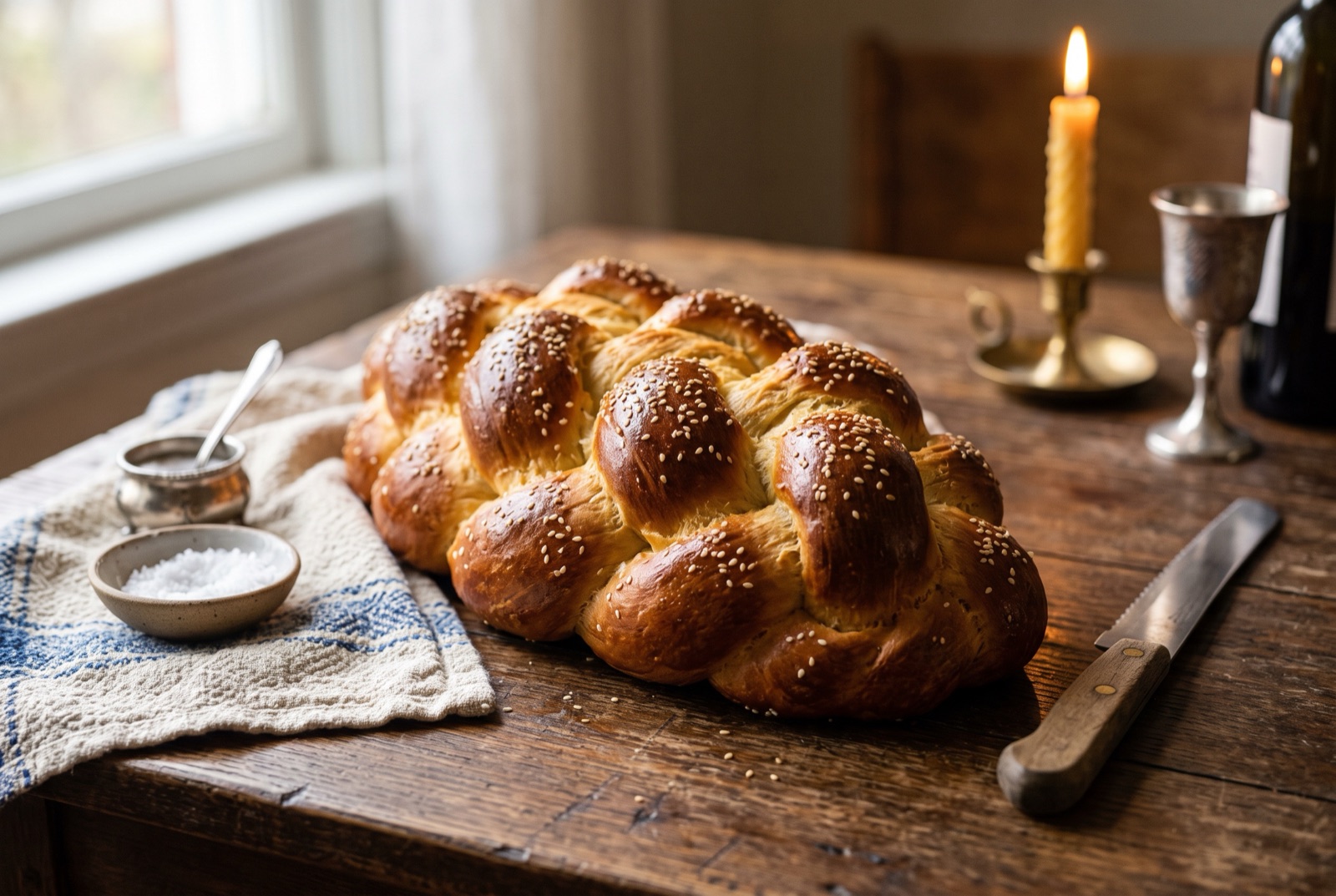
Israel has 9 more dishes in the atlas — Challah and Cholent, and 7 more.
Recipe by The DishRoute Kitchen · published August 20, 2026 · updated August 20, 2026