Russia.
Россия
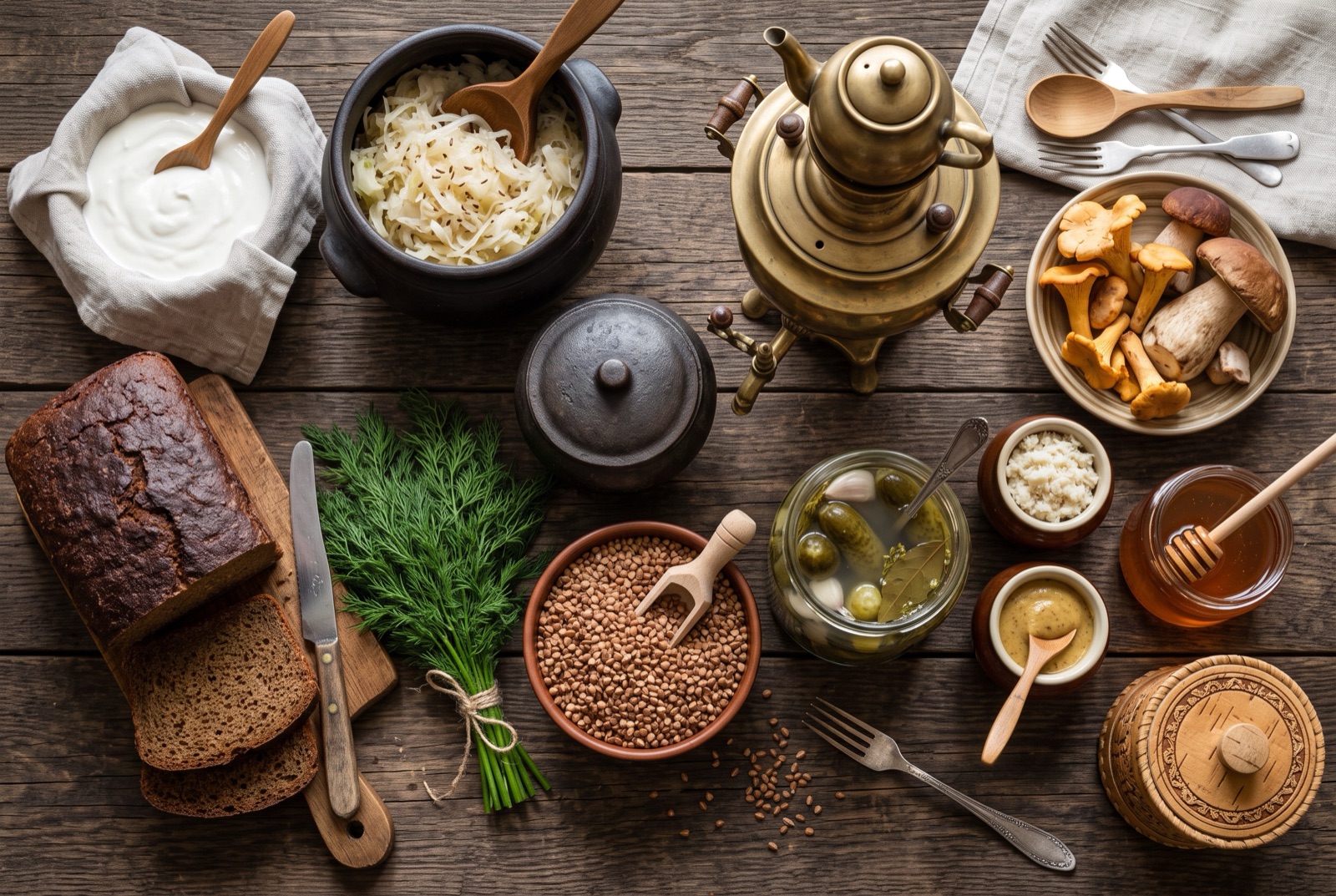
Russian cooking is a kitchen of long winters, rye bread and sour dairy, and its first principle is preservation. Cabbage is salted into sauerkraut by the barrel, cucumbers and mushrooms go into brine, fish is salted and cold-smoked, berries are cooked down into loose preserves, and in Siberia dumplings are frozen outdoors by the sackful. Those preserved things are not footnotes — they are the seasoning. The sour edge in a bowl of shchi or solyanka comes from sauerkraut and pickle brine rather than from lemon, and the richness comes from smetana, the thick cultured sour cream stirred into almost every savory dish at the table rather than in the pot. The aromatics stay deliberately quiet: dill, bay leaf, black pepper, onion, garlic, and mustard or horseradish when heat is wanted. Grain carries as much weight as meat, with buckwheat, barley, millet and rye running through the everyday table, and the meal itself is built around soup, which here is the centre of lunch rather than a polite opening course.

- Continent
- EuropeEastern Europe
- Recipes in atlas
- 10
- Must-try dishes
- 3
- Pantry staples
- 9
Start with the classics.
Must tryThe dishes that explain the Russia kitchen fastest — if you cook only a few things from this page, cook these.
Inside the Russia kitchen.
Start with the pantry, because it explains almost everything else. Rye, not wheat, is the historic bread grain — dense, sour, dark, and eaten with practically every savory dish. Buckwheat, toasted and simmered into kasha, is the default grain the way rice is elsewhere. Potatoes arrived late, in the eighteenth and nineteenth centuries, and were resisted before they became indispensable. Dairy comes in a family of cultured forms that are not interchangeable: smetana (sour cream) for finishing soups and salads, tvorog (fresh curd cheese) for baking and breakfast, kefir and ryazhenka for drinking. Sunflower oil, pressed from a plant that Russia adopted enthusiastically, is the everyday cooking fat, with butter reserved for pastry and richness.
Soup is the structural centre of the meal. Shchi, built on cabbage, is the oldest and the most Russian; ukha is a clear fish soup, rassolnik is soured with pickle brine and barley, okroshka is a cold summer soup poured over with kvas or kefir, and solyanka is the loud, salty-sour one made from whatever smoked and cured meats the kitchen has. Borscht is eaten across Russia and beloved there, but its origin and identity are Ukrainian, and it belongs to Ukraine's culinary heritage rather than Russia's — a distinction worth keeping straight even when the same bowl appears on both tables.
The defining old technique was the russkaya pech, the huge masonry stove that heated the house. It gave falling, indirect heat rather than a flame, which suited long braises, slow-baked porridges, milk left to brown and thicken for hours, and the technique called tomlenie — something between stewing and steeping. Almost nothing was fried, because there was no direct fire to fry over. When cooking moved to the stovetop, dishes were rewritten for pans, which is why so many modern Russian recipes ask you to imitate gentleness rather than to chase browning.
There are really two Russian kitchens sitting on top of each other. One is the peasant and monastic tradition of grains, cabbage, mushrooms, fish and pies, shaped by the Orthodox fasting calendar that removes meat and dairy for a large part of the year and left behind a serious repertoire of vegan cooking. The other is the aristocratic kitchen of the nineteenth century, when French chefs worked in noble houses and produced beef Stroganoff, Olivier salad, Pozharsky cutlets and the grand pies of the Moscow restaurant era. The Soviet century then flattened both into a standardised canteen canon, with printed state cookbooks fixing recipes so firmly that many Russians still consider a dish wrong if it deviates.
Regionally, the country is too vast for one answer. Siberia freezes and stockpiles, and gave the whole country pelmeni. The northern coast and Karelia lean on fish, berries, mushrooms and rye pies. The Volga carries deep Tatar influence, and the southern steppe grows the wheat, sunflowers, tomatoes and peppers that make its cooking noticeably lighter. Shashlik, plov and other dishes now eaten daily in Russian cities came from the Caucasus and Central Asia and never stopped being recognisably theirs.
Signature pantry.
9 staplesThe ingredients this cuisine cannot function without.
- smetana (sour cream)
- sauerkraut
- rye bread
- dill
- buckwheat
- pickled cucumbers and their brine
- mushrooms
- horseradish and mustard
- honey
How people eat in Russia.
A proper meal opens with zakuski, a spread of cold plates — pickles, salted fish, cured meats, salads, black bread and butter — that are grazed rather than served in order, and that exist partly to line the stomach for toasts. Then comes soup, then a hot main, then tea. Bread is on the table constantly and is treated with real respect; throwing it away is genuinely frowned upon. Smetana is added by each person at the table, not stirred into the pot, so everyone sets their own richness. Toasting is structured rather than casual: someone speaks, everyone drinks together, and drinking alone mid-conversation looks odd. Tea closes everything, poured strong and diluted to taste, with jam, honey, chocolate or a cake alongside and no hurry at all.
Regional kitchens.
Russia cooks 4 distinctly different ways depending on where you stand — here is what changes between them.
- R1Moscow and Central Russia
- The heartland of shchi, rye bread, mushroom pies and buckwheat, and also the city where nineteenth-century restaurant cooking produced Olivier salad and Pozharsky cutlets. Everyday food here is the country's default register.
- R2The North and Karelia
- Cold-water fish, cloudberries and lingonberries, wild mushrooms, and a strong tradition of rye pastry — including open rye pies filled with porridge. Salting and smoking outrank almost every other technique.
- R3Siberia and the Urals
- Where pelmeni were born, along with the habit of freezing food outdoors as a preservation method. Game, river fish such as omul, pine nuts and cranberries define the pantry.
- R4The Volga and the Southern Steppe
- Wheat, sunflower oil, tomatoes and peppers make the cooking lighter and warmer, while centuries of Tatar and steppe influence show up in stuffed doughs, lamb and rice dishes.
All Russia recipes.
10 recipes and counting
Russia35 min
Beef Stroganoff
Beef Strips in Mustard Sour Cream
Russia2 hr 15 min
Blini
Thin Yeast-Risen Russian Pancakes

Russia3 hr 55 min
Kulebyaka
Layered Salmon and Buckwheat Pie
Russia10 hr
Medovik
Russian Honey Layer Cake
Russia2 hr 10 min
Olivier Salad
Potato, Pea and Pickle Salad
Russia2 hr 10 min
Pelmeni
Siberian Meat Dumplings
Russia3 hr 30 min
Pirozhki
Russian Stuffed Yeast Buns
Russia1 hr 30 min
Pozharsky Cutlets
Breaded Minced Chicken Cutlets
Russia2 hr 55 min
Shchi
Russian Cabbage and Root Vegetable Soup
Russia1 hr 30 min
Solyanka
Sour Soup with Smoked Meats and Olives
Keep traveling.
Russia sits in Eastern Europe, and its kitchen shares borders as well as ingredients with Albania and Austria.
 Albania
 Austria