Balachaung.
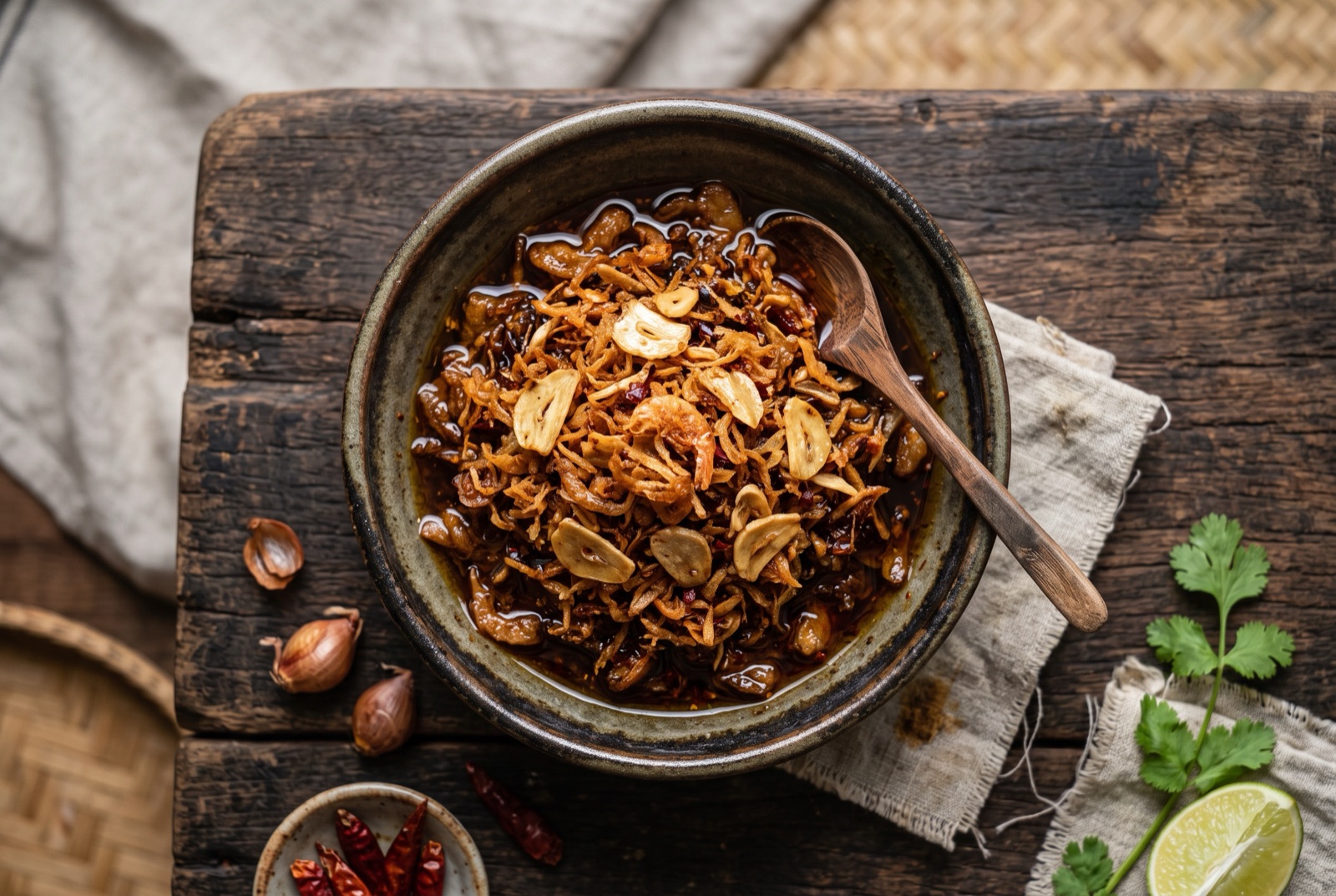
Burmese Dried Shrimp and Garlic Relish
ငါးပိကြော် · say it: BAH-lah-chown
Balachaung is the jar that sits on a Burmese table when there is nothing else to eat: dried shrimp ground to a fibrous floss, fried in a great deal of oil with thin sheets of garlic and shallot until everything turns crisp and deep gold, then seasoned with chilli powder, fermented shrimp paste and enough tamarind to keep it from tasting flat. It is salty, crunchy, fishy and lightly sour, and it is eaten in very small amounts with a large bowl of plain rice. Made properly and kept under its own oil, it survives for weeks without a fridge, which is the entire point of it.

- Gate
- MyanmarYangon and the Irrawaddy Delta
- Prep
- 25 min
- Cook
- 35 min
- Total time
- 1 hr
- Serves
- 12
- Status
- Medium
- Nutrition / serving · estimated
- Calories 165 kcal
- Protein 9 g
- Carbs 4 g
- Fat 13 g
- Fiber 1 g
- Sodium 780 mg
Why this recipe works.
- Fries the shrimp, garlic and shallot separately so each one ends up genuinely crisp instead of collectively soggy.
- Explains the moisture problem, which is the single reason most homemade balachaung goes soft within a day.
- Balanced with tamarind rather than vinegar, so the sourness stays in the relish instead of steaming away.
- Stores for weeks under its own oil, so one afternoon of frying covers a month of meals.
Ingredients.
11 itemsFor the relish
For the seasoning
Equipment
- Wok or wide heavy frying pan
- Spice grinder or food processor
- Slotted spoon
- Sealable glass jar
Instructions.
Grind the shrimp
Pulse the dried shrimp in a spice grinder or processor in short bursts until they break into a loose, fibrous floss. Stop while there are still visible threads — a fine powder will clump and scorch in the oil.
Fry the garlic
Heat the oil in a wok over a low-to-medium flame and add the sliced garlic. Fry gently for 6 to 8 minutes, stirring, until the slices are pale gold and the bubbling slows, then lift them out with a slotted spoon onto kitchen paper.
Tip Pull the garlic out earlier than looks right. Residual heat takes it two shades darker on the paper, and burnt garlic turns the whole jar bitter.
Fry the shallots
Add the sliced shallots to the same oil and fry for 10 to 14 minutes over low heat, stirring often, until they shrink, stop steaming and turn an even light brown. Drain them onto paper alongside the garlic.
Fry the shrimp floss
Pour off all but about 6 tablespoons of the oil and reserve it. Add the shrimp floss to the pan and fry over medium-low heat for 8 to 10 minutes, stirring constantly, until it darkens, separates into dry threads and smells toasted rather than raw.
Season the pan
Push the shrimp to one side, add the shrimp paste and turmeric to the hot oil and mash them for a minute until the paste breaks down and the smell turns nutty. Stir everything together with the fish sauce, tamarind water and sugar and cook for 2 to 3 minutes until the pan is dry again.
Tip The pan must return to dry. Any liquid left behind is what shortens the shelf life from weeks to days.
Add the chilli off the heat
Take the pan off the heat, wait 30 seconds for the temperature to drop, then stir in the chilli powder. It will bloom in the residual heat without scorching and turn the mixture a deep rust colour.
Combine and cool
Crumble in the fried garlic and shallots and toss everything together. Spread the relish on a tray and leave it until completely cool and crisp, which takes about 30 minutes, tasting for salt once cold.
Jar it
Pack the cold relish into a clean dry jar and pour over enough of the reserved frying oil to cover the surface by a finger. Seal and store in a cupboard, always digging in with a dry spoon.
Tips from our kitchen.
- Grind the dried shrimp to a loose floss, not a powder. Powder clumps and burns; floss separates into crisp threads in the oil.
- Fry the garlic and shallots at a genuinely low heat and lift them out while they are still pale gold — they carry on darkening for a minute after leaving the oil.
- Slice the shallots thinly and evenly. Thick pieces stay chewy and hold moisture, which is what turns the whole jar soft in storage.
- Add the chilli powder off the heat. It scorches in seconds at frying temperature and turns the relish bitter and grey-brown.
- Let everything cool completely before it goes into a jar. Warm relish steams inside the lid and the condensation undoes all the frying.
- Keep the relish under a finger of its frying oil. That seal is what lets it sit at room temperature for weeks.
Substitutions.
- Dried shrimp → Dried anchovies or dried whitebait, soaked briefly and dried
- Common in coastal Rakhine kitchens. They are bonier and stronger, so use about a third less and taste before adding fish sauce.
- Shrimp paste (ngapi) → An extra tablespoon of fish sauce plus a pinch of extra salt
- Keeps the salt level right but loses the fermented depth, which is most of what makes the relish taste Burmese.
- Tamarind → A teaspoon of lime juice stirred in once the pan is off the heat
- Sharper and less rounded, and it shortens the shelf life because the extra moisture goes in at the end rather than cooking out.
Variations.
- Balachaung with tomato
- Chopped tomato is fried down into the mixture until jammy, giving a softer, moister relish that is eaten within a few days rather than stored.
- Peanut balachaung
- Crushed roasted peanuts are folded in at the end for extra crunch and a rounder flavour — common in Mandalay, which is groundnut country.
- Extra-hot Rakhine style
- Coastal cooks push the chilli far higher and add more ngapi, producing the punishing heat that Bamar cooks from the interior complain about.
Storage & reheating.
Keeps 3 to 4 weeks in a sealed jar at room temperature provided the relish is fully cool when jarred and covered with a finger of its own oil, and 3 months refrigerated. Always use a dry spoon; a wet one introduces the moisture that starts spoilage. If the relish softens, spread it on a tray and dry it in a low oven for 10 minutes to bring the crunch back.
Serve with
Plain steamed rice, raw cucumber and a clear vegetable broth — or spooned over rice noodles and a boiled egg for a quick lunch.
The story behind Balachaung.
Myanmar is hot, and until recently most kitchens had no refrigeration at all, so the pantry leaned hard on things that keep: fermented pastes, dried fish, pickled tea, and fried condiments sealed under a layer of oil. Balachaung belongs to that last group. Dried shrimp are already preserved by salt and sun; frying them removes the last of the moisture, and the oil that covers the finished relish blocks air from reaching it. A jar made on a Sunday is still good a month later on a shelf, which is why it travels — students take it to hostels, monks receive it as alms, and Burmese families abroad ask for it in luggage more often than for anything else.
The name is one of the clues to how far shrimp paste has moved around maritime Asia. Linguists generally connect balachaung to the same root as Malay belacan and the Macanese balichão, all of them pointing back to a shared trade in fermented shrimp along the coasts rather than to a single inventor. What Myanmar did with it is specific, though: instead of using the paste raw as a dip, Burmese cooks fry it into a dry, crunchy relish built around three separate crisp elements — shrimp, garlic and shallot — each fried to its own doneness and then combined.
It is not a curry and not a sambal, and the confusion causes most home-cooking failures. There is no sauce, nothing simmers, and the finished texture should rattle slightly against the side of a spoon. The savoury weight comes from ngapi, the fermented paste that anchors nearly every Burmese savoury dish, and the sourness from tamarind rather than from vinegar or lime, which would evaporate off in the pan. Chilli is present but restrained; balachaung is usually one of several things on the table, and the household chilli dish is separate.
In a full Burmese meal it appears as one of the small accompaniments beside the rice, the curry, the clear broth and the plate of raw vegetables. On a bad day it is the meal itself, spooned over rice with a raw cucumber, which is how a great many people in Yangon have eaten lunch at some point.
Questions, answered.
Why did my balachaung go soft after a day?
Almost always moisture. Either the shrimp were not fried long enough to drive off their remaining water, the shallots were sliced too thickly to crisp through, or the relish was jarred while still warm and the trapped steam condensed inside the lid. Cool everything completely on a tray before storing, and keep it under a layer of oil.
What is ngapi and can I leave it out?
Ngapi is Burmese fermented fish or shrimp paste, sold in blocks or jars and used as the savoury base of most Burmese savoury cooking. You can leave it out and compensate with extra fish sauce and salt, but the result tastes like fried shrimp rather than like balachaung, because the fermented note is the backbone of the dish.
How much of it do you actually eat?
A teaspoon or two per person alongside a full bowl of rice. Balachaung is a concentrated salty condiment in the Burmese meal, not a side dish to be eaten by the spoonful, and a small jar comfortably feeds a household for a couple of weeks.
Is balachaung very spicy?
Not usually. Most Burmese households keep the chilli moderate because a separate dish of fried chilli flakes is on the table for anyone who wants more heat. Coastal Rakhine versions are a genuine exception and are made considerably hotter.
Can I use the frying oil for anything else?
Yes, and it is prized. The oil left over is deeply flavoured with shrimp, garlic and chilli, and Burmese cooks spoon it over noodles, into salads and onto plain rice. Keep whatever does not go back over the relish in a separate jar in the fridge and use it within a month.
You might also like.
All recipes →
Keep exploring Myanmar.
Myanmar has 9 more dishes in the atlas — Danbauk and Lahpet Thoke, and 7 more.
All Myanmar recipes Dried shrimp recipes Garlic recipes Onion recipes sidesaucedairy freegluten freepescatariannut freeRecipe by The DishRoute Kitchen · published August 21, 2026 · updated August 21, 2026