Lahpet Thoke.
Burmese Fermented Tea Leaf Salad
လက်ဖက်သုပ် · say it: lah-PET toke
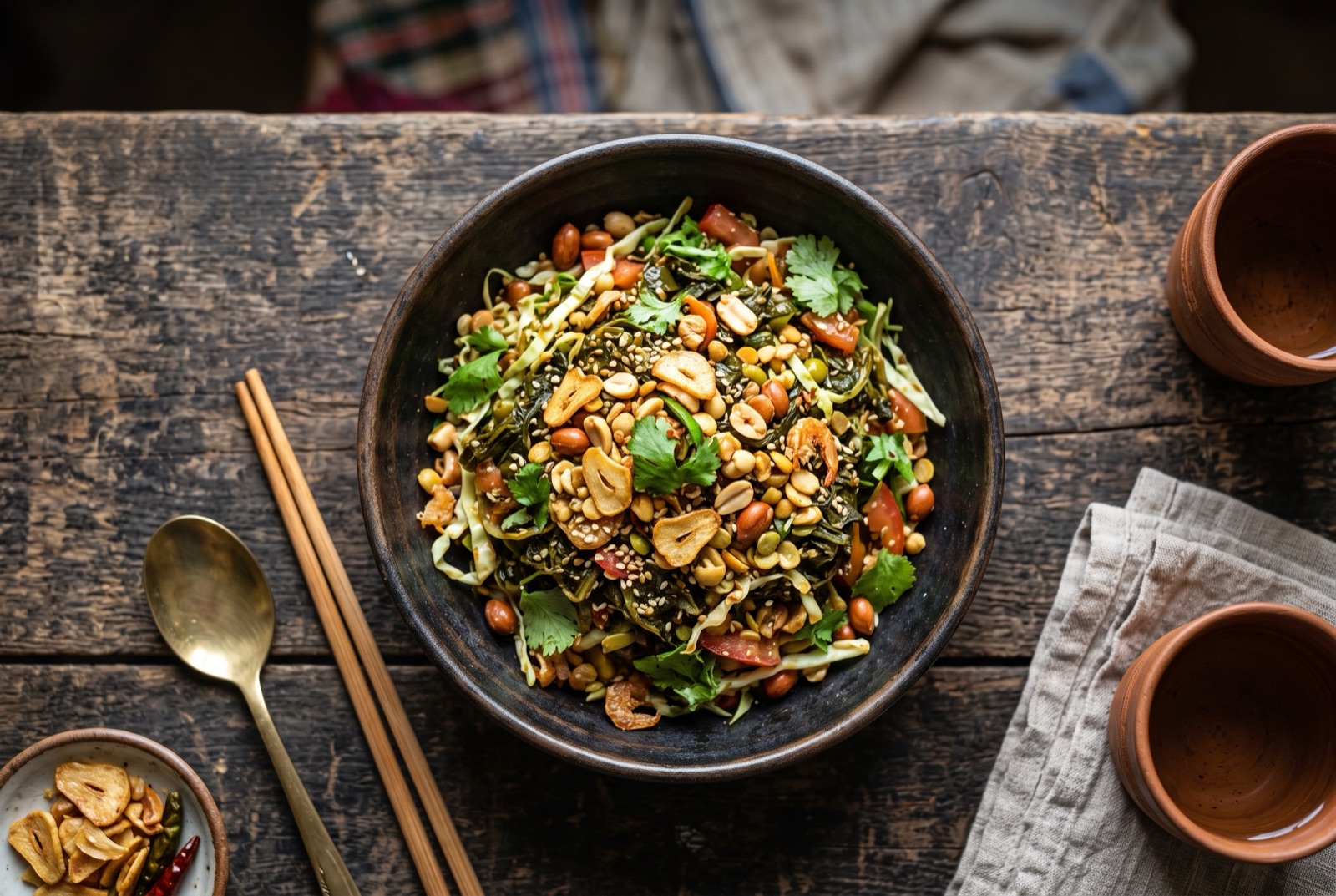
Lahpet thoke is a salad made from tea you eat rather than drink. Fermented tea leaves — sour, bitter and faintly astringent, with a texture like soft seaweed — are mixed by hand with a pile of fried and toasted things: crisp garlic, peanuts, sesame seeds, deep-fried split peas and dried shrimp, plus fresh tomato, shredded cabbage, green chile and a hard squeeze of lime. Every bite has four or five textures in it, and the flavor runs bitter-salty-sour with almost no sweetness. It is genuinely unlike anything else in Southeast Asian cooking, and it carries enough caffeine that Burmese students eat it to stay awake before exams. Served as a snack, an appetizer, or the last dish of a meal.

- Gate
- MyanmarShan State and nationwide
- Prep
- 15 min
- Cook
- 10 min
- Total time
- 25 min
- Serves
- 4
- Status
- Easy
- Nutrition / serving · estimated
- Calories 340 kcal
- Protein 13 g
- Carbs 20 g
- Fat 24 g
- Fiber 7 g
- Sodium 890 mg
Why this recipe works.
- Treats the crunchy mix as the backbone of the dish rather than as a garnish sprinkled on top.
- Honest about fermented tea leaf: where to buy it, and why green tea leaves are not a real substitute.
- Balanced so the bitterness reads as a feature, cut with lime, tomato and enough salt to hold it up.
- Ready in fifteen minutes with no cooking beyond frying garlic, so it works as an actual weeknight snack.
Ingredients.
13 itemsFor the salad
For the crunch
Equipment
- Small saucepan for frying garlic
- Wide mixing bowl
- Sharp knife
Instructions.
Fry the garlic
Put the sliced garlic and oil together in a cold small pan and bring slowly up over medium-low heat. Fry for 6–7 minutes until the slices are pale straw gold and the bubbling has almost stopped, then strain, keeping both the crisp garlic and the oil.
Tip Pull them a shade lighter than you want. Residual heat finishes the browning on the plate.
Check the tea leaves
Taste a small pinch of the lahpet. If it is very salty or fiercely bitter, rinse it briefly under cold water and squeeze out the excess liquid; if it is mild, use it straight from the jar. Loosen the clump with a fork so it is not one solid mass.
Toast the sesame and dried shrimp
Toast the sesame seeds in a dry pan over medium heat for 2 minutes, shaking, until they smell nutty and a few start to jump. Add the dried shrimp for the last 30 seconds so they crisp slightly and lose their raw edge.
Lay out the components
Arrange the tea leaves, cabbage, tomato, chile, peanuts, split peas, sesame, shrimp and fried garlic in separate piles in a wide bowl. Keeping them apart until the last moment stops the crunchy elements absorbing moisture.
Dress and mix by hand
Pour over the garlic oil, lime juice and fish sauce, then mix hard with your fingers for a minute, lifting from the bottom, until the tea leaves are evenly distributed and everything glistens with oil. There should be no dry pockets and no wet puddle at the base.
Taste and serve immediately
Taste for salt and acid — it should hit bitter, salty and sour in that order, with crunch in every bite. Add more lime if the bitterness sits heavy. Serve straight away while the peanuts and split peas are still crisp.
Tips from our kitchen.
- Taste your jar of lahpet first. Brands vary from mildly sour to very salty and bitter; rinse briefly and squeeze dry if yours is aggressive.
- Fry the garlic in cool oil brought slowly up to heat, and pull it out while it is still pale gold — it darkens off the heat and turns bitter fast.
- Keep the crunchy elements separate until the moment you mix, or they soften in the moisture from the tomato.
- Mix with your hands rather than a spoon. Fingers distribute the oil and tea evenly through the dry ingredients without crushing the peanuts.
- Add lime last and generously — the acid is what makes the bitterness pleasant rather than heavy.
- Shred the cabbage as thin as you can manage; thick pieces dominate and dilute the tea flavor.
Substitutions.
- Fermented tea leaves (lahpet) → There is no honest substitute
- Recipes suggesting soaked green tea leaves produce a pleasant crunchy salad that does not taste like lahpet thoke. Jars are sold by Burmese grocers and online and keep for months refrigerated — it is worth the order.
- Fried yellow split peas → Roasted chana dal, or crushed corn nuts
- Roasted chana dal from an Indian grocer is the closest and cheapest match for the same hard, nutty crunch.
- Dried shrimp → Omit entirely, adding a pinch of extra salt
- Leaving it out makes the salad vegan and is a common variation; the dish keeps its character since the tea is the dominant flavor.
Variations.
- Lahpet on a lacquer tray
- The ceremonial form: the pickled tea sits in the middle of a compartmented tray with the peanuts, split peas, sesame, garlic and dried shrimp separate, and each guest builds their own mouthful.
- With rice
- Some households mix lahpet thoke into a plate of hot rice, which mellows the bitterness considerably and turns a snack into a light meal.
- Vegan lahpet thoke
- Drop the dried shrimp and use only the plant crunches. The salad stays fully recognizable and is common among Buddhist households observing vegetarian days.
Storage & reheating.
Best eaten within an hour of mixing — the crunchy elements go soft once the tomato and lime start working on them. Unmixed components hold separately: fried garlic and its oil keep 2 weeks in a jar, the crunchy mix keeps a month airtight, and an opened jar of lahpet lasts several months refrigerated under a film of oil. Never refrigerate the assembled salad overnight.
Serve with
Green tea, and a plate of plain hot rice if you want to turn the snack into a light meal.
The story behind Lahpet Thoke.
Tea in Myanmar has always had two lives. The leaves that get dried and brewed are one thing; the leaves that get steamed and packed down to ferment for months are lahpet, and lahpet is a national institution. It comes mostly from the hills of Shan State, where the climate suits tea, and it has historically functioned as far more than food — lahpet was exchanged as a formal offering to settle disputes, presented to guests as a gesture of welcome, and served at weddings, funerals and monastic ceremonies. A lacquer tray with lahpet at the center and the crunchy accompaniments in compartments around it is one of the most recognizable images of Burmese hospitality.
The salad version, lahpet thoke, is the everyday form: the same pickled leaves, but mixed rather than arranged, and eaten as a dish. Tea shops serve it all day, and it turns up at the end of meals in the way another cuisine might offer something sweet, because the bitterness and caffeine act as a kind of full stop. Some Burmese eat it as a mid-afternoon snack in exactly the situation where an office worker elsewhere would drink coffee.
The crunchy elements are not optional decoration; they are the structural argument of the dish. Fried yellow split peas, fried broad beans, peanuts, sesame and crisp garlic are sold specifically as lahpet accompaniments in Burmese markets, often as a pre-mixed bag. Without them the pickled leaves are just intense and soft. Outside Myanmar, the main obstacle is the tea itself: fermented tea leaf is genuinely difficult to make at home and takes months, so this recipe assumes a jar of prepared lahpet from a Burmese grocer or online seller, and says plainly that the widely repeated substitute of soaked green tea leaves gives you a different dish, not the same one.
Questions, answered.
Where do I buy fermented tea leaves?
Burmese and some Southeast Asian grocers stock lahpet in jars or vacuum packs, and several Burmese food producers sell it online internationally. Look for a paste-like dark green product labelled pickled or fermented tea leaf. It keeps for months in the fridge once opened.
Can I substitute regular green tea leaves?
Not really. Soaked green tea leaves give you bitterness but none of the fermented sourness or the soft, slippery texture that defines lahpet. The result is a decent crunchy salad but it is a different dish, and it is worth being clear about that rather than pretending otherwise.
Does lahpet thoke contain caffeine?
Yes. The leaves are real tea, so eating a portion delivers a noticeable amount of caffeine — enough that Burmese students eat it to stay awake studying. Avoid a large serving late at night if caffeine affects your sleep.
Is it supposed to taste bitter?
Yes, distinctly. Bitterness and sourness are the point of the dish, balanced by salt, fat from the fried elements and acid from lime. If it tastes unpleasantly harsh rather than pleasantly bitter, add more lime and a little more oil, or rinse the tea leaves before mixing.
Can I make it in advance for a party?
Prepare all the components ahead and keep them in separate bowls, then mix just before serving. Once combined the crunchy elements soften within an hour. Serving it as a tray with everything separate is traditional anyway and solves the problem elegantly.
You might also like.
All recipes →
Keep exploring Myanmar.
Myanmar has 9 more dishes in the atlas — Balachaung and Danbauk, and 7 more.
All Myanmar recipes Peanuts recipes Cabbage recipes Tomato recipes appetizersnackdairy freegluten freeRecipe by The DishRoute Kitchen · published August 20, 2026 · updated August 20, 2026