Humintas al Horno.
Baked Corn and Cheese Parcels
Humintas al horno · say it: oo-MEEN-tahs ahl OR-noh
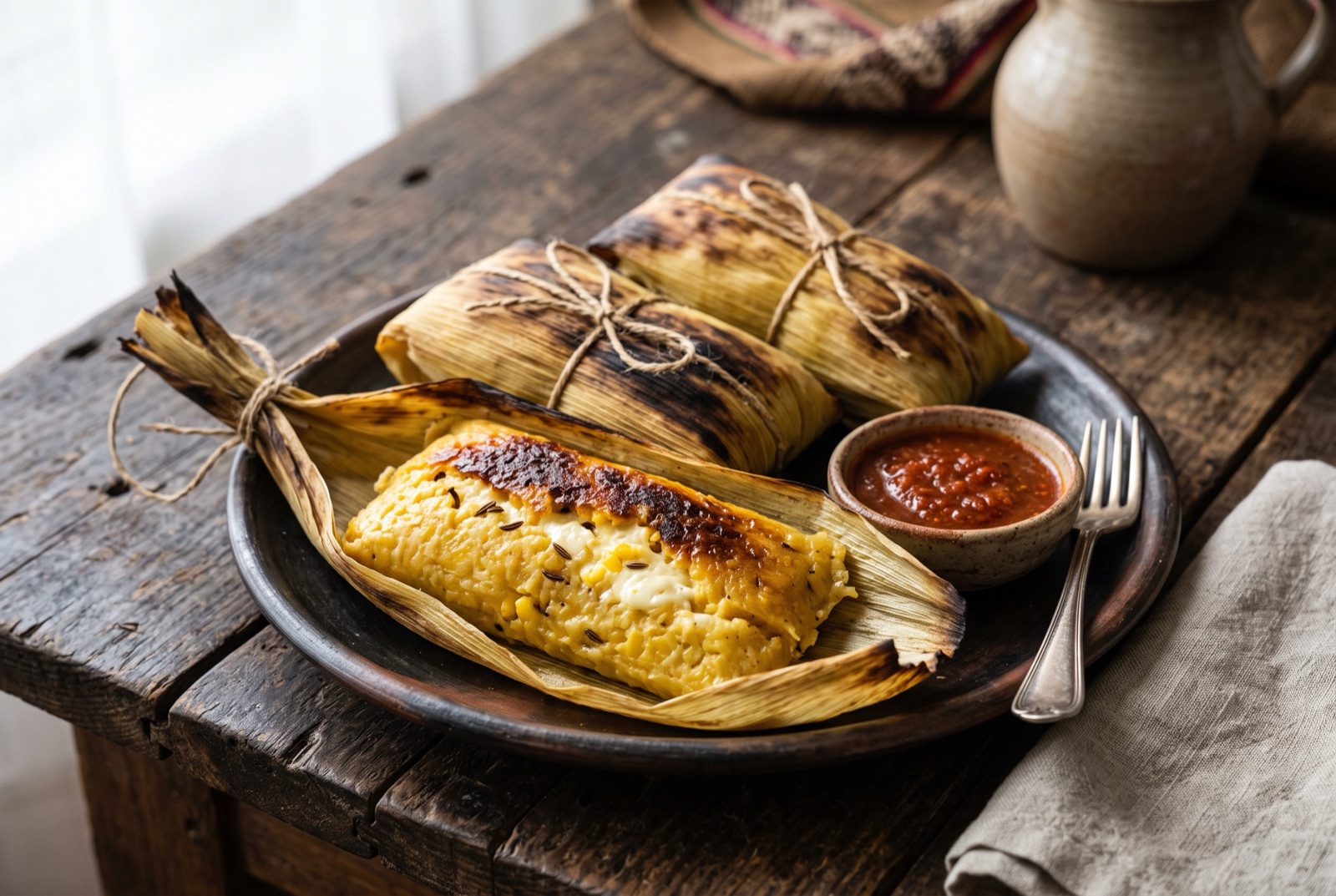
A huminta is fresh corn turned into its own pudding. Whole cobs are grated down to a wet, gritty mash — never blended smooth — then worked with butter, crumbled white cheese, a spoonful of sugar and a scatter of anise seed until it holds together like a loose batter. Packed into the corn husks it came wrapped in, tied shut and baked in a hot oven, it firms into something between cornbread and a savoury custard, sweet at the edges and salty wherever the cheese has melted into a pocket. Baking rather than steaming is the point of this version: the underside sits against the hot tray and caramelises into a chewy brown crust that a steamed huminta never develops.

- Gate
- BoliviaLa Paz and the highlands
- Prep
- 40 min
- Cook
- 55 min
- Total time
- 1 hr 35 min
- Serves
- 8
- Status
- Medium
- Nutrition / serving · estimated
- Calories 310 kcal
- Protein 10 g
- Carbs 36 g
- Fat 15 g
- Fiber 3 g
- Sugar 12 g
- Sodium 460 mg
Why this recipe works.
- Grating is specified over blending, so the mixture keeps the coarse, mealy texture that defines a huminta.
- The sugar is calibrated for sweetcorn rather than for starchy Andean choclo, which is the difference between balanced and cloying.
- Cheese goes in as coarse crumbs, not grated dust, so it melts into distinct salty pockets instead of vanishing.
- Baking directly on a preheated tray builds the browned base that separates this version from the steamed one.
Ingredients.
8 itemsFor the mixture
Equipment
- Box grater
- Heavy baking tray
- Kitchen string or torn husk strips
Instructions.
Undress the cobs
Peel the husks off each cob one leaf at a time, keeping the broad inner leaves intact for wrapping, and set aside a few ragged outer ones to tear into ties. Rinse the husks and pat them dry.
Grate the corn
Stand each cob upright in a wide bowl and grate it down the coarse holes of a box grater, turning as you go, until only the bare cob is left. You should have a wet, uneven mash flecked with kernel skins, not a smooth purée.
Tip Scrape the grater and the cob with the back of a knife afterwards — the milky liquid clinging to them carries a lot of the sweetness.
Beat the mixture
Work the softened butter, sugar, anise, baking powder and salt into the corn with a wooden spoon for a couple of minutes, until it lightens slightly and looks glossy. Fold in the crumbled cheese last, keeping the pieces visible. If the mixture spreads rather than mounding on the spoon, beat in cornmeal a tablespoon at a time.
Wrap the parcels
Overlap two husk leaves to make a wide bed, spoon about three heaped tablespoons of mixture into the middle, fold the long sides over the filling, then fold the ends up and tie the parcel closed with a strip of husk or string. Repeat until you have eight snug, well-sealed parcels.
Bake on a hot tray
Heat the oven to 200 °C with a heavy tray inside. Sit the parcels seam-down on the hot tray and bake for 50–55 minutes, until the husks are dry, papery and scorched at the edges and a parcel feels firm rather than soft when pressed.
Rest before opening
Let them sit 10 minutes out of the oven so the inside finishes setting, then untie one and peel the husk back — the base should lift away with a chewy brown crust and the centre should be moist and just holding its shape. Serve warm in the opened husks.
Tips from our kitchen.
- Strip the husks off the cobs carefully so they stay whole — the wide inner leaves are the wrappers and the ragged outer ones are only good for tying strips.
- Grate the corn on the coarse side of a box grater, standing the cob upright in a bowl. A blender turns it into soup and the parcels will never set properly.
- If the mixture slumps rather than holding a soft mound on the spoon, beat in cornmeal a tablespoon at a time until it sits up. Sweetcorn almost always needs this.
- Toast the anise seed for thirty seconds in a dry pan before adding it; the aroma sharpens noticeably and it stops the flavour disappearing into the sugar.
- Bake on a tray preheated in the oven. A cold tray gives you a pale, soft base instead of the chewy caramelised underside that is the whole reason to bake them.
- At high altitude the parcels dry out faster in the thin air, so wrap them tightly and check ten minutes earlier than the recipe says.
Substitutions.
- Fresh corn husks → Dried corn husks soaked in warm water for 30 minutes, or squares of baking paper tied with string
- Dried husks are sold wherever tamale ingredients are. Baking paper works mechanically but contributes none of the grassy corn aroma the husk gives during baking.
- Queso fresco → Firm feta rinsed of excess salt, halloumi, or a mild young cheddar
- You want something that softens without flowing away. Very salty cheese should be rinsed first, since the corn mixture is already seasoned.
- Anise seed → Fennel seed, lightly crushed, or a small pinch of ground cinnamon
- Fennel is the closest in aroma and easier to find. Cinnamon takes the parcels in a sweeter, dessert-leaning direction that some Bolivian households prefer anyway.
Variations.
- Humintas a la olla
- The steamed version, cooked standing upright in a covered pot over an inch of water for about an hour — softer, moister, with no browned base.
- Huminta salada
- The savoury version, with the sugar cut to a single teaspoon, extra cheese and a little chopped locoto or spring onion beaten into the mixture.
- With raisins
- A handful of raisins stirred through before wrapping, which is common at festivals and pushes the parcels firmly into sweet territory.
Storage & reheating.
Wrapped humintas keep 3 days in the fridge and reheat well in a 170 °C oven for 12–15 minutes, still in their husks, which protect them from drying. They freeze raw or baked for 2 months; bake from frozen with an extra 20 minutes, or reheat baked ones from frozen at 180 °C for about 25 minutes. Avoid the microwave, which turns the corn rubbery and undoes the browned base entirely.
Serve with
Hot api or black coffee in the afternoon, or alongside a mug of hot chocolate on a cold morning.
The story behind Humintas al Horno.
Grated fresh corn wrapped in its own husk is one of the oldest ideas in Andean cooking, and it survives across an enormous stretch of the continent under related names — humitas in Peru, Chile and Argentina, humintas in Bolivia, with tamales and their many cousins occupying overlapping territory further north. Trying to award ownership is pointless: the technique predates every modern border in the region and moved with the crop. What varies from place to place is the seasoning, the sweetness and the cooking method, and Bolivian highland cooks are firmly in the sweet-and-cheesy camp.
The division within Bolivia is between humintas a la olla, steamed in a pot and eaten soft and moist, and humintas al horno, baked in the oven until the outside dries and the base browns. Bakeries and market stalls in La Paz sell the baked kind in the afternoon, and they are a standard companion to api or to a cup of tea, sold in stacks with the blackened husk still tied around them. The husk is a wrapper and a cooking vessel, not food — you untie it, peel it back and eat what is inside with a spoon or your hands.
There is one genuine problem for cooks outside the Andes, and it is the corn. Choclo, the large-kernelled variety grown throughout the region, is starchy and only faintly sweet, and it grates into a thick paste that holds together on its own. Ordinary sweetcorn is bred for sugar and tenderness: it is wetter, much sweeter, and gives a batter that slumps. That difference is why an honest home version usually needs a little cornmeal to firm the mixture and less sugar than a Bolivian recipe calls for. The result is not identical, but it is close enough to be worth making, and it is far better than skipping the dish.
Questions, answered.
What is the difference between humintas and tamales?
Humintas are made from fresh corn grated straight off the cob, which gives a moist, slightly sweet, cake-like result. Tamales, in most of Latin America, are made from masa — dried corn treated with lime, ground into dough — and are firmer, more savoury and usually filled with meat or sauce. Both are wrapped in husks or leaves and cooked in them, but the starting ingredient is entirely different.
Can I use frozen or tinned corn?
Frozen kernels work reasonably well: thaw them completely, drain off all the water and pulse briefly in a food processor to a coarse, uneven mash rather than a purée. Tinned corn is a poor choice because it is packed in liquid, often sweetened, and gives a wet mixture that will not set. Either way you will probably need a few tablespoons of cornmeal to firm things up.
Are humintas sweet or savoury?
In Bolivia they sit between the two and lean sweet, with sugar and anise balanced against salty fresh cheese. There is also a properly savoury version made with almost no sugar and extra cheese or chilli. Neighbouring countries pull the same dish in different directions, so both answers are correct depending on whose kitchen you are standing in.
Why is my huminta mixture too runny to wrap?
Almost certainly because you used sweetcorn rather than starchy Andean choclo, which holds together on its own. Sweetcorn carries much more water and sugar and much less starch. Beat in cornmeal a tablespoon at a time until the mixture mounds on a spoon without spreading, and let it stand for ten minutes before wrapping so the grains hydrate.
Do you eat the corn husk?
No. The husk is a wrapper and a cooking vessel — it holds the shape, keeps the mixture moist and perfumes it faintly with corn. Untie the string, fold the leaves back and eat what is inside, either with a spoon or straight from the opened husk. The husks can be composted or, if dried, kept and reused for another batch.
You might also like.
All recipes →
Keep exploring Bolivia.
Bolivia has 9 more dishes in the atlas — Api con Pastel and Cuñapé, and 7 more.
Recipe by The DishRoute Kitchen · published August 20, 2026 · updated August 20, 2026