Gallo Pinto.
Costa Rican Rice and Black Beans
Gallo pinto · say it: GAH-yo PEEN-toh
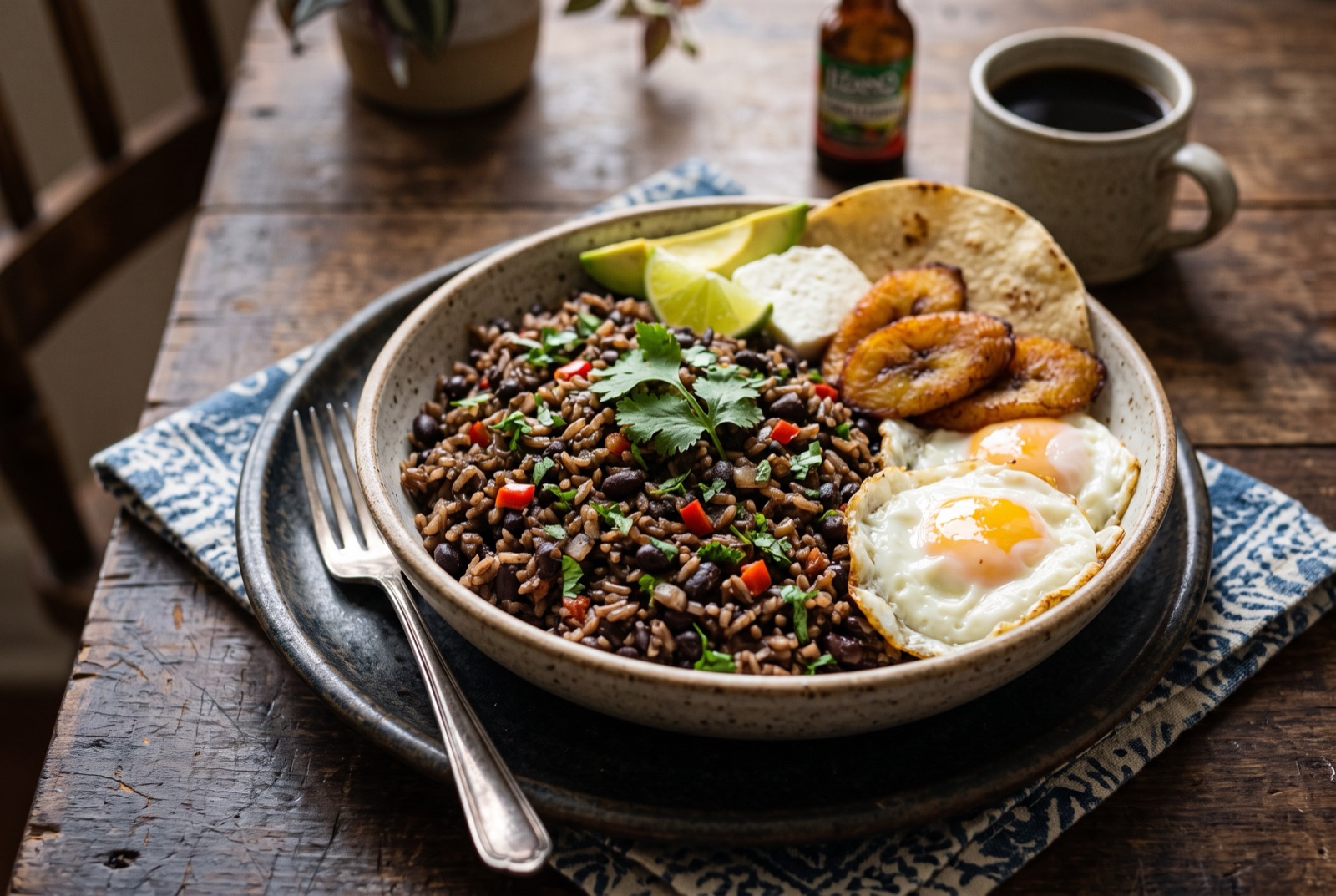
Gallo pinto is rice and black beans fried together the morning after both were cooked, and the whole trick is that the rice must be cold and dry. Hot fresh rice turns to paste; day-old rice separates into individual grains that pick up bean broth, onion, sweet pepper and Salsa Lizano without ever going mushy. The finished pan is speckled dark and light — that is what pinto means — smelling of coriander and faintly sweet from the Lizano, savoury rather than spicy, and soft rather than crisp. Costa Ricans eat it at breakfast with a fried egg, fried ripe plantain, natilla and a corn tortilla, and then quite happily again at dinner. It takes fifteen minutes if the rice and beans are already in the fridge, which in a Tico house they always are.

- Gate
- Costa RicaCentral Valley
- Prep
- 10 min
- Cook
- 15 min
- Total time
- 25 min
- Serves
- 4
- Status
- Easy
- Nutrition / serving · estimated
- Calories 380 kcal
- Protein 10 g
- Carbs 62 g
- Fat 10 g
- Fiber 8 g
- Sodium 560 mg
Why this recipe works.
- Built around day-old rice, the single detail that decides whether pinto is fluffy or gluey.
- Uses a measured splash of bean broth, not water, so the grains colour and season at the same time.
- Gives a genuine Lizano substitute for cooks who cannot find the bottle, with an honest note on what changes.
- Fifteen minutes start to finish, and it scales to a whole family without needing a bigger pan technique.
Ingredients.
12 itemsEquipment
- Large frying pan or wok
- Wooden spoon
- Sharp knife
Instructions.
Break up the rice
Tip the cold rice into a bowl and rub it between your fingers until every clump has separated into loose grains. Any lump you leave now will stay a lump in the finished pan.
Soften the aromatics
Heat the oil in a large pan over medium heat and cook the onion, sweet pepper, garlic and celery for about 6 minutes, stirring, until the onion is translucent and the kitchen smells sweet rather than sharp. Do not let them colour.
Warm the beans
Add the drained black beans and stir for 2 minutes until they are hot and glossy with oil. Crush a small spoonful of them against the side of the pan — that little bit of mashed bean helps the colour spread through the rice.
Add the rice and bean broth
Turn the heat to medium-high, add the rice, and pour in the bean liquid a couple of tablespoons at a time, folding after each addition. Stop when the grains are evenly tinted grey-purple and look glossy but still separate.
Tip If the pan looks wet, keep folding over the heat for another minute — the liquid should be absorbed, not pooling.
Season with Lizano
Pour in the Salsa Lizano and toss for 2 to 3 minutes until it has disappeared into the rice and the mixture smells faintly sweet and cumin-like. Taste and correct with salt and black pepper.
Finish with the herbs
Take the pan off the heat, fold through the coriander and spring onions, and let it sit for a minute so the herbs perfume the rice without wilting to brown. Serve hot, straight from the pan.
Tips from our kitchen.
- The rice must be cold, dry and at least a day old. If you only have fresh rice, spread it on a tray in the fridge for an hour uncovered so the surface starch dries out.
- Keep the bean-to-rice ratio around one to two. More beans and the pan turns heavy and wet instead of speckled.
- Add the bean cooking liquid a spoonful at a time. You want the rice tinted grey-purple and glossy, not soaked.
- Fry the onion and sweet pepper until they are soft and sweet-smelling, not browned — pinto is not meant to taste caramelised.
- Stir the coriander in off the heat at the very end so it stays green and perfumed rather than khaki.
- A knob of butter at the finish is not traditional in every house, but it makes reheated rice taste freshly cooked.
Substitutions.
- Salsa Lizano → 2 tbsp Worcestershire sauce mixed with 1 tsp ground cumin and 1 tsp brown sugar
- This gets close to the sweet-savoury tang. It is not the same — Lizano is thinner and more vegetal — but it is much better than leaving the pinto unseasoned. Latin grocers and online shops stock the real bottle cheaply.
- Black beans cooked from scratch → Two tins of black beans, undrained
- Use the liquid from the tin as your bean broth. Rinse nothing — that starchy liquid is what colours the rice.
- Culantro coyote → Extra fresh coriander leaf
- Culantro is far more pungent, so if you find it use one leaf where you would use a handful of coriander.
Variations.
- Pinto with natilla and egg
- The standard breakfast build: a fried egg on top, a spoon of natilla (thin cultured sour cream) on the side, and fried ripe plantain.
- Nicaraguan gallo pinto
- Small red beans instead of black, no Lizano, and often a heavier hand with oil. Plainer, and the subject of a long-running cross-border argument about ownership.
- Caribbean pinto
- On the Limón coast the rice and beans are cooked together in coconut milk with thyme and a whole Scotch bonnet, which makes a richer, sweeter, quite different dish.
Storage & reheating.
Gallo pinto keeps 3 days refrigerated in a sealed container. Reheat in a dry hot pan with a teaspoon of oil rather than in the microwave, which steams the grains soft. It freezes acceptably for a month but loses its separate-grain texture; if you plan to freeze, undercook slightly and add the coriander only after reheating.
Serve with
A fried egg, fried ripe plantain, natilla and warm corn tortillas — the full Tico breakfast plate.
The story behind Gallo Pinto.
Gallo pinto is the dish Costa Rica and Nicaragua have been arguing about for as long as either country has had a tourism board. Both eat it daily, both claim it, and both are probably describing an older Central American habit of stretching a small amount of beans across a larger amount of rice — a technique that appears wherever rice and beans grow side by side, from the Caribbean to West Africa, and that almost certainly travelled with enslaved Africans before it belonged to any modern nation. What is not in dispute is that the two versions are genuinely different. Nicaraguan pinto uses small red beans and stays plainer; Costa Rican pinto uses black beans and gets a decisive pour of Salsa Lizano, the thin brown vegetable sauce that has been bottled in the country since the 1920s and that gives the dish its slightly sweet, cumin-edged, almost Worcestershire-like tang.
The name means "spotted rooster", which nobody can explain to general satisfaction. The most common reading is simply visual: black beans scattered through white rice look like the mottled plumage of a speckled bird. Costa Rican Spanish is full of this kind of affectionate literalism, and the dish has never needed a grander origin story than that.
What matters more is how completely it saturates daily life. Gallo pinto is not a special-occasion food or a regional speciality; it is what a construction worker, a bank manager and a schoolchild all eat before eight in the morning. Sodas — the small family diners that serve most of the country's lunches — sell it in a standard breakfast set with egg, plantain, natilla and tortillas. Hotels serve it to tourists who often meet black beans at breakfast for the first time and are surprised how well the sweetness of fried plantain works against the salt. It is also thrift made permanent: a household cooks a pot of beans and a pot of rice, eats them separately at lunch, and turns the remainder into breakfast. The recipe below assumes that rhythm and tells you how to fake it if your fridge is empty.
Questions, answered.
Why does my gallo pinto turn out mushy?
Almost always because the rice was freshly cooked. Warm rice still holds surface moisture and starch, so it clumps and smears the moment it meets bean liquid. Use rice that has been refrigerated overnight, break the clumps apart with your fingers before it goes in the pan, and add bean broth one spoonful at a time rather than pouring it all in at once.
What is Salsa Lizano and do I really need it?
Salsa Lizano is a thin, light-brown Costa Rican condiment made from vegetables, spices and a little sugar, produced in the country since the 1920s and present on nearly every table there. It tastes faintly of cumin, tamarind and Worcestershire. Without it the dish is still rice and beans, but it is not recognisably Tico. Worcestershire sauce with cumin and a pinch of sugar is the best home substitute.
What is the difference between Costa Rican and Nicaraguan gallo pinto?
Costa Rican pinto uses black beans and is seasoned with Salsa Lizano, which gives it a slightly sweet, tangy flavour and a darker colour. Nicaraguan pinto uses small red beans, no Lizano, and tastes plainer and more directly of beans and onion. Both countries claim to have invented the dish and neither claim can be settled, since rice-and-bean frying predates both as national cuisines.
Is gallo pinto vegan?
The pan itself is, as long as you fry in oil rather than butter and check your condiment. Salsa Lizano contains no animal products, but Worcestershire sauce usually contains anchovies, so vegans substituting it should look for a vegan version. What makes a typical breakfast plate non-vegan are the additions around the pinto — fried egg and natilla — which are easy to leave off.
Can I eat gallo pinto at times other than breakfast?
Yes, and Costa Ricans do. It appears at dinner constantly and turns up beside grilled meat or eggs at any hour. Breakfast is simply where it is most ritualised, paired with plantain, natilla and coffee. Leftover pinto reheated in a pan with a fried egg on top is one of the most common quick suppers in the country.
You might also like.
All recipes →
Keep exploring Costa Rica.
Costa Rica has 9 more dishes in the atlas — Agua Dulce and Casado, and 7 more.
All Costa Rica recipes Rice recipes Black beans recipes Onion recipes breakfastsidevegetarianvegandairy freenut freeRecipe by The DishRoute Kitchen · published August 20, 2026 · updated August 20, 2026