Costa Rican Arroz con Pollo Tico.
Chicken and Rice
Arroz con pollo · say it: ah-ROSS kohn POH-yo TEE-koh
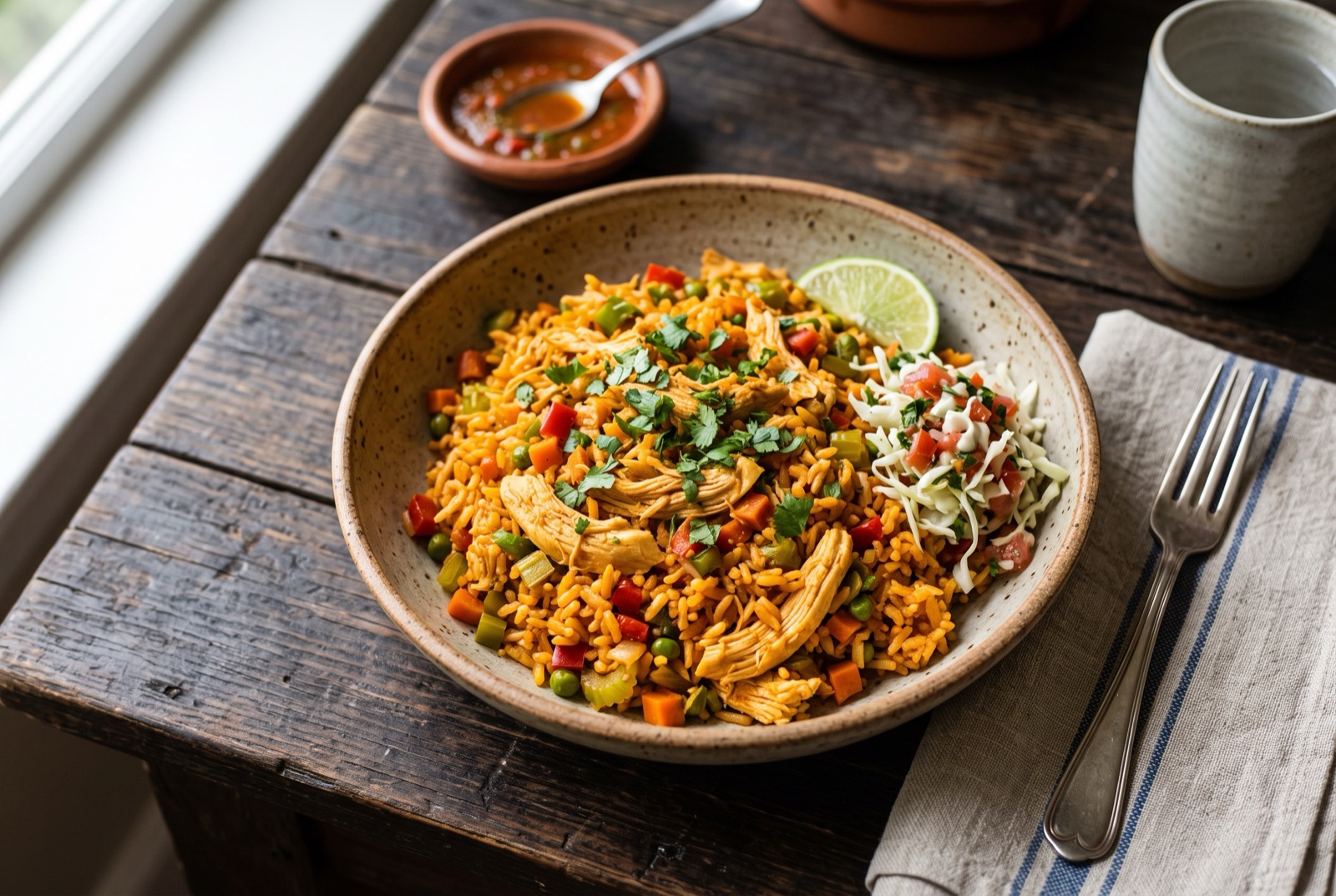
Costa Rican arroz con pollo is not the wet, saffron-scented Spanish version and not the Peruvian green one either. Here the chicken is poached first and shredded fine, the rice is cooked in that poaching broth with achiote until it turns a soft brick-orange, and the two are folded together with diced sweet pepper, carrot and peas at the end so nothing turns to mush. Salsa Lizano goes in twice, which gives the whole pan a gently sweet, cumin-edged tang that Ticos recognise instantly. It is mild, soft-textured, faintly sweet and deeply comforting — party food more than restaurant food, made in enormous batches for birthdays, first communions and any gathering where people will be standing up holding plates.

- Gate
- Costa RicaCentral Valley
- Prep
- 20 min
- Cook
- 45 min
- Total time
- 1 hr 15 min incl. 10 min rest
- Serves
- 4
- Status
- Easy
- Nutrition / serving · estimated
- Calories 610 kcal
- Protein 38 g
- Carbs 82 g
- Fat 14 g
- Fiber 5 g
- Sodium 690 mg
Why this recipe works.
- Poaching the chicken first gives you a real broth to cook the rice in, which is where most versions lose their flavour.
- The vegetables go in at the end so the peas stay green and the carrot keeps a bite instead of dissolving.
- Achiote is bloomed in oil rather than stirred in dry, so the colour is even and the rice never tastes chalky.
- Scales cleanly from a family dinner to a party pot without changing any of the timings.
Ingredients.
15 itemsFor the chicken
For the rice
To finish
Equipment
- Large heavy pan or Dutch oven with a lid
- Sieve or colander
- Two forks for shredding
Instructions.
Poach the chicken
Put the chicken, halved onion, bay leaf and smashed garlic in a pan with the water and a good pinch of salt. Bring to a bare simmer and cook 20 minutes, until the meat pulls apart with no pink at the thickest point. Lift the chicken out and strain the broth.
Shred and season
When the chicken is cool enough to handle, pull it into short fine threads with two forks. Toss the shreds with 1 tablespoon of the Salsa Lizano so the meat is seasoned before it ever meets the rice.
Bloom the achiote
Heat the oil in a heavy pan over medium heat and stir in the ground achiote. Within about 30 seconds the oil will turn a clear deep orange and smell faintly peppery — do not let it go past that or it turns bitter.
Fry the aromatics and rice
Add the diced sweet pepper, carrot and celery and cook 5 minutes until they soften and take on the orange colour. Tip in the rinsed rice and stir for 2 minutes until every grain is coated and looks glassy at the edges.
Cook the rice covered
Pour in 700 ml of the strained chicken broth and the remaining Salsa Lizano, season with salt, and bring to a boil. Cover, drop to the lowest heat and cook 15 minutes without lifting the lid or stirring.
Tip Lifting the lid releases the steam that is doing the cooking. Trust the timer.
Fold in chicken and peas, then rest
Take the pan off the heat, scatter over the shredded chicken and the peas, replace the lid and leave it for 10 minutes. The residual steam cooks the peas and warms the chicken while the grains firm up.
Fluff and finish
Fork everything through gently from the bottom up until the chicken, peas and rice are evenly mixed and the grains fall apart cleanly. Fold in the coriander, taste for salt and pepper, and serve straight away.
Tips from our kitchen.
- Shred the chicken by hand into short threads, not chunks. It should disappear into the rice rather than sit on top of it.
- Bloom the achiote in hot oil for about 30 seconds until the fat runs orange, then use that oil to fry the rice — dry powder stirred in late leaves a dusty taste.
- Use the poaching broth, measured, as your cooking liquid. Water makes a noticeably flatter pan.
- Rest the finished rice covered off the heat for 10 minutes before fluffing. This is where the grains firm up and separate.
- Fold the peas in during the rest rather than cooking them, so they stay bright and pop rather than turning grey.
- If you want a slightly moister party-style rice, stir in an extra spoonful of Lizano and a splash of broth just before serving.
Substitutions.
- Salsa Lizano → Worcestershire sauce with a pinch of cumin and brown sugar
- Gets the tang and sweetness, misses the vegetal note. Worth ordering the real bottle if you plan to cook Tico food more than once.
- Ground achiote → Sweet paprika plus a pinch of turmeric
- Achiote is mostly about colour with a faint peppery earthiness, so this gets you close visually. Achiote paste dissolved in the oil works even better.
- Chicken thighs → A whole chicken, poached and picked
- Traditional and cheaper, and the carcass gives a much better broth. Budget an extra 20 minutes of poaching and picking.
Variations.
- Party plate service
- The standard Costa Rican celebration presentation: a mound of rice topped with a swirl of mayonnaise, crisps and a few strips of sweet pepper.
- Arroz con camarones
- The same rice built with prawns instead of chicken, folded in during the final rest so they just turn opaque.
- Arroz con pollo con maíz dulce
- Some households add tinned sweetcorn along with the peas, which pushes the whole pan sweeter — common in Guanacaste, where corn is everywhere.
Storage & reheating.
Keeps 3 days refrigerated in a sealed container. Reheat covered with a tablespoon of broth or water per portion so the grains steam back to softness instead of drying out. It freezes well for up to 2 months, though the peas lose colour; add fresh peas after reheating if that bothers you.
Serve with
Fried ripe plantain, a lime-dressed cabbage salad, and crisps on the side if you are serving it the party way.
The story behind Costa Rican Arroz con Pollo Tico.
Arroz con pollo travelled from Spain to the Americas and then split into as many versions as there are countries, which is why arguing about the "correct" one is pointless. The Spanish original is a paella relative, cooked in one pan with the chicken on the bone. Latin American cooks kept the name and rebuilt the method around what their kitchens actually did. Costa Rica's answer is unusually specific: shred the chicken rather than serve pieces, colour the rice with achiote rather than saffron, keep it dry enough to eat with a fork while standing, and season with Salsa Lizano, a condiment that exists nowhere else and that Ticos abroad ask visitors to bring in their luggage.
That last detail is what makes the dish local rather than generic. Lizano has been produced in Costa Rica since the 1920s, a thin brown sauce of vegetables, spices and a little sugar, and its flavour sits somewhere between Worcestershire, tamarind and cumin. Poured into rice it does something no single spice does: it rounds the achiote's earthiness and adds a background sweetness that makes people go back for a second plate without being able to say why.
The social setting matters as much as the recipe. In Costa Rica arroz con pollo is celebration catering. It appears at children's birthdays alongside a bowl of crisps and a tray of small sandwiches, at office parties, at wakes and at any event where forty people need feeding cheaply and well. It is normally served with a garnish that looks strange to outsiders — a swirl of mayonnaise, some crisps, sometimes tinned beetroot or a lettuce leaf — because it is party food and party food is meant to look decorated. A soda will serve it at lunch with fried plantain and a cabbage salad, but its home is a folding table under a tarpaulin. Making it for four people at home is a slight distortion of scale; the technique below is written for a normal pan, but understand that its natural habitat is a pot the size of a bucket.
Questions, answered.
How is Costa Rican arroz con pollo different from other versions?
Three things set it apart: the chicken is poached and shredded into fine threads rather than served in bone-in pieces, the colour comes from achiote instead of saffron or tomato, and it is seasoned with Salsa Lizano, a Costa Rican condiment with a sweet, cumin-and-tamarind tang. The result is drier and milder than Spanish or Cuban versions and is eaten as party food more than as a restaurant dish.
Why is my rice sticky instead of separate?
Usually too much liquid or stirring after the lid goes on. Measure the broth rather than eyeballing it, keep the ratio at roughly one and a half parts liquid to one part rice by volume, and do not lift the lid or stir during the covered cooking. The ten-minute rest off the heat matters too — that is when the grains firm up and stop clinging.
Can I make arroz con pollo ahead for a party?
Yes, and it is genuinely better for it. Cook it a day ahead, cool it fast and refrigerate. Reheat in a covered oven dish at 160C with a few spoonfuls of extra broth for about 25 minutes, then fold through fresh coriander. Costa Rican caterers work exactly this way because the seasoning settles into the grains overnight.
What is achiote and where do I find it?
Achiote, also called annatto, is the seed of a Central American shrub used mainly as a natural colouring. It gives food a deep orange-red tone with a mild, slightly peppery, faintly earthy flavour. Latin grocers sell it as ground powder, as a compressed paste in blocks, or as whole seeds you steep in warm oil. Sweet paprika with a pinch of turmeric is a workable stand-in.
Is this dish spicy?
Not at all. Costa Rican cooking is famously mild and there is no chile in the pan. If you want heat, add it at the table with pickled chile panameño or a hot sauce, which is exactly how Ticos handle it. Keeping the rice itself mild is important because it is usually served to a crowd that includes small children.
You might also like.
All recipes →
Keep exploring Costa Rica.
Costa Rica has 9 more dishes in the atlas — Agua Dulce and Casado, and 7 more.
All Costa Rica recipes Chicken recipes Rice recipes Bell pepper recipes maingluten freedairy freenut freeRecipe by The DishRoute Kitchen · published August 20, 2026 · updated August 20, 2026