Ful Medames.
Egyptian Slow-Cooked Fava Beans
فول مدمس · Fūl mudammas · say it: fool meh-DAM-mes
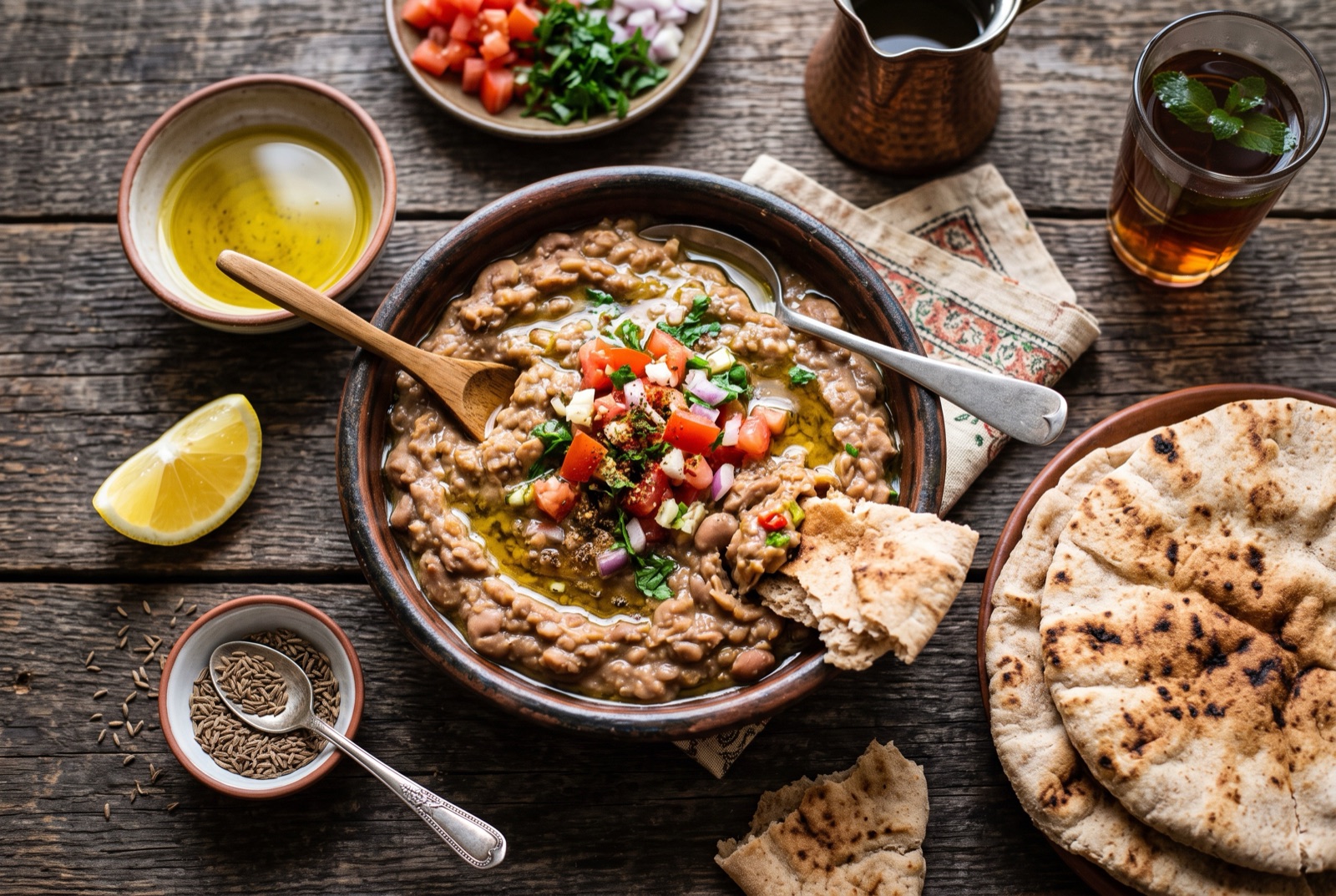
Ful medames is dried fava beans cooked long and slow until the skins soften and the insides turn to paste, served warm in a shallow bowl and finished by whoever is eating it. Nobody hands you a plated dish — you get beans, a bottle of olive oil, cut lemon, ground cumin, salt and a pile of chopped tomato and parsley, and you crush and season it yourself with the back of a spoon. The flavour is earthy and mild on its own, which is the point: the lemon and cumin do the talking, and the beans carry them. It is eaten before dawn during Ramadan, before work every other morning, and cold from the fridge at midnight, and it costs almost nothing.

- Gate
- Egypt
- Prep
- 10 min
- Cook
- 2 hr 30 min
- Total time
- 14 hr 40 min incl. 12 hr rest
- Serves
- 4
- Status
- Easy
- Nutrition / serving · estimated
- Calories 380 kcal
- Protein 19 g
- Carbs 46 g
- Fat 14 g
- Fiber 17 g
- Sugar 5 g
- Sodium 420 mg
Why this recipe works.
- Uses the low, long simmer that actually breaks the beans down, instead of boiling them hard and ending up with tough skins.
- Seasons at the table the way Egyptian ful shops do, so everyone gets the balance of lemon, cumin and oil they want.
- Includes the tinned-bean shortcut honestly, with what changes in texture, for mornings when there is no overnight pot.
- Scales from one bowl to a full table without changing anything but the pot size.
Ingredients.
10 itemsThe beans
To finish
Equipment
- Deep pot with a tight lid (or a pressure cooker)
- Potato masher or heavy spoon
- Sieve
Instructions.
Cook the beans
Drain the soaked beans, put them in a deep pot with the bay leaf and cover with 5 cm of fresh cold water. Bring to a boil, skim off the grey foam that rises, then drop the heat until the surface only trembles. Add no salt.
Tip That first skim matters — the foam carries the raw, slightly bitter note off the top of the pot.
Simmer until they slump
Cover loosely and cook for 2 to 2½ hours, topping up with hot water whenever the beans peek above the surface. They are ready when a bean squashes to paste between your fingers with no resistance and the skins have gone soft rather than papery.
Reduce and mash
Uncover and let the liquid cook down until it just covers the beans and looks cloudy and thick. Mash roughly half of them against the side of the pot with a masher, leaving the rest whole so the bowl still has texture.
Season the pot
Stir in the garlic paste, half the cumin and a good pinch of salt. Taste — the beans should now taste seasoned rather than flat, and slightly loose, since they will thicken in the bowl.
Serve and finish at the table
Spoon the hot beans into warmed shallow bowls. Pour a spool of olive oil over each, scatter the tomato and parsley, and put the lemon wedges, remaining cumin, salt and chilli flakes on the table so everyone crushes and seasons their own.
Tip Give each person a spoon with a flat back — the crushing is part of the meal, not preparation for it.
Tips from our kitchen.
- Soak the beans at least 12 hours. Under-soaked favas stay stubbornly firm no matter how long you cook them.
- Never salt the beans while they cook — salt firms the skins. Season only once they are soft.
- Keep the water barely trembling, not boiling. A rolling boil breaks the beans apart before the skins soften and the result is grainy.
- Mash only about half the beans. Ful is meant to have whole beans in it, not to be hummus.
- Warm the serving bowls. Ful cools fast and thickens as it does, and lukewarm beans taste dull.
- Buy small brown fava beans (ful hammam) rather than the large flat ones — they cook softer and are what Egyptian shops use.
Substitutions.
- Dried fava beans → Two 400 g tins of cooked fava beans
- Drain, rinse, and simmer for 15 minutes with a splash of water. The texture is looser and the flavour flatter, but it turns a nine-hour dish into a fifteen-minute one.
- Tahini → An extra spoonful of olive oil
- Tahini makes ful richer and slightly creamy. Plenty of Egyptian shops serve it without any at all.
- Fresh lemon → A splash of vinegar
- Less fragrant but it does the same job of cutting the earthiness. Add it a little at a time.
Variations.
- Ful bil tahina
- Whisk 3 tablespoons of tahini with lemon juice and a little water into a loose cream and stir it through the hot beans until they turn pale and glossy.
- Ful iskandarani
- The Alexandrian style: much more tomato, green pepper and cumin stirred into the pot rather than added on top, so the beans arrive already seasoned.
- Ful with eggs
- Top each bowl with a soft-boiled egg cut in half and let the yolk run into the beans. Standard in Egyptian cafés and the usual way to make it a full meal.
Storage & reheating.
Ful keeps 4 days refrigerated and improves overnight as the seasoning settles. It thickens considerably when cold — reheat gently with a splash of water, stirring until it loosens back to a spoonable paste. Freeze the plain cooked beans without seasoning for up to 3 months; add oil, lemon and cumin fresh after thawing, because those flavours fade in the freezer.
Serve with
Warm aish baladi for scooping, a plate of raw spring onions and pickles, and ta'ameya alongside if you are doing a proper Egyptian breakfast.
The story behind Ful Medames.
Fava beans have been eaten in Egypt for a very long time — they are among the crops found in the archaeological record of the Nile valley, and the dish's name comes from an old word meaning buried, which describes the cooking method rather than the beans. Traditionally ful was cooked in a qidra, a narrow-necked copper or clay pot, set overnight in the dying heat of a public oven or over embers. The narrow neck slowed evaporation so the beans stewed for eight or ten hours without drying out or being stirred, which is exactly what turns a hard bean into something spreadable.
That overnight pot became a public institution. Ful carts and small shops open before sunrise, and there is a whole vocabulary for how you want yours: plain with oil, with tahini stirred through, with butter, with tomato, mashed smooth or left rough, hot pepper or none. Regulars order in shorthand and get exactly what they expect. In Cairo the ful cart is close to what a coffee stand is elsewhere — a fixed point in the morning that people organise the rest of their day around.
Egypt does not have a monopoly on the dish. Sudan, Palestine, Syria, Lebanon and Yemen all make versions, and arguing about whose is definitive is not a fight worth entering. What is specifically Egyptian is the scale and the ritual: the volume of beans consumed daily, the expectation that you finish the seasoning yourself, and the fact that ful and ta'ameya arrive at the same table, in the same paper, at the same hour of the morning.
Questions, answered.
Do I have to soak the beans overnight?
For dried fava beans, yes — at least 12 hours, and 24 does no harm. Fava skins are thick and an unsoaked bean can simmer for hours and still be chalky in the centre. If you have no time, use tinned cooked favas instead; the result is looser but perfectly good.
Why are my beans still hard after hours of cooking?
Almost always one of three things: they were old, they were not soaked long enough, or salt or acid went into the pot early. Beans that have sat in a cupboard for two years may never soften. Add salt, lemon and tomato only at the end, once the beans have collapsed.
What is the difference between ful and hummus?
Different bean and different intention. Ful is fava beans, served warm, only partly mashed, with whole beans still in the bowl and seasoning added at the table. Hummus is chickpeas blended smooth with tahini into a cold or room-temperature dip. Egypt eats both, but ful is breakfast.
Can I make ful in a pressure cooker?
Yes, and many Egyptian households do. After soaking, cook the beans under pressure with plenty of water for about 25 minutes, then release, check for softness and simmer uncovered to reduce. You lose a little of the deep, slightly caramelised note of the long pot, but very little.
You might also like.
All recipes →
Keep exploring Egypt.
Egypt has 9 more dishes in the atlas — Aish Baladi and Fattah, and 7 more.
All Egypt recipes Chickpeas recipes Olive oil recipes Lemon recipes breakfastmainvegetarianvegandairy freegluten freenut freeRecipe by The DishRoute Kitchen · published August 20, 2026 · updated August 20, 2026