Koshari.
Egyptian Rice, Lentil and Pasta Bowl
كشري · Kushari · say it: KOO-sha-ree
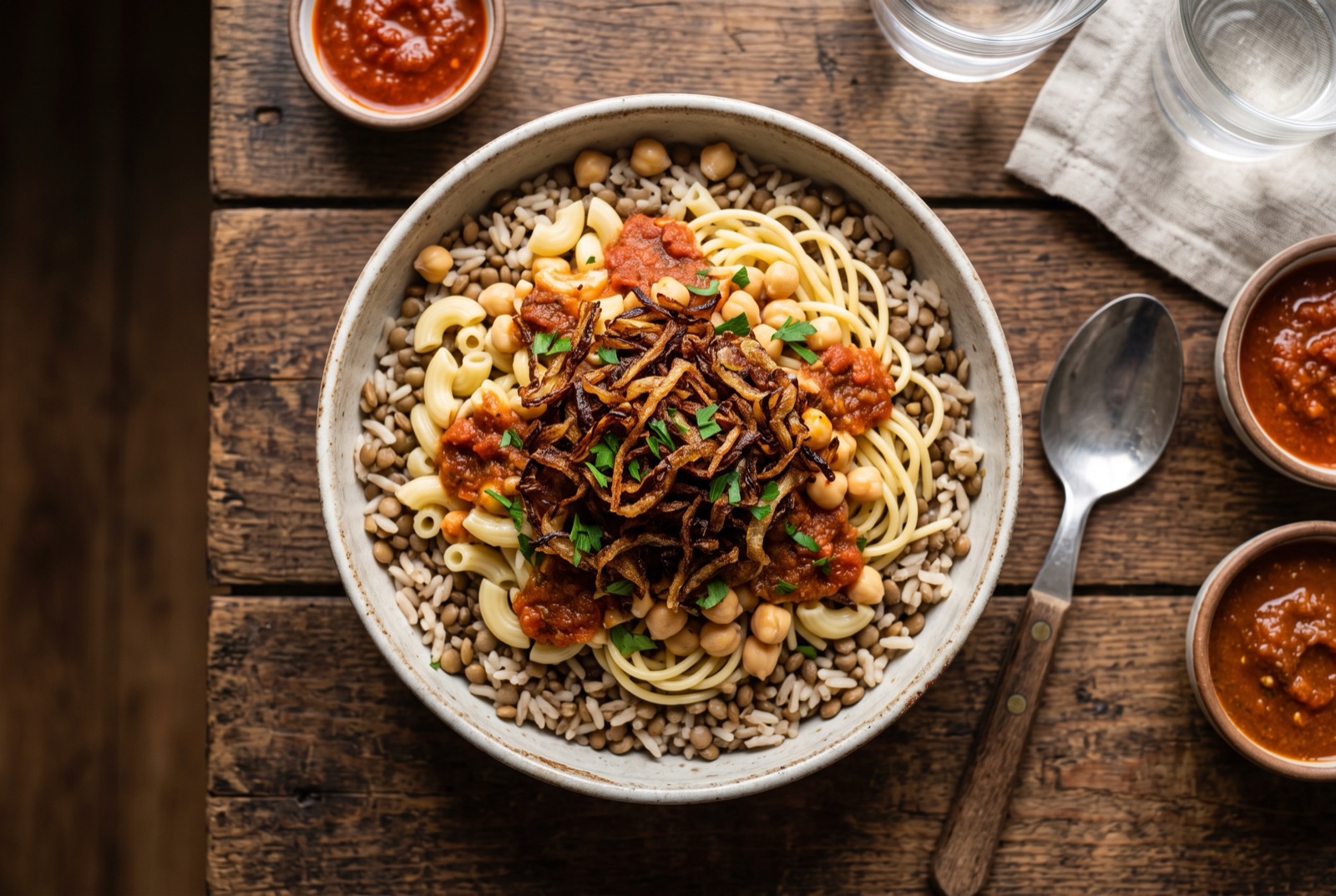
Koshari is a bowl of three starches that has no business tasting as good as it does. Rice and brown lentils are cooked in one pot, short macaroni in another, and the two are layered with chickpeas before three separate sauces go over the top: a cumin-heavy tomato sauce, a sharp garlic vinegar called dakka, and a shower of onions fried until they are dark and brittle. Every mouthful is soft, sharp, sweet and crunchy at once. It is street food, sold from counters where the assembly takes eleven seconds, and it is also the thing Egyptian families eat on a Tuesday because it costs almost nothing and feeds everyone. Made properly at home it takes an hour, most of which is unattended.

- Gate
- EgyptCairo
- Prep
- 20 min
- Cook
- 45 min
- Total time
- 1 hr 5 min
- Serves
- 4
- Status
- Medium
- Nutrition / serving · estimated
- Calories 640 kcal
- Protein 20 g
- Carbs 108 g
- Fat 14 g
- Fiber 15 g
- Sugar 9 g
- Sodium 720 mg
Why this recipe works.
- Cooks the rice and lentils together in one pot, the way koshari counters do, instead of boiling them separately and losing flavour.
- Fries the onions first and uses their oil for the tomato sauce, so nothing is wasted and the sauce carries the same sweetness.
- Gives all three sauces properly, including the dakka vinegar most home versions skip — it is what makes koshari taste like koshari.
- Every component can be made ahead and reheated, which is exactly how Egyptian households handle it.
Ingredients.
17 itemsFried onions
Rice and lentils
Tomato sauce
Garlic vinegar (dakka)
Equipment
- Large heavy pot with a lid
- Deep frying pan for the onions
- Slotted spoon
- Sieve
Instructions.
Fry the onions
Heat the oil in a deep pan over medium heat and fry 3 of sliced onions in two or three batches, stirring often. Pull each batch out with a slotted spoon when it is deep gold and the sizzling has quietened — they carry on darkening on the paper. Drain on kitchen paper and salt lightly. Keep 4 tablespoons of the onion oil.
Tip If the onions go from gold to brown in the pan, they will be bitter in the bowl. Take them out earlier than looks right.
Start the lentils
Put 200 g of rinsed brown lentils in a heavy pot with 700 ml water and bring to a simmer. Cook uncovered for about 15 minutes, until they are tender at the edge but still firm in the middle. Do not salt them yet.
Cook the rice with the lentils
Stir the rinsed rice, ground cumin and salt into the lentils, add enough hot water to sit 2 cm above the surface, and bring back to a boil. Cover, drop the heat to its lowest setting and cook for 15 minutes, then leave the lid on off the heat for another 10 minutes.
Tip Do not lift the lid during those 15 minutes. The steam trapped under it is what cooks the top layer of rice.
Make the tomato sauce
Warm 2 tablespoons of the reserved onion oil in a saucepan, add the crushed garlic and cumin and stir for 30 seconds, until the garlic smells sweet rather than raw. Pour in the passata, add the chilli flakes if using, and simmer for 15 minutes until it darkens and a spoon dragged through leaves a track. Stir in the vinegar and season firmly with salt.
Mix the dakka
Whisk the vinegar, grated garlic, cumin and a good pinch of salt in a small bowl and leave it to stand while you finish everything else. Twenty minutes takes the raw edge off the garlic.
Boil the pasta
Cook the macaroni in well-salted water until just tender, drain, and toss with a spoonful of the onion oil so it does not stick together while it waits.
Warm the chickpeas
Heat the drained chickpeas through in a small pan with a spoonful of the tomato sauce and a pinch of salt. Two minutes is enough — they only need to be hot.
Build the bowls
Fluff the rice and lentils with a fork and spoon them into bowls. Add a layer of macaroni, then chickpeas, then a ladle of hot tomato sauce. Finish with a generous handful of fried onions and pass the dakka at the table so everyone adds their own.
Tip Fold a few onions through the middle layer as well as piling them on top — this is how the good Cairo counters do it.
Tips from our kitchen.
- Slice the onions thin and even, and dry them on kitchen paper before frying — wet onions steam instead of crisping and stay chewy.
- Fry the onions in batches and pull them out when they are deep gold, not brown. They keep darkening off the heat and burnt onion turns the whole bowl bitter.
- Use brown or green lentils, never red. Red lentils dissolve completely and you end up with rice porridge.
- Rinse the rice until the water runs clear, or the finished bowl clumps instead of staying loose.
- Make the garlic vinegar first so it has time to sit — raw garlic in vinegar mellows in twenty minutes and tastes rounder.
- Salt the tomato sauce harder than feels right. It has to season three bland starches, not just itself.
Substitutions.
- Short macaroni (ditalini or elbows) → Any small pasta shape, or broken spaghetti
- Koshari counters use small tubes because they fall between the rice grains. Large shapes sit on top and the bowl loses its mix.
- Brown lentils → Green (Puy-style) lentils
- They hold their shape even better. Cooking time is close, but check them five minutes early.
- Vermicelli in the rice → Leave it out
- Some Cairo shops toast a handful of broken vermicelli in the rice, some do not. It adds a nutty note and is entirely optional.
Variations.
- Koshari with hot dakka
- Blend a few dried chillies or a spoon of chilli paste into the garlic vinegar. This is the shatta version served on request at most counters.
- Extra-onion koshari
- Double the fried onions and fold half through the rice and lentils before serving, so the crunch runs all the way through the bowl instead of sitting on top.
- Koshari with pasta only
- A common home shortcut on a weeknight: skip the chickpeas and macaroni, keep rice, lentils and all three sauces. Faster, and still recognisably the same dish.
Storage & reheating.
Store the components separately and koshari keeps for three days. Rice and lentils reheat well with a splash of water under a lid; tomato sauce reheats in a pan; fried onions must be kept in an airtight container at room temperature or they go soft in the fridge. Assembled koshari does not keep — the onions collapse and the starches turn pasty within an hour. If you are cooking ahead for a crowd, prepare everything and assemble at the table.
Serve with
A bowl of pickled vegetables (torshi) on the side, and extra dakka vinegar at the table so everyone can sharpen their own portion.
The story behind Koshari.
Koshari is younger than most Egyptian dishes and its parentage is genuinely mixed. The rice-and-lentil base is a Middle Eastern and South Asian idea — the name is usually traced to the Hindi khichri, a rice-and-lentil dish that likely arrived with British Indian troops stationed in Egypt in the nineteenth century. The macaroni is Italian, brought by the large Italian community in Alexandria and Cairo, and the tomato sauce is a New World ingredient that had by then become the backbone of Mediterranean cooking. Somewhere in late-Ottoman Cairo those three traditions landed in the same bowl, and by the early twentieth century koshari was being sold from carts.
What turned it into a national dish was economics. Koshari is protein and carbohydrate assembled from the cheapest shelf-stable goods in the country, it is entirely plant-based without ever presenting itself as vegetarian food, and it scales to industrial quantities without losing anything. Dedicated koshari shops — some of them now more than a century old and fiercely defended by regulars — serve nothing else, and the ritual is fixed: you pick a size, the server layers it in front of you with a speed that looks careless and is not, and the sauces go on at the counter or at the table.
Egyptians argue about koshari the way other countries argue about barbecue. How much vinegar. Whether the lentils should keep their shape or start to blur into the rice. Whether the sauce should be hot or merely warm with cumin. Whether the fried onions should go in the middle as well as on top — the correct answer, for anyone asking, is both. The one point of agreement is that the onions must be genuinely crisp, because they are what stops the bowl from being a pile of soft things.
Questions, answered.
Why did my fried onions turn soft instead of crisp?
Either they were sliced too thick, they went into oil that was not hot enough, or the pan was crowded so they steamed in their own moisture. Slice thin, pat the slices dry, use oil at about 170°C, and fry in batches with room to move. Drain them on paper and they will crisp further as they cool.
Can I make koshari ahead of time?
Yes, but only as separate components. Cook the rice and lentils, the pasta, the tomato sauce and the onions up to three days in advance and keep them apart — onions at room temperature in a sealed container, everything else refrigerated. Assemble only when you are ready to eat, because a built bowl goes soggy within the hour.
Is koshari vegan?
Yes, in its standard form. Rice, lentils, pasta, chickpeas, tomato, onion, garlic and vinegar contain no animal products, and the dish is naturally vegan without being marketed that way in Egypt. Check only that your pasta is egg-free, which most dried macaroni is.
What is dakka and can I skip it?
Dakka is the garlic-vinegar sauce spooned over koshari at the table — vinegar, crushed garlic, a little cumin and sometimes chilli. You can skip it, but you should not: without acid the bowl is three soft starches and a sweet tomato sauce, and it tastes flat by the third mouthful.
What kind of lentils should I use?
Brown or green lentils, whole and unhulled, so they stay intact through cooking. Red or split lentils break down into purée within fifteen minutes, which is right for soup and wrong for koshari — you want distinct lentils among the rice grains.
You might also like.
All recipes →
Keep exploring Egypt.
Egypt has 9 more dishes in the atlas — Aish Baladi and Fattah, and 7 more.
All Egypt recipes Rice recipes Lentils recipes Pasta recipes mainstreet foodvegetarianvegandairy freenut freeRecipe by The DishRoute Kitchen · published August 20, 2026 · updated August 20, 2026