Sauce Arachide.
Ivorian Groundnut Stew
Sauce arachide · say it: sohs ah-rah-SHEED
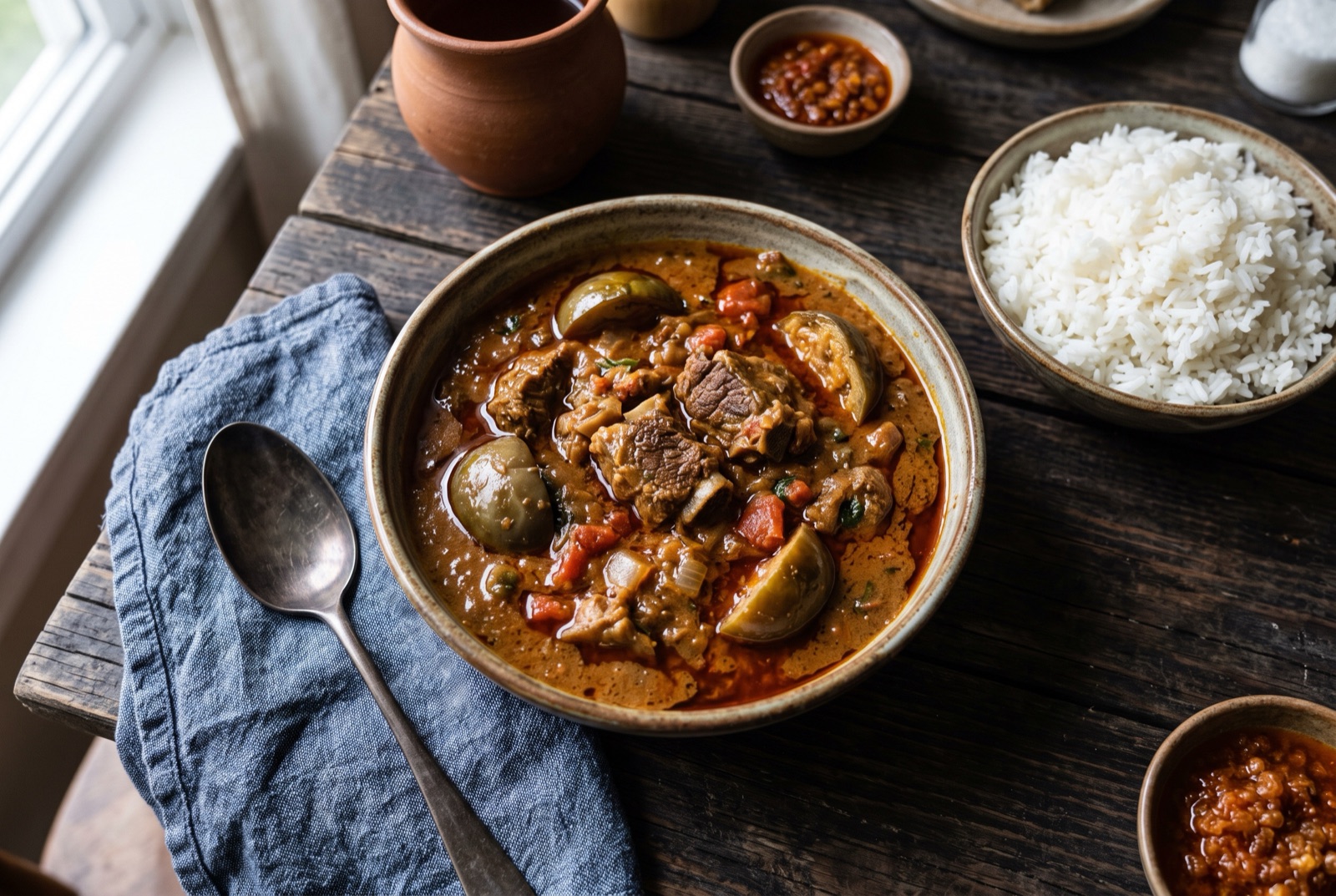
Sauce arachide is a groundnut stew: peanut paste whisked into stock, simmered with tomato, onion, ginger and chilli, and cooked with beef or fish until it thickens and a layer of nut oil breaks free at the top. It tastes savoury and deeply nutty, with a slow chilli heat and enough acidity from the tomato to keep the richness in check — nothing about it resembles a sweet peanut sauce. Aubergine goes in to soften and thicken, and okra sometimes joins it. Served over white rice, it is one of the most-cooked dishes in Ivorian homes, cheap enough for any weekday and substantial enough to need nothing beside it. The one rule is patience at the end, because undercooked groundnut paste tastes raw and pasty.

- Gate
- Ivory CoastNationwide
- Prep
- 25 min
- Cook
- 1 hr 15 min
- Total time
- 1 hr 40 min
- Serves
- 4
- Status
- Medium
- Nutrition / serving · estimated
- Calories 690 kcal
- Protein 43 g
- Carbs 22 g
- Fat 48 g
- Fiber 7 g
- Sodium 780 mg
Why this recipe works.
- Tempers the groundnut paste with hot stock first, so it disperses smoothly instead of seizing into lumps.
- Cooks long enough to lose the raw peanut-butter taste, with a visual cue for when that happens.
- Keeps the tomato ratio high enough that the sauce stays balanced rather than cloying.
- Adapts easily to fish or a meat-free pot without changing the method.
Ingredients.
13 itemsFor the pot
For the sauce
To season
Equipment
- Heavy-based pot or Dutch oven
- Whisk
- Wooden spoon
Instructions.
Brown the beef
Heat the oil in a heavy pot until it shimmers, then brown 600 g of beef in two batches until each cube has a dark crust on at least two sides. Lift the meat out and set it aside; crowding the pan here gives you grey meat and no fond.
Start the base
Drop the chopped onion into the same pot and cook until it turns translucent and picks up the brown residue from the base, about 6 minutes. Add the ginger and garlic and stir for a minute, until the raw garlic smell gives way to something sweeter.
Cook down the tomato
Stir in the tomato paste and cook for 2 minutes, until it darkens from bright red to brick. Pour in the blended tomato and simmer for 10 minutes, until the mixture has reduced by about a third and no longer smells sharp and raw.
Temper the groundnut paste
Whisk the groundnut paste in a bowl with 300 ml of the hot stock, adding it gradually, until you have a smooth loose cream with no lumps at all. Pour it into the pot with the rest of the stock and stir until the sauce is uniformly beige-orange.
Tip Adding the liquid in stages is what keeps it smooth. Dumping it in all at once makes the paste seize.
Simmer the sauce
Return the beef, add the whole chilli and the sliced onion, and simmer uncovered for 45 minutes, stirring along the bottom every 5 minutes. Add the aubergine after 25 minutes and the okra, if using, for the last 8.
Tip Keep it at a lazy blip. A rolling boil splits the sauce into oil and grit.
Look for the oil
The sauce is done when it coats the back of a spoon, slides off slowly, and a thin orange slick has gathered on the surface. Season with salt now, stir the oil back through, and serve over rice with the chilli left whole for anyone who wants it.
Tips from our kitchen.
- Use 100% groundnut paste or natural peanut butter with no added sugar, salt or palm fat. Sweetened supermarket spreads turn the sauce into something closer to satay, which it is not.
- Whisk the paste with a ladle of hot stock in a separate bowl before it goes in the pot. Dropped in whole, it clumps and never fully disperses.
- Stir along the bottom every few minutes once the paste is in — groundnut sauce catches and scorches faster than almost anything else, and burnt paste ruins the whole pot.
- If the sauce looks split and greasy rather than glossy, it has boiled too hard. Drop the heat and whisk in a splash of hot water to bring it back together.
- Aubergine is not optional in spirit. As it collapses it thickens the sauce and adds a mild bitterness that stops the richness from flattening the palate.
- Taste for salt only after the oil rises, because the flavour concentrates sharply in the final fifteen minutes.
Substitutions.
- Beef chuck → Smoked fish, chicken thighs or goat
- All are standard. Smoked fish goes in for the last 15 minutes only; chicken thighs need about 25 minutes rather than 45.
- Groundnut paste → Natural peanut butter, thinned with stock
- Practically identical, provided it contains nothing but peanuts. Check the label for sugar before you buy.
- African aubergine → Regular aubergine cut into chunks, or courgette
- Small round African aubergines are more bitter and firmer. Ordinary aubergine works, just add it 10 minutes later so it does not disintegrate.
Variations.
- Sauce arachide au poisson fumé
- Built on smoked fish instead of beef, which pushes the sauce smokier and lets it cook in half the time.
- With okra
- A handful of sliced okra added near the end, giving the sauce more body and a slight silkiness against the nut paste.
- Vegetarian groundnut sauce
- Sweet potato, aubergine and greens in a strong vegetable stock, with extra tomato to compensate for the missing savoury depth.
Storage & reheating.
Keeps 4 days refrigerated and thickens considerably as it cools — expect to loosen it with hot water or stock when reheating. Warm it slowly and stir often, because the settled paste at the bottom scorches immediately over high heat. It freezes for 3 months without splitting, which makes it a useful thing to double. Rice is better cooked fresh than frozen with the sauce.
Serve with
Plain white rice, or foutou banane if you want the heavier Ivorian pairing.
The story behind Sauce Arachide.
Groundnuts are among the oldest crops in the West African field system, and the sauce made from them stretches across the entire Sahel and coast in dozens of local forms: maafe in Mali and Senegal, tigadèguèna in Bambara, groundnut soup in Ghana and Nigeria, sauce arachide in French-speaking countries including Côte d'Ivoire. The plant itself came from South America through the Atlantic trade, but it landed in a region already cooking with oily seeds and nut pastes — egusi, sesame, palm kernel — so it slotted straight into an existing technique rather than creating a new one.
Because of that spread, no single country owns it. An Ivorian cook and a Malian cook making groundnut sauce on the same day would recognise each other's pot immediately, and the differences are small: what protein goes in, whether the tomato is fresh or concentrated, whether the sauce is served over rice, over fonio, or with a pounded starch. Anyone insisting on a definitive national version is arguing about a dish that predates the borders. In Côte d'Ivoire it is most often eaten over rice, made with beef or smoked fish, and pushed a little more toward chilli heat than its Sahelian relatives.
What is common everywhere is the technique and its failure mode. Raw groundnut paste is starchy and mealy, and it needs a long, slow simmer for that texture to break down and the oil to separate. Rushed, the sauce is gritty and tastes like nothing so much as thinned peanut butter. Done properly, the paste dissolves into the stock, the surface goes glossy with a slick of orange oil, and the flavour turns roasted and savoury. Ivorian cooks judge it by that oil and by the spoon: when the sauce coats the back of one and slides slowly off, it is ready to eat.
Questions, answered.
Is sauce arachide sweet?
Not at all. It is a savoury stew seasoned with onion, ginger, tomato and chilli, and the groundnut paste behaves more like a thickener and a source of richness than a flavouring. Any sweetness usually means sweetened peanut butter was used instead of pure groundnut paste. Buy a jar whose only ingredient is peanuts.
Why does my groundnut sauce taste gritty?
It has not cooked long enough. Raw groundnut paste is starchy and mealy, and it needs at least 30 to 40 minutes of gentle simmering for that texture to dissolve into the liquid. The sauce is ready when it turns glossy, coats a spoon, and a thin layer of oil has separated onto the surface.
How is this different from Senegalese maafe?
They are versions of the same regional dish rather than different recipes. Maafe often uses more tomato paste and frequently includes root vegetables such as cassava and sweet potato, and is strongly associated with Mali and Senegal. Ivorian sauce arachide tends to be hotter with chilli, is commonly served over rice, and often includes small aubergines. Neither is the original.
Can I make it without peanuts because of an allergy?
Not really — the groundnut paste is the entire structure of the sauce, not a garnish. Sunflower seed butter or tahini will produce a thick savoury stew with a similar consistency, but the flavour is clearly different and it should be described as something else. If cooking for an allergic guest, sauce claire or kedjenou are safer Ivorian choices.
What is the oil floating on top?
Natural peanut oil released from the paste as it cooks, along with any palm oil used at the start. It is a sign the sauce is properly done rather than a mistake. Stir it back in before serving; skimming it off strips out flavour and leaves the sauce dull.
You might also like.
All recipes →
Keep exploring Ivory Coast.
Ivory Coast has 9 more dishes in the atlas — Alloco and Attiéké, and 7 more.
All Ivory Coast recipes Beef chuck recipes Tomato recipes Eggplant recipes maingluten freedairy freehalal friendlyRecipe by The DishRoute Kitchen · published August 20, 2026 · updated August 20, 2026