Sauce Graine.
Ivorian Palm Nut Stew
Sauce graine · say it: sohs GREN
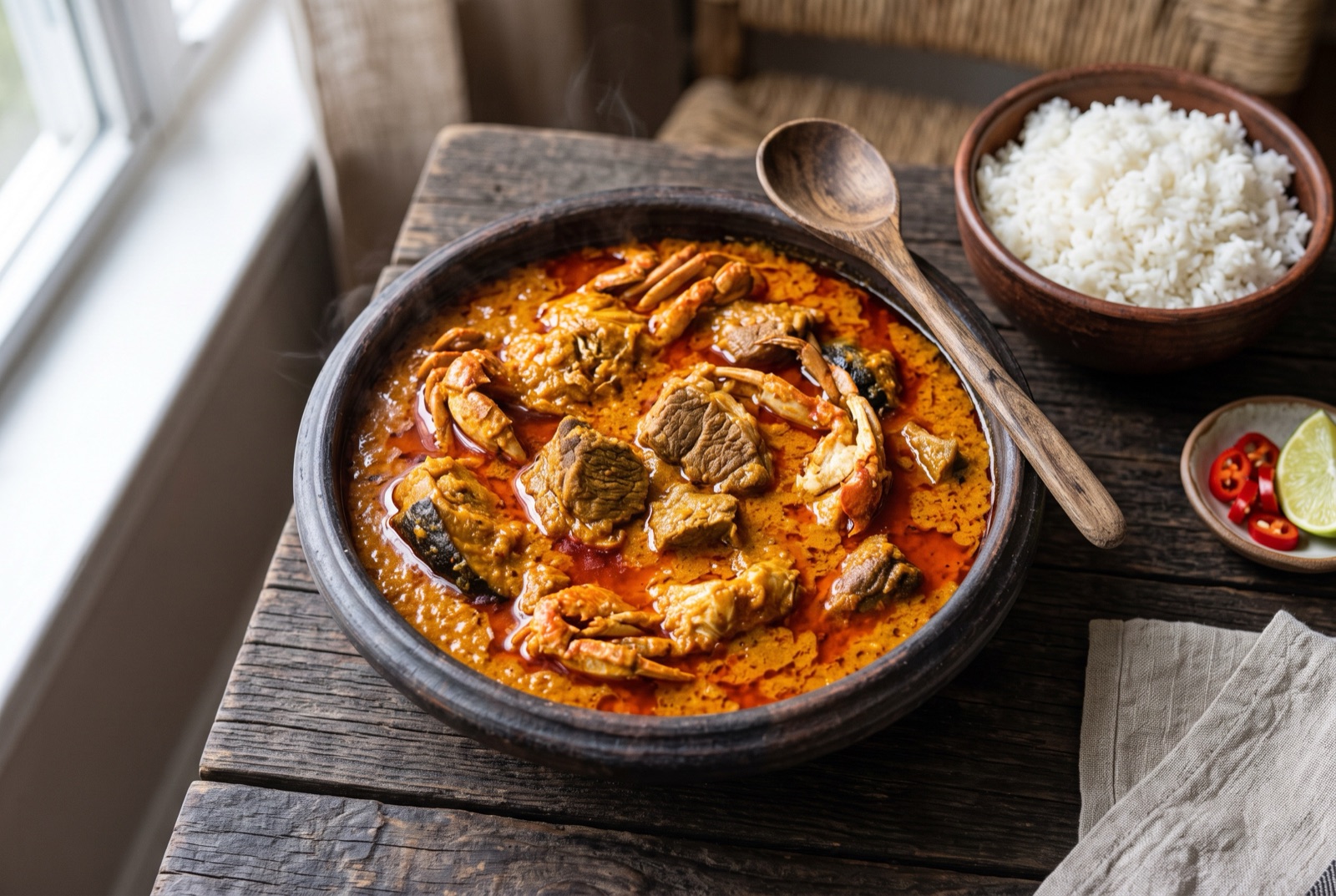
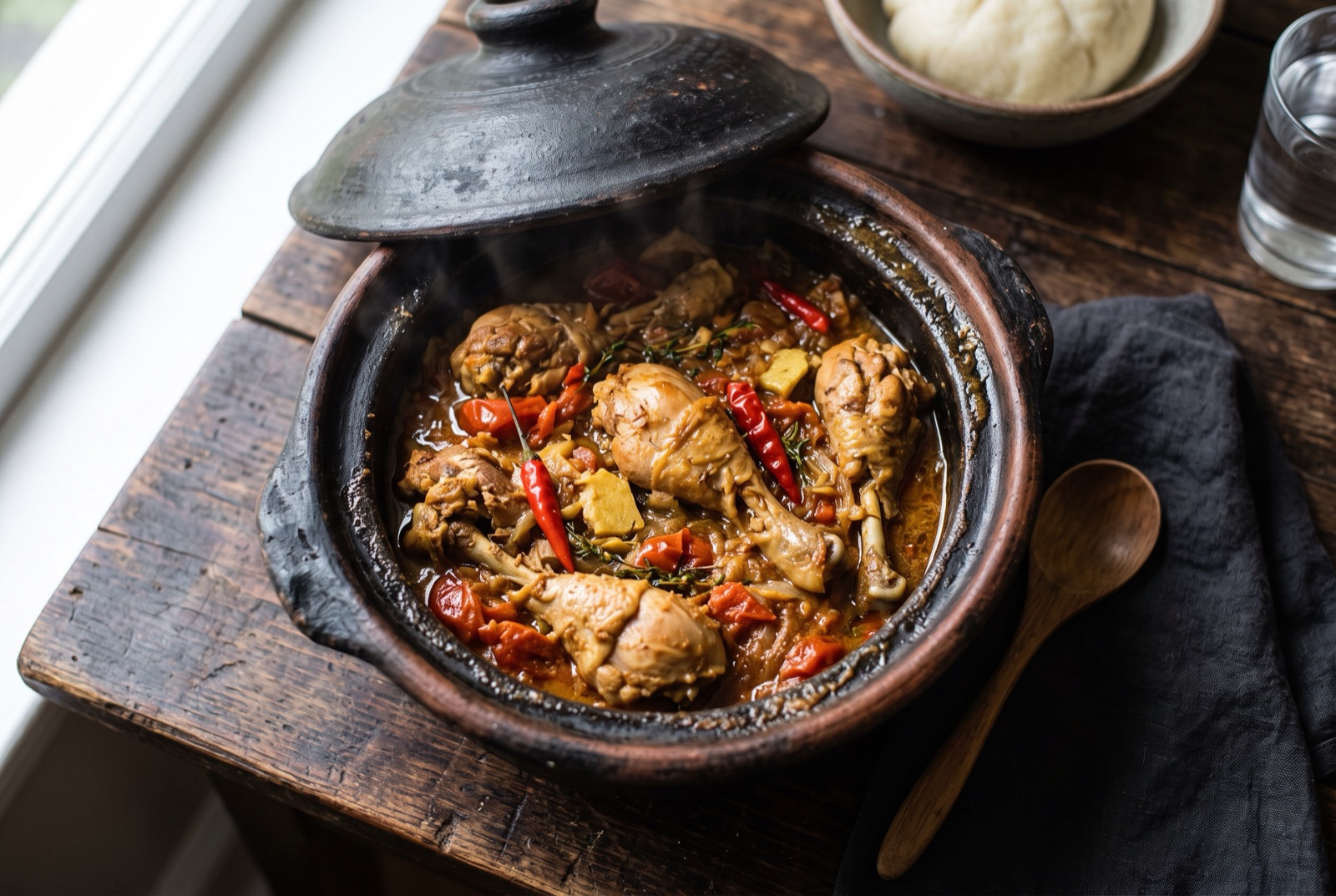
Sauce graine is what you get when palm fruit is boiled, pounded and pressed for its pulp, then cooked slowly with meat and seafood until the fat separates and floats. The flavour is unlike anything in European cooking: dense, savoury, faintly fruity and slightly resinous, with a smokiness from dried fish running underneath and a long chilli warmth at the end. Colour is the giveaway — a deep brick orange, with a clear slick of oil on the surface that tells you the sauce is finished. It is not a delicate dish and it is not meant to be; it goes over white rice or beside a ball of foutou, in generous ladlefuls, and one bowl is a whole meal. Canned palm nut pulp makes it entirely achievable outside West Africa.

- Gate
- Ivory CoastSouthern forest belt
- Prep
- 30 min
- Cook
- 1 hr 25 min
- Total time
- 1 hr 55 min
- Serves
- 6
- Status
- Medium
- Nutrition / serving · estimated
- Calories 620 kcal
- Protein 38 g
- Carbs 18 g
- Fat 44 g
- Fiber 5 g
- Sodium 940 mg
Why this recipe works.
- Built around canned palm pulp with clear instructions for fresh nuts, so the dish is possible wherever you live.
- Waits for the oil to break and rise — the actual doneness signal, and the step most recipes skip.
- Layers the proteins by cooking time so the beef is tender, the fish intact and the crab not overcooked.
- Balances the richness with okra and aubergine rather than letting the sauce sit heavy on the plate.
Ingredients.
14 itemsFor the sauce
For the pot
To season
Equipment
- Large heavy pot
- Fine sieve
- Ladle
Instructions.
Get the beef going
Put 600 g of beef in a heavy pot with the chopped onion, half the ginger and garlic, a good pinch of salt and 400 ml of the stock. Cover and simmer for 40 minutes, until a cube gives easily when pressed with a spoon but has not started to shred.
Loosen the palm pulp
Scrape the palm nut concentrate into a bowl and whisk in the remaining stock a little at a time until it is smooth and pourable with no grainy lumps. Pass it through a sieve if the tin has left any fibre behind.
Tip Doing this off the heat matters — dropping thick concentrate straight into a hot pot scorches it before it dissolves.
Build the sauce
Pour the loosened pulp into the pot with the beef, add the blended tomato, the rest of the ginger and garlic, and the whole chilli. Bring to a simmer and cook uncovered for 30 minutes, stirring every 10 minutes and scraping the base.
Tip The colour shifts from dull orange to a deeper brick red as it reduces. That change is the first sign it is going the right way.
Wait for the oil to break
Keep simmering until a clear orange film gathers across the surface and pools around the rim of the pot, usually another 10 to 15 minutes. Until you see it, the sauce still tastes chalky and unfinished — this is the step to be patient with.
Add fish, crab and vegetables
Slide in the smoked fish, the crab and the aubergine, and simmer for 10 minutes. Add the okra for the final 8 minutes, just long enough to turn bright green and lose its raw squeak while keeping some bite.
Season and rest the pot
Taste and correct with salt and the stock cube if using, remembering that the smoked fish has already salted the sauce. Take the pot off the heat and leave it to settle for 5 minutes, then stir the surface oil back through and ladle over rice or beside foutou.
Tips from our kitchen.
- Buy palm nut concentrate, not palm oil — they are different products. The tin should list palm fruit pulp and water, and the contents look like thick orange purée.
- Rinse and dilute the concentrate before it goes near heat. Straight from the tin it is far too thick and will catch on the base before the flavours have time to meet.
- The oil separating out is not a fault. When an orange film gathers at the surface and around the edges, the sauce is cooked; before that it tastes flat and slightly raw.
- Soak smoked fish in hot water for ten minutes and pick out the bones before adding it, or you will be finding them all through dinner.
- Add okra in the last ten minutes only. Cooked longer it dissolves and makes the sauce ropy instead of adding body.
- Season at the very end. The sauce reduces by a third, and smoked fish and stock cubes both bring salt of their own.
Substitutions.
- Canned palm nut concentrate → 1.5 kg fresh palm nuts, boiled 40 minutes, pounded and strained
- Fresher and fruitier if you can find them, though it adds well over an hour of work. There is no non-palm substitute — the pulp is the dish.
- Smoked fish → Smoked mackerel fillet, or two tablespoons of dried shrimp
- Smoked mackerel is the easiest supermarket stand-in and gives a similar oily smokiness, though it breaks up more readily.
- Crab → Large prawns in the shell, added in the last 5 minutes
- Shell-on is what matters. Peeled prawns give you the protein but none of the sweetness the shells release into the sauce.
- Beef chuck → Goat shoulder or oxtail
- Both are common in Ivorian pots. Oxtail needs an extra 45 minutes of simmering before the palm pulp goes in.
Variations.
- Sauce graine aux escargots
- Made with large forest snails, which are widely eaten in southern Côte d'Ivoire and give the sauce a firmer, chewier bite.
- All-seafood graine
- Crab, prawns and smoked fish with no red meat, simmered for a shorter time — lighter, sweeter, and common along the lagoons.
- Sauce graine with dried okra
- Northern-leaning version thickened with ground dried okra instead of fresh, which gives a denser sauce that clings to foutou.
Storage & reheating.
Refrigerated in a covered container the sauce keeps 4 days and the flavour deepens noticeably by the second. The palm fat sets into an orange cap on top when cold; stir it back in as it warms rather than skimming it off, because that is where much of the flavour lives. Reheat gently to a bare simmer. It freezes for 3 months, though crab is best removed before freezing and added fresh on reheating.
Serve with
White rice, foutou banane or attiéké — and a bowl for the crab shells.
The story behind Sauce Graine.
The oil palm grows across the humid belt of West and Central Africa, and its fruit has fed the region for thousands of years — archaeological evidence of palm oil use in the area goes back several millennia. Sauce graine uses the whole fruit rather than the extracted oil: the nuts are boiled until the orange flesh softens, pounded in a mortar to loosen it from the hard kernel, then kneaded with hot water and strained, producing a thick coloured liquid that is simmered down into sauce. Nothing is wasted, and the kernels are set aside for other uses.
Every country along that belt has its own version, and the family resemblance is obvious once you see them side by side: banga soup in Nigeria, abenkwan or palm nut soup in Ghana, moambe further south in Congo and Angola. Ivorian sauce graine sits within that family rather than apart from it, distinguished mostly by what goes in — a mix of beef, smoked fish and crab in the same pot is very characteristic here — and by what it is served with, since foutou banane and attiéké are Ivorian company that the others do not keep.
In Côte d'Ivoire the sauce carries some weight beyond dinner. It is Sunday food and celebration food, cooked in quantity because it takes real time, and the version with crab in the shell is the one you make when people are coming. Cracking the crab at the table with your fingers is part of the experience, and the sauce is deliberately loose enough to spoon over a starch rather than thick enough to stand alone. Outside the region, canned palm fruit concentrate — sold as noix de palme, palm soup base or banga — reduces a long morning of boiling and pounding to opening a tin, and while the fresh version has a brighter fruitiness, the canned one makes a genuinely good sauce.
Questions, answered.
What are palm nuts and where do I buy them?
They are the fruit of the African oil palm — plum-sized, bright orange, with a fibrous flesh around a hard kernel. Fresh ones appear in African markets, but for home cooking most people buy the canned pulp sold as palm nut concentrate, noix de palme, banga soup base or palm soup cream. African and Caribbean grocers stock it, and it keeps indefinitely in the tin.
Is sauce graine the same as palm nut soup or banga soup?
They are close relatives built from the same palm fruit pulp. Ghanaian abenkwan is usually thinner and served as a soup with fufu; Nigerian banga soup is seasoned with a distinct spice mix including beletientien and ataiko. Ivorian sauce graine tends to combine beef, smoked fish and crab in one pot and is eaten over rice or foutou. No version is a corruption of the others.
Why has oil risen to the top of my sauce?
That is exactly what should happen. Palm pulp is naturally very fatty, and as the sauce reduces the fat separates and gathers on the surface as a clear orange layer. It signals that the sauce is properly cooked. Stir it back through before serving rather than skimming it away.
Can I make sauce graine without meat?
Yes, though it will taste noticeably different. Build it with aubergine, okra, mushrooms and plenty of onion, and lean on a strong vegetable stock, since smoked fish is doing most of the savoury work in the standard version. A spoonful of fermented locust bean paste, if you can find it, restores some of that depth.
How thick should the finished sauce be?
Loose enough to pour off a ladle in a steady stream, roughly the consistency of single cream, not a thick paste. It is meant to be spooned generously over rice or foutou and soak in. If it has reduced past that point, whisk in a little hot stock or water and bring it back to a simmer.
You might also like.
All recipes →
Keep exploring Ivory Coast.
Ivory Coast has 9 more dishes in the atlas — Alloco and Attiéké, and 7 more.
Recipe by The DishRoute Kitchen · published August 20, 2026 · updated August 20, 2026