Meorav Yerushalmi.
Jerusalem Mixed Grill
מעורב ירושלמי · Me'orav Yerushalmi · say it: meh-oh-RAHV yeh-roo-shahl-MEE
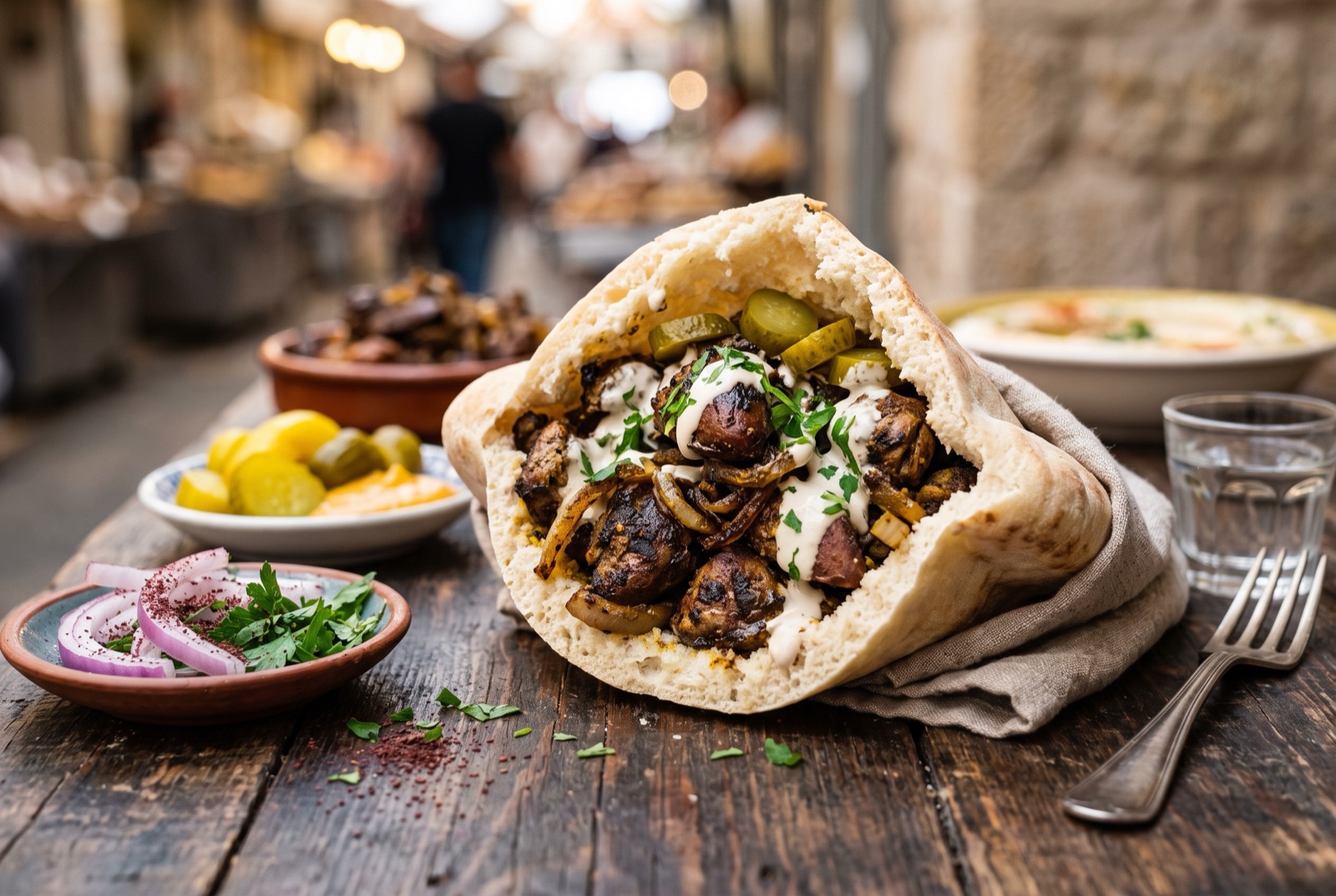
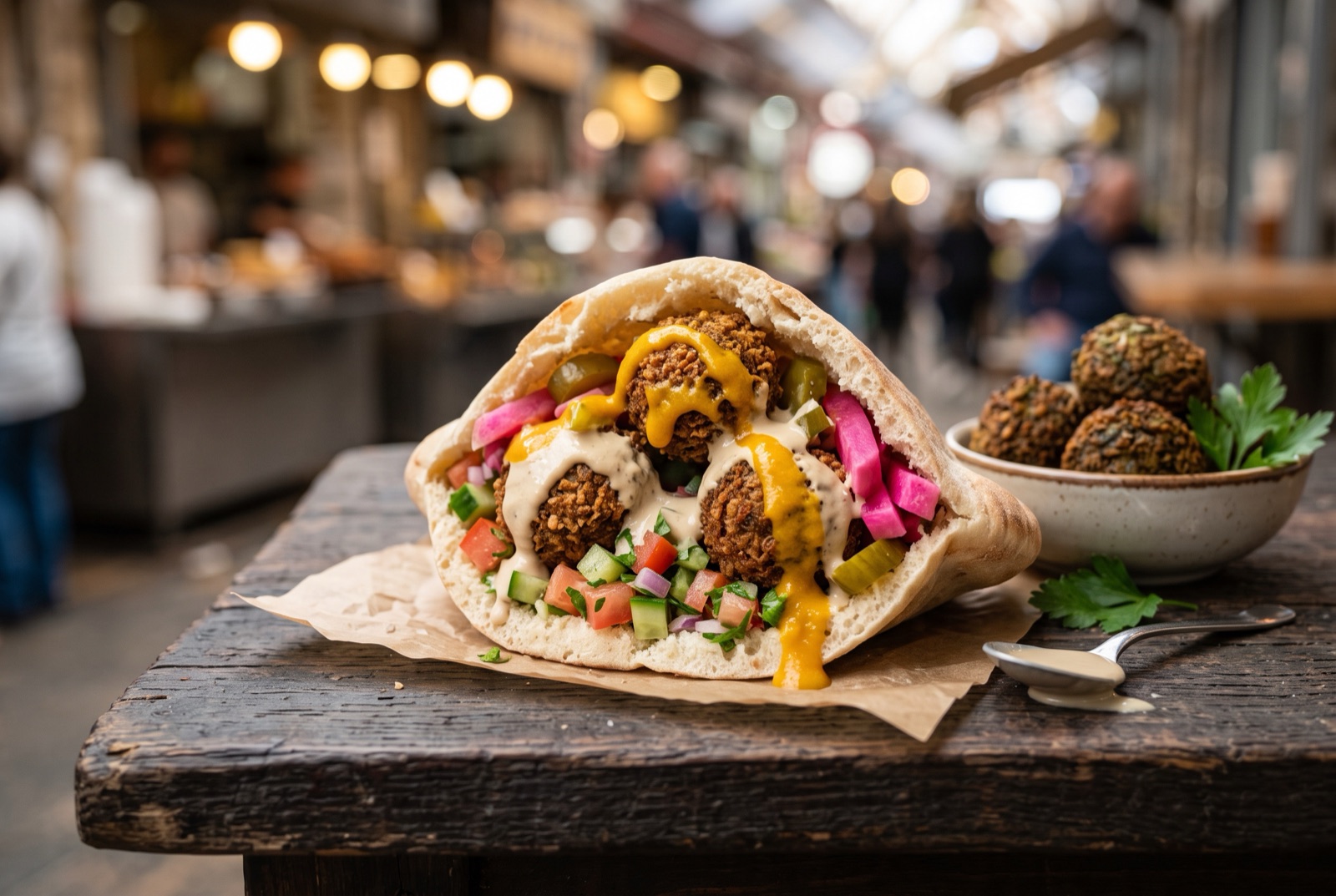
Meorav Yerushalmi is a fast, loud plate of chicken offal cooked on a griddle with onions and a turmeric-heavy spice mix. Hearts, livers and thigh meat go onto searing metal in that order, each cut hitting the heat for exactly as long as it needs, with sliced onion collapsing underneath into something dark and sweet. The seasoning is warm rather than hot — cumin, coriander, turmeric, black pepper, a little cardamom — and the whole thing takes under fifteen minutes of actual cooking. The flavour is deeply savoury and slightly mineral from the liver, cut by lemon and by the pickles that come with it. It is eaten stuffed into pita with tahini, standing up, usually late.

- Gate
- IsraelJerusalem, Mahane Yehuda market
- Prep
- 25 min
- Cook
- 20 min
- Total time
- 1 hr 45 min incl. 1 hr rest
- Serves
- 4
- Status
- Medium
- Nutrition / serving · estimated
- Calories 640 kcal
- Protein 48 g
- Carbs 44 g
- Fat 29 g
- Fiber 5 g
- Sodium 1080 mg
Why this recipe works.
- Cooks each cut for its own time instead of throwing everything into the pan at once, so livers stay pink inside and hearts stay tender.
- Uses a dry, very hot pan in batches to get real browning rather than the grey stewing that a crowded pan produces.
- A turmeric-forward spice mix in the correct proportions, added late so it toasts without burning.
- Includes the koshering-style flame treatment for the livers and explains why it matters to the texture.
Ingredients.
20 itemsFor the grill
For the spice mix
To finish
To serve
Equipment
- Heavy cast-iron or steel frying pan
- Sharp paring knife for trimming
- Tongs
Instructions.
Trim and dry the offal
Go through 300 g of livers lobe by lobe, cutting out any green-stained patch and the pale threads between the lobes. Rinse the halved hearts, then spread everything on a tray lined with kitchen paper and pat completely dry.
Tip Wet offal will never brown. Ten minutes uncovered in the fridge dries the surface further.
Flame the livers
Lay the livers on a rack and pass them briefly over a live gas flame or under a hot grill for about a minute a side, until the surface turns opaque and dull. They should still be raw inside. This is the traditional koshering step and it firms them so they hold their shape in the pan.
Marinate lightly
Toss the thigh strips, hearts and flamed livers with the olive oil, garlic and half the spice mix and leave them at room temperature for an hour, or refrigerate them for up to a day. Keep the remaining spice mix aside for the pan.
Collapse the onions
Melt the lamb fat in a heavy pan over medium-high heat and cook the sliced onions with a pinch of salt for 10–12 minutes, stirring occasionally, until they have shrunk to a third of their volume and taken on brown edges. Scrape them into a bowl.
Sear in batches
Raise the heat until the pan is smoking faintly. Sear the hearts first for 3 minutes, then the thigh strips for 3–4 minutes, then the livers for 2 minutes a side, moving each batch out as it browns. Everything should hiss on contact and colour in patches rather than steam.
Tip Resist stirring for the first minute of each batch. That still contact is where the crust comes from.
Bring it together
Return the onions and all the meat to the pan off the fiercest heat, scatter over the remaining spice mix and toss hard for 60–90 seconds until the turmeric stains the onions yellow and the pan smells toasted, not raw. Squeeze in the lemon juice and scrape up everything stuck to the base.
Stuff and eat
Scatter the parsley over the pan, then load the mixture into warm pitas lined with tahini, tucking pickles and turnip down the sides. Add zhug and a squeeze from the lemon wedges, and eat while the pan is still ticking.
Tips from our kitchen.
- Trim the livers carefully: cut away every trace of green bile and the white connective threads, or the whole pan turns bitter.
- Halve the hearts lengthways and rinse out the interior. They need slightly longer than the livers, which is why they go in first.
- Get the pan properly hot before anything touches it — the meat should hiss loudly on contact. A lukewarm pan releases juices and boils the offal grey.
- Cook in two or three batches. Crowding drops the pan temperature and you lose the browning that carries the dish.
- Add the ground spices in the last minute of cooking, off the fiercest heat. Turmeric and cumin scorch fast and turn acrid.
- Livers are done at medium — a blush of pink at the centre. Cooked through, they go chalky and grainy in a way nothing can fix.
Substitutions.
- Chicken spleen → Extra hearts, or a few slices of lamb liver
- Spleen is traditional and hard to find outside a good butcher. Nobody will notice its absence; the hearts carry the texture.
- Chicken livers → Turkey livers, or half livers and half chicken thigh
- A half-and-half version is far less intense and a good way in for anyone unsure about offal.
- Lamb fat → A tablespoon of olive oil plus a knob of chicken schmaltz
- Lamb fat is the traditional richness at the market grills; schmaltz keeps it poultry-only and works nearly as well.
Variations.
- Meorav with lamb
- Add 200 g of thinly sliced lamb shoulder or lamb offcuts with the thigh meat. Heavier, richer, and common at grills that also sell kebab.
- On a plate, not in pita
- Serve over rice or chips with hummus, salatim and a lemon wedge — the sit-down restaurant version and the easier one for a table of four.
- Extra-onion version
- Double the onions and cook them down almost to a jam before the meat goes back in. Sweeter and softer, closer to how some market cooks serve it.
Storage & reheating.
Best eaten within minutes of leaving the pan; offal degrades faster than muscle meat in both texture and flavour. Cooked meorav keeps 2 days refrigerated in a sealed container, and reheating should be brief and fierce — a very hot dry pan for 60 to 90 seconds, no longer, since a second cooking pushes the livers from grainy to unpleasant. Do not freeze the finished dish. Raw offal, on the other hand, freezes for 2 months and should be thawed slowly in the fridge and patted very dry before it goes anywhere near heat.
Serve with
Warm pita, tahini sauce, hummus, pickled cucumbers, pink pickled turnip, zhug and lemon wedges.
The story behind Meorav Yerushalmi.
The dish was born at the grill restaurants around Mahane Yehuda, Jerusalem's produce market, sometime in the second half of the twentieth century. The economics are the origin story: the grills sold skewers of chicken and lamb, and the offal — hearts, livers, spleens, the odds and ends nobody ordered — was cheap and plentiful. Cooking it fast on a flat-top with onion and spice turned scraps into something worth selling, and it sold. Several restaurants in and around the market claim to have invented it and there is no way to adjudicate between them, so the safest thing to say is that it came out of that street rather than out of one kitchen.
The name means simply "Jerusalem mixture", and the mixture is not fixed. The classic combination is chicken hearts, livers and spleen with pieces of thigh, though many cooks now leave out the spleen and some add lamb offcuts or slices of lamb fat for richness. What is consistent is the method: a hot flat surface, not a grill over coals; onions cooked in the same fat as the meat; and a spice hand heavy enough that the turmeric stains the onions yellow.
Offal has a longer history in the region's Jewish kitchens than the market grills do. Kosher slaughter and koshering rules made liver a specific case — it must be grilled over an open flame to remove blood before it can be cooked further — and thrift did the rest: in poor households nothing edible was discarded. Meorav sits in that tradition, but it belongs to the specific, noisy, late-night world of the market restaurants, and it is one of the few genuinely Jerusalem-born dishes in a cuisine largely assembled from elsewhere.
Questions, answered.
What exactly is in a Jerusalem mixed grill?
Classically chicken hearts, livers and spleen mixed with pieces of chicken thigh, all cooked on a flat-top with onions and spices. There is no fixed formula — some cooks leave out the spleen, some add lamb offcuts or lamb fat, and the ratio of offal to thigh meat varies from stand to stand. The onion, turmeric and cumin are the constants.
How do I stop chicken livers from tasting bitter?
Trim them properly before cooking. Any green-tinged patch is bile and will make an entire pan bitter, so cut it out generously along with the pale connective threads that join the lobes. Rinse the trimmed livers, pat them completely dry, and do not overcook them — overcooked liver develops its own harsh, metallic edge.
Can I make this in a normal frying pan?
Yes. The dish is cooked on a flat metal griddle, not over coals, so a heavy cast-iron or steel frying pan is the right tool. What matters is that the pan is genuinely hot and not overcrowded — work in two or three batches and combine everything at the end rather than trying to fit it all in at once.
Why are the livers grilled over a flame first?
It comes from kosher practice: liver holds too much blood to be koshered by salting alone, so it must be broiled over an open flame before further cooking. Beyond the religious requirement it does something useful in the pan, firming the surface so the livers hold their shape and brown rather than weeping into the onions. If you do not need to kosher your meat you can skip it, but the texture is better with it.
Is meorav Yerushalmi spicy?
Not in itself. The spice mix is warm rather than hot — turmeric, cumin, coriander, black pepper and a little cardamom — and any real heat comes from zhug, the Yemenite green chilli relish, added at the table by whoever wants it. This lets one pan serve a mixed table without anybody having to negotiate.
You might also like.
All recipes →
Keep exploring Israel.
Israel has 9 more dishes in the atlas — Challah and Cholent, and 7 more.
All Israel recipes Chicken recipes Onion recipes Turmeric recipes mainstreet fooddairy freehalal friendlyRecipe by The DishRoute Kitchen · published August 20, 2026 · updated August 20, 2026