Hāngī.
Māori Earth Oven Feast
Hāngī · say it: HAH-ngee
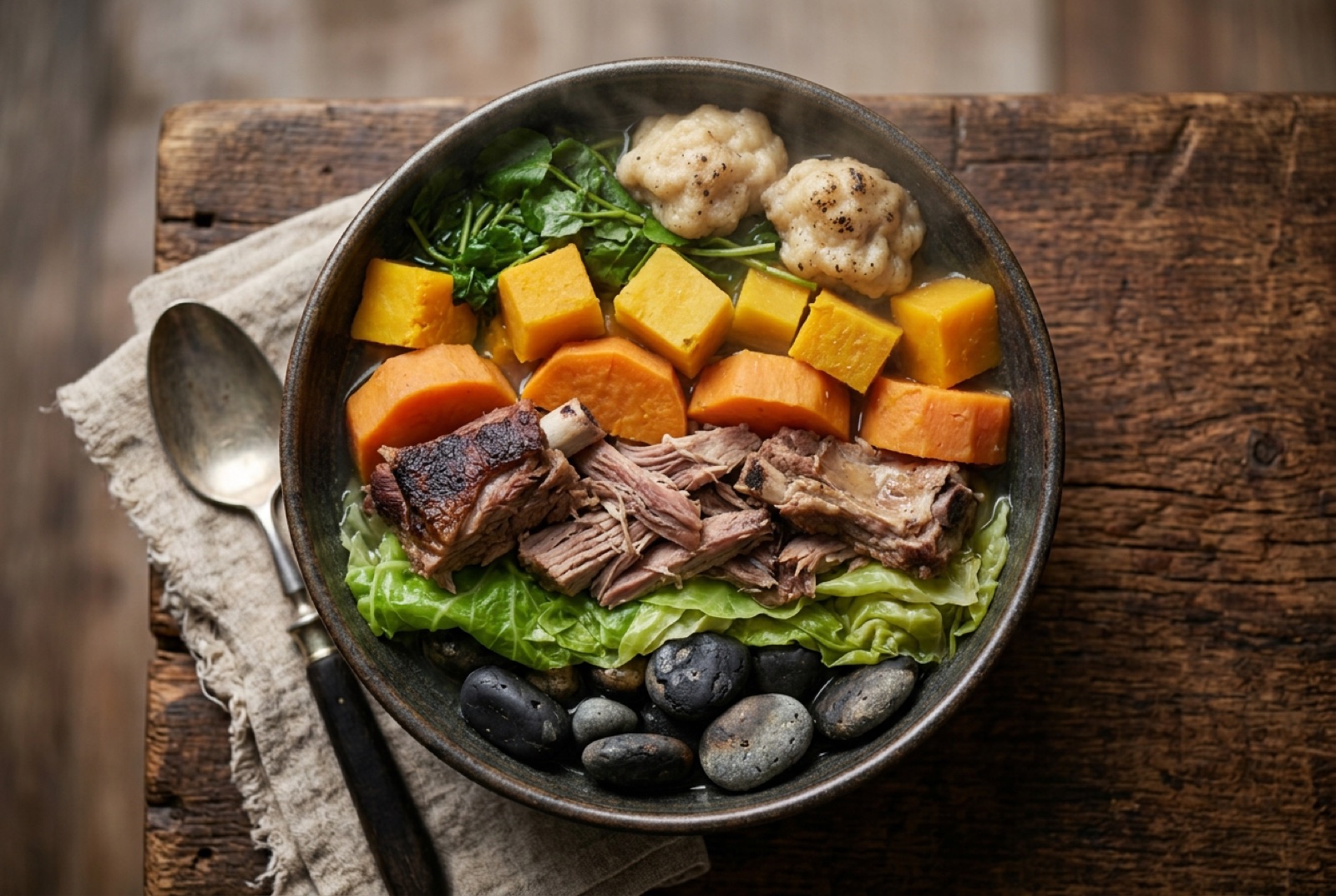
Hāngī is a whole meal cooked underground. A pit is dug, river stones are heated in a fire until they glow, and baskets of pork, chicken, lamb, kūmara, pumpkin, potato and cabbage are stacked on top, covered with wet sacking and earth, and left to steam for three to four hours. Nothing is browned and nothing is sauced. What comes out is soft, deeply savoury food carrying a smell that no oven reproduces: damp smoke, hot stone, and the sweetness of root vegetables that have been steaming in their own moisture half the afternoon. It is the food of tangi, weddings, birthdays and marae welcomes — cooked by a group, for a crowd, and eaten off paper plates while it is still too hot to hold.

- Gate
- New ZealandAotearoa (nationwide, strongest in Te Arawa and Northland)
- Prep
- 40 min
- Cook
- 4 hr
- Total time
- 5 hr incl. 20 min rest
- Serves
- 8
- Status
- Takes skill
- Nutrition / serving · estimated
- Calories 610 kcal
- Protein 44 g
- Carbs 42 g
- Fat 29 g
- Fiber 6 g
- Sodium 890 mg
Why this recipe works.
- Explains the real earth-oven method properly, then gives an oven version that gets close instead of pretending it is identical.
- Layers by cooking time — meat and dense root vegetables low, cabbage on top — so nothing collapses and nothing stays raw.
- Uses smoke deliberately rather than accidentally, which is the one flavour a home oven cannot generate on its own.
- Feeds eight to ten from one roasting setup, with almost no active work after the first half hour.
Ingredients.
11 itemsMeat
Vegetables
Seasoning
Equipment
- Large deep roasting tray
- Wire rack
- Heavy-duty foil
- Oven thermometer
Instructions.
Season the meat
Rub the pork, chicken and lamb all over with the smoked salt and cracked pepper, working it into the scored pork skin. Leave uncovered at room temperature for 20 minutes while the oven heats to 150°C — the surface should look dry rather than wet.
Set up the steam tray
Pour the water into a deep roasting tray and sit a wire rack over it, clear of the liquid. This water is doing the work of the wet earth — it must never boil dry, so check it every hour and top up with boiling water.
Load the meat
Arrange 1.5 kg of pork shoulder in the centre of the rack with the chicken and lamb around it, skin side up. Cover the whole tray tightly with two layers of foil, crimped hard against the rim so no steam escapes at the corners.
Steam the meat low and slow
Cook at 150°C for 2 hours 30 minutes without opening except to check the water. The pork is ready for the next stage when a skewer slides into the shoulder with almost no resistance and the juices run clear.
Tip If the foil balloons and hisses at the edges, the seal is working. A silent tray usually means a leak.
Add the root vegetables
Toss the kūmara, potato, pumpkin and onion with a pinch of smoked salt and tuck them around the meat in a single layer. Re-seal the foil and return the tray to the oven for 1 hour, until a knife goes through the kūmara like soft butter.
Add the cabbage last
Sit the cabbage quarters on top of everything, cut side down, re-seal and cook a final 30 minutes. The cabbage should collapse to soft, pale green leaves that still hold their wedge shape — grey, falling-apart cabbage means it went in too early.
Rest, then open at the table
Take the tray out and let it stand sealed for 20 minutes. Peel the foil back in front of everyone so the steam rolls out the way it does when a pit is lifted, then pull the pork apart with two forks and pile meat and vegetables straight onto plates.
Tips from our kitchen.
- If you are cooking a real hāngī, use only hard volcanic or river stones that have been fired before. Untested stones can explode in the pit and injure people.
- Kūmara is the point, not a side. Use the orange or gold varieties if you can find them; ordinary sweet potato works but is wetter and sweeter.
- Do not season heavily. Hāngī tastes of smoke, meat fat and steam — salt, pepper and a little smoked salt is the whole seasoning plan.
- Wrap the meat and vegetables separately in the oven version so the cabbage does not turn grey and the kūmara does not soak up all the pork fat.
- The steam is what cooks everything, so keep at least 500 ml of water in the base tray and check it once an hour rather than opening constantly.
- Cabbage goes in for the final hour only. Any longer and it turns to sulphurous mush that overpowers the whole tray.
Substitutions.
- Kūmara (New Zealand sweet potato) → Orange sweet potato, or half sweet potato and half parsnip
- Kūmara is drier and less sugary than most sweet potato. Parsnip in the mix pulls the sweetness back towards the real thing.
- Earth oven smoke → Smoked salt plus a teaspoon of liquid smoke stirred into the tray water
- A blunt instrument, but it puts the missing note in the right place. Manuka wood chips in a covered barbecue do the job better if you have one.
- Pork shoulder → Lamb shoulder, whole chicken pieces, or all three together
- A real hāngī nearly always carries more than one meat. Mixing them is traditional, not a compromise.
Variations.
- Geothermal hāngī
- In Whakarewarewa and around Rotorua, food is cooked in natural steam boxes and boiling pools instead of a fire pit — no stones, no digging, and a distinct mineral edge to the flavour.
- Hāngī pit with a modern steam box
- Many marae now use gas-fired steam boxes for large numbers. Purists object, cooks with 300 people to feed generally do not.
- Hāngī pie and hāngī sandwich
- Leftover hāngī gets a second life shredded into pastry or stacked in white bread with plenty of butter — arguably the best meal of the whole event.
Storage & reheating.
Hāngī keeps 3 days refrigerated and is famously better the next day, when the smoke has settled into the meat. Store meat and vegetables together in their juices so nothing dries out. Reheat covered at 160°C with a splash of water until steaming through, about 25 minutes. The meat freezes well for 3 months; the cabbage and pumpkin do not, so pull those out before freezing.
Serve with
Rēwena bread and butter, a bowl of watercress, and plain gravy made from the tray juices.
The story behind Hāngī.
Earth-oven cooking arrived in Aotearoa with Polynesian voyagers and is a cousin of the Hawaiian imu, the Samoan umu and the Fijian lovo — the same idea of heated stones, wrapped food and buried heat, adapted to a colder, wetter, more volcanic country. Māori found stones that held heat well, learned which ones shattered dangerously in the fire, and cooked what the land gave: kūmara brought south by the first canoes, fernroot, birds, fish. Pork, potato and cabbage arrived later with European contact and were absorbed without ceremony, which is why a modern hāngī looks like a mix of Pacific and colonial pantries. In Rotorua and other geothermal areas, the fire step is skipped entirely — food is lowered into natural steam vents and boiling pools, an unbroken practice that predates any oven in the country.
What matters about hāngī is not the recipe but the labour. It takes a team: someone splits wood before dawn, someone else lays the stones, someone tests the pit for heat with a thrown handful of water, someone wraps the baskets. Digging and lifting a hāngī is one of the standard ways a Māori community feeds a large gathering, and the roles are learned by watching from childhood. The pit is opened in front of everyone, the steam rolls out, and the first look at the food is a genuine moment of judgement — undercooked or scorched hāngī is remembered for years.
Most New Zealanders will only ever eat hāngī someone else has cooked, and many kitchens have quietly worked out an oven method for the flavour rather than the ritual. That version is what follows: the same layered ingredients, the same long slow steam, and smoked salt or manuka smoke standing in for the pit. It is honest to say this is not hāngī. It is hāngī-style kai, and it is worth cooking for a full table on a cold Sunday, so long as nobody pretends the earth oven has been replaced.
Questions, answered.
What is a hāngī exactly?
A hāngī is a Māori earth oven and the meal cooked in it. Stones are heated in a fire until glowing, dropped into a pit, and baskets of meat and vegetables are stacked on them, covered with wet cloth and soil, then left to steam underground for three to four hours before the pit is opened in front of everyone.
Can I make hāngī in a normal oven?
You can make something very close in flavour, and this recipe shows how: layered meat and root vegetables, a tray of water for steam, a low oven and several hours. What you cannot reproduce is the earth-and-stone smoke, so smoked salt or a covered barbecue with manuka chips stands in. Call it hāngī-style rather than hāngī.
Why does hāngī food taste smoky if it is steamed?
The stones sit directly in the fire for hours and carry wood smoke into the pit, and the wet sacking laid over the baskets traps that smoke against the food while it steams. The smoke is absorbed through moisture rather than dry heat, which is why it tastes soft and damp rather than charred.
How long does a real hāngī take from start to finish?
Around six to eight hours in total. Roughly two to three hours to burn the fire down and heat the stones properly, three to four hours buried, then the lifting. Most of that is waiting, which is why hāngī is a social event rather than a cooking task.
Is it rude to ask for a hāngī at a marae?
It is not rude to be curious, but a hāngī is a substantial community effort put on for specific occasions, not a menu item. If you are invited to one, accept, help lift it if asked, and eat what you are given. Commercial hāngī evenings in Rotorua are the normal way for visitors to try it.
You might also like.
All recipes →


Keep exploring New Zealand.
New Zealand has 9 more dishes in the atlas — Afghan Biscuits and Boil Up, and 7 more.
Recipe by The DishRoute Kitchen · published August 20, 2026 · updated August 20, 2026