Ndolé.
Cameroonian Bitterleaf and Peanut Stew
Ndolè · say it: n-doh-LAY
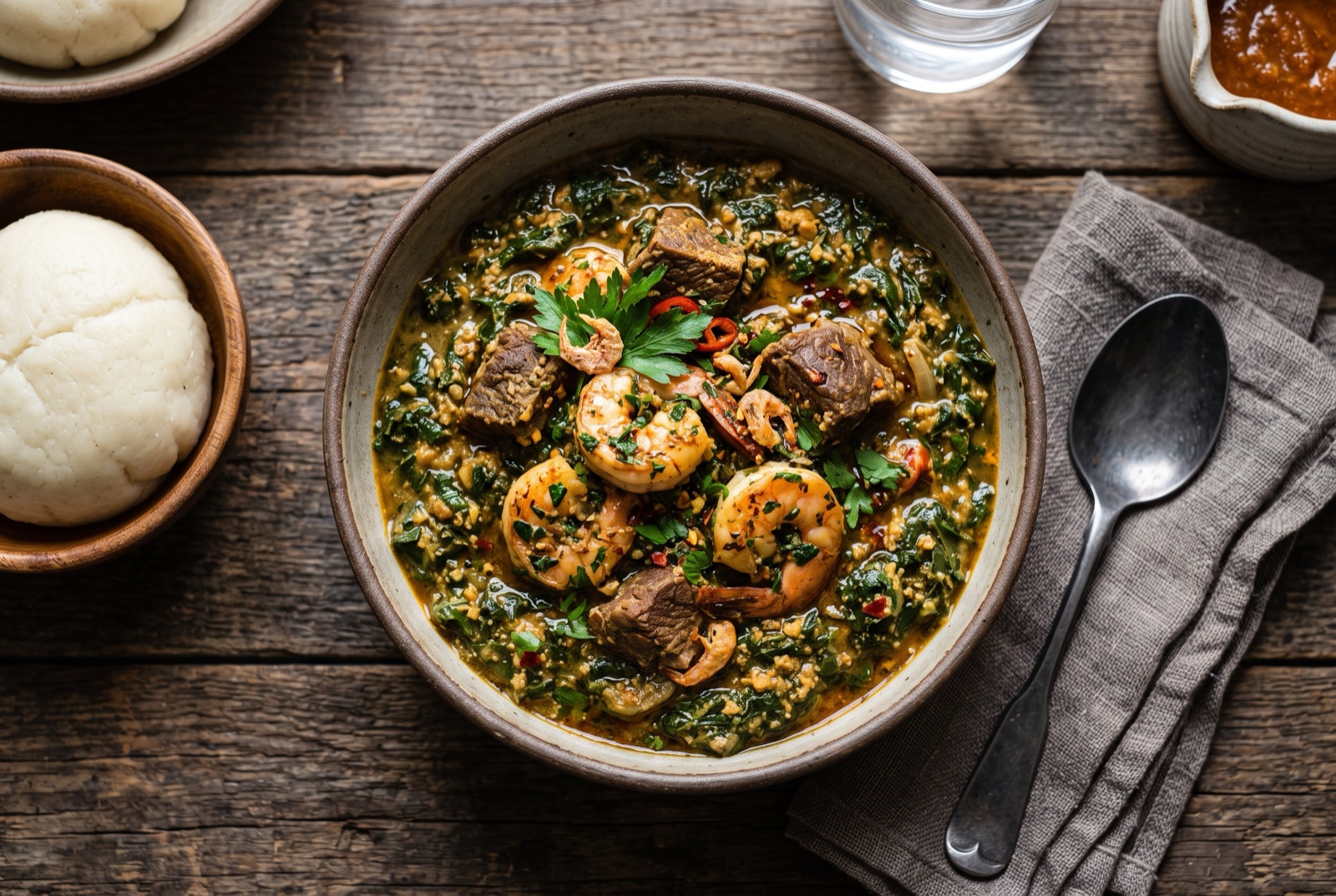
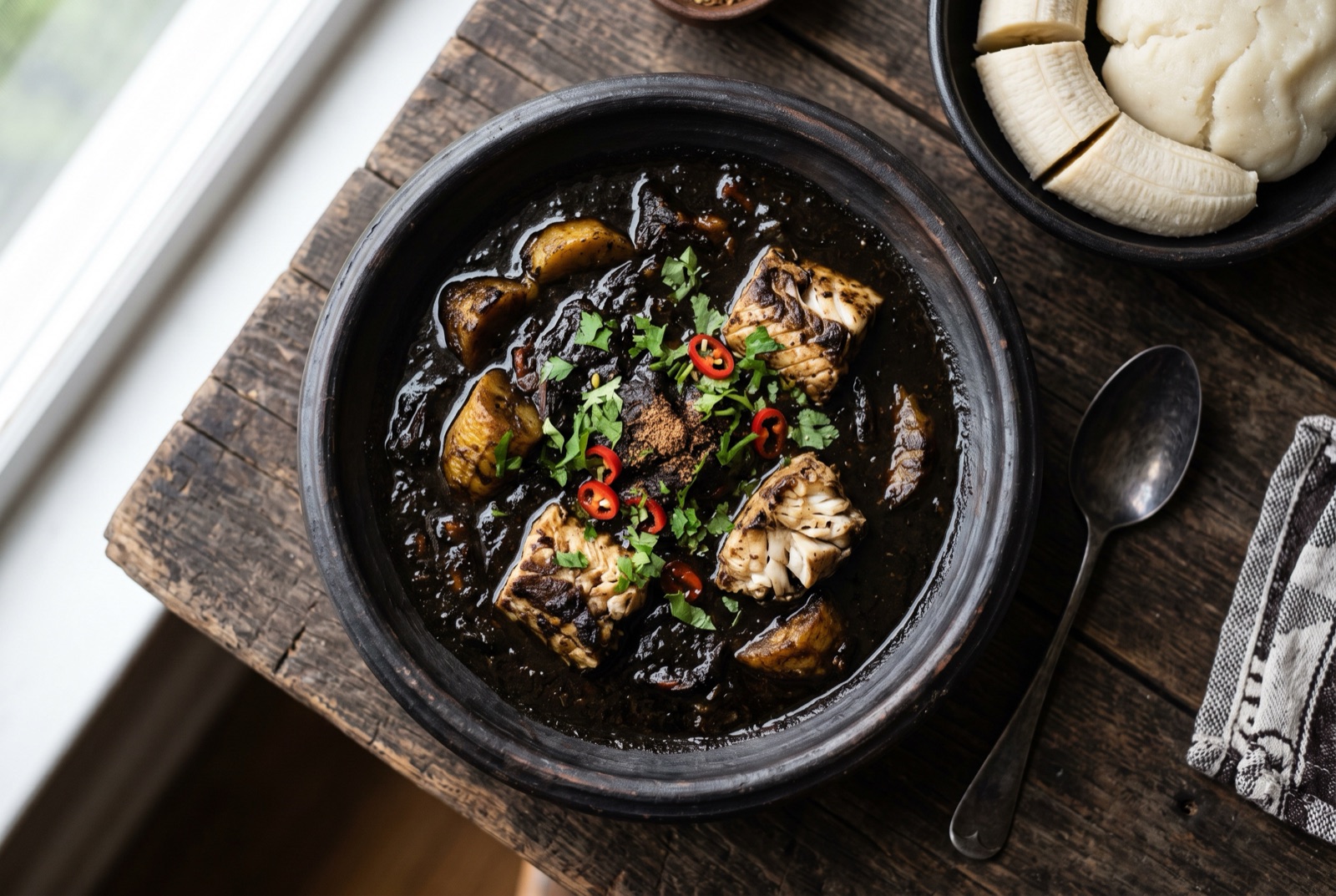
Ndolé is a thick green stew built on two things — bitterleaf and boiled peanuts — cooked together until the sauce turns dense enough to hold a spoon upright. The bitterleaf is washed and squeezed repeatedly before it ever meets the pot, which takes the edge off without erasing the pleasant bitterness that gives the dish its name. Ground peanuts do the thickening, so the texture is closer to a coarse, nutty purée than to a broth, and the flavour runs savoury and rounded rather than hot. Beef simmered to tenderness and shrimp added at the end give it two different kinds of richness. It is served with fried ripe plantain, boiled cassava or miondo, and it is the plate Cameroonians name first when asked what their country tastes like.

- Gate
- CameroonLittoral (Douala)
- Prep
- 40 min
- Cook
- 1 hr 35 min
- Total time
- 2 hr 15 min
- Serves
- 6
- Status
- Medium
- Nutrition / serving · estimated
- Calories 640 kcal
- Protein 44 g
- Carbs 19 g
- Fat 44 g
- Fiber 7 g
- Sodium 890 mg
Why this recipe works.
- Spells out the bitterleaf washing properly — how many changes of water, and what the leaf should taste like when it is finally ready.
- Boils and blends raw peanuts rather than shortcutting with peanut butter, which is what keeps the sauce clean and not cloying.
- Cooks the peanut base long enough for the oil to break out, the step most home versions stop short of.
- Gives an honest substitution for bitterleaf and says plainly what it does and does not deliver.
Ingredients.
17 itemsFor the meat
For the greens
For the sauce
To finish
To serve
Equipment
- Large heavy pot or Dutch oven
- Blender or food processor
- Sieve or colander
- Large bowl for washing the leaves
Instructions.
Wash the bitterleaf
Cover the bitterleaf with boiling water, leave 10 minutes, then drain and squeeze it hard in handfuls over the sink. Repeat with fresh hot water three to five more times, tasting a leaf each round. Stop when the bitterness reads like strong black tea rather than something medicinal, then squeeze the leaves as dry as you can and set aside.
Tip The water tells you as much as the taste — it runs murky olive at first and comes out nearly clear when the leaf is close to ready.
Simmer the beef
Put 700 g of beef in a pot with the quartered onion, crushed garlic, sliced ginger, bay leaves, a teaspoon of salt and the water. Bring to a boil, skim the grey foam, then cover and simmer for 50 minutes until a cube gives easily to a fork but has not collapsed. Lift out the meat and strain the broth — keep every drop.
Boil the peanuts
While the beef cooks, boil the peanuts in plenty of unsalted water for 30 to 40 minutes, until a kernel crushes between finger and thumb into a smooth paste with no dry, chalky centre. Drain them.
Tip Older peanuts take longer than the packet suggests. Test rather than trust the clock — this is the one step that decides whether the sauce is silky or sandy.
Blend the base
Blend the boiled peanuts with 500 ml of the hot beef broth until completely smooth, then pour into a bowl. Without rinsing the jug, blend the chopped onions, garlic, ginger and scotch bonnet with a splash of broth into a coarse paste.
Fry the aromatics
Heat the groundnut oil in a heavy pot over medium heat and cook the onion paste for 8 to 10 minutes, stirring, until it stops smelling raw and sharp and turns pale gold with the oil pooling at the edges.
Build and thicken the sauce
Stir in the peanut purée, the ground crayfish and another 300 ml of broth. Simmer uncovered over medium-low heat for 25 minutes, stirring every few minutes and scraping the base, until the sauce darkens to a dull tan, thickens like porridge, and beads of oil rise and float on the surface.
Tip That floating oil is the signal that the raw groundnut taste has cooked out. Stop before it and the sauce tastes chalky.
Add the bitterleaf and beef
Fold in the squeezed bitterleaf and the cooked beef, loosening with broth until the stew is thick but still spoonable. Simmer gently for 15 minutes so the leaf softens into the sauce and the beef takes on the peanut flavour. Taste and salt firmly.
Finish with shrimp and serve
Scatter in the shrimp, stir once and cook for 4 to 5 minutes, just until they curl and turn opaque through the centre. Take the pot off the heat and let it settle for 5 minutes before serving with fried ripe plantain or boiled cassava.
Tips from our kitchen.
- Taste the bitterleaf after every wash. Stop when it tastes like strong tea rather than aspirin — wash it to blandness and the finished stew is just a peanut sauce.
- Raw peanuts must be boiled until a kernel crushes to paste between your fingers with no chalky core, or the blended sauce will stay gritty no matter how long it simmers.
- Keep the beef cooking liquid. It is the only stock the dish gets, and water in its place makes the sauce taste flat.
- Stir the peanut base often once it thickens — it catches on the bottom of the pan quickly and scorched groundnut is unrecoverable.
- Add the fresh shrimp in the last five minutes only. They toughen fast and the dish already has plenty of savour from the dried crayfish.
- The stew should hold a channel when you drag a spoon across the pan bottom. If it floods back instantly, keep reducing.
Substitutions.
- Bitterleaf (frozen or dried) → 400 g spinach plus 150 g mustard greens or dandelion greens, blanched and squeezed dry
- This gives you a green, faintly bitter peanut stew that is genuinely good, but it is not ndolé — bitterleaf has a specific lingering bitterness and a firmer, almost chewy texture that greens from a supermarket do not carry. If there is an African grocer within reach, buy the real thing and freeze the rest.
- Dried crayfish (ground) → Dried shrimp, ground fine in a spice grinder
- Close enough in function — both are there for concentrated savoury depth rather than for texture. Skip it entirely and the stew loses its backbone; a spoonful of fish sauce is a poor last resort but better than nothing.
- Beef chuck → Beef shank, or smoked mackerel for a lighter version
- Shank needs an extra 20 minutes but gives a richer broth. A fish ndolé is traditional on the coast and cuts the cooking time roughly in half.
Variations.
- Ndolé aux crevettes
- Shrimp only, no beef, with the sauce built on a light shrimp stock. Lighter and faster, common in Douala where the shrimp are landed fresh.
- Ndolé au poisson fumé
- Smoked mackerel or stockfish flaked into the peanut base near the end. The smoke pushes the whole dish in a darker, more rustic direction.
- Meat-free ndolé
- Built on mushroom or vegetable stock with the crayfish left out and extra peanuts for body. Not traditional, but the bitterleaf-and-groundnut structure survives it intact.
Storage & reheating.
Ndolé improves on day two and keeps 3 days refrigerated. Reheat gently with a splash of water or stock, stirring — the peanut sauce tightens considerably as it cools and will look claggy straight from the fridge. It freezes well for up to 3 months, though the shrimp turn slightly rubbery, so freeze the base before adding them if you are planning ahead. Never reheat in a thin pan on high heat; the groundnut solids catch and burn in seconds.
Serve with
Fried ripe plantain, boiled cassava or miondo — the starch is not optional, it is what balances the richness of the peanut sauce. Plain white rice for a simpler weeknight plate.
The story behind Ndolé.
Ndolé belongs to Douala, the humid Atlantic port where the Wouri river meets the sea, and to the Sawa peoples of the Littoral. Vernonia amygdalina, the bitterleaf plant, grows readily across the region and is used as much as medicine as food — the same bitter compounds that need washing out are the reason the leaf was valued in the first place. Peanuts arrived from the Americas centuries ago and were absorbed so completely into the cooking of West and Central Africa that a groundnut-thickened sauce now reads as fundamentally African, not imported. Shrimp and crayfish came from the estuary at the door. The dish is a portrait of its city.
It earned its status the way most national dishes do: by being the thing cooked for occasions. Ndolé takes hours, uses expensive protein, and is judged publicly, so it appears at weddings, baptisms, funerals and Sunday tables rather than on a Tuesday night. Cameroonians abroad hunt frozen bitterleaf in African grocers precisely because a birthday without ndolé does not feel like a birthday. Cooks argue about the balance — how much bitterness to leave in, whether shrimp or beef should lead, whether the sauce should be smooth or textured — and those arguments are family arguments, passed down along with the pot.
The hardest part to reproduce outside Cameroon is the leaf itself. Bitterleaf sold frozen or dried in African shops is the real ingredient and worth seeking out. Spinach mixed with a bitter green gets you a good stew, but not ndolé — the bitterness is not a flaw to be engineered away, it is the point, the thing that keeps a very rich peanut sauce from becoming heavy. Anyone tasting the dish for the first time should expect that faint back-of-the-tongue edge and read it as the dish working, not as a mistake.
Questions, answered.
What is bitterleaf and where do I find it?
Bitterleaf is the leaf of Vernonia amygdalina, a shrub common across West and Central Africa, sold outside the continent frozen, dried or vacuum-packed in African and Caribbean grocers. Frozen is the best option because it has usually been pre-washed already. Dried needs soaking and considerably more washing before it can be used.
Why does the bitterleaf have to be washed so many times?
The leaf contains bitter compounds that are water-soluble, so repeated boiling and hard squeezing pulls them out gradually. Cooking it without washing gives a stew so bitter most people cannot finish it. The aim is to reduce the bitterness to a pleasant background edge, not to remove it, which is why you taste as you go rather than following a fixed number of rinses.
Can I use peanut butter instead of boiling raw peanuts?
You can, and many home cooks do — use around 250 g of unsweetened natural peanut butter with no added sugar or palm fat. The result is sweeter, heavier and slightly oilier than a sauce built from boiled peanuts, because roasted peanut flavour dominates. Boiled raw peanuts give a cleaner, more savoury base that lets the bitterleaf come through.
Is ndolé supposed to be spicy?
Not particularly. Heat is present but restrained, usually one scotch bonnet for a large pot, and the dominant flavours are nutty and bitter rather than hot. Cameroonians who want more heat add fresh pepper sauce at the table rather than loading the stew, so it can be served to a mixed table without argument.
My sauce tastes gritty. What went wrong?
The peanuts were undercooked before blending, or blended without enough liquid. Grittiness cannot be fixed by simmering longer once the sauce is assembled. Prevent it by boiling the peanuts until a kernel smears to a smooth paste between your fingers, then blending with plenty of hot stock until the mixture is completely smooth before it goes anywhere near the pot.
You might also like.
All recipes →
Keep exploring Cameroon.
Cameroon has 9 more dishes in the atlas — Achu Soup and Beignets Haricots, and 7 more.
Recipe by The DishRoute Kitchen · published August 20, 2026 · updated August 20, 2026