Sanga.
Cameroonian Maize and Cassava Leaf Pot
Sanga · say it: SAN-gah
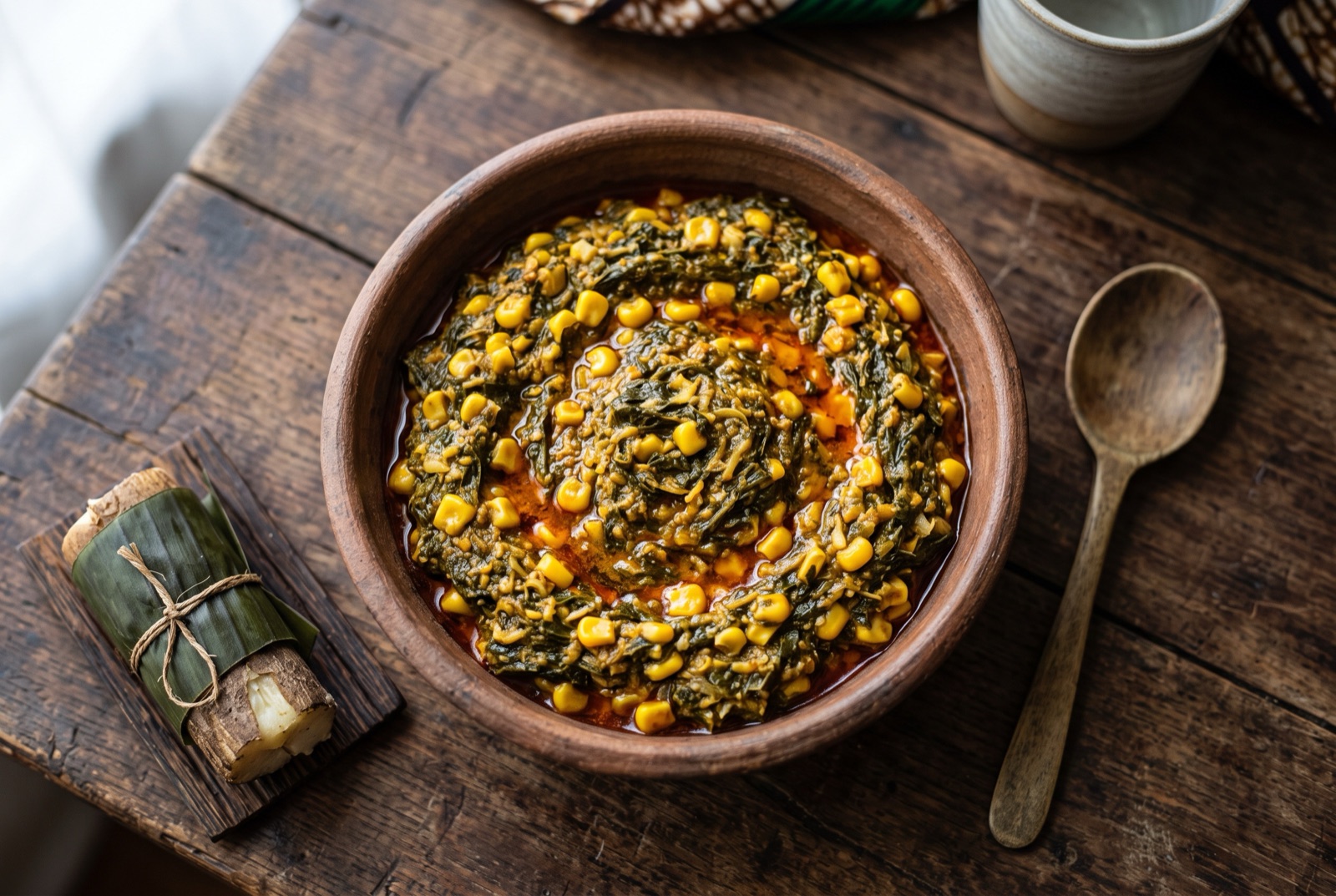
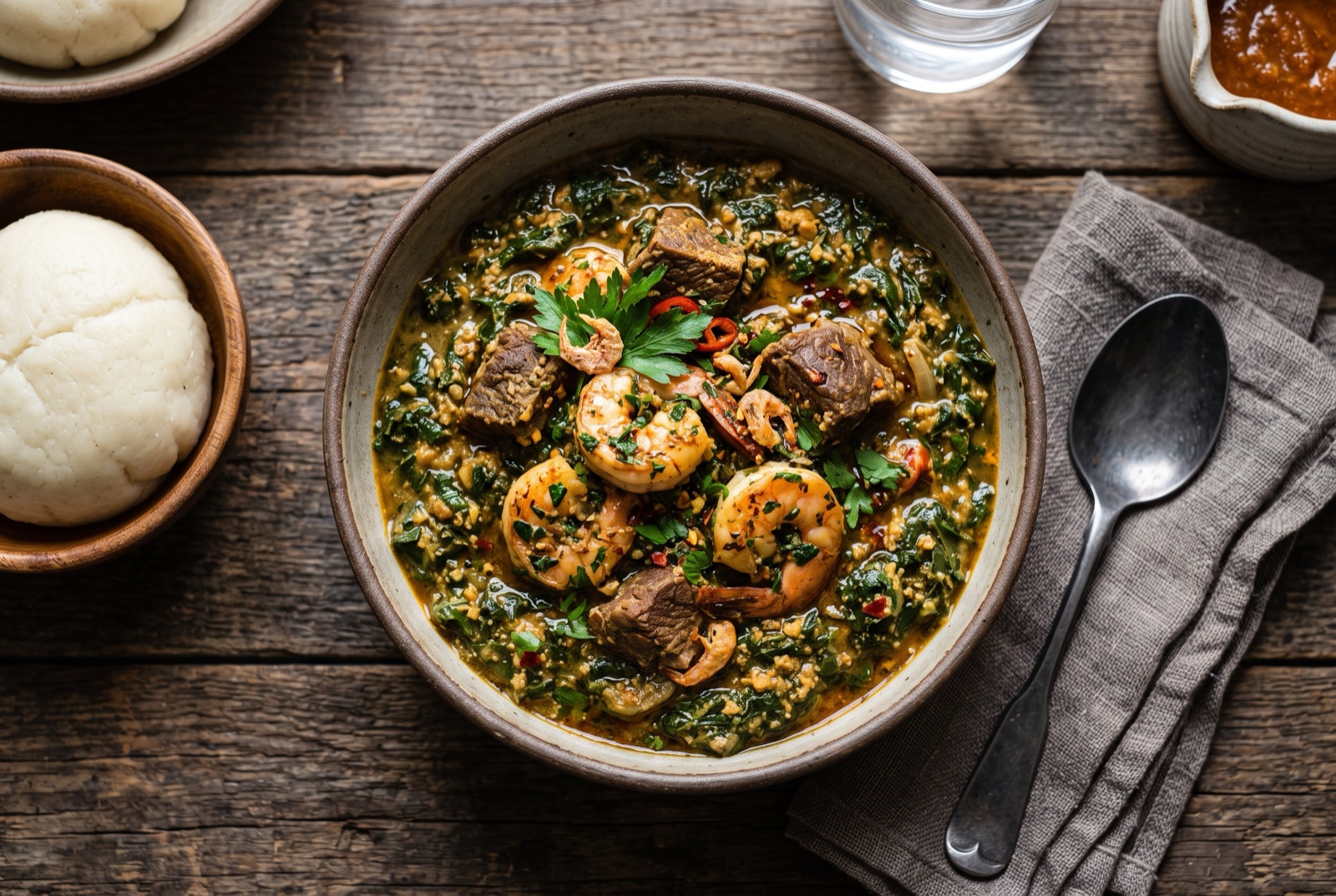
Sanga is maize and cassava leaves cooked together in palm oil until the pot turns thick and dark green and the kernels soften but keep a slight pop. It has four or five ingredients and no technique to speak of, and it tastes of exactly what it is: sweet starchy corn against the mineral, faintly bitter green of cassava leaf, held together by the earthy richness of unrefined palm oil. Cameroonians eat it as a side or as a light meal on its own, and it is a rural, seasonal dish tied to the maize harvest rather than restaurant food. It is also proof that cooking with almost nothing is a skill rather than a limitation.

- Gate
- CameroonCentre and South
- Prep
- 25 min
- Cook
- 1 hr
- Total time
- 1 hr 25 min
- Serves
- 5
- Status
- Easy
- Nutrition / serving · estimated
- Calories 380 kcal
- Protein 12 g
- Carbs 41 g
- Fat 21 g
- Fiber 9 g
- Sugar 8 g
- Sodium 540 mg
Why this recipe works.
- Cooks the cassava leaves long enough for both safety and texture, and explains why the method matters.
- Adds the maize partway through so the kernels stay distinct rather than dissolving into the greens.
- Uses the palm oil in two stages, which keeps its aroma present in the finished pot.
- Sets expectations honestly about sweetcorn versus field maize instead of pretending they behave the same.
Ingredients.
9 itemsFor the pot
Equipment
- Heavy pot with a lid
- Sharp knife
- Wide bowl for stripping the cobs
Instructions.
Strip the cobs
Stand each maize cob upright in a wide bowl and cut the kernels away in strips, then scrape the bare cob firmly with the back of the knife to release the starchy white milk. Keep kernels and milk together.
Boil the cassava leaves
Put the pounded cassava leaves in a heavy pot with the water and a teaspoon of salt. Bring to a boil, then simmer covered for 30 minutes, stirring occasionally, until the leaves darken from bright to deep olive green and lose their raw grassy smell.
Tip Do not shorten this. Long cooking is what makes cassava leaf both safe and pleasant to eat.
Add the aromatics and oil
Stir in half the palm oil, the chopped onion, crushed garlic, ground crayfish and scotch bonnet. The pot will turn glossy and the colour will deepen almost at once. Simmer uncovered for 10 minutes.
Cook in the maize
Tip in the kernels and their milk and stir well. Simmer for 15 to 20 minutes, stirring every few minutes so nothing catches, until the kernels are tender but still burst under the tooth and the pot has thickened around them.
Reduce and finish
Cook uncovered for a final 5 minutes so any loose liquid disappears — a spoon drawn through the pot should leave a track that closes slowly. Stir in the remaining palm oil off the heat and taste for salt and pepper before serving with boiled plantain.
Tips from our kitchen.
- Buy frozen pounded cassava leaf if you can — the pounding is genuinely hard work and the frozen product is exactly what village cooks would produce by hand.
- Give the leaves at least 30 minutes of hard simmering before anything else joins them. They go from stiff and grassy to soft and dark, and undercooked cassava leaf is unpleasantly fibrous.
- Cut the kernels from the cob with the cob standing upright in a wide bowl, then scrape the bare cob with the back of the knife to release the starchy milk. That milk thickens the pot.
- Hold back a spoonful of palm oil to stir in at the end — the aroma fades with long cooking and a final addition brings it straight back.
- The pot is ready when a spoon drawn through it leaves a track that closes slowly rather than instantly.
- Season late. Ground crayfish and any bouillon are salty, and the mixture reduces as it cooks.
Substitutions.
- Pounded cassava leaves → 600 g spinach with 200 g collard greens, blitzed to a coarse pulp
- This gives you a green, palm-oil-rich maize pot that is good in its own right, but it is a different dish. Cassava leaf has a distinctive slightly bitter, mineral flavour and a dense, almost mossy texture that no European green reproduces. Frozen pounded cassava leaf is sold in African shops as saka-saka or pondu and needs no preparation beyond thawing.
- Fresh maize on the cob → 500 g frozen sweetcorn kernels
- Frozen corn works and is available year-round. It is sweeter and lacks the starchy milk that fresh cobs release, so the pot is a little thinner and a little sweeter — compensate with a slightly longer reduction and a firmer hand with the pepper.
- Ground dried crayfish → Omit for a vegan pot, or use 1 tsp light miso
- Crayfish supplies the savoury depth that keeps such a simple dish from tasting flat. Miso is not remotely traditional but does a similar job; without either, add extra salt and a little more palm oil.
Variations.
- Sanga with groundnuts
- A few spoonfuls of ground peanuts stirred in near the end, thickening the pot and softening the bitterness of the leaf.
- Sanga with smoked fish
- Flaked smoked mackerel added with the maize, turning the dish from a side into a full meal.
- Saka-saka style
- Cassava leaves alone, without maize, cooked long and slow in palm oil — how the same leaf is eaten across the Congo basin.
Storage & reheating.
Sanga keeps 3 days refrigerated and reheats without any loss of quality, gaining a little as the palm oil settles through the greens. Warm it in a pan over low heat with a small splash of water, since it tightens considerably when cold. It freezes for 3 months, though the maize kernels soften noticeably on thawing. Do not leave it at room temperature for hours — like any low-acid vegetable dish, it should be cooled quickly and refrigerated.
Serve with
Boiled plantain, cassava or yam, as the starch alongside. Grilled or fried fish, which suits the mild bitterness of the leaves particularly well.
The story behind Sanga.
Cassava is grown across southern Cameroon for its roots, but the leaves are food too, and in the Centre and South they are pounded to a fine green pulp and cooked into a range of dishes. The same leaf appears across Central Africa — as saka-saka in the Congos, pondu, or matapa further south in Mozambique — usually with palm oil and often with peanuts or fish. Sanga is the Cameroonian version that pairs it with maize, which makes it strictly seasonal in the villages where the corn has to be fresh off the cob rather than out of a bag.
There is a practical reason the leaves are pounded so thoroughly. Cassava in all its parts contains cyanogenic compounds, and the traditional preparation — heavy pounding followed by long boiling — breaks them down. This is not folklore, it is why the method has survived unchanged: cooks across the region pound the leaves to a pulp and then simmer them for a long time, and the resulting dish is completely safe. Anyone buying frozen pounded cassava leaf abroad is buying leaves that have already been through the pounding stage, and it still needs the long cook.
What makes sanga particular is the maize. Cameroonian field maize is starchier and less sugary than the sweetcorn sold in European and American supermarkets, so a village pot tastes more savoury and more filling than a home version made with sweetcorn will. That is worth knowing before you make it, because the sweetness of good sweetcorn changes the balance noticeably — you get a lighter, sweeter dish that plays against the bitter leaf in a slightly different way. Neither is wrong. Cooks in Cameroon adjust with salt, pepper and a spoonful of ground crayfish, and the same adjustments work in any kitchen.
Questions, answered.
Are cassava leaves safe to eat?
Yes, when prepared traditionally. Cassava contains cyanogenic compounds throughout the plant, and the standard preparation of pounding the leaves to a pulp and then boiling them for a long period breaks these down. This is why every recipe across Central Africa insists on thorough pounding and extended cooking. Never eat cassava leaves raw or lightly cooked, and buy frozen pounded leaf if you are not pounding it yourself.
Where do I buy pounded cassava leaves?
African and Caribbean grocers stock them frozen, usually in 500 g blocks labelled cassava leaf, saka-saka, pondu or feuilles de manioc. They are already pounded, so you simply thaw and cook. Some shops also sell them dried, which need soaking for several hours before use and give a slightly duller colour.
Can I use sweetcorn instead of field maize?
Yes, and most people outside Cameroon will have to. Supermarket sweetcorn is bred for sugar, so the finished pot is sweeter and lighter than the starchier village version. It is still a very good dish; just expect the corn to sit forward on the palate rather than acting as a neutral starch, and season a little more assertively to balance it.
Is sanga bitter?
Mildly, and the bitterness is a feature rather than a fault. Cassava leaf carries a gentle mineral bitterness that plays against the sweetness of the maize and the richness of palm oil. If it is too pronounced for you, a spoonful of ground peanuts stirred in near the end rounds it off, which is a traditional adjustment rather than a compromise.
Can I make sanga without palm oil?
Technically yes, but it will not taste like sanga. Unrefined red palm oil provides the colour and the earthy, faintly floral aroma that carries such a simple dish. A neutral oil leaves you with boiled corn and greens. Red palm oil is inexpensive, sold in African, Caribbean and Brazilian shops, and keeps for months in a cupboard.
You might also like.
All recipes →
Keep exploring Cameroon.
Cameroon has 9 more dishes in the atlas — Achu Soup and Beignets Haricots, and 7 more.
All Cameroon recipes Corn recipes Cassava recipes Onion recipes sidemaingluten freedairy freenut freeRecipe by The DishRoute Kitchen · published August 20, 2026 · updated August 20, 2026