Achu Soup.
Cameroonian Yellow Palm Oil Soup
Achu / Taro jaune · say it: AH-choo
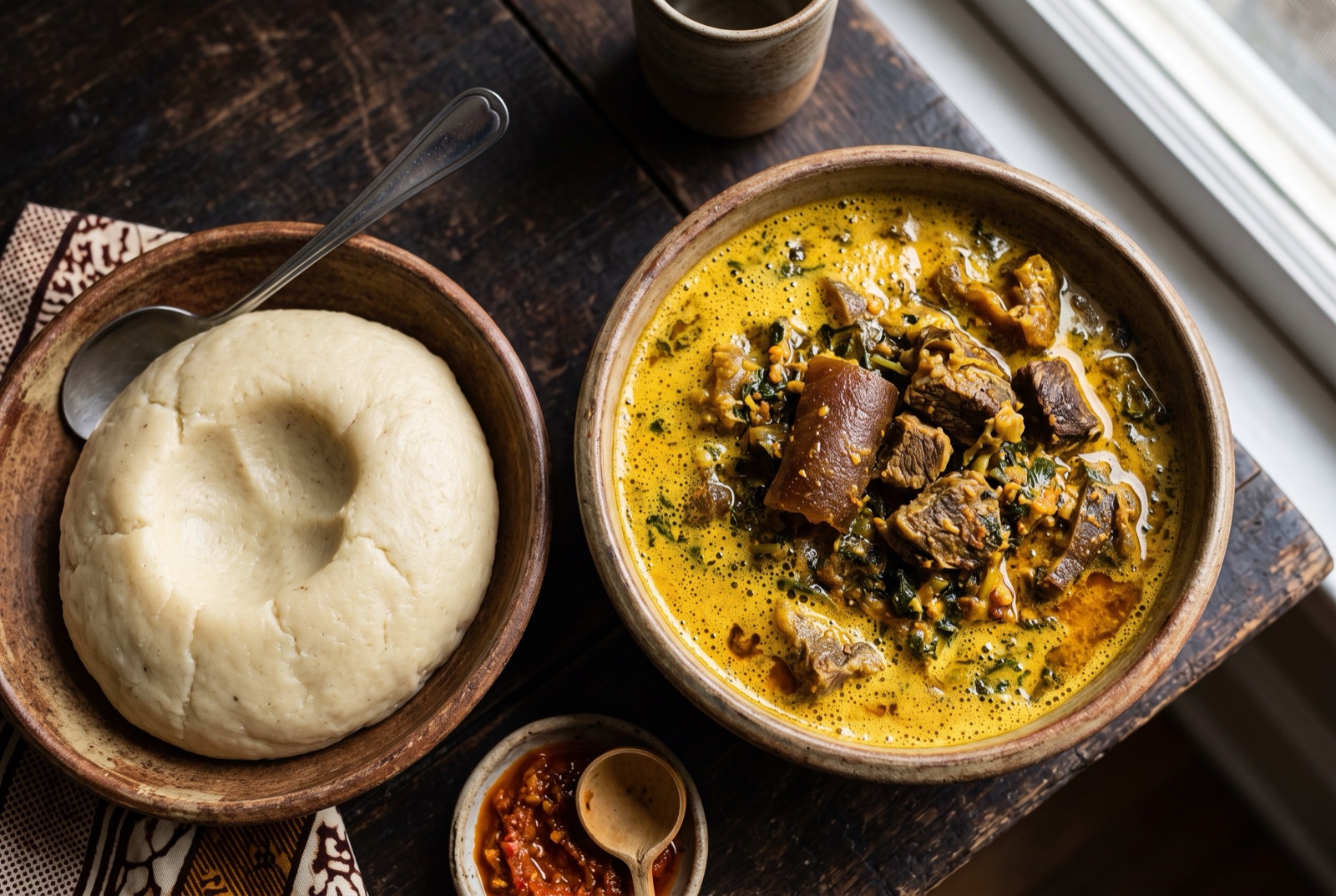
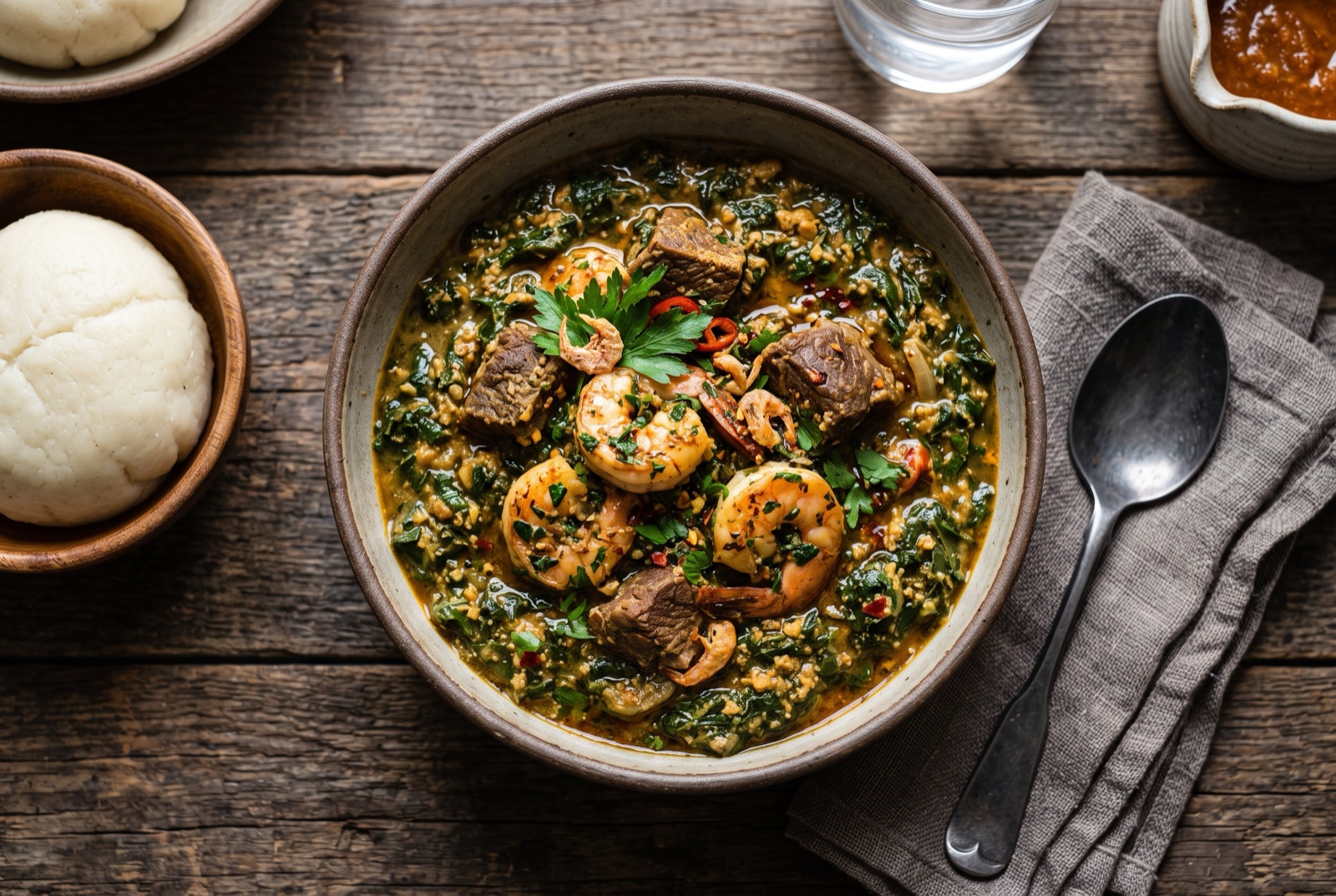
Achu soup is a piece of kitchen chemistry served for lunch. Deep orange red palm oil is beaten with alkaline limestone water until the two emulsify and the colour flips to a startling canary yellow, thin and glossy rather than oily on the tongue. Into it go beef, cow skin and tripe simmered until yielding, ground crayfish for savour, and a fragrant spice mix built on country onion and calabash nutmeg. The taste is unusual for anyone new to it: rich but strangely light, faintly soapy-mineral in a way that turns out to be pleasant, aromatic and warm with pepper. It is the ceremonial food of the North West Grassfields, eaten by hand with a mound of pounded cocoyam.

- Gate
- CameroonNorth West
- Prep
- 30 min
- Cook
- 2 hr
- Total time
- 2 hr 30 min
- Serves
- 6
- Status
- Medium
- Nutrition / serving · estimated
- Calories 690 kcal
- Protein 33 g
- Carbs 42 g
- Fat 44 g
- Fiber 5 g
- Sodium 1150 mg
Why this recipe works.
- Walks through the emulsion step by feel and colour, which is the only way to judge it reliably.
- Sets out safe, sensible quantities for limestone water instead of leaving it to guesswork.
- Cooks the meats in stages so cow skin, tripe and beef all finish at the right texture.
- Says clearly what baking soda does and does not replace, rather than presenting it as an equal swap.
Ingredients.
14 itemsFor the meats
For the yellow soup
To serve
Equipment
- Large pot
- Wide bowl for emulsifying
- Sturdy whisk or wooden spoon
- Fine sieve
Instructions.
Prepare the limestone water
Crush the kanwa and stir it into 300 ml of water. Leave it to stand for 15 minutes until the sediment settles, then carefully pour off the clear liquid through a fine sieve and discard the grit at the bottom.
Simmer the meats
Put the cow skin and tripe in a large pot with the halved onion, bay leaves, a tablespoon of salt and the water. Simmer for 60 minutes, then add the beef shank and cook 40 minutes more, until the skin is translucent and soft and the beef pulls apart under gentle pressure. Strain and keep the stock hot.
Boil the cocoyam
While the meat cooks, boil the peeled cocoyam in salted water for about 30 minutes until a knife slides in without resistance. Pound it hot in a mortar, or mash and beat it hard with a wooden spoon, until smooth and elastic. Keep it covered and warm.
Tip Cocoyam sets fast as it cools. Work quickly and keep a bowl of warm water nearby to wet your hands and the pestle.
Start the emulsion
Warm the palm oil in a wide bowl set over a pan of hot water until it is fully liquid and just warm to the finger, not hot. Whisk in the limestone water one tablespoon at a time, beating continuously in one direction.
Watch the colour turn
Keep beating for 3 to 5 minutes. The oil will thicken, lighten through peach, then flip quite suddenly to an opaque canary yellow that coats the whisk. Stop adding limestone water the moment the colour holds.
Tip If it stays orange and loose, add half a spoon more solution and beat harder — it usually needs persistence rather than more liquid.
Build the soup
Whisk in the achu spice, ground crayfish and scotch bonnet paste, then ladle in about 700 ml of the hot meat stock a little at a time, whisking to keep the emulsion smooth. The soup should pour in a steady, slightly thickened stream.
Finish and serve
Return the soup to the pan with the cooked meats and warm through over low heat for 5 minutes without letting it boil. Taste for salt and for the mineral edge. Serve poured into a well pressed into the mound of pounded cocoyam.
Tips from our kitchen.
- Dissolve the kanwa in water and let it settle, then use only the clear liquid from the top — the grit at the bottom is not food.
- Add the limestone water a spoonful at a time. The colour change is dramatic and once the soup goes too alkaline there is no pulling it back.
- Beat with a wooden spoon or a whisk in one direction and keep going. The oil looks stubbornly orange for a while, then flips to yellow quite suddenly.
- Keep the meat stock hot when you add it, since cold liquid can shock the emulsion into splitting.
- The finished soup should coat a spoon lightly and pour in a smooth stream. If it looks like oil floating on broth, it never emulsified — whisk in a little more limestone water off the heat.
- Taste for the alkaline edge before salting. A faintly mineral finish is correct; anything that stings the tongue means you overshot.
Substitutions.
- Kanwa (limestone / potash) → 1 tsp bicarbonate of soda dissolved in 200 ml water
- Bicarbonate is also alkaline and will emulsify the palm oil and turn it yellow, so mechanically it works. The flavour is not identical — kanwa brings a rounder mineral note, while bicarbonate can taste flatly soapy if you use a gram too much. Add it far more cautiously than you would kanwa, and buy food-grade kanwa from an African grocer if you plan to make this again.
- Achu spice mix → 1 tsp ground nutmeg, 1 tsp ground coriander seed, 1 tsp white pepper and 1 tsp ground ginger
- A reasonable aromatic stand-in that keeps the soup from tasting bare. It does not reproduce country onion or calabash nutmeg, both of which have a musky, almost camphor-like quality that defines the real thing. Ready-made achu spice is inexpensive online and keeps for months.
- Cow skin, tripe and cow foot → Beef shank and oxtail
- Both give you collagen and long-simmered richness. You lose the textural variety that Grassfields cooks prize, but the soup remains balanced and is easier for cautious eaters.
Variations.
- Achu with dried fish
- Stockfish or smoked fish added alongside the meats, giving a sharper savoury profile that some families prefer to an all-beef pot.
- Lighter yellow soup
- Half the palm oil and extra stock, producing a thinner soup that still emulsifies. Common for everyday eating rather than for feast days.
- Achu with plantain
- Served over boiled green plantain or cocoyam chunks instead of pounded achu, for cooks without a mortar. Not traditional, but it keeps the soup on the table.
Storage & reheating.
Keeps 3 days refrigerated, though the emulsion sets solid and pale as it chills. Reheat slowly over low heat, whisking as it loosens, and it comes back together; do not boil it hard or the oil separates out and will not re-emulsify. Freezing is not recommended for the same reason. The meats can be cooked and refrigerated up to two days ahead, which takes most of the work out of the day itself.
Serve with
Pounded cocoyam (achu) is the traditional partner — boiled cocoyam pounded to a smooth elastic mound with a well in the centre for the soup. Boiled taro or a stiff cassava fufu if pounding is out of reach.
The story behind Achu Soup.
In the North West region around Bamenda, achu is what you eat on important days. The name properly belongs to the starch — cocoyam boiled and pounded in a wooden mortar into a smooth, elastic white mound with a well pressed into the middle — and the yellow soup is poured into that well. Eating it is a specific ritual: you pinch the cocoyam from the edge with the fingers of the right hand, dip it into the soup, and work inward, never breaking the wall until the end. Pounding proper achu is heavy physical work, usually done by several people taking turns, which is one reason the dish signals occasion rather than everyday cooking.
The soup itself depends on kanwa, also called akanwu or limestone, a naturally occurring alkaline mineral used across West and Central Africa. Dissolved in water, strained and beaten into palm oil, it saponifies the oil just enough to emulsify it, and that reaction produces the yellow colour. It is the same principle that makes some Nigerian dishes cling and thicken, but achu soup is the clearest demonstration of it — you literally watch the pot change colour in your hands. Get the balance wrong and the emulsion breaks or the soup tastes bitterly alkaline, which is why cooks add the limestone water gradually and taste constantly.
The spice side is regional and hard to reproduce elsewhere. Achu spice mixes contain country onion (rondelle), calabash nutmeg (ehuru), alligator pepper and hot pepper, sold ready-ground in Cameroonian shops as a yellow-brown powder. Every family adjusts it. The meat side is deliberately varied: beef, cow skin, tripe and sometimes cow foot, each contributing a different texture, and Grassfields cooks consider a soup made from a single cut a poor showing. It is generous, communal food, and Cameroonians from the North West living abroad will carry kanwa and achu spice back in their luggage rather than attempt it without.
Questions, answered.
Why does the palm oil turn yellow?
Alkaline limestone water reacts with the fatty acids in red palm oil and partially saponifies it, which emulsifies the oil into the water and changes how it reflects light. The result is a bright, opaque yellow instead of translucent orange. It is a chemical change, not a colouring, and it is also what gives the soup its smooth, non-greasy texture.
What is kanwa and is it safe to eat?
Kanwa, also called akanwu, potash or limestone, is a naturally occurring alkaline mineral salt used in small quantities across West and Central African cooking as a tenderiser and emulsifier. Food-grade kanwa from a reputable African grocer is safe in the tiny amounts used here. Use it sparingly, always dissolve and decant it, and never treat it as a seasoning to be added by eye at the table.
What is achu, exactly?
Achu is the starch: cocoyam, a taro relative, boiled and pounded until smooth and stretchy, shaped into a mound with a crater in the middle to hold the soup. The phrase achu soup refers to the yellow soup served with it. In practice Cameroonians often say achu for the whole plate, since neither half is served without the other.
Can I use ordinary cooking oil instead of red palm oil?
No. The colour, flavour and the emulsion itself all depend on unrefined red palm oil, which contains the free fatty acids that react with the alkaline water. Neutral vegetable oils simply will not turn yellow or thicken. Unrefined red palm oil is sold in African, Caribbean and Brazilian shops and keeps for months in a cupboard.
My soup separated into oil and broth. Can I fix it?
Usually yes. Take it off the heat, let it cool slightly, and whisk hard while adding limestone water half a teaspoon at a time until it comes together and pales. Separation is normally caused by too little alkaline water, too much heat, or cold stock added too quickly. Once fixed, keep it at a bare simmer rather than a boil.
You might also like.
All recipes →
Keep exploring Cameroon.
Cameroon has 9 more dishes in the atlas — Beignets Haricots and Eru, and 7 more.
All Cameroon recipes Beef shank recipes Tripe recipes Dried shrimp recipes soupdairy freegluten freeRecipe by The DishRoute Kitchen · published August 20, 2026 · updated August 20, 2026