Rinderrouladen.
German Beef Roll-Ups in Onion Gravy
Rinderrouladen · say it: RIN-der-roo-LAH-den
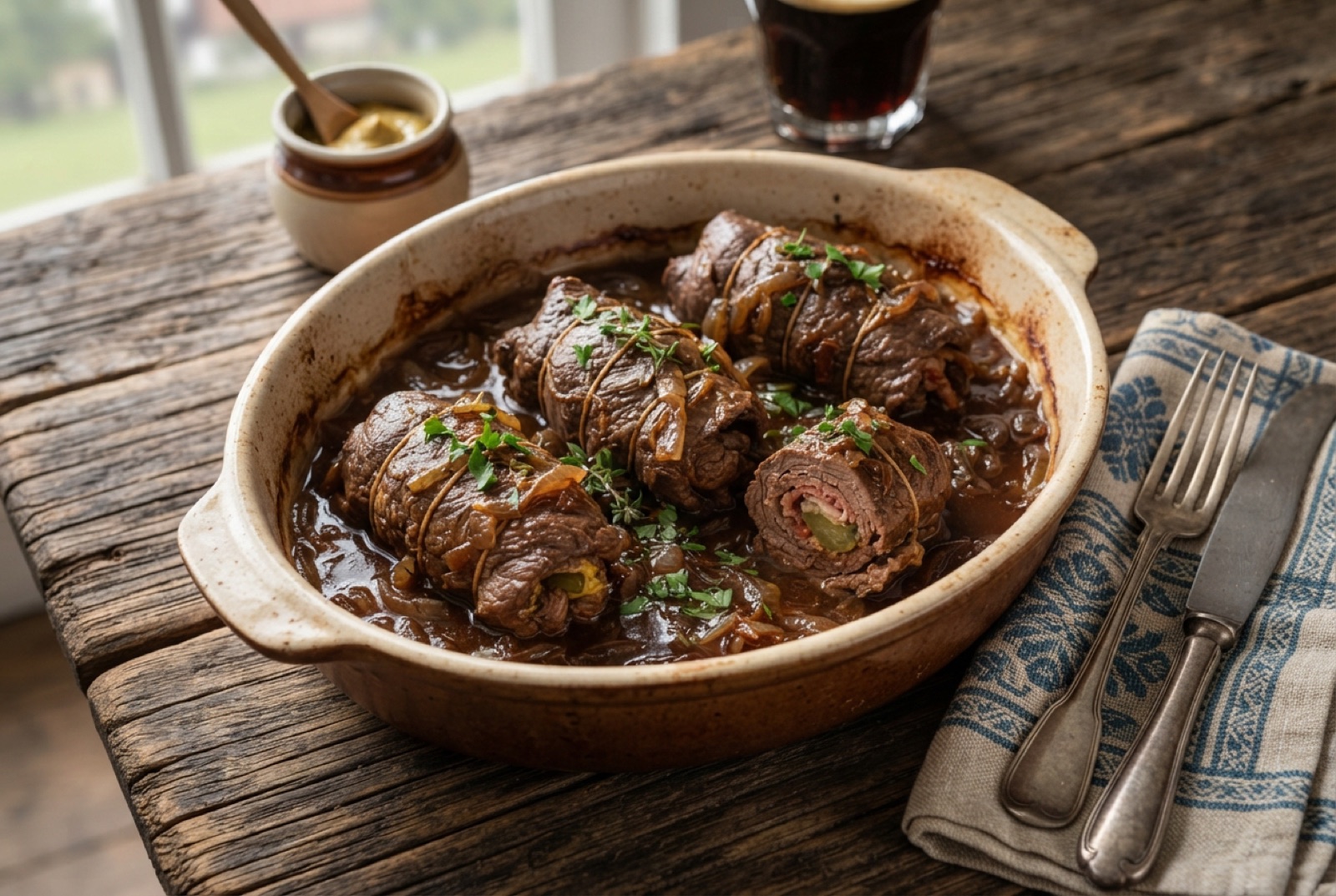
Rinderrouladen are beef slices pounded thin, painted with sharp mustard, packed with bacon, raw onion and a strip of pickled gherkin, rolled up and braised until a fork goes through them without effort. The filling is the whole idea: the gherkin and mustard cut the richness from the inside while the bacon bastes the lean beef, so every slice you cut through tastes seasoned rather than just meaty. The braising liquid becomes the gravy, dark and glossy from the browned meat and softened onions. In most German families this is Sunday lunch, and it comes with red cabbage and something starchy — dumplings, Spätzle or plain boiled potatoes.

- Gate
- Germany
- Prep
- 35 min
- Cook
- 1 hr 45 min
- Total time
- 2 hr 20 min
- Serves
- 4
- Status
- Medium
- Nutrition / serving · estimated
- Calories 610 kcal
- Protein 58 g
- Carbs 12 g
- Fat 34 g
- Fiber 2 g
- Sugar 5 g
- Sodium 1050 mg
Why this recipe works.
- The filling is balanced for a whole roll, not just piled in: enough gherkin to cut the fat, not so much that the gravy turns sour.
- Rolls are seared hard before braising, so the gravy gets its colour from the pan rather than from a bottle of gravy browning.
- Braising vegetables are strained and pressed through, which thickens the sauce naturally before any starch is added.
- Written as a make-ahead: the rolls genuinely improve overnight, and the reheating method is spelled out.
Ingredients.
17 itemsFor the rolls
For the gravy
To finish
Equipment
- Meat mallet or heavy rolling pin
- Wooden cocktail sticks, kitchen string or roulade clips
- Wide heavy pan or Dutch oven with a lid
- Fine sieve
Instructions.
Prepare and fill the slices
Lay the beef slices flat between sheets of baking paper and pound any thick spots until each one is an even 5 mm. Spread a thin layer of mustard over each slice, grind over a little pepper, then lay on a rasher of bacon, a scatter of sliced onion and a quarter of gherkin near one short end.
Roll and secure
Fold the long sides in over the filling, then roll each slice up tightly from the filled end. Fix the seam with two cocktail sticks pushed in flat, string or a roulade clip. The roll should feel firm, not loose — slack rolls fall open in the pot.
Sear hard
Heat the oil in a wide heavy pan until it shimmers and brown the rolls in two batches, seam-side down first, turning until every side is deeply coloured — about 8 minutes per batch. Leave space between them; crowded rolls steam grey and the gravy never recovers its colour.
Tip Wait for the roll to release itself from the pan before turning it. If it sticks, it is not browned yet.
Build the gravy base
Lift the rolls out. Fry the chopped onion, carrot and celeriac in the same pan until the onion edges go properly brown, then stir in the tomato paste and cook it for a minute until it darkens and smells sweet rather than raw and metallic.
Deglaze and braise
Pour in the red wine and scrape every brown patch off the pan base, letting it reduce by half. Add the stock, bay leaves and peppercorns, return the rolls seam-side down, cover, and simmer very gently for 90 minutes, turning them once halfway.
Tip Done means a fork slides into a roll with no resistance and the roll sags slightly when lifted. Ninety minutes is a guide, not a rule — thicker slices need longer.
Strain and finish the sauce
Move the rolls to a warm dish and remove every stick, clip or piece of string. Strain the sauce into a clean pan, pressing the vegetables firmly through the sieve so their purée thickens it, then skim the fat and simmer to reduce until it coats a spoon. Thicken with the slaked cornflour only if it is still thin, and season.
Serve
Return the rolls to the sauce for a couple of minutes to warm through and take on gloss, then serve two per person with plenty of gravy and a scatter of parsley, alongside dumplings and red cabbage.
Tips from our kitchen.
- Ask the butcher for Rouladen slices from the round, roughly 15 x 20 cm and 5 mm thick. Failing that, buy thin sandwich steaks and pound them out between two sheets of baking paper.
- Pound from the centre outwards with the flat side of the mallet. Hammering with the toothed side tears holes that let the filling escape in the pot.
- Fold the long sides in over the filling before you start rolling, the way you fold a burrito. Rolled without that fold, the ends leak onion and bacon into the sauce.
- Sear in batches with space between the rolls. Crowded rolls release liquid and boil grey, and grey rolls make pale gravy that never recovers.
- Do not salt the rolls heavily before browning — the bacon, the mustard and the gherkins are all salty, and the gravy reduces on top of that. Salt at the end instead.
- If the gravy is still thin at the end, take out the rolls and boil it down rather than adding more starch; reduction gives gloss that cornflour cannot.
Substitutions.
- Pickled gherkins → Cornichons, or a strip of pickled red pepper
- Use sour, salt-brined gherkins rather than sweet bread-and-butter pickles, which turn the gravy cloying. Cornichons are smaller, so use two per roll.
- Smoked bacon → Pancetta, or thin slices of smoked ham
- The point is smoky fat that renders inside the roll. Unsmoked bacon works but the filling tastes noticeably flatter.
- German medium-hot mustard → Dijon mustard, used slightly more sparingly
- Dijon is sharper and more volatile; German mittelscharfer Senf is rounder. Avoid English mustard, which overwhelms everything else in the roll.
Variations.
- Rouladen with root vegetables inside
- Add a matchstick of carrot and one of celeriac alongside the gherkin. The rolls slice into a prettier spiral and the filling tastes sweeter against the mustard.
- Pork or turkey Rouladen
- Schnitzel-thin pork or turkey breast rolled the same way needs only 45–50 minutes of braising. Lighter, faster, and the standard weeknight version in many households.
- Vegetarian cabbage Rouladen
- Blanched savoy leaves rolled around mushrooms, onion and breadcrumbs, braised in vegetable stock with mustard stirred into the sauce — the same flavour logic without the beef.
Storage & reheating.
Rouladen keep 3 days refrigerated in their gravy and are widely considered better on day two, once the mustard and gherkin have worked through the meat. Reheat covered over low heat until the gravy just steams, roughly 20 minutes from cold — boiling makes the beef fibrous. They freeze well for 3 months submerged in gravy; thaw overnight in the fridge before reheating. Remove skewers or string before storing so nothing pierces the container or spears anyone later.
Serve with
Potato dumplings or Spätzle to soak up the gravy, with braised red cabbage or buttered green beans alongside.
The story behind Rinderrouladen.
Rouladen are Germany's answer to a broader European habit of rolling thin meat around a savoury filling — Italy has involtini, France has paupiettes, the Balkans have their own versions — and the technique makes sense wherever a lean, cheap slice of beef needs help. The German filling is unmistakable, though: medium-hot mustard, smoked bacon, raw onion and a sour gherkin, four ingredients that between them supply fat, sharpness, salt and acid to a cut that has none of its own. Butchers still sell the specific slice cut for this dish, labelled Rouladenfleisch and taken from the round, wide and about half a centimetre thick.
The dish reads as festive without being expensive, which explains its position in the household calendar. It appears at Sunday lunches, at Christmas in many regions, and at the kind of family gathering where the number of rouladen per person is a known quantity. It is also the classic make-ahead: the rolls are better reheated, so the cooking happens the day before and the host is not tied to the stove. Regional habits diverge on the details — some cooks add a slice of celeriac or carrot inside, some skip the gherkin, some tie the rolls with string rather than pinning them with wooden skewers or the clips German kitchen shops sell for exactly this purpose.
What every version shares is the gravy discipline. The rolls are browned hard first, the fond is deglazed with stock and often red wine, root vegetables go in to give body, and everything simmers together until the rolls give up enough gelatine to make the sauce cling. Strain it or leave it rustic depending on the household, but it is never made separately — the sauce and the rouladen are one process, and a Sunday plate lives or dies on it.
Questions, answered.
What cut of beef do I need for Rouladen?
Thin slices from the round — top round or silverside — cut across the muscle to about 5 mm thick. German butchers sell them ready-cut as Rouladenfleisch. If you can only find thicker steaks, pound them between sheets of baking paper until they are wide and even, since anything thicker than about 7 mm will not roll neatly or cook through in the time given.
How do I stop the rolls from unravelling?
Fold the long sides in over the filling before rolling, then secure the seam with two wooden cocktail sticks pushed in flat, kitchen string, or purpose-made roulade clips. Always place the rolls seam-side down in the pan for the first sear so the heat sets the seam shut before anything moves.
Can I make Rouladen in advance?
Yes, and it is the traditional approach. Braise them completely, cool them in the gravy and refrigerate for up to three days, then reheat gently in the sauce. The flavour deepens overnight and the gravy sets slightly, which makes it easier to skim fat from the surface before serving.
Why is my gravy pale instead of dark brown?
Almost always because the rolls were not browned hard enough or the pan was crowded, so they released liquid and steamed instead of searing. The colour in this sauce comes entirely from the fond stuck to the pan base. If it has already happened, deepen the sauce by frying the onions until genuinely brown and cooking the tomato paste until it darkens before adding liquid.
Can I cook Rouladen in a pressure cooker?
Yes. Sear them in the open pot as usual, then pressure-cook for 25 minutes at high pressure with a natural release. Reduce the liquid by a third afterwards, since a sealed pot loses no steam and the gravy comes out thinner than a conventional braise would leave it.
You might also like.
All recipes →
Keep exploring Germany.
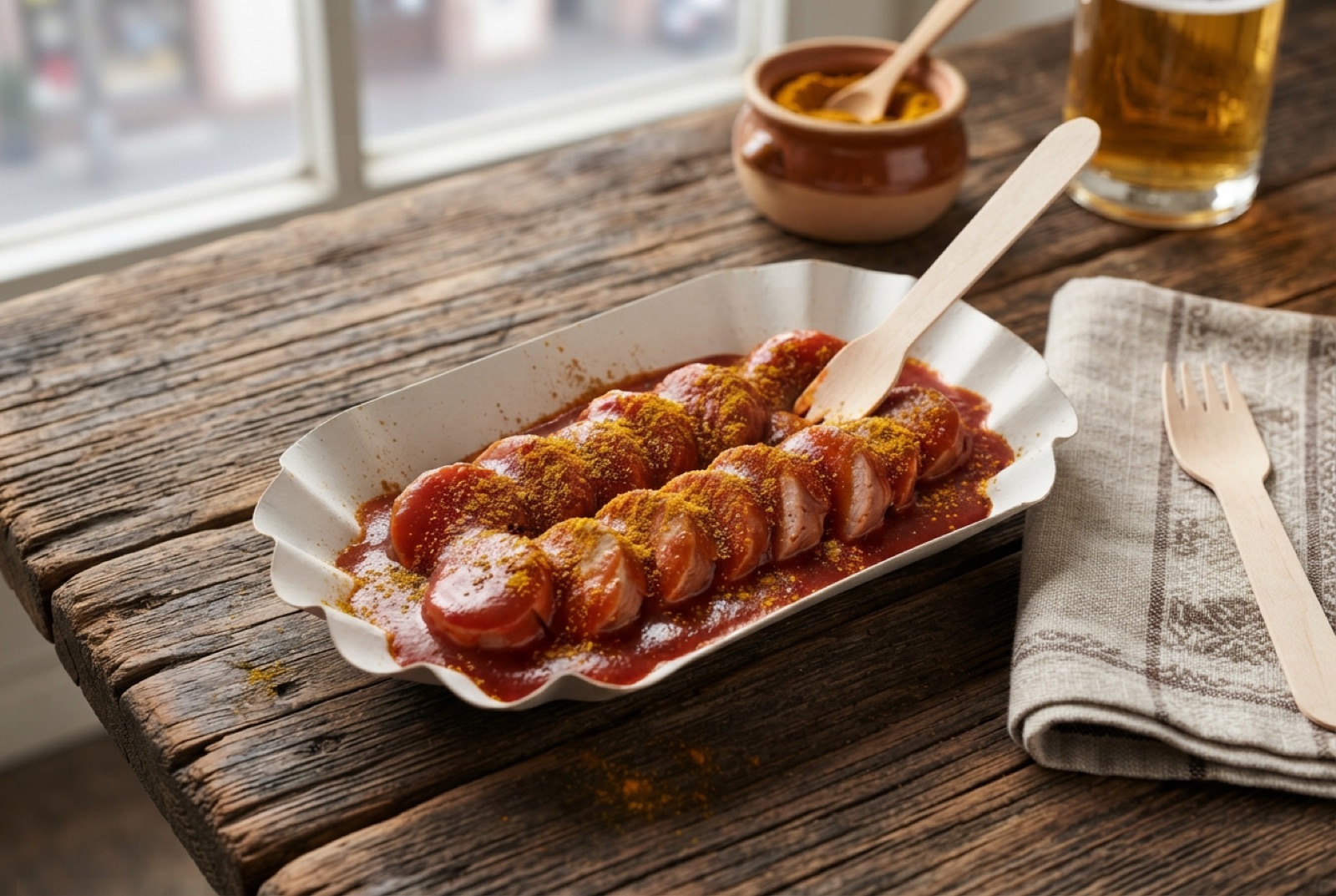
Germany has 9 more dishes in the atlas — Currywurst and Handkäse mit Musik, and 7 more.
Recipe by The DishRoute Kitchen · published August 19, 2026 · updated August 19, 2026