Risotto alla Milanese.
Saffron Risotto from Milan
Risotto alla milanese · say it: ree-ZOT-toh AH-lah mee-lah-NEH-zeh
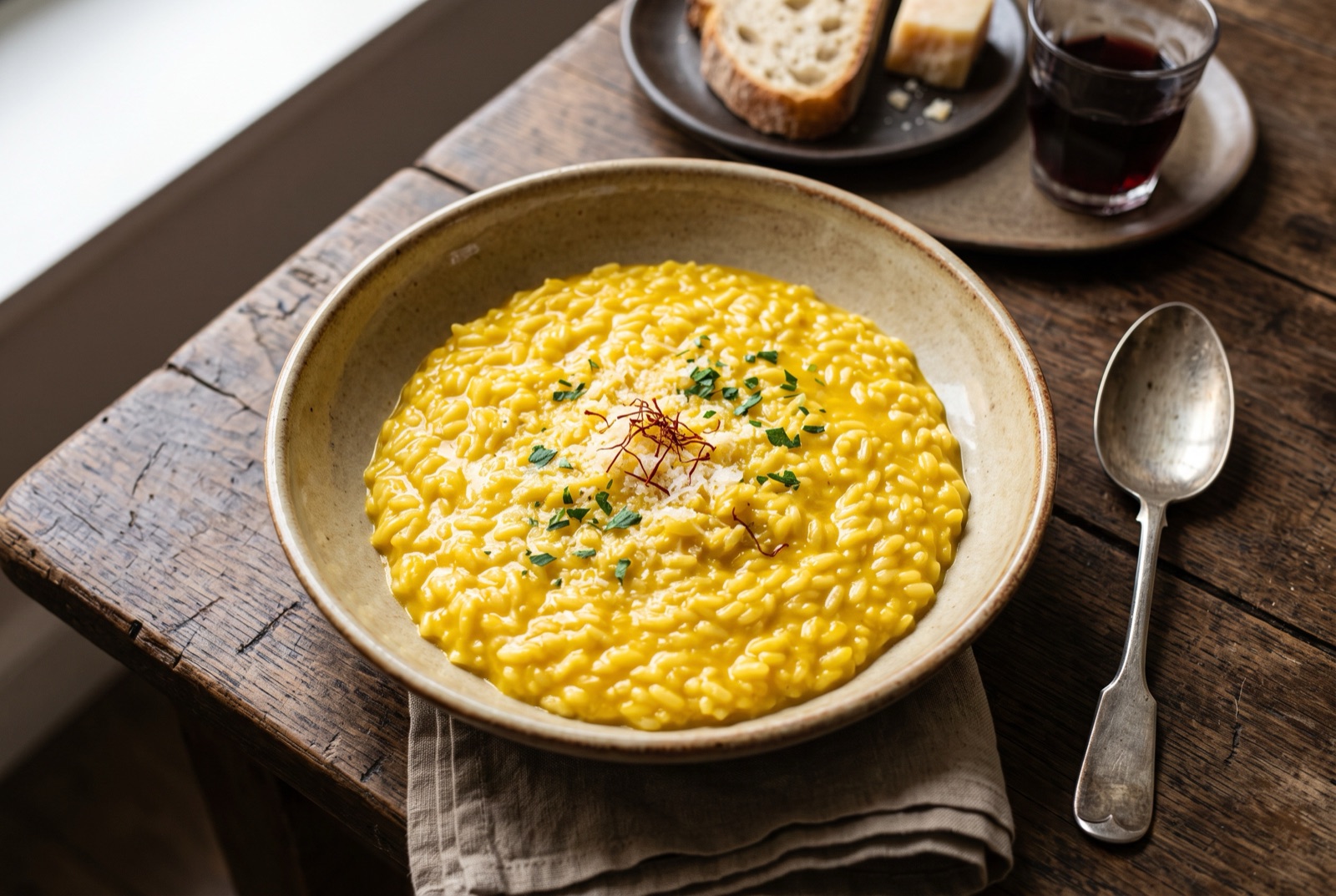
Risotto alla Milanese is a single-flavour risotto — saffron, and almost nothing else competing with it. Short-grain carnaroli or arborio rice is toasted in butter and marrow, moistened ladle by ladle with hot beef broth, and stained deep yellow by saffron threads steeped in a little of that broth. The finish is what makes it Milanese rather than merely yellow: off the heat, cold butter and grated Parmigiano are beaten in hard until the grains loosen and the whole pan moves in a slow wave. It tastes rich and savoury with a faint honeyed bitterness from the saffron, and each grain still has a firm centre.

- Gate
- ItalyLombardy
- Prep
- 15 min
- Cook
- 30 min
- Total time
- 47 min incl. 2 min rest
- Serves
- 4
- Status
- Medium
- Nutrition / serving · estimated
- Calories 590 kcal
- Protein 15 g
- Carbs 68 g
- Fat 26 g
- Fiber 2 g
- Sodium 890 mg
Why this recipe works.
- Saffron is bloomed in warm broth rather than dropped in dry, so the colour is even and the perfume actually reaches the rice.
- Bone marrow in the soffritto — the detail that separates Milanese risotto from generic yellow rice — with an honest substitution if you cannot get it.
- Clear sensory markers for the toasting and the final texture, so you stop cooking at the right moment instead of guessing.
- The mantecatura is done off the heat with cold butter, which is what keeps the finish glossy instead of oily.
Ingredients.
9 itemsEquipment
- Wide heavy-bottomed pan or shallow casserole
- Second pan for the broth
- Wooden spoon
- Fine grater
Instructions.
Bloom the saffron
Crumble the saffron threads into a small cup and pour over a ladle of hot broth. Leave it to steep while you cook — after ten minutes the liquid should be a strong orange-gold, not pale yellow.
Tip Crushing the threads first with the back of a spoon speeds up the extraction noticeably.
Melt the marrow and sweat the onion
In a wide heavy pan over low heat, melt the marrow with 30 g of the butter until it turns liquid and smells faintly beefy. Add the onion and cook for 6–8 minutes, stirring, until it is completely soft and translucent but has taken no colour at all.
Toast the rice
Tip in 320 g of rice and raise the heat to medium. Stir for 2–3 minutes until the grains are coated in fat, the edges look glassy and the centres stay chalky white, and the pan smells toasty rather than raw.
Tip This tostatura firms the outside of each grain so it can absorb broth for 18 minutes without collapsing.
Deglaze with wine
Pour in the white wine and stir until the sharp alcohol smell is gone and the pan is nearly dry again, about 2 minutes. The rice should sizzle, not swim.
Add broth ladle by ladle
Add hot broth one ladle at a time, just enough to cover the rice, stirring regularly and waiting until each addition is almost absorbed before the next. Keep this going for about 12 minutes, adjusting the heat so the surface bubbles steadily but never boils hard.
Stir in the saffron
Pour in the steeped saffron and its broth and stir until the colour is even throughout, then continue with the remaining broth for 4–6 minutes more. Start tasting at 16 minutes total: the grains should be tender with a distinct firm centre and no chalky core.
Mantecatura
Pull the pan off the heat, season with salt, and beat in the cold butter and grated Parmigiano hard with a wooden spoon for about 30 seconds until the risotto turns glossy and loosens visibly. It should slump into a wave when you tilt the pan.
Tip If it holds its shape stiffly, beat in another small ladle of hot broth — risotto tightens further on the plate.
Rest and serve
Cover and rest for 1–2 minutes, then spoon onto warm shallow plates and tap the base of each plate once so the rice spreads itself into an even layer. Serve immediately with more grated Parmigiano.
Tips from our kitchen.
- Keep the broth at a bare simmer in a separate pan. Cold liquid drops the pan temperature and stalls the starch release, and the rice ends up chalky.
- Use carnaroli if you can find it — it holds its centre longer than arborio and is far more forgiving of a distracted cook.
- Never rinse the rice. The surface starch you would wash away is the entire mechanism of the dish.
- Stir often but not constantly; what matters is that the grains keep rubbing against each other and the pan is never dry.
- Salt late. Broth and Parmigiano are both salty, and rice that tastes right at minute ten will be too salty at the end.
- The risotto should be all'onda — flowing in a wave. If it stands in a mound on the plate, it needed one more ladle of broth.
Substitutions.
- Beef bone marrow → An extra 20 g butter plus 1 tsp of the fat skimmed from the broth
- You lose the meaty backbone but the risotto is still very good. Butchers sell marrow bones cheaply; ask them to split the bones lengthways so you can scoop the marrow out easily.
- Beef broth → Light chicken broth, or a vegetable broth for a meat-free version
- Vegetable broth makes a cleaner, more floral risotto where the saffron dominates. Avoid strong cube-based stock — it flattens the saffron under salt.
- Carnaroli rice → Arborio or vialone nano
- Vialone nano cooks faster and drinks more broth; start tasting at 13 minutes. Long-grain and basmati will not work at all — they have the wrong starch.
Variations.
- Risotto al salto
- The classic use for leftovers: press cold risotto into a thin disc in a buttered pan and fry it undisturbed until a deep golden crust forms, then flip and crisp the other side.
- Risotto alla Milanese con ossobuco
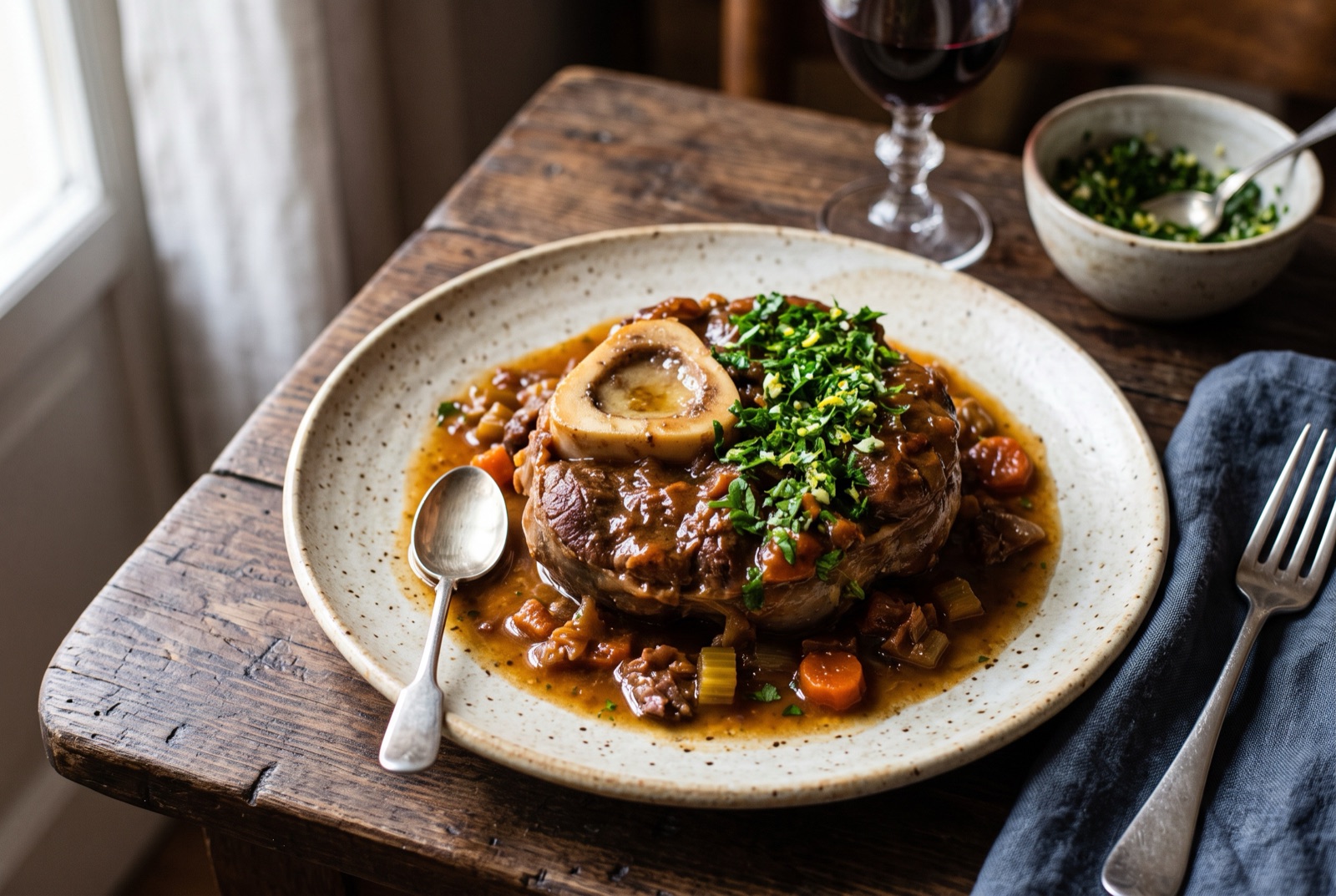
- Served as a plate rather than a course, with a braised veal shank set on the rice so its juices run into the grains. In Milan this counts as one dish, not two.
- Saffron risotto with red wine
- A Lombard variant that deglazes with dry red instead of white, giving a darker, deeper risotto with a slightly tannic edge against the saffron.
Storage & reheating.
Risotto is at its best within minutes of the mantecatura and does not hold well; refrigerated it stiffens into a solid block as the starch retrogrades. Rather than fighting that, use it: keep leftovers up to 2 days and make risotto al salto, or roll them into rice balls. If you do want to reheat it as risotto, loosen it in a pan over low heat with a splash of hot broth and a knob of butter, stirring until it flows again. Do not freeze — the grains turn mealy on thawing.
Serve with
A shallow warm plate, extra Parmigiano at the table, and a glass of dry Lombard white — or a braised veal shank on top for the full Milanese plate.
The story behind Risotto alla Milanese.
Saffron in a Lombard rice dish is less strange than it sounds. Rice has been grown in the flooded plains of the Po valley since the fifteenth century, and Milan sat on trade routes that carried saffron north from the Mediterranean; the city's cooks had both cheap local rice and an expensive spice within reach. The popular tale credits a glassworker on Milan Cathedral who tinted the dish with the saffron he used for stained glass — a story repeated everywhere and documented nowhere, so treat it as folklore rather than history. What is documented is that yellow rice was on Milanese tables by the early nineteenth century and had settled into something close to today's recipe not long after.
The technical heart of the dish is the ratio of surface starch to liquid. Carnaroli and arborio grains shed amylopectin as they are agitated in hot broth, and that starch — not cream, which has no place here — is what makes risotto creamy. Milanese cooks add one more richness that most other risottos skip: midollo, beef bone marrow, melted into the soffritto at the start. It contributes a savoury depth that butter alone cannot, and it is the reason a proper risotto alla Milanese tastes meatier than its ingredient list suggests.
In Milan the dish leads a double life. On its own it is a primo, served in a shallow plate and spread with a tap of the base rather than heaped. Alongside ossobuco it becomes the other half of the city's defining pairing, the rice soaking up the braising juices. And leftovers get their own name: risotto al salto, pressed into a pan the next day and fried until a lacquered crust forms on both sides.
Questions, answered.
Why is my risotto gluey instead of creamy?
Almost always too much stirring combined with too little liquid, which mashes the grains and releases starch faster than the broth can carry it. Add liquid in small ladles so the rice is always just barely covered, stir in bursts rather than continuously, and stop cooking while the grains still have a firm core. A gluey risotto cannot be rescued, but a slightly stiff one can be loosened with hot broth.
How much saffron should I use and in what form?
For four servings, about 0.3–0.5 g of threads — roughly a generous pinch — steeped in warm broth for at least ten minutes before it goes into the pan. Threads are worth the price over powder, which is frequently cut with turmeric or safflower and gives colour without perfume. If your saffron smells of nothing when you rub a thread between your fingers, it is old.
Can I make risotto ahead for a dinner party?
Yes, using the restaurant method. Cook the rice until it is about two-thirds done, roughly 11 minutes, then spread it in a thin layer on a tray to stop the cooking and refrigerate. To serve, tip it back into the pan with hot broth and finish the last few minutes plus the butter-and-cheese mantecatura. The result is close to freshly made and buys you a calm twenty minutes.
Is cream ever used in risotto alla Milanese?
No. The creaminess comes from starch released by the rice and from the emulsion formed when cold butter and grated cheese are beaten in off the heat. Cream masks the saffron and gives a heavy, sauce-like texture that Italian cooks would immediately identify as wrong. If your risotto needs help, it needs more agitation and better butter, not dairy.
What does mantecatura mean and why must the pan be off the heat?
Mantecatura is the final beating-in of cold butter and grated Parmigiano that turns a pan of cooked rice into risotto. It works because butterfat emulsifies into the starchy liquid, and that emulsion is fragile — over direct heat it breaks and the fat separates into greasy pools. Pull the pan off, add cold butter, and beat vigorously for about thirty seconds until the surface looks glossy.
You might also like.
All recipes →
Keep exploring Italy.
Italy has 9 more dishes in the atlas — Arancini and Classic Tiramisu, and 7 more.
Recipe by The DishRoute Kitchen · published August 19, 2026 · updated August 19, 2026