Sabich.
Iraqi-Jewish Aubergine and Egg Pita
סביח · Sabich · say it: sah-BEEKH
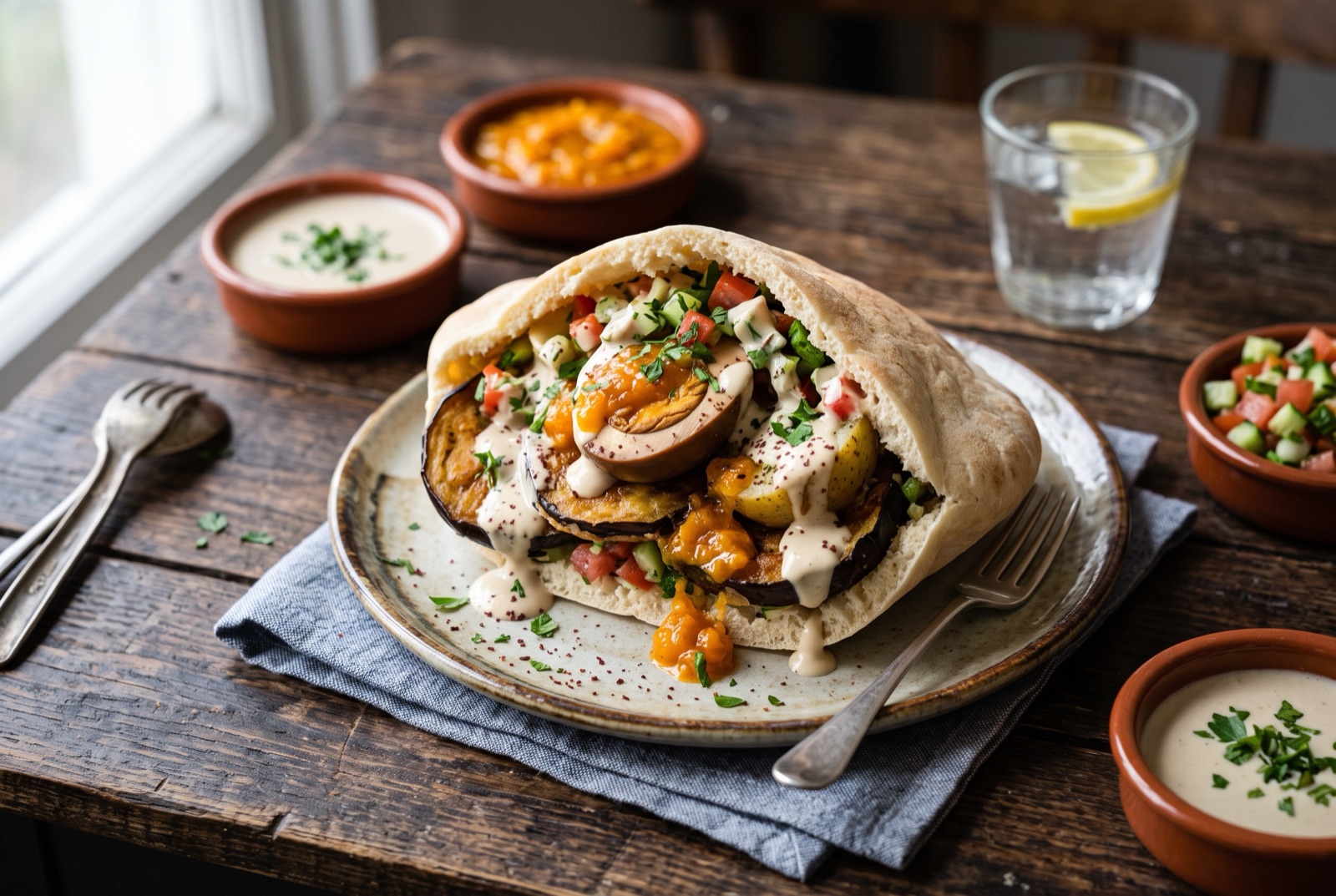
Sabich is a pita stuffed with fried aubergine and a hard-cooked egg that has spent hours in a low pot until the white turns beige and the yolk goes creamy and faintly sweet. Around them go slices of boiled potato, a sharp chopped salad of tomato, cucumber and parsley, pickles, a pour of tahini and a stripe of amba, the sour pickled-mango sauce that makes the whole thing taste unmistakably Iraqi-Jewish. Bitten into, it is soft on soft on soft, held together by the acidity of the amba and the pickles — a sandwich built from leftovers that turned out to be better than most sandwiches built on purpose. Everything can be cooked the day before, which is exactly how it came to exist.

- Gate
- IsraelRamat Gan and greater Tel Aviv
- Prep
- 30 min
- Cook
- 45 min
- Total time
- 4 hr 15 min incl. 3 hr rest
- Serves
- 4
- Status
- Easy
- Nutrition / serving · estimated
- Calories 610 kcal
- Protein 19 g
- Carbs 63 g
- Fat 32 g
- Fiber 11 g
- Sodium 900 mg
Why this recipe works.
- Includes the real slow-cooked brown egg with a shortcut timing that still gives the creamy yolk, rather than swapping in a plain boiled egg.
- Salts and drains the aubergine so it fries golden and rich instead of collapsing into an oil sponge.
- Every component can be made a day ahead, which is how the dish was designed to work.
- Balances the softness with the two acidic elements — amba and pickles — that keep the sandwich from turning heavy.
Ingredients.
16 itemsFor the brown eggs
For the aubergine
For the filling
For the salad
For the tahini sauce
To build
Equipment
- Small heavy pot with a tight lid for the eggs
- Wide frying pan
- Colander
- Whisk
Instructions.
Start the eggs the day before
Put 4 eggs in a small pot with the onion skins, cover with cold water by 3 cm and bring to the barest tremble. Cover, drop the heat as low as it goes and leave for at least 3 hours, topping up the water if it drops below the eggs. The shells will darken and the whites turn pale tan.
Tip A heat diffuser or the smallest burner on its lowest setting is ideal. Anything approaching a real simmer makes the whites rubbery.
Salt and drain the aubergine
Lay the aubergine rounds in a colander, salting each layer as you go, and leave them 30 minutes over the sink. Beads of moisture will collect on the surface and the slices will go visibly limp. Press each one firmly dry between two towels.
Fry the aubergine
Heat a 5 mm layer of oil in a wide pan until a corner of aubergine sizzles on contact. Fry the slices in a single layer for 3–4 minutes per side, until deep gold with a few darker blisters and completely yielding in the centre. Drain on a rack and season lightly.
Tip If the slices go pale and floppy, the oil was not hot enough. Wait for the shimmer before the next batch.
Whip the tahini sauce
Whisk the tahini with the grated garlic, a good pinch of salt and half the lemon juice. It will seize into a stiff grey paste — keep going. Add the ice water a splash at a time, whisking hard between additions, until it turns pale, glossy and pourable.
Chop the salad
Toss the diced tomato and cucumber with the parsley, the remaining lemon juice, a pinch of salt and a drizzle of olive oil. Chop everything small — the pieces should be the size of the diced aubergine, so no single element dominates a bite.
Peel and slice the eggs
Peel the brown eggs under cold running water and cut them into thick rounds. The yolks should be firm but creamy and pale gold rather than crumbly and grey-edged.
Build the sandwich
Warm the pitas until soft and pliable, cut a wide opening and paint the inside of the pocket with tahini. Layer in the potato slices, then the aubergine, then the egg rounds, so the heaviest things sit at the bottom.
Finish with amba and pickles
Pack the chopped salad over the top, tuck in pickles and pink turnip, then finish with a heavy zigzag of amba, a last pour of tahini and zhug if you want heat. Wrap the base in paper and eat straight away.
Tips from our kitchen.
- Cut the aubergine into 1 cm slices, no thinner. Thin slices go floppy and greasy; thick ones stay creamy inside with a proper browned face.
- Salt the slices for 30 minutes and press them dry with a towel before frying. Wet aubergine steams in the pan and drinks far more oil.
- Cook the eggs in their shells at the barest simmer for at least three hours with a handful of onion skins in the water — that is where the colour and the creamy yolk come from.
- Warm the pita before filling. A cold pita cracks along the fold and dumps the filling on the counter.
- Line the inside of the pocket with tahini first so it coats the bread rather than pooling at the bottom.
- Build in layers and do not overfill. Aubergine and potato at the bottom, egg in the middle, salad and sauces on top so the last bite is not just bread.
Substitutions.
- Amba → Mango chutney loosened with lemon juice, a pinch of turmeric and a pinch of ground fenugreek
- Real amba is sour and pungent rather than sweet; the substitute gets you the colour and tang but not the funk. Jars keep for months once opened.
- Fried aubergine → Aubergine slices brushed with oil and roasted at 220°C for 25 minutes, turning once
- Uses a fraction of the oil and works genuinely well. The texture is drier and slightly chewier than fried, which some people prefer.
- Pita → Laffa or any large soft flatbread, rolled rather than stuffed
- Easier to pack full and less likely to tear. Wrap the bottom half in paper because a rolled sabich leaks.
Variations.
- Sabich with schug
- Add a teaspoon of Yemenite green chilli relish alongside the amba. The heat cuts straight through the richness of the egg and fried aubergine.
- Sabich plate
- Serve everything unassembled on a platter with bread on the side — the original Shabbat-morning format, and much easier when feeding a table.
- Sabich with hummus
- Line the pita with hummus as well as tahini. Common at Israeli stands and it makes the sandwich considerably more filling.
Storage & reheating.
Never store an assembled sabich — the bread turns to paste within an hour. The components, on the other hand, are made for storage: brown eggs keep 4 days in their shells in the fridge, fried aubergine 3 days in a covered container, boiled potatoes 3 days, and tahini sauce a week. Chop the salad fresh, since tomato and cucumber weep once salted. To reassemble, bring the aubergine and potato back to room temperature or warm them briefly, and heat the pita for 30 seconds.
Serve with
Pickled cucumbers, pink pickled turnip, extra tahini in a jug and cold lemonade with mint.
The story behind Sabich.
Sabich began as a Shabbat morning meal in Iraqi Jewish households. Because cooking is not permitted on the Sabbath, everything was prepared on Friday: aubergine fried in advance, eggs left overnight in a pot on the lowest possible flame — often tucked into the same pot as the overnight stew — potatoes boiled, salad chopped and dressed. On Saturday morning the components were laid out and eaten with flatbread. When Iraqi Jews arrived in Israel in large numbers around 1950 and 1951, the meal came with them, and at some point in the following decades a stand in Ramat Gan started selling it stuffed into a pita as a fast, cheap lunch. From there it spread across the country and eventually abroad.
The name is genuinely disputed. One story holds that it comes from the Arabic sabah, meaning morning, which fits the dish's original slot in the week. Another says it was the nickname of the vendor who first sold it. A third, popular but almost certainly invented after the fact, reads it as a Hebrew acronym for the ingredients. Nobody can settle it, and Israeli food writers cheerfully cite all three.
What matters more than the etymology is the egg. Beitzah haminada — a brown egg, cooked for many hours at very low heat, often with onion skins or coffee grounds in the water — is a Sephardi and Middle Eastern tradition shared well beyond Iraq, and it is not the same thing as a hard-boiled egg. The long, gentle cooking turns the white pale tan and the yolk dense, smooth and almost custardy, with a mellow flavour that stands up to the amba instead of disappearing under it. Making sabich with a ten-minute boiled egg will produce a decent aubergine sandwich, but it will not produce sabich.
Questions, answered.
What is a haminado egg and can I skip it?
It is an egg simmered in its shell for many hours at very low heat, traditionally with onion skins, until the white turns pale brown and the yolk becomes dense and creamy. It is a Sephardi and Middle Eastern tradition tied to overnight Sabbath cooking. You can substitute a normal hard-boiled egg and the sandwich will still be good, but the mellow, almost custardy yolk is a large part of what makes sabich taste like sabich.
Do I really have to salt the aubergine?
For this dish, yes — not to remove bitterness, which modern varieties barely have, but to collapse the sponge-like cell structure. Salted and pressed aubergine absorbs noticeably less oil and fries to a golden, creamy slice instead of a greasy grey one. Thirty minutes is enough, and rinse only if you used a heavy hand with the salt.
What does sabich taste like compared with falafel?
Softer and richer. Falafel is about crunch and herbs, while sabich is a study in soft textures — silky aubergine, creamy yolk, floury potato — held in balance by the sourness of amba and pickles and the bitterness of good tahini. It is heavier than falafel and, for many people, more satisfying as a full lunch.
Can I make sabich the night before?
The components, absolutely — that is the tradition it comes from, since Iraqi Jewish families prepared everything on Friday to eat on Saturday morning without cooking. Fry the aubergine, cook the eggs, boil the potatoes and make the tahini sauce a day ahead. Only the chopped salad and the assembly should happen right before you eat.
Why does my tahini sauce turn stiff and grey?
That is normal and it happens to everyone. Adding lemon juice or a little water to raw tahini makes it seize into a thick paste before it loosens. Keep whisking and keep adding ice-cold water a splash at a time; it passes through the stiff stage and then suddenly turns pale, smooth and pourable. Cold water gives a whiter, fluffier sauce than warm.
You might also like.
All recipes →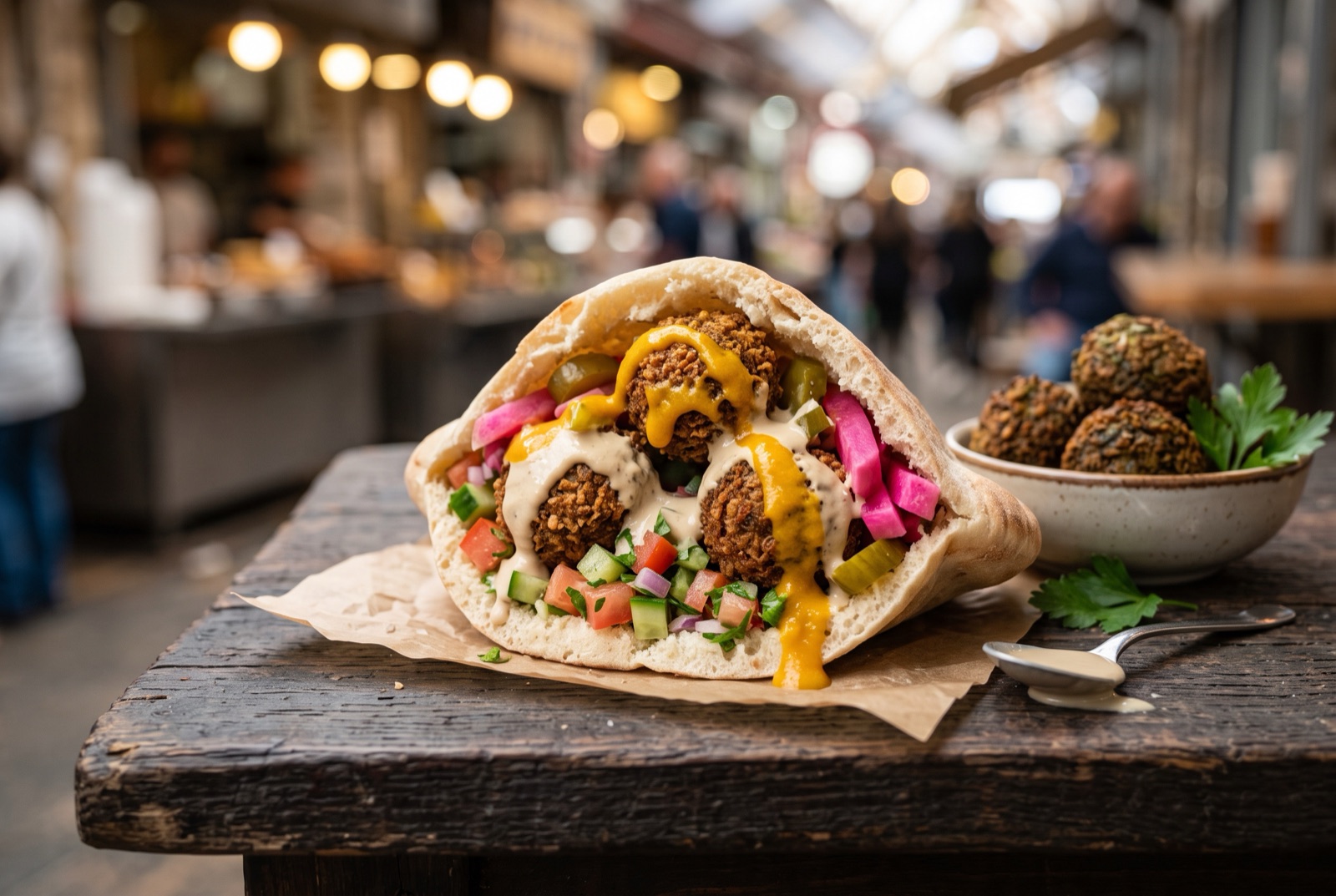
Keep exploring Israel.
Israel has 9 more dishes in the atlas — Challah and Cholent, and 7 more.
Recipe by The DishRoute Kitchen · published August 20, 2026 · updated August 20, 2026