Zagrebački Odrezak.
Veal Folded Around Ham and Cheese
Zagrebački odrezak · say it: ZAH-greb-atch-kee OH-dreh-zak
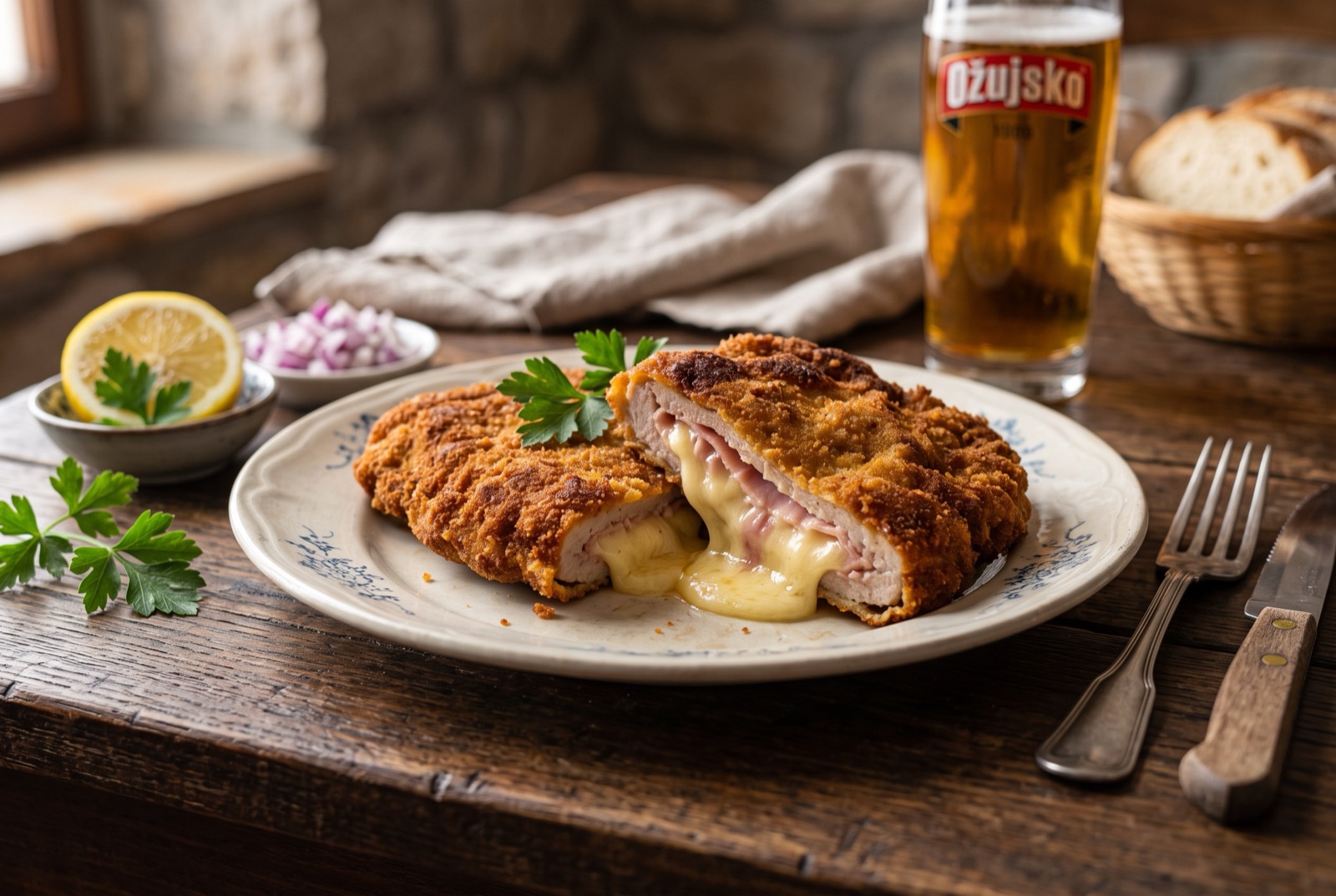
Zagrebački odrezak is continental Croatia's answer to the schnitzel: a veal escalope beaten thin, layered with ham and a mild melting cheese, folded shut like a book, then breaded and fried. Cutting into it is the whole point — the crust should crackle, the veal should be pale and tender, and the cheese should run out slowly rather than having leaked into the pan twenty minutes earlier. The taste is straightforward comfort food: salty ham, mild dairy, clean veal, and the toasted-breadcrumb flavour that makes any breaded cutlet worth eating. It cooks in under ten minutes once the pan is hot, and the only real skill involved is sealing the edges properly.

- Gate
- CroatiaZagreb and continental Croatia
- Prep
- 30 min
- Cook
- 15 min
- Total time
- 1 hr 5 min incl. 20 min rest
- Serves
- 4
- Status
- Easy
- Nutrition / serving · estimated
- Calories 720 kcal
- Protein 55 g
- Carbs 42 g
- Fat 36 g
- Fiber 2 g
- Sodium 1250 mg
Why this recipe works.
- Chills the assembled cutlets before breading, which is the single most effective way to stop the cheese escaping into the pan.
- Uses one folded escalope rather than two stacked cutlets, which is how it is actually made in Zagreb.
- Gives real doneness cues for the fry — colour, sound and the way the crust puffs away from the meat.
- Fries in enough fat for the cutlet to float, so the crust crisps evenly instead of scorching where it touches the pan.
Ingredients.
10 itemsFor the cutlets
For the coating
For frying
To serve
Equipment
- Meat mallet or heavy rolling pin
- Three wide shallow bowls for breading
- Large heavy frying pan
- Cooling rack
Instructions.
Beat the veal thin
Lay each escalope between two sheets of baking paper and work it outwards from the centre with a mallet until it is an even 4–5 mm thick and roughly doubled in area. Season both sides lightly with salt and white pepper, remembering the ham is already salty.
Tip Use a flat mallet face or a rolling pin. The spiked side tears veal into holes that leak later.
Fill and fold
Lay two slices of ham and a quarter of the cheese over one half of each escalope, keeping a clear 2 cm margin of bare meat all the way round. Fold the empty half over the top and press the three open edges together firmly with your fingertips.
Chill the parcels
Transfer the folded cutlets to a tray and refrigerate for at least 20 minutes. This firms the cheese and helps the layers stick, which is what keeps the filling inside during the fry.
Set up the breading line
Put the flour, beaten egg and breadcrumbs into three shallow bowls in that order. Coat each cutlet in flour and shake off every loose speck, then dip it fully in egg and let the excess drip away, then press it into the breadcrumbs on both sides and around the sealed edges.
Tip Pay particular attention to the folded edges — a gap in the crumb coating is where the cheese escapes.
Heat the pan
Pour the oil into a large heavy pan to a depth of about 1 cm, add the butter, and heat over medium until a stray breadcrumb sizzles briskly on contact but takes several seconds to turn golden. Too hot and the crust burns before the cheese softens.
Fry the first side
Slide in two cutlets, never more, and fry for 3–4 minutes without moving them. The crust is ready to turn when it has set into an even deep gold and has begun to lift very slightly away from the meat underneath.
Fry the second side
Turn once with tongs and fry another 3 minutes, spooning some of the hot fat over the top so the crust puffs. Press the centre gently — it should feel springy and the cutlet should feel noticeably lighter and hollower than raw.
Drain and serve
Lift onto a cooling rack for a minute so steam escapes and the crust stays crisp, then repeat with the remaining cutlets. Serve immediately with lemon wedges — cut into one at the table so the cheese is still flowing.
Tips from our kitchen.
- Beat the veal to an even 4–5 mm. Thin spots tear when you fold, and thick spots are still raw when the crust is done.
- Leave a clear 2 cm border of bare meat around the filling. Cheese that reaches the edge will find its way out, every time.
- Press the folded edges firmly and chill the assembled cutlets for at least 20 minutes before breading — cold cheese melts later and leaks less.
- Bread in strict order — flour, then egg, then breadcrumbs — and shake off the excess at each stage. Clumps of wet flour turn into pale soggy patches.
- The oil should be about 1 cm deep and hot enough that a breadcrumb sizzles immediately but does not brown in under five seconds. Too hot and the crust colours before the cheese melts.
- Drain on a rack, never on paper on a plate — steam trapped underneath softens the crust you just made.
Substitutions.
- Veal escalope → Pork loin or turkey breast, sliced and beaten thin
- Pork is the common home substitute in Croatia and tastes excellent. Turkey is leaner and needs a slightly gentler fry so it does not dry out.
- Pršut (air-dried ham) → Cooked ham, or prosciutto crudo
- Cooked ham is milder and gives a softer, more child-friendly result. Air-dried ham brings more salt, so ease off on salting the meat.
- Mild semi-hard cheese → Gruyère, emmental or young gouda
- Any cheese that melts smoothly works. Avoid mozzarella, which releases too much water, and avoid hard aged cheeses, which turn oily rather than stringy.
Variations.
- Pork zagrebački
- The everyday home version, made with pork loin instead of veal. Cheaper, slightly richer, and indistinguishable to most people once it is breaded.
- With mushrooms
- A layer of sautéed, well-drained mushrooms added alongside the ham and cheese — a common restaurant upgrade in the Zagorje region.
- Oven-finished
- Fry to colour on both sides then finish in a 190°C oven for 6–8 minutes. Less fat, more even melting, and a good route if you are cooking six at once.
Storage & reheating.
Best straight out of the pan. Cooked cutlets keep 2 days refrigerated and reheat acceptably in a 190°C oven for 10 minutes on a rack, which re-crisps the crust — a microwave turns it to damp bread. You can assemble and bread them up to a day ahead and keep them uncooked in the fridge on a tray, uncovered, which actually improves the crust. Breaded uncooked cutlets freeze well for a month; fry from frozen over lower heat, adding about four minutes.
Serve with
Roast or boiled potatoes with parsley, a lemon wedge, and tartar sauce or a plate of pickled vegetables.
The story behind Zagrebački Odrezak.
The dish is a product of Zagreb's Habsburg kitchen inheritance. Continental Croatia spent centuries inside the Austro-Hungarian sphere and absorbed its cooking wholesale — breaded cutlets, roasts with dumplings, strudel, cream sauces — so a breaded veal escalope was already thoroughly at home there. Zagrebački odrezak takes that base and stuffs it, which puts it in a family with cordon bleu and with the various stuffed schnitzels of central Europe. There is no reliable single origin story, and claims that pin the invention on one Zagreb hotel or one chef in one particular year should be treated with scepticism; what is certain is that it became the standard restaurant order across northern Croatia and stayed there.
What distinguishes it from cordon bleu is mostly a matter of construction and cheese. The Croatian version usually takes one large escalope folded over its filling rather than two cutlets sandwiched together, and the cheese is a mild yellow semi-hard one — gouda, edamer or a local equivalent — rather than gruyère or emmental. The ham is often pršut, the air-dried Croatian prosciutto, which brings more salt and aroma than cooked ham does. Beyond that, the technique is the standard central European breading drill: flour, egg, breadcrumbs, and enough fat in the pan for the cutlet to float rather than sit.
In Croatia this is confident restaurant food rather than something people fuss over at home, usually landing on a plate with a lemon wedge, a mound of roast or boiled potatoes, and either tartar sauce or a pile of pickled vegetables. It is also what a great many Croatian children order when a family goes out to eat, which tells you something about its position in the national diet. The only serious failure mode is a leak, and the fix for that is patience: seal the edges properly, chill the assembled cutlets, and do not crowd the pan.
Questions, answered.
How do I stop the cheese leaking out?
Three things fix it. Leave a wide bare border of meat around the filling so the edges can seal, press those edges firmly together before breading, and chill the assembled cutlets for at least twenty minutes so the cheese is properly cold when it hits the pan. A crack in the crumb coating is also a common escape route, so bread carefully and patch any bare spots.
What is the difference between zagrebački odrezak and cordon bleu?
They are close relatives. Cordon bleu is usually two cutlets sandwiched together or a pocket cut into thick meat, typically with gruyère or emmental. Zagrebački odrezak is a single large escalope folded over its filling, made with veal or pork, and uses a mild yellow semi-hard cheese, often with air-dried pršut instead of cooked ham. The technique is the same central European breading drill in both cases.
Can I use pork instead of veal?
Yes, and most Croatian home cooks do. Pork loin sliced and beaten thin behaves almost identically, costs considerably less, and is slightly more forgiving because it has a little more fat. Turkey breast also works. Whichever you use, the meat should end up an even four to five millimetres thick before you fill it.
Can I bake it instead of frying?
You can, but manage your expectations. Baking at 200°C on a rack for about 20 minutes cooks the meat and melts the cheese, but the crumbs will be drier and paler than a fried crust. Spraying or brushing the coated cutlet with oil before baking helps a great deal. A better compromise is to fry both sides to colour and finish in the oven.
What do I serve with it?
Roast or boiled potatoes are the standard, usually with chopped parsley and butter, plus a lemon wedge to cut the richness. Tartar sauce is common in Croatian restaurants, as is a plate of pickled vegetables — gherkins, pickled peppers or sauerkraut salad. A plain green salad afterwards rather than alongside follows local habit.
You might also like.
All recipes →
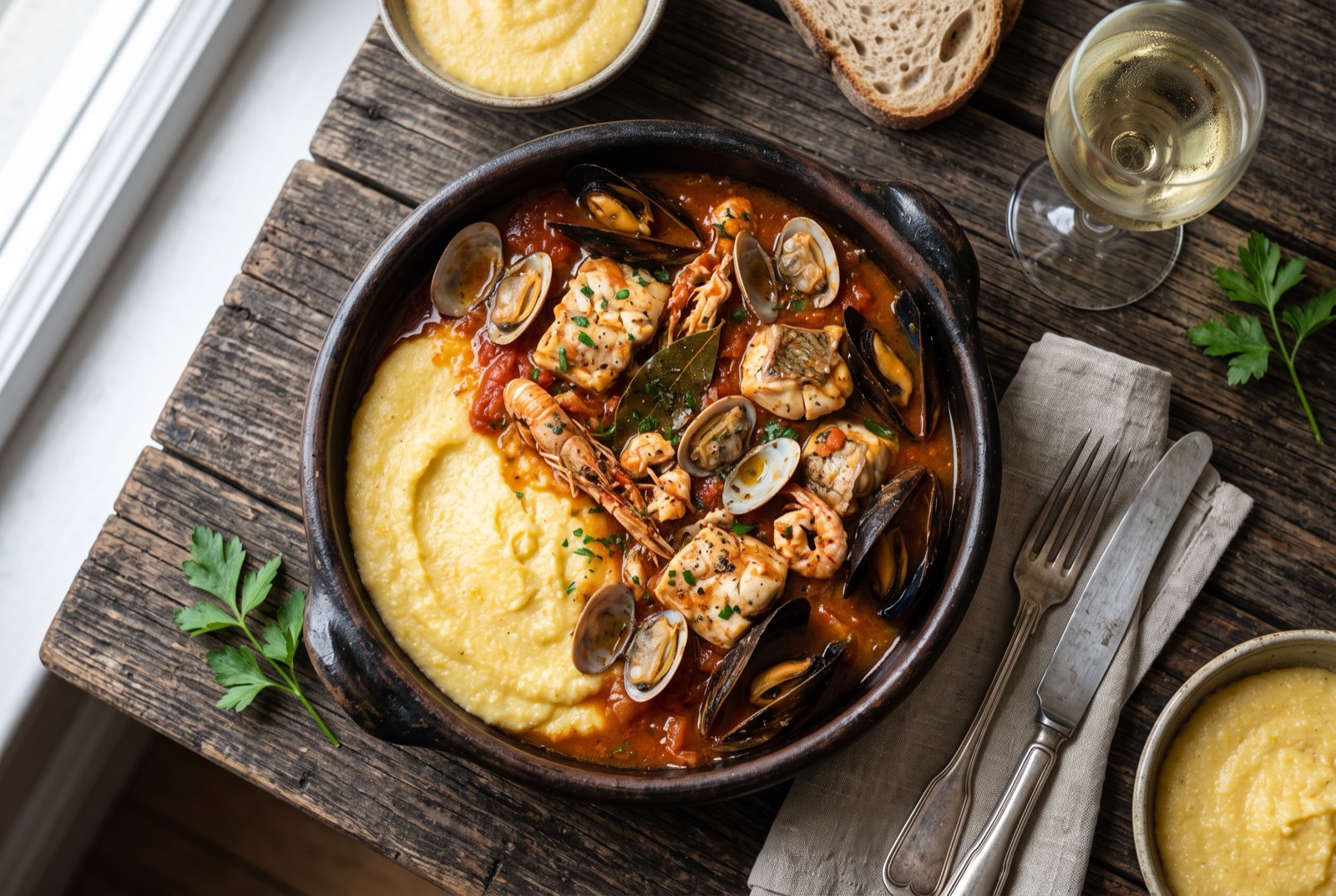
Keep exploring Croatia.
Croatia has 9 more dishes in the atlas — Brudet and Crni Rižot, and 7 more.
Recipe by The DishRoute Kitchen · published August 20, 2026 · updated August 20, 2026