Acarajé.
Bahian Black-Eyed Pea Fritters
Acarajé · say it: ah-kah-rah-ZHEH
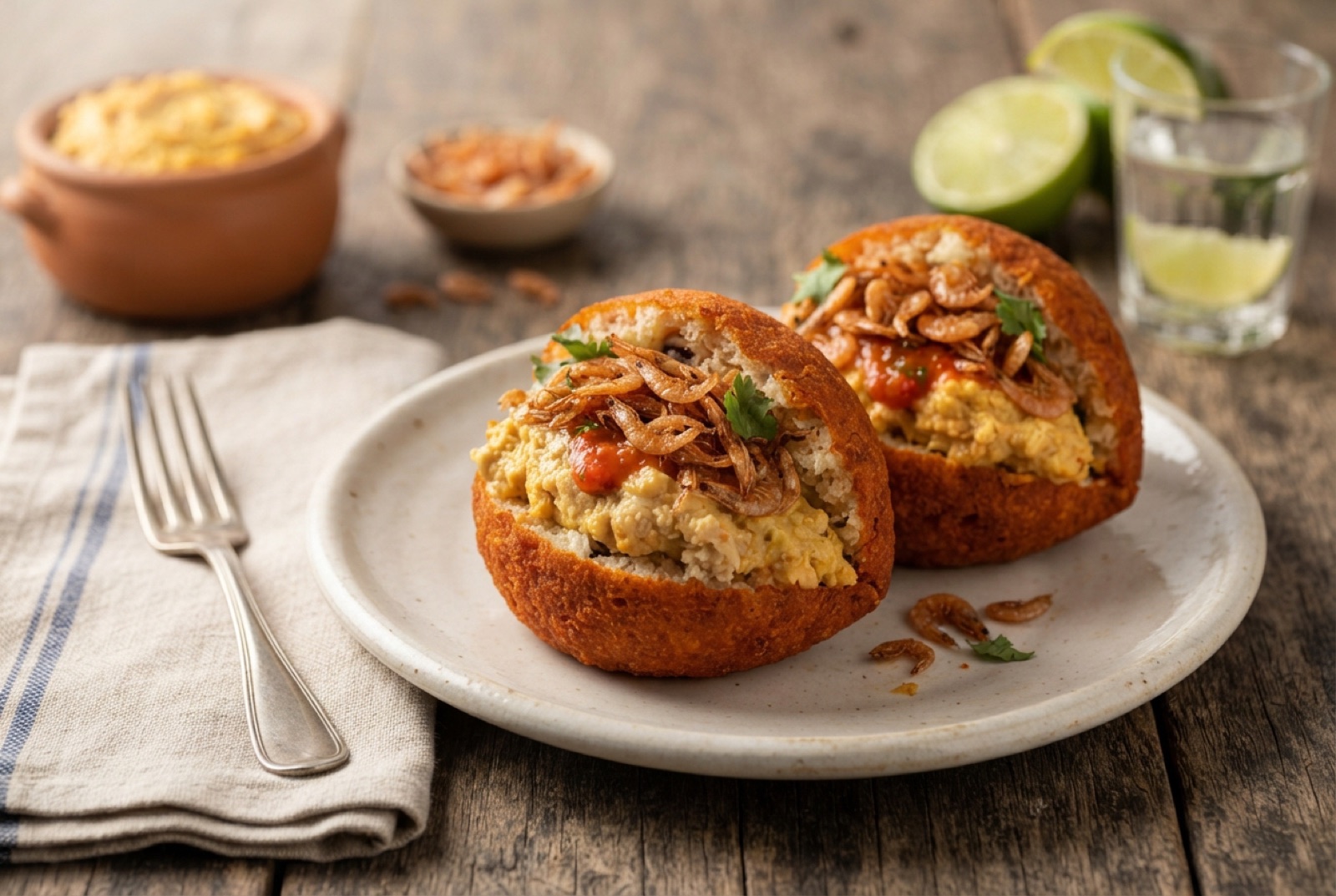
Acarajé is a deep-fried ball of black-eyed pea batter, crisp and dark orange outside from the palm oil it fries in, and inside as light and open as a fried dumpling. Split hot, it gets filled like a pocket sandwich: vatapá, a thick paste of bread, coconut milk, ground shrimp and nuts; caruru, stewed okra with dried shrimp; whole dried shrimp on top; and as much malagueta pepper sauce as you dare. The flavor is savory, faintly sweet from coconut, deeply shrimpy, and completely dominated by dendê. It is one of the great street foods anywhere, and it is genuinely difficult to make well.

- Gate
- BrazilBahia
- Prep
- 1 hr 10 min
- Cook
- 40 min
- Total time
- 13 hr 50 min incl. 12 hr rest
- Serves
- 4
- Status
- Takes skill
- Nutrition / serving · estimated
- Calories 610 kcal
- Protein 27 g
- Carbs 48 g
- Fat 35 g
- Fiber 9 g
- Sodium 1250 mg
Why this recipe works.
- Spells out the two steps that decide everything: skinning the peas completely, and beating the batter until it floats.
- Includes real vatapá and caruru fillings rather than a token spoonful of something creamy, because the fritter alone is not the dish.
- Treats dendê as non-negotiable and explains exactly what you get and lose if you use another oil.
- Gives the float test and the oil-temperature window, so you can tell whether the batter is ready before you commit a litre of palm oil.
Ingredients.
19 itemsFor the fritters
For the vatapá
For the caruru
To fill and serve
Equipment
- Large bowl for soaking
- Food processor or blender
- Stand mixer or a strong wooden spoon
- Deep heavy pan
- Frying thermometer
- Slotted spoon
Instructions.
Soak the peas overnight
Cover the black-eyed peas with plenty of cold water and leave them overnight, or at least 8 hours. They should swell to roughly double and the skins should look loose and wrinkled when you pinch one.
Skin the peas
Working in handfuls, rub the peas firmly between your palms in the soaking water so the skins slip off and float. Pour the loose skins away, top up with fresh water and repeat four or five times until the peas are uniformly white and no skins surface.
Tip This takes 20 to 30 minutes and there is no way around it. Put music on.
Grind and beat the batter
Drain the peas well and blend them with the chopped onion and salt to a thick, smooth paste, adding water a tablespoon at a time only if the machine stalls. Transfer to a bowl and beat hard for 8 to 10 minutes, until the batter turns pale, grows in volume and a half-teaspoon dropped into cold water floats.
Tip A stand mixer with the paddle does this happily. By hand, use a wooden spoon and your whole arm.
Make the vatapá
Soak the bread in the coconut milk for 10 minutes, then blend it with the dried shrimp, cashews, peanuts, ginger and garlic until smooth. Cook the mixture in a pan over medium-low heat with the 3 tablespoons of dendê, stirring constantly for 12 to 15 minutes, until it thickens enough to pull away from the base of the pan in a single mass.
Tip Stir without stopping. Vatapá catches on the bottom the moment you turn your back.
Cook the caruru
Soften the chopped onion in the 2 tablespoons of dendê, add the caruru dried shrimp and the sliced okra, and cook over medium heat for 12 to 15 minutes with a splash of water, until the okra is tender and the mixture has gone thick and glossy rather than slippery.
Heat the dendê
Pour the frying dendê into a deep heavy pan to a depth of at least 6 cm and bring it to 175°C. The oil should shimmer and a drop of batter should rise and sizzle steadily within two seconds, without browning instantly.
Fry the fritters
Shape the batter into large ovals with two wet spoons and lower them into the oil, four or five at a time. Fry for 4 to 5 minutes, turning once, until they are deep burnt-orange, firm to a tap and no longer sinking. Drain on a rack, not paper.
Tip Give them room. A crowded pan drops the oil temperature and you get greasy fritters.
Split and fill
While each fritter is still too hot to hold comfortably, cut it almost in half like a pitta and open it out. Spoon in vatapá, then caruru, tuck in two whole dried shrimp and a pinch of cilantro, and offer the pepper sauce separately. Eat it standing up, immediately.
Tips from our kitchen.
- Rub handfuls of soaked peas between your palms under water, then pour off the floating skins and repeat. Expect four or five rounds — patchy skinning is the most common failure.
- Beat the batter hard with a wooden spoon or a stand mixer for a full 8 to 10 minutes; it should turn from beige to almost white and visibly increase in volume.
- Test before frying: drop half a teaspoon of batter into a glass of cold water. If it sinks, keep beating. If it bobs to the surface, you are ready.
- Hold the dendê between 170 and 180°C. Hotter and the outside goes mahogany before the center cooks; cooler and the fritters drink oil and turn heavy.
- Shape with two wet spoons, quenelle style, and slide the batter gently into the oil rather than dropping it — a splash of hot dendê is worth avoiding.
- Assemble one fritter at a time and eat it immediately. Filled acarajé softens within minutes and never recovers its crunch.
Substitutions.
- Dendê (unrefined red palm oil) → There is no honest substitute for deep-frying
- Neutral oil plus paprika gives you a fried pea fritter, which is fine, but it is not acarajé — dendê supplies the color, the perfume and most of the flavor. Look for sustainably sourced brands at African, Caribbean or Brazilian grocers.
- Fresh black-eyed peas for skinning → Pre-peeled black-eyed pea flour or frozen skinned peas
- Sold at West African grocers for àkàrà and a legitimate shortcut. The batter is slightly denser but the work saved is considerable.
- Dried shrimp → Fresh shrimp, chopped and dried briefly in a low oven
- Dried shrimp are intensely savory in a way fresh ones are not, so expect a milder vatapá. Do not skip them entirely — they carry the filling.
- Malagueta peppers → Bird's eye chiles or a hot pepper sauce served on the side
- In Salvador the heat is always applied by the customer, so keep it separate and let people choose.
Variations.
- Abará
- The same batter steamed in banana leaves instead of fried, giving a soft, dense parcel rather than a crisp shell. Sold from the same tray and eaten with the same fillings.
- Acarajé de vento
- Literally acarajé of wind — served plain with nothing but pepper sauce, so you taste the fritter and the dendê alone. A common order among people who fry their own.
- Àkàrà
- The West African original: the same skinned-pea batter, usually beaten with onion and chile and fried in a neutral oil, eaten for breakfast with pap or bread.
Storage & reheating.
Acarajé does not keep. Fried fritters go leathery within an hour and soggy once filled, so fry only what you will eat. The components, however, store well: raw batter holds 24 hours in the fridge, though it needs re-beating before use, and vatapá and caruru both keep 3 days refrigerated and reheat with a splash of water or coconut milk. Skinned peas can be frozen raw for 3 months, which turns the hardest part of the recipe into something you do once for several batches.
Serve with
Malagueta pepper sauce on the side, an ice-cold beer, and salada — chopped tomato, onion and cilantro — tucked in with the vatapá.
The story behind Acarajé.
Acarajé is not a Brazilian dish that happens to have African roots — it is a Yoruba dish that lives in Brazil. Its ancestor is àkàrà, the black-eyed pea fritter still sold across southwestern Nigeria and Benin, brought across the Atlantic by enslaved West Africans and rebuilt in Bahia with the ingredients that grew there. In Candomblé, the Afro-Brazilian religion centred in Salvador, acarajé is a votive food offered to Iansã, the orixá of wind and storms, and the frying in dendê is part of what makes it an offering rather than a snack. Brazil formally recognised the trade of the baiana de acarajé as intangible cultural heritage in 2005, which protects the practice itself: the women, the white lace dress and headwrap, the tabuleiro tray, the method.
That recognition exists because the tradition has been contested. Acarajé is sold on street corners all over Salvador, and its religious identity has been the subject of real friction with evangelical vendors who sell an identical fritter under a different name. The women who hold the traditional trade are specific about the distinction and about the lineage behind it, and it is worth knowing that when you eat one — the fritter is a religious object with a street-food life, not the other way around.
The technique is the hard part. The peas must be soaked and then rubbed until every skin floats free, because skins make the batter grey and heavy. The batter is beaten by hand, traditionally in a wooden bowl, until it lightens visibly and holds air — a well-beaten batter dropped into water will float, which is the test baianas use. Then it fries in dendê deep enough to submerge, and the oil must be hot but not smoking, or the fritter darkens before the middle sets. A home cook will not match a tabuleiro on the first attempt. The second attempt is usually much closer.
Questions, answered.
Why do the black-eyed peas need to be skinned?
The skins are fibrous and darkly coloured, and they stop the batter from aerating properly. Left in, you get a grey, dense fritter that fries heavy instead of puffing up. Soaking loosens the skins so they slip off under friction; rubbing the peas between your palms under water and pouring off the floaters is the standard method.
Can I make acarajé without dendê palm oil?
You can fry the batter in any neutral oil and it will taste pleasant, but it will not be acarajé in any meaningful sense. Dendê is unrefined red palm oil with a deep orange colour and an earthy, slightly floral flavour, and it is the defining ingredient of Bahian cooking. Look for it in African, Caribbean or Brazilian grocers, where it is often sold as red palm oil.
What is vatapá?
Vatapá is a thick Bahian paste made from stale bread or bread soaked in coconut milk, blended with dried shrimp, ground cashews and peanuts, onion, ginger and dendê, then cooked until it holds its shape. It is the standard filling for acarajé and is also served on its own with rice as a main dish.
How do I know the batter is beaten enough?
Drop half a teaspoon into a glass of cold water: properly aerated batter floats, under-beaten batter sinks. Visually, the batter should lighten from beige to near-white, grow noticeably in volume and hold soft peaks when you lift the spoon. This usually takes 8 to 10 minutes of vigorous beating by hand or in a mixer.
Is acarajé vegetarian?
The fritter itself is — black-eyed peas, onion, salt and palm oil, with no animal products at all. The standard fillings are not, since both vatapá and caruru are built on dried shrimp. Ordering it as acarajé de vento, plain with only pepper sauce, gives you a vegan version, and some vendors will fill it with just salada.
You might also like.
All recipes →
Keep exploring Brazil.
Brazil has 9 more dishes in the atlas — Bolo de Fubá and Brigadeiro, and 7 more.
All Brazil recipes Dried shrimp recipes Coconut milk recipes Okra recipes street foodpescatariandairy freeRecipe by The DishRoute Kitchen · published August 19, 2026 · updated August 19, 2026