Moqueca Baiana.
Brazilian Coconut Fish Stew
Moqueca baiana · say it: moh-KEH-kah bah-YAH-nah
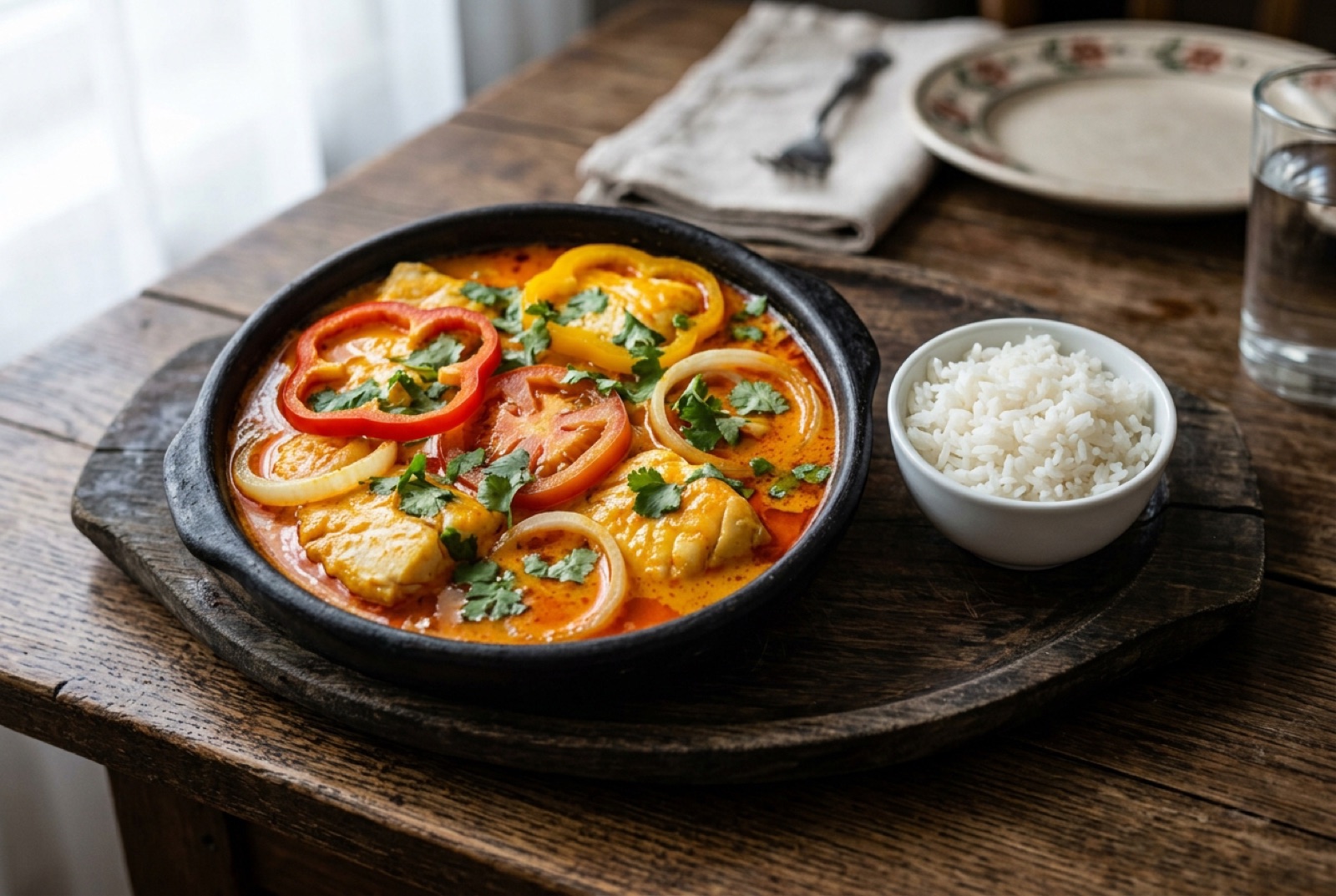
Moqueca baiana is the fish stew of Salvador and the Bahian coast: thick slices of firm white fish laid over rings of onion, tomato and bell pepper, then simmered — never stirred — in coconut milk stained orange with dendê, the red palm oil that defines Afro-Brazilian cooking. The taste is rich but bright: sweet coconut, gentle chile warmth, lime-marinated fish, and the faintly earthy, almost carroty note of dendê tying it together. Nothing is browned and nothing is complicated; the whole dish is an exercise in layering and restraint, which is exactly why it works so well at home. Serve it over white rice with the broth spooned generously on top.

- Gate
- BrazilBahia
- Prep
- 20 min
- Cook
- 25 min
- Total time
- 1 hr 15 min incl. 30 min rest
- Serves
- 4
- Status
- Easy
- Nutrition / serving · estimated
- Calories 460 kcal
- Protein 38 g
- Carbs 14 g
- Fat 29 g
- Fiber 3 g
Why this recipe works.
- True Bahian layering method — nothing browned, nothing stirred, so the fish stays intact and the broth stays clean.
- A quick lime-and-garlic marinade seasons the fish all the way through, not just the surface.
- Honest about dendê: the recipe works with the substitution given, and tells you what you gain by finding the real thing.
- One pot, under an hour, and it scales from a weeknight dinner to a table-centerpiece stew without changing technique.
Ingredients.
14 itemsFor the fish
For the stew
To finish
Equipment
- Wide, heavy sauté pan or Dutch oven with a lid (or a clay pot)
- Sharp knife
- Citrus juicer
Instructions.
Marinate the fish
Toss 800 g of fish pieces with the lime juice, grated garlic and salt in a bowl. Cover and refrigerate for 30 minutes — the surface of the fish will turn slightly opaque as the lime seasons it.
Tip Don't go much past 45 minutes or the lime starts to "cook" the fish ceviche-style.
Build the layers
Film a wide, heavy pan with the olive oil. Lay in half the onion, pepper and tomato rings, arrange the fish on top in a single layer with its marinade, and cover with the remaining vegetables and the chile. No stirring from here on.
Add coconut milk and dendê
Pour the coconut milk evenly over everything and drizzle with 1 tablespoon of the dendê. Give the pan a gentle shake to settle the liquid down through the layers — it should come about three-quarters of the way up.
Simmer, covered
Bring to a bare simmer over medium heat, then cover and cook gently for 15 minutes, until the peppers are silky, the broth is stained orange, and the fish flakes when nudged with a fork but still holds in whole pieces. Swirl the pan once or twice instead of stirring.
Tip Bubbles should whisper, not roll. A hard boil breaks the fish and can split the coconut milk.
Finish and season
Uncover and drizzle in the last tablespoon of dendê, letting it bloom on the surface until the broth turns a deeper sunset orange. Taste the broth and correct with salt and a squeeze of lime — it should be rich, gently sweet and clearly citrusy.
Serve from the pot
Scatter the cilantro and scallions over the top and bring the pan straight to the table while it still bubbles at the edges. Serve over white rice, spooning plenty of broth over each portion, with lime wedges alongside.
Tips from our kitchen.
- Use a firm white fish that holds its shape — grouper, halibut, cod loin, monkfish or snapper. Thin flaky fillets like sole disintegrate into the broth.
- Cut the fish thick, 3–4 cm. Big pieces survive the simmer and make the finished stew look like moqueca instead of chowder.
- Do not stir once the fish goes in. Shake or swirl the pot to move things around; a spoon will break the fish apart.
- Full-fat coconut milk only. Light coconut milk splits into thin, watery broth instead of a rich one.
- If you have dendê, add it at the end as well as the start — its aroma fades with long cooking, and a final spoonful restores the color and perfume.
- A wide, shallow pan beats a deep pot: the fish cooks in a single layer and the broth reduces slightly instead of stewing the fish to death.
Substitutions.
- Dendê (red palm oil) → 2 tbsp olive oil + 1 tsp sweet paprika (or ½ tsp annatto/achiote powder)
- This mimics the color and some earthiness, but dendê's flavor is unique — Brazilian and African grocers carry it, and it keeps for months. Look for sustainably sourced brands.
- Firm white fish → Large shrimp, or half fish and half shrimp
- A classic Bahian variation. Add shrimp for only the last 5 minutes — they cook much faster than fish.
- Fresh chile → A pinch of dried chile flakes, or omit entirely
- Bahian malagueta chiles are hot; the stew is traditionally warming rather than fiery, so season to your table.
Variations.
- Moqueca capixaba
- The Espírito Santo rival: skip coconut milk and dendê, use olive oil tinted with annatto, and cook in a clay pot. Lighter, sharper, and the subject of a real inter-state rivalry.
- Moqueca de camarão
- All-shrimp moqueca — same layering and broth, with peeled large shrimp added in the final minutes so they just turn pink.
- Moqueca de banana-da-terra
- A meat-free Bahian version built on thick slices of plantain instead of fish — vegetarian, and genuinely traditional rather than an invention.
Storage & reheating.
Moqueca keeps 2 days refrigerated in its broth. Reheat gently in a covered pan over low heat until the broth steams — a hard boil overcooks the fish and can split the coconut milk. It does not freeze well: thawed fish turns woolly and the broth separates. If you must plan ahead, make the broth with vegetables a day early, refrigerate, and simmer the marinated fish in it just before serving.
Serve with
White rice, farofa, and pirão made by whisking manioc flour into a ladle of the hot broth — the full Bahian table.
The story behind Moqueca Baiana.
Moqueca is older than Brazil itself. The name and the method trace back to indigenous coastal cooking — the Tupi moquém, a technique of cooking fish over fire — and some form of fish moqueca has been made on this coastline for centuries, long before the Portuguese arrived. What happened next is the story of Bahia: the transatlantic slave trade brought African cooks, ingredients and techniques to Salvador, and out of that kitchen came moqueca baiana as it is known today — fish simmered with coconut milk and finished with dendê, the red palm oil pressed from the fruit of an African oil palm that took root in Bahian soil. Dendê is not a garnish; it is the identity of the dish, giving the stew its sunset color and a flavor no other fat replicates.
Brazilians will also tell you, correctly, that moqueca is a two-state rivalry. Espírito Santo, further south, makes moqueca capixaba: no coconut milk, no dendê, just fish, tomato, onion, cilantro and annatto-tinted olive oil, cooked in a black clay pot handmade in the Goiabeiras district — a craft so specific it carries heritage protection. Capixabas argue theirs is the older, purer moqueca and that the Bahian version drowns the fish; baianos answer that coconut and dendê are precisely the point. The argument is genuinely unresolved and genuinely enjoyed, and ordering "the real moqueca" in the wrong state is a reliable way to start a conversation.
In Bahia the stew is traditionally built in a wide clay pot, brought bubbling to the table, and served with white rice, farofa and pirão — a savory porridge made by whisking manioc flour into the hot broth. It is Sunday-lunch food, beach-restaurant food, and one of the dishes Brazilians abroad miss first. The home version below keeps the essential discipline: marinate the fish, layer the vegetables, pour over the coconut milk, and let the pot do the work without stirring, so the fish stays in proud, intact pieces.
Questions, answered.
What is the difference between moqueca baiana and moqueca capixaba?
Moqueca baiana, from Bahia, is made with coconut milk and dendê (red palm oil), giving a rich, orange-tinted broth with Afro-Brazilian roots. Moqueca capixaba, from Espírito Santo, uses neither — just fish, tomato, onion, cilantro and annatto-colored olive oil, cooked in a local black clay pot. Each state claims the true moqueca, and the rivalry is a running national joke that nobody actually wants settled.
What is dendê and can I substitute it?
Dendê is unrefined red palm oil, pressed from the fruit of African oil palms grown in Bahia since the colonial era. It has a deep orange color and an earthy, slightly floral flavor central to Bahian cooking. If you can't find it, olive oil plus sweet paprika or annatto approximates the color and warmth — the stew will still be very good, just not fully Bahian.
What fish works best for moqueca?
Any firm white fish cut thick: grouper, snapper, halibut, monkfish, cod loin or mahi-mahi. The fish must hold together through 15 minutes of gentle simmering, so avoid thin, delicate fillets like sole or tilapia, which fall apart and cloud the broth. Steaks or thick loin portions work better than tail pieces.
Is moqueca spicy?
Traditionally warming rather than hot. Bahians serve fiery malagueta chile sauce on the side rather than loading the pot, so each person sets their own heat. This recipe uses one fresh chile for gentle background warmth; leave it out entirely and the stew is still completely authentic in spirit.
Do I need a clay pot to make moqueca?
No. Clay pots (panelas de barro) are traditional in both Bahia and Espírito Santo and hold heat beautifully for serving, but a wide, heavy sauté pan or Dutch oven produces an equally good stew. What matters is width — the fish should sit in a single layer — and a lid for the gentle, steamy simmer.
You might also like.
All recipes →
Keep exploring Brazil.
Brazil has 9 more dishes in the atlas — Acarajé and Bolo de Fubá, and 7 more.
All Brazil recipes White fish recipes Tomato recipes Bell pepper recipes mainpescatariandairy freegluten freeRecipe by The DishRoute Kitchen · published August 18, 2026 · updated August 18, 2026