Khorovats.
Armenian Charcoal-Grilled Skewers
Խորոված · say it: kho-ro-VATS
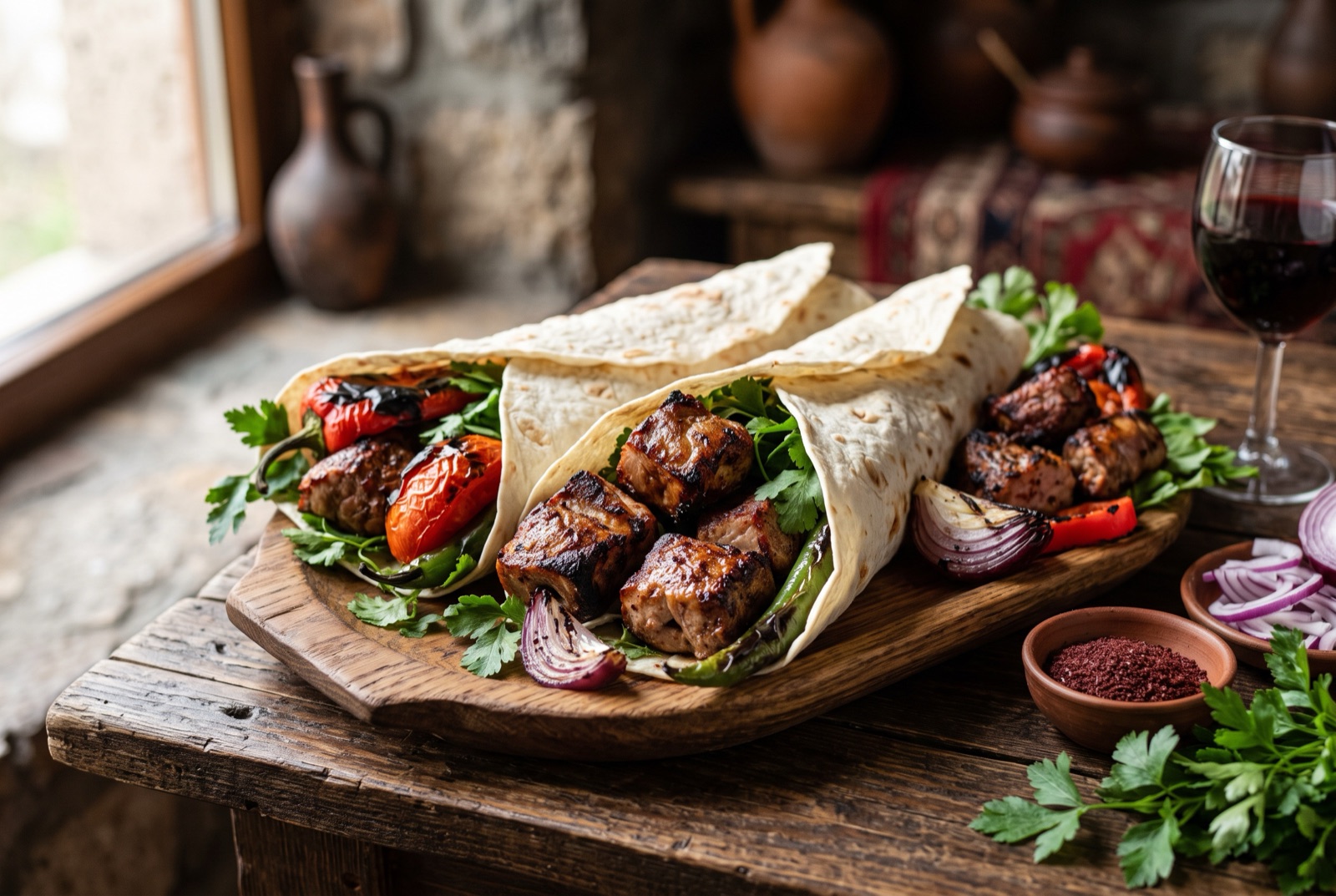
Khorovats is Armenian grilled meat in its most stripped-down form: fist-cut chunks of pork neck or lamb shoulder left overnight with sliced onion, salt and a heavy hand of black pepper, threaded onto wide flat skewers and cooked over vine-cutting embers. There is no marinade of oil, no yogurt, no spice rub and usually no lemon — the onion softens the meat and everything else comes from fat hitting fire. The result is dark and crusted on the outside, still dripping in the middle, and eaten straight off the skewer into a sheet of lavash along with aubergines and peppers charred beside it. It is the national weekend ritual as much as a recipe.

- Gate
- ArmeniaArarat Valley
- Prep
- 25 min
- Cook
- 25 min
- Total time
- 4 hr 50 min incl. 4 hr rest
- Serves
- 4
- Status
- Easy
- Nutrition / serving · estimated
- Calories 610 kcal
- Protein 44 g
- Carbs 28 g
- Fat 36 g
- Fiber 6 g
- Sodium 1100 mg
Why this recipe works.
- The real marinade — onion, salt, pepper and time — with an explanation of why oil and acid actively make it worse.
- Cut sizes and skewer spacing spelled out, since these decide whether the meat is juicy or grey.
- Covers the charred vegetable salad on the same grill, which is half the meal in Armenia.
- Gives an honest oven-and-broiler fallback for anyone without live fire.
Ingredients.
13 itemsFor the meat
For the grilled vegetables
To serve
Equipment
- Charcoal grill or mangal
- Flat metal skewers (shampoor) or doubled wooden skewers
- Large non-reactive bowl for marinating
Instructions.
Marinate overnight
Toss the pork chunks with the sliced onion, salt and pepper in a bowl, squeezing the onion in your fists as you mix so it releases its juice into the meat. Cover and refrigerate for at least 4 hours, ideally overnight.
Tip No oil, no lemon, no water. Onion juice is the entire marinade.
Build the fire
Light the charcoal and let it burn down until the coals are covered in grey ash and no flames remain — you should be able to hold a hand 15 cm above the grate for about four seconds. Rake the embers into an even bed.
Skewer the meat
Brush the onion slices off each chunk and thread the meat onto flat skewers, leaving a finger of space between pieces so heat can move around them. Do not push them tight together.
Grill the vegetables first
Lay the whole aubergines, peppers and tomatoes straight on the grate and turn them until the skins are blackened, split and lifting away — 12 to 15 minutes for the aubergines, less for the rest. Move them to a covered bowl to steam.
Grill the skewers
Set the skewers over the embers and turn them a quarter turn every 3 to 4 minutes. In 15 to 18 minutes the outside should be deeply browned and lacquered, the fat should be visibly bubbling at the edges, and a cut chunk should run clear.
Tip If fat dripping into the coals throws up flames, lift the skewers aside for a moment rather than letting the meat take the flare.
Make the vegetable salad
Peel the steamed vegetables while still warm, discarding the skins and pepper seeds, and chop them roughly on a board. Mix with the garlic, parsley, coriander, olive oil and salt, keeping the texture chunky rather than smooth.
Rest under lavash and serve
Slide the meat off the skewers onto a warm platter, cover it with a sheet of lavash and let it sit for 5 minutes. Serve straight from the platter with the vegetable salad, spring onions and the rest of the bread for wrapping.
Tips from our kitchen.
- Pork neck or shoulder is the traditional cut, and its fat marbling is the reason. Loin and lean lamb leg both come out dry no matter how carefully you cook them.
- Squeeze the onion hard as you mix it in — you want its juice, not the slices themselves, and you brush the slices off before the meat goes on the skewer.
- Do not add oil or lemon to the marinade. Oil makes the fire flare and blacken the meat, and acid firms the surface into something closer to ceviche than steak.
- Cook over embers with no visible flame. If flames are licking the meat, move it aside and wait rather than blowing the coals.
- Leave a finger of space between chunks on the skewer. Meat pressed together steams in its own moisture instead of crusting.
- Rest the skewers under a sheet of lavash for a few minutes off the fire — the bread traps the steam and soaks up what runs out.
Substitutions.
- Pork neck → Lamb shoulder, boned and cut into 4 cm chunks
- The standard alternative and equally traditional. Lamb wants slightly hotter, faster cooking so the fat renders before the meat dries.
- Charcoal or vine cuttings → A very hot oven grill or broiler, meat on a rack over a tray
- You lose the smoke but keep the crust. Run the broiler at full heat with the meat about 10 cm below it, turning every few minutes.
- Flat shampoor skewers → Two parallel wooden skewers per row of meat
- Doubling up stops the chunks spinning when you turn them. Soak wooden skewers for 30 minutes so they do not burn through.
Variations.
- Karsi khorovats
- Larger, thinner slabs of meat threaded flat onto the skewer and grilled quickly — named for the city of Kars, and usually eaten rolled straight into lavash.
- Khorovats with sour plum
- A few dried sour plums or a spoon of tkemali-style plum sauce served alongside, which sharpens the fat without acidifying the meat itself.
- Chicken khorovats
- Bone-in thighs and wings marinated the same way, cooked slower and further from the coals so the skin renders and crisps without burning.
Storage & reheating.
Grilled khorovats is at its best within minutes and declines quickly, but leftovers keep 2 days refrigerated. Reheat covered in a low oven with a splash of water rather than in a pan, which drives off what juice remains. Cold leftover meat chopped into lavash with the vegetable salad and fresh herbs makes an excellent next-day wrap and is how most Armenian households actually eat it. The raw marinated meat can be refrigerated for up to 48 hours or frozen in its onion for a month.
Serve with
Warm lavash for wrapping, the charred vegetable salad from the same grill, raw spring onions and a bowl of coarse salt.
The story behind Khorovats.
Every culture with fire and livestock grills meat on sticks, so what makes khorovats specifically Armenian is not the concept but the conventions around it. The skewers, called shampoor, are wide flat bars rather than round rods, so the meat cannot spin when you turn them. The fuel of choice is dried grapevine cuttings, which burn fast and hot and leave a light, sweetish smoke; in the Ararat valley, pruning season and grilling season are connected. The cuts are large — 4 to 5 centimetres — because small cubes dry out, and the meat is never packed tight on the skewer.
The division of labour is fixed and slightly comic. Khorovats is cooked by men, almost without exception, and the man at the grill — the khorovatsapan — does not share the job. He is handed a chair, an opinion is offered by everyone present, and none of it is taken. The rest of the household handles bread, herbs, salads and the table. This is not a rule anybody wrote down, but it is observed so consistently across Armenia and the diaspora that it functions as one.
Alongside the meat go the vegetables, and they matter as much. Whole aubergines, peppers and tomatoes are laid directly on the grill until their skins blister black and split, then peeled while hot and chopped roughly with garlic, herbs and oil into the salad called khorovats bostani or, in its aubergine-heavy form, mangal salad. Everything is then eaten wrapped in lavash, which does the work of both plate and cutlery. Add cold vodka or oghi, the local fruit spirit, and the argument about which valley grows the best apricots, and you have a standard Armenian Sunday.
Questions, answered.
Why is there no oil or lemon in the marinade?
Because khorovats is meant to taste of meat and fire, not of the marinade. Oil drips into the coals and produces flames that blacken the surface with soot, and acid like lemon or vinegar denatures the outer layer of the meat so it firms up and holds less juice. Onion, salt, pepper and time do everything that is needed.
How long should the meat marinate?
At least four hours, and overnight is better. The onion needs time to break down and release its juice into the meat, and the salt needs time to travel inward. Beyond about 24 hours the surface starts to soften unpleasantly, so a night in the fridge is the sweet spot.
How do I know the pork is done without cutting into every piece?
Take one chunk off the skewer and cut it: the juices should run clear with no pink at the centre, and the meat should still visibly bead with fat. On a hot ember bed, 4 cm chunks take roughly 15 to 18 minutes with regular turning. An instant-read thermometer should show about 71°C in the middle.
Can I make khorovats on a gas grill?
Yes, though you lose the smoke that vine cuttings give. Run the grill as hot as it goes with the lid down between turns, and if your model takes a smoker box, a handful of soaked fruitwood chips gets you part of the way back. The cut, the marinade and the resting matter more than the fuel.
What do I do with the grilled vegetables?
Char aubergines, peppers and tomatoes whole until their skins are black and blistered, then put them in a covered bowl for ten minutes so the steam loosens the skin. Peel, chop roughly, and dress with garlic, chopped herbs, salt and a little oil. That is khorovats bostani, and it is served in the same bowl as the juices from the meat.
You might also like.
All recipes →
Keep exploring Armenia.
Armenia has 9 more dishes in the atlas — Armenian Harissa and Eetch, and 7 more.
Recipe by The DishRoute Kitchen · published August 20, 2026 · updated August 20, 2026