Armenian Harissa.
Wheat and Chicken Porridge
Հարիսա · say it: hah-ree-SAH
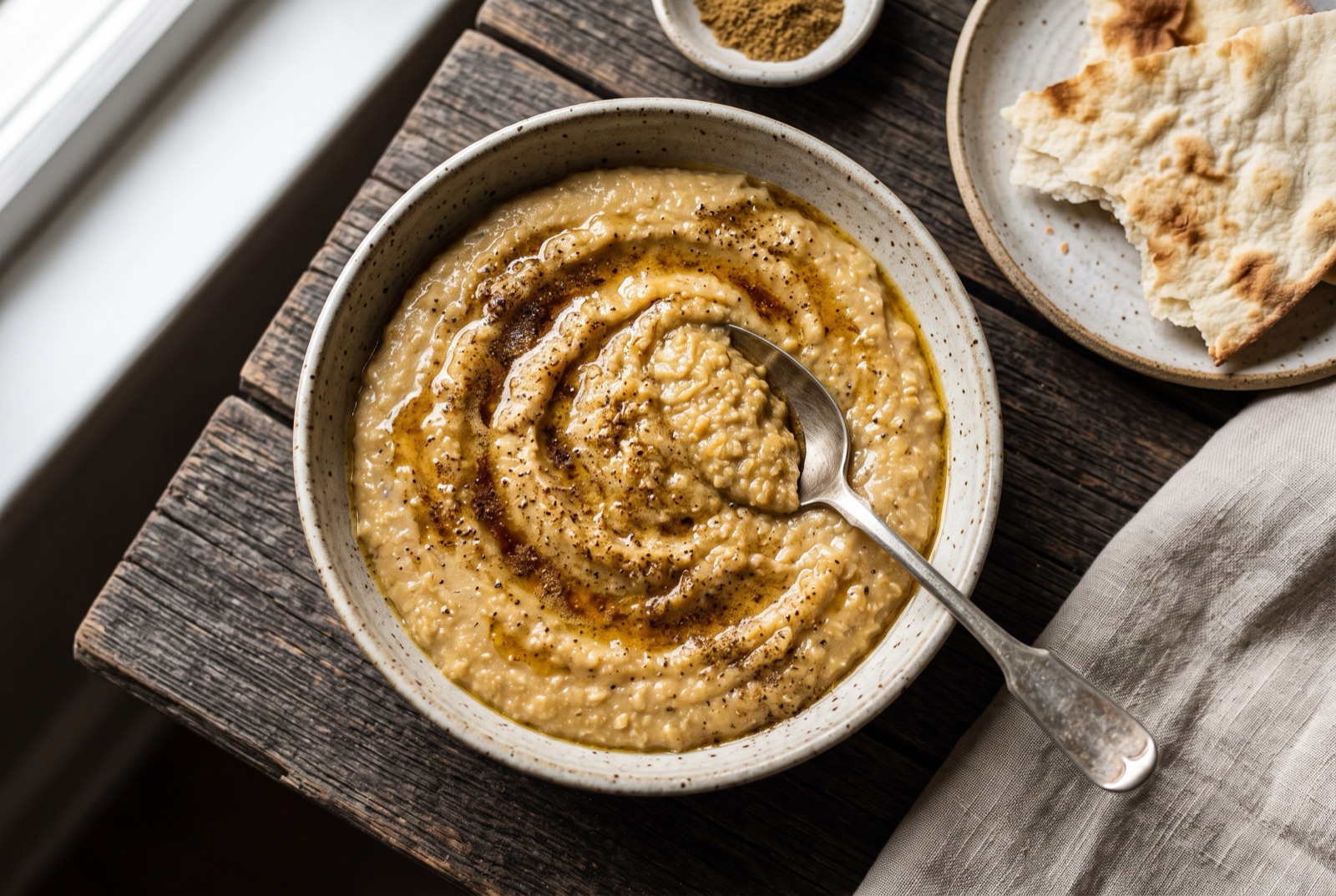
Harissa is a porridge of hulled wheat and chicken cooked so long, and beaten so hard, that the two dissolve into a single pale, glossy, stringy mass you eat with a spoon. It tastes of very little on purpose: wheat, chicken, salt, and a slick of hot butter with cumin poured over at the table. The texture is the dish — pulled and elastic, somewhere between congee and mashed potato, warm rather than rich. Armenians make it for memorial days and for feeding crowds in cold weather, and it is the least photogenic and most beloved thing in the repertoire. Nothing about it is fast, but almost none of the work is skilled.

- Gate
- ArmeniaMusa Dagh and the highlands
- Prep
- 20 min
- Cook
- 4 hr 30 min
- Total time
- 5 hr 5 min incl. 15 min rest
- Serves
- 6
- Status
- Takes skill
- Nutrition / serving · estimated
- Calories 540 kcal
- Protein 34 g
- Carbs 52 g
- Fat 21 g
- Fiber 8 g
- Sodium 820 mg
Why this recipe works.
- Scaled from cauldron to a household pot without shortcutting the step that matters — the beating.
- Uses bone-in chicken so the gelatine from the bones gives the porridge its glossy pull.
- Tells you the exact texture cue to stop at, instead of a meaningless time range.
- Includes the pressure-cooker route for anyone who does not have six hours to give it.
Ingredients.
9 itemsFor the porridge
To finish
Equipment
- Large heavy-based pot or Dutch oven
- Flat wooden spoon or small paddle
- Skimmer or ladle
Instructions.
Soak the wheat
Cover the wheat berries with cold water by a good three fingers and leave them overnight. They will swell noticeably and lose their chalky bite. Drain and rinse before using.
Start the pot
Put the chicken, halved onion and drained wheat in a large heavy pot, pour over the water, and bring slowly to a boil. Skim the grey foam off the surface repeatedly for the first 20 minutes until the liquid runs clear.
Simmer long and low
Turn the heat to the lowest setting, cover partly, and cook for about 3 hours, stirring every half hour to stop the wheat catching. It is ready for the next stage when the chicken has slipped off the bones and the grains crush easily between your fingers.
Tip Top up with hot water whenever the surface looks thick enough to hold a spoon upright.
Pull out the bones
Fish out the onion halves and every bone and piece of cartilage you can find, going through the pot methodically with a slotted spoon. Nothing hard should remain — the porridge gets beaten, not chewed.
Beat it
Now work the pot over low heat with a flat wooden spoon, pressing and dragging the mass against the sides rather than stirring, for 30 to 45 minutes. It will go from lumpy to smooth to elastic, and will start pulling away from the pot in one sheet.
Tip Add hot water a ladle at a time whenever it stiffens. Harissa should move like thick porridge throughout the beating.
Season and rest
Salt it properly — taste, add, taste again, as it needs far more than seems reasonable — then cover and let it stand off the heat for 15 minutes so the texture settles and the surface smooths out.
Pour over the cumin butter
Melt the butter in a small pan until it foams and smells nutty, stir in the cumin and paprika off the heat, and pour it over the harissa in the serving bowl so it pools on top. Grind over black pepper and serve immediately.
Tips from our kitchen.
- Use hulled or pearled wheat berries (dzedzadz, korkoto or shelled wheat) — not bulgur, which is pre-cooked and will turn to paste in an hour with no pull at all.
- Soak the wheat overnight. Unsoaked grains stay stubbornly whole long after the chicken has fallen apart.
- Skim the surface properly in the first half hour. Anything you leave will end up beaten into the porridge as grey scum.
- Beat with a flat wooden spoon or a paddle held upright, pressing the mass against the side of the pot rather than stirring in circles.
- It should pull in ropes off the spoon when it is done. If it slides off in lumps, it needs more beating, not more time.
- Salt late and generously — the wheat absorbs a surprising amount, and an under-salted harissa tastes like wallpaper paste.
Substitutions.
- Hulled wheat berries → Pearl barley
- Barley gives a softer, less elastic porridge and cooks about an hour faster. It is a real village variation, not a compromise.
- Chicken → Lamb shoulder on the bone
- Lamb harissa is common for madagh feasts. It needs an extra hour and the fat should be skimmed more aggressively.
- Butter with cumin → Clarified butter with a pinch of paprika, or lamb fat
- Any fat browned and poured hot over the top works. The point is that it sits in a pool on the surface, not stirred through.
Variations.
- Madagh harissa
- The church-courtyard version, cooked in cauldrons from the meat of an animal offered for the community and given away to everyone present rather than sold.
- Lamb harissa
- Made with bone-in lamb shoulder or neck instead of chicken, giving a heavier, more strongly flavoured porridge for winter feast days.
- Pressure-cooker harissa
- Soaked wheat and chicken cooked under pressure for about 50 minutes, then beaten by hand for the last stretch. The beating still has to happen — pressure alone does not create the pull.
Storage & reheating.
Harissa keeps 4 days refrigerated and sets to a solid block you can cut with a knife. Reheat with a generous splash of water or stock over low heat, breaking it up with a spoon until it loosens back to a spoonable porridge — it always needs more liquid than you expect. It freezes well in portions for up to three months. Reheat from frozen in a covered pan on low, stirring often so the base does not catch.
Serve with
A pool of hot cumin butter on top, a bowl of pickled vegetables to cut it, and nothing else.
The story behind Armenian Harissa.
Harissa belongs to a family of pounded grain-and-meat dishes that stretches across the Middle East — the Levantine harees, the Persian haleem, the Gulf jareesh — all built on the same idea of cooking wheat with meat until neither can be separated from the other. The Armenian version is distinguished less by its ingredients than by what it means. It is the dish of Vardavar and of village feast days, and above all it is the dish cooked in enormous cauldrons at church courtyards for madagh, the communal offering meal, where it is stirred in shifts by whoever is standing nearby and handed out free.
The association most Armenians make is with Musa Dagh. In 1915, villagers from the mountain held out against deportation for weeks before being evacuated by French warships, and harissa is the dish tied to that resistance and to the commemorations that followed. The often-repeated story that eagles dropped chickens to the starving defenders is folklore rather than history, and Armenians tell it as folklore; what is not in question is that harissa became a memorial food, cooked every year at Musa Ler in Armenia for the descendants of those villagers and for anyone who turns up.
The traditional method is communal because it has to be. The wheat is soaked, then simmered with the meat for the better part of a day, and then someone has to beat it — with a wooden paddle, in long rhythmic strokes — until the fibres of the chicken break down completely and the mass turns elastic and pulls away from the sides of the pot. The beating is the step people remember: hot, slow, done in turns, and traditionally accompanied by singing to keep the rhythm. A home cook with a heavy pot and a wooden spoon can reach the same place in a fraction of the volume, which is what this version does.
Questions, answered.
Can I use bulgur instead of wheat berries?
No, not for real harissa. Bulgur is parboiled and cracked, so it collapses into a soft mush within an hour and never develops the stretchy, ropy texture that defines the dish. You need whole hulled or pearled wheat berries, sold as dzedzadz, korkoto, shelled wheat or wheat for haleem.
How do I know when harissa is finished?
Lift the spoon: finished harissa hangs off it in a thick elastic rope and pulls back into the pot rather than dropping in blobs. There should be no recognisable pieces of chicken and no whole grains — if you can still see either, keep beating over low heat.
Why is my harissa gluey and heavy instead of smooth?
Usually too little liquid. Wheat keeps absorbing right to the end, and a pot that looked correct an hour ago will be stiff now. Add hot water or stock a ladle at a time while beating until it moves like thick porridge rather than dough.
Is Armenian harissa related to the North African chili paste?
No — they only share a name in English transliteration. North African harissa is a hot red pepper paste used as a condiment. Armenian harissa is a plain, unspiced wheat-and-meat porridge, and the two have no connection in ingredients, method or origin.
Can I make harissa in a slow cooker?
Partly. A slow cooker on high for six to eight hours will cook the wheat and chicken through, but it cannot do the beating, and unbeaten harissa is just wheat soup with chicken in it. Transfer it to a heavy pot on the stove for the final 20 minutes of vigorous beating.
You might also like.
All recipes →
Keep exploring Armenia.
Armenia has 9 more dishes in the atlas — Eetch and Gata, and 7 more.
Recipe by The DishRoute Kitchen · published August 20, 2026 · updated August 20, 2026