Attiéké.
Ivorian Fermented Cassava Couscous
Attiéké · say it: ah-tyeh-KEH
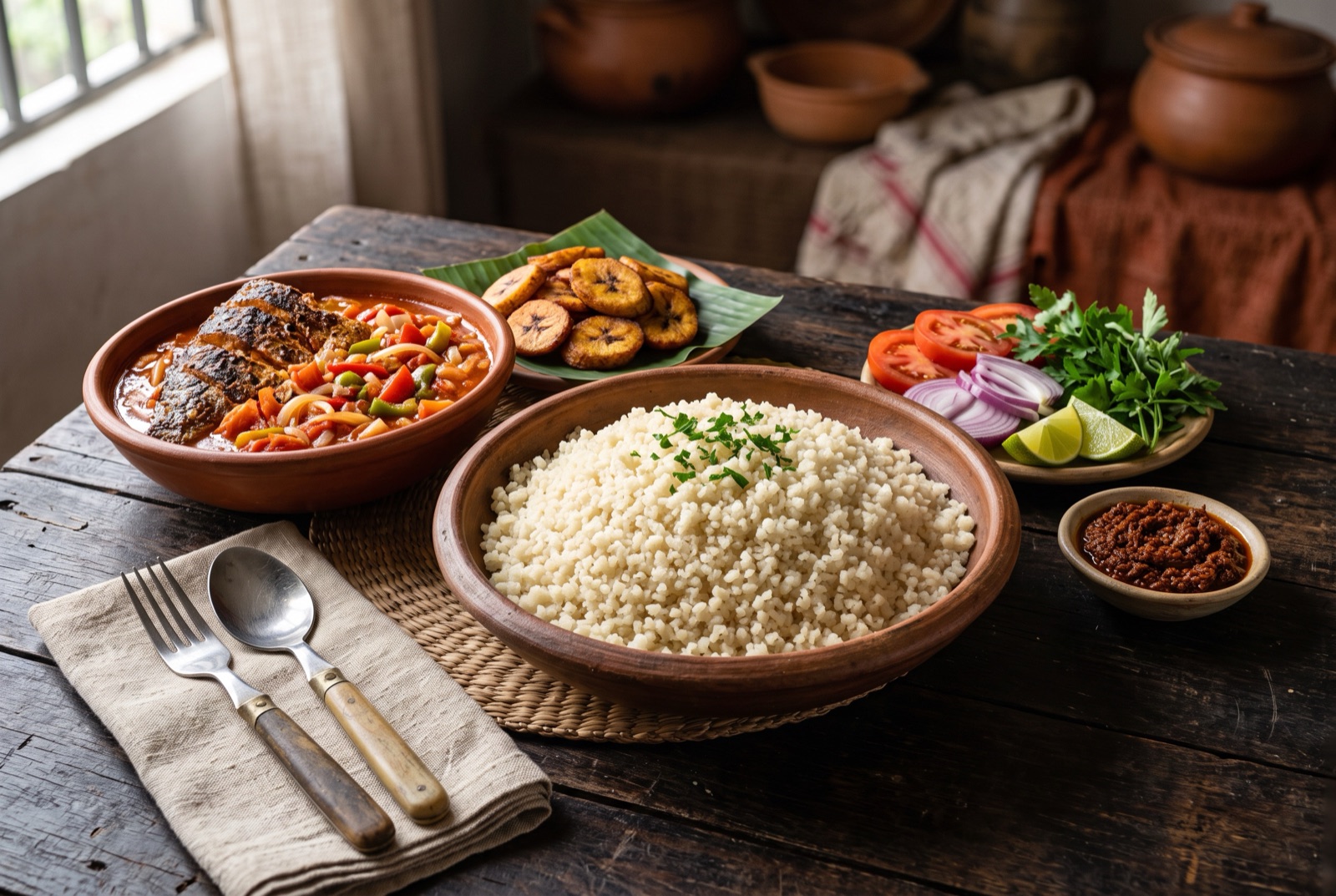
Attiéké is cassava turned into something close to couscous: the root is grated, mixed with a fermented starter, left to sour for a couple of days, pressed of its liquid, rubbed through a sieve into loose granules and steamed. The result is pale, light and slightly damp, with a distinct lactic tang that separates it immediately from plain boiled cassava — a little like sourdough, a little like fresh cheese, and never bland. It is eaten hot or at room temperature under grilled fish, fried tuna, palm nut sauce or simply with raw onion and chilli. Making it from scratch is a two-day project rather than a difficult one; almost all the work is waiting, and the only real skill is judging when the pressed mass is dry enough to granulate cleanly.

- Gate
- Ivory CoastLagoon coast around Abidjan
- Prep
- 1 hr
- Cook
- 35 min
- Total time
- 53 hr 35 min incl. 52 hr rest
- Serves
- 6
- Status
- Medium
- Nutrition / serving · estimated
- Calories 300 kcal
- Protein 2 g
- Carbs 68 g
- Fat 5 g
- Fiber 3 g
- Sodium 320 mg
Why this recipe works.
- Explains the fermentation as a process with visible checkpoints, not a vague instruction to wait.
- Covers granulating properly — the step that decides whether you get fluffy attiéké or damp lumps.
- Steams in two stages, which is how the granules cook through without turning gluey.
- Honest about the starter: what it is, how to get one, and what to do if you have none.
Ingredients.
5 itemsEquipment
- Coarse grater or food processor
- Large bowl and clean cloth for fermenting
- Cloth or muslin plus a heavy weight for pressing
- Coarse sieve
- Steamer basket
Instructions.
Peel and grate the cassava
Cut 2 kg of cassava into lengths, strip off the thick brown skin and the pink layer beneath it, and pull out the fibrous cord running down the centre. Grate the white flesh coarsely, or pulse it in a processor until it looks like wet snow with no lumps larger than a lentil.
Tip Work in cold water if the pieces start to discolour, and discard any root that smells sharp or looks grey inside.
Inoculate and ferment
Knead the starter dough thoroughly through the grated cassava until the colour is uniform, pack it into a bowl, cover with a damp cloth and leave somewhere warm for 48 hours. It is ready when it smells clearly sour and slightly alcoholic and a squeezed handful weeps cloudy liquid.
Tip A faint yeasty smell is right. Anything ammoniac or mouldy means the batch has gone wrong — start again.
Press out the liquid
Tip the mash into a cloth, twist the top closed and set it under a chopping board weighted with something heavy for 4 hours, draining the liquid away as it collects. The mass should end up crumbly and cool, holding its shape only briefly when squeezed.
Granulate
Rub the pressed mass across a coarse sieve with the flat of your hand, in circles, so it breaks into loose grains roughly the size of coarse semolina. Pick out and discard any remaining fibres. Spread the granules on a tray and leave them uncovered for 20 minutes to dry at the surface.
First steam
Line a steamer basket with a damp cloth, heap the granules in loosely without packing them, and steam over vigorously boiling water for 20 minutes. The grains will darken slightly and start to look translucent at the edges rather than chalky white.
Loosen and steam again
Turn the attiéké into a bowl, sprinkle over the warm water mixed with the salt, and break up every clump with a fork until the grains fall apart individually. Return to the steamer for a final 12 minutes, until a grain crushed between finger and thumb is soft all the way through with no chalky centre.
Fluff and serve
Stir the oil through while the attiéké is still hot, lifting and separating rather than mashing. Taste for salt and serve warm, mounded on the plate with the sauce or grilled fish alongside rather than poured over.
Tips from our kitchen.
- Sweet cassava, sold fresh or frozen in African and Caribbean shops, is the practical choice at home. Buy roots that are firm and unblemished, and reject any with grey or blue streaks in the flesh.
- Press the fermented mash much harder than feels reasonable. A wet mash cannot be granulated — it smears through the sieve into paste instead of breaking into grains.
- Rub, do not push. Move the dried mash across the sieve with your palm in circles so it crumbles; forcing it straight down compacts it.
- Steam in a cloth-lined basket rather than directly on metal, or the smallest granules fall through and clog the holes.
- The finished attiéké should be loose enough to fall off a fork in separate grains while still feeling moist. If it looks dry and dusty, sprinkle over warm salted water and steam for five more minutes.
- Save 200 g of your fermented dough in the fridge as the starter for the next batch — it will keep about a week, or several months frozen.
Substitutions.
- Fermented cassava starter (magnan) → A tablespoon of plain live yogurt whey, or a batch left to ferment 24 hours longer without any starter
- Neither is traditional and the sourness is different — cleaner and less complex. If an African grocer near you sells attiéké dough, buy some and use a fistful as your first starter.
- Fresh cassava root → Frozen peeled cassava, thawed
- Widely available and perfectly good. Drain it well before grating, as it carries more water than fresh root.
- The whole process → Dried attiéké from an African grocer
- Rehydrate 250 g with 350 ml of hot salted water, cover for 10 minutes, then steam 10 minutes and fluff. Not the same texture, but a genuinely common shortcut in Ivorian households abroad.
Variations.
- Attiéké garba
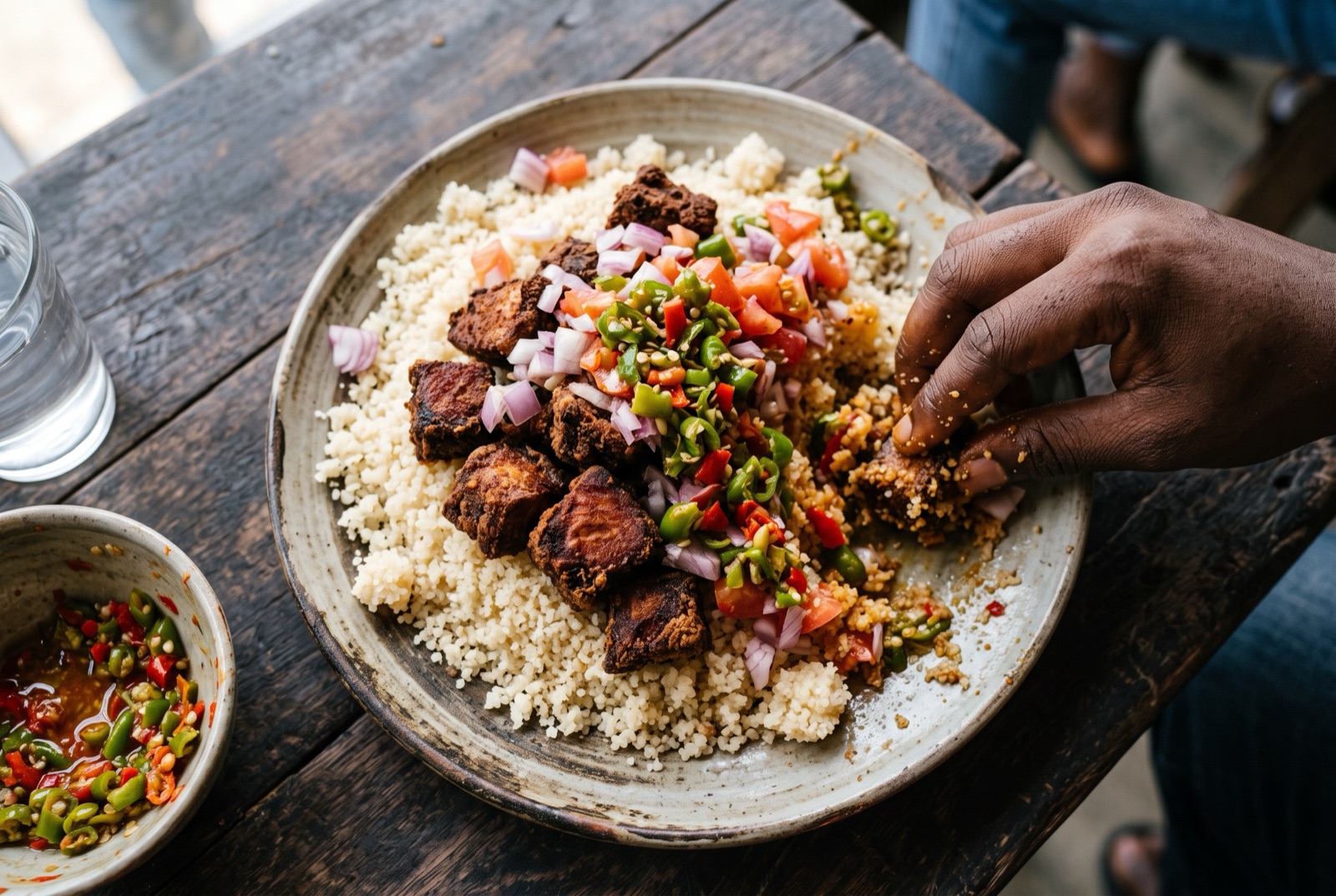
- Coarser-grained attiéké, deliberately made with larger granules, which is what street kiosks serve under fried tuna.
- Attiéké rouge
- Fluffed with red palm oil instead of neutral oil, turning the granules a warm orange and adding a faint fruity note.
- Placali
- The same fermented cassava dough taken in the other direction — cooked and stirred into a smooth, elastic paste rather than steamed into grains.
Storage & reheating.
Steamed attiéké keeps 3 days in the fridge in a sealed container and firms up considerably when cold. Revive it by sprinkling with a little water and steaming for 5 minutes, or microwaving covered — it comes back almost exactly. It freezes for 3 months in portions. The unsteamed fermented granules can also be spread out and air-dried for long storage, which is what commercial dried attiéké is.
Serve with
Grilled fish with onion and chilli, sauce graine, sauce arachide, or fried tuna as garba.
The story behind Attiéké.
Attiéké belongs to the lagoon peoples of southern Côte d'Ivoire — the Ébrié, Adjoukrou, Alladian and Avikam communities around what is now Abidjan — and it was their household food long before it became a national one. Cassava itself is not African; it arrived from South America through Portuguese trade routes and was adopted so completely across West and Central Africa that it now feeds more people there than in its homeland. Fermenting it was not originally about flavour. Bitter cassava varieties contain cyanogenic compounds, and grating plus fermentation plus pressing plus heat is the traditional processing chain that makes the root safe. The sourness is a by-product that became the point.
The starter is what makes attiéké attiéké. Cooks keep a portion of previously fermented cassava dough, known regionally as magnan or placali, and use it to inoculate each new batch, so a household's attiéké carries a continuous microbial lineage in the same way a sourdough culture does. Different communities produce noticeably different results — coarser or finer granules, more or less sour — and Ivorians will argue at length about whose is best, with attiéké from the Adjoukrou area of Dabou holding particular prestige.
It is also one of the clearer cases of a dish having a home. Cassava starches are eaten across the whole region — gari in Ghana, Nigeria and Benin, farinha in Brazil, chikwangue in Congo — but attiéké specifically, as steamed sour granules, is Ivorian in a way that most West African dishes are not, and it has been granted a protected geographical indication for that reason. That said, it now travels: it is sold across neighbouring countries and in African groceries worldwide, both fresh and freeze-dried, and plenty of Ivorian families abroad simply buy it. Making your own is worth doing once, to understand what the sourness is and why the texture matters.
Questions, answered.
What does attiéké taste like?
Mildly sour and slightly yeasty, with the neutral starchy background of cassava underneath. The tang is gentle rather than sharp, closer to a light sourdough than to vinegar, and it is what makes attiéké work under fatty grilled fish or a rich palm nut sauce. Texture matters as much as flavour: separate, moist granules, never sticky.
Is attiéké the same as couscous?
No, only similar in appearance. Couscous is rolled from semolina, which is wheat, and contains gluten. Attiéké is made from fermented cassava root, contains no gluten at all, and is sour rather than neutral. The visual resemblance is why French speakers sometimes call it couscous de manioc.
Why does cassava need to be fermented?
Cassava contains cyanogenic compounds, more so in bitter varieties, and the traditional chain of grating, fermenting, pressing and cooking reduces them to safe levels. Fermentation also breaks down the starch enough to give attiéké its light texture and its characteristic sour flavour, so it does two jobs at once.
Can I make attiéké without a starter?
You can, but expect a different result. Wild fermentation of grated cassava does happen on its own if you leave it warm and covered for two to three days, though it is slower and less predictable, and the acidity is thinner. A spoonful of dough saved from a previous batch or bought from an African grocer gives a much more reliable sourness.
How much attiéké is one serving?
About 200 g of steamed attiéké per person as the starch for a main meal, a little more if it is the centre of the plate as in garba. Two kilos of raw cassava yields roughly 1.2 kg finished, since a large amount of water is pressed out along the way.
You might also like.
All recipes →
Keep exploring Ivory Coast.
Ivory Coast has 9 more dishes in the atlas — Alloco and Claclo, and 7 more.
Recipe by The DishRoute Kitchen · published August 20, 2026 · updated August 20, 2026