Liptauer.
Viennese Paprika Cheese Spread
Liptauer Aufstrich · say it: LIP-tow-er
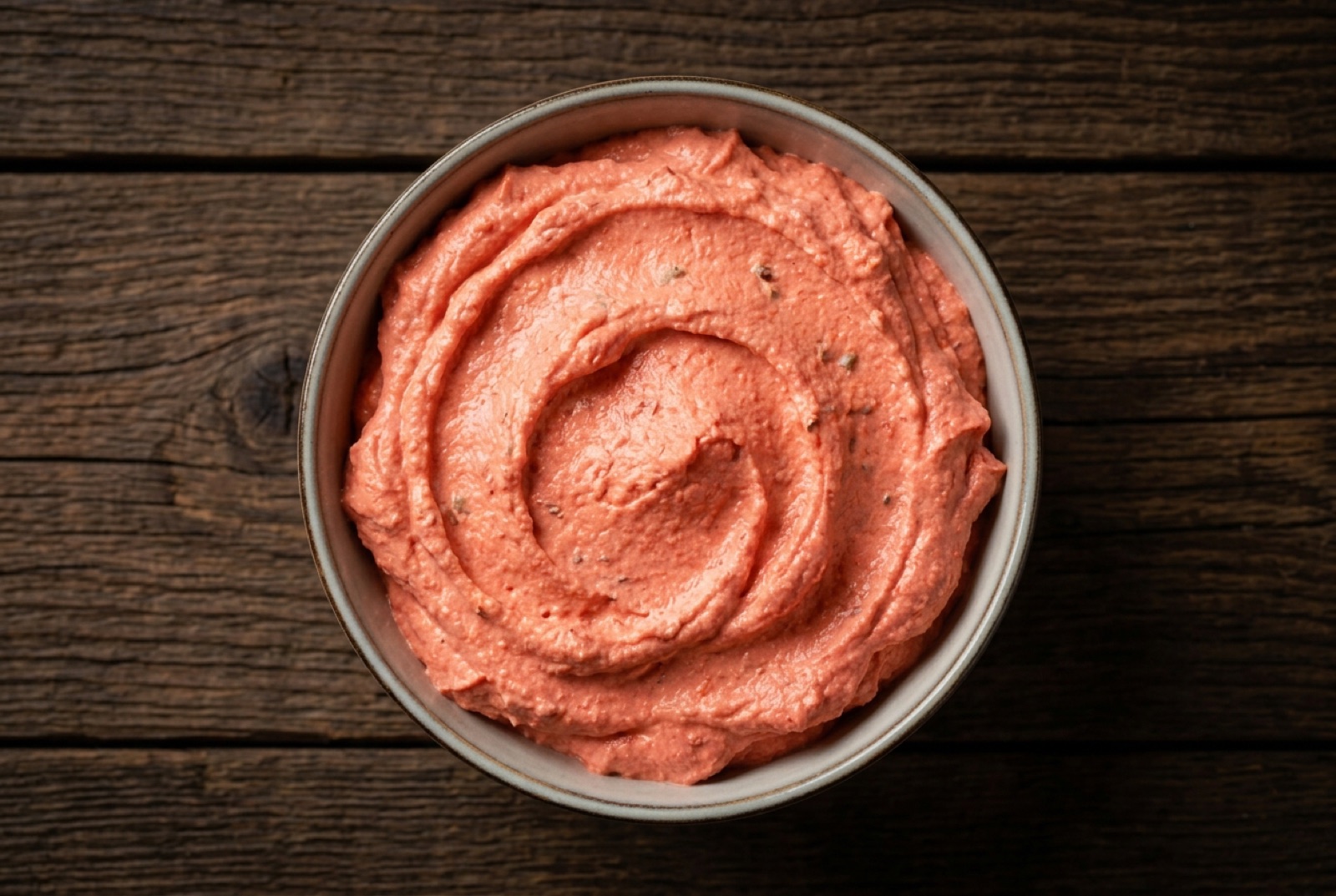
Liptauer is a soft cheese spread stained orange-pink with sweet paprika and sharpened with capers, onion, caraway and mustard. It sits somewhere between a dip and a pâté: rich from the butter beaten into it, sour from the curd cheese, and salty enough that it demands beer or a glass of young white wine. It takes ten minutes, needs no cooking, and improves overnight as the paprika bleeds through and the raw onion loses its bite. In Austria it comes to the table on dark rye bread with sliced radish and a scattering of chives, usually as part of a cold plate before anything hot arrives.

- Gate
- AustriaVienna and Burgenland
- Prep
- 15 min
- Cook
- 0 min
- Total time
- 4 hr 15 min incl. 4 hr rest
- Serves
- 6
- Status
- Easy
- Nutrition / serving · estimated
- Calories 230 kcal
- Protein 8 g
- Carbs 4 g
- Fat 20 g
- Fiber 1 g
- Sodium 470 mg
Why this recipe works.
- Beats the butter first so the spread whips light instead of turning into grainy cheese paste.
- Uses the full Viennese seasoning set, with clear guidance on the parts people fight about.
- Softens the raw onion in advance, which removes the harsh note that ruins most homemade versions.
- Built around widely available quark, with an honest note on what bryndza would change.
Ingredients.
12 itemsFor the spread
To serve
Equipment
- Mixing bowl and hand whisk or electric beaters
- Fine grater
- Mortar and pestle (optional)
Instructions.
Cream the butter
Beat 100 g of very soft butter in a bowl with a whisk or electric beaters for 2–3 minutes, until it is pale, fluffy and holds soft peaks like whipped cream.
Tip If the butter is still cool from the fridge, stop and wait. Cold butter never creams and you will taste the lumps.
Bloom the paprika in the fat
Beat the paprika into the creamed butter until the mixture turns an even deep coral. Working it into the fat first is what gives the finished spread its colour rather than a dusty pink streak.
Tame the onion
Grate the onion finely, rinse it under cold water in a sieve for a few seconds and squeeze it dry in your hand. This removes the raw sulphurous edge without losing the flavour.
Fold everything together
Add the drained curd cheese, onion, capers, crushed caraway, mustard, anchovy if using and sour cream, and fold and beat until completely smooth and uniformly coloured with no white streaks left.
Season and rest
Season with salt and pepper, remembering that capers and anchovy already bring salt. Cover the surface with parchment and refrigerate for at least 4 hours, ideally overnight.
Serve at cool room temperature
Take the spread out 20 minutes before eating, pile it into a bowl and rough up the surface with the back of a spoon. Scatter with chives and serve with dark bread and sliced radish.
Tips from our kitchen.
- Have the butter genuinely soft, at proper room temperature. Cold butter will not cream and leaves lumps that never disappear no matter how long you beat.
- Grate the onion rather than chopping it, then rinse it briefly in cold water and squeeze dry. It disappears into the spread and loses its aggression.
- Use fresh sweet paprika and add it early, not at the end. It needs time in the fat to release colour, which is why the spread deepens overnight.
- Chop the capers rather than leaving them whole, unless you want occasional salt bombs in an otherwise even spread.
- Crush the caraway seeds lightly in a mortar. Whole seeds are unpleasant to bite and their aroma stays locked in.
- Rest the finished spread for at least four hours and preferably overnight before serving — this step is not optional if you want it to taste right.
Substitutions.
- Topfen or quark → Cream cheese thinned with a little sour cream, or drained full-fat cottage cheese blended smooth
- Cream cheese is sweeter and less acidic, so add a squeeze of lemon. Cottage cheese needs blending or the texture stays lumpy.
- Sweet Hungarian paprika → Half sweet paprika, half smoked paprika
- Not traditional, but a good fix if your sweet paprika is old and flat. Do not use hot paprika alone — Liptauer is warm, not fiery.
- Capers → Finely chopped pickled gherkin
- Both appear in Viennese recipes and either works. Gherkin gives more crunch and sweetness, capers more salt and floral bitterness.
Variations.
- Körözött
- The Hungarian version, usually made with sheep's cheese and a heavier hand with paprika, served with bread and raw onion rings.
- Liptauer with bryndza
- Closest to the original: replace a third of the curd cheese with Slovak bryndza for the sharp, grassy sheep's milk note the spread was built on.
- Heuriger cold plate
- Served as part of a wine tavern spread with Verhackert, cured pork, hard-boiled eggs, radishes and dark bread.
Storage & reheating.
Liptauer keeps 4 to 5 days in a sealed container in the fridge and genuinely peaks on day two, once the paprika has coloured the whole mixture and the onion has mellowed. Press a piece of baking parchment onto the surface to stop it drying and taking on fridge smells. Take it out 20 minutes before serving — straight from the cold it is stiff and tastes muted. Do not freeze it: the curd cheese separates on thawing and the spread turns grainy and weeping, and no amount of beating brings it back.
Serve with
Dark rye or pumpernickel bread, sliced radish, spring onion and a glass of Grüner Veltliner or cold lager.
The story behind Liptauer.
The name is a geographical fact rather than an Austrian one. Liptau is the German name for Liptov, a region in what is now northern Slovakia, historically famous for bryndza — a soft, sharp sheep's milk cheese made in the Carpathian highlands. That cheese travelled across the Austro-Hungarian empire, and cooks in Budapest and Vienna started mixing it with butter and paprika to make a spread. When the empire dissolved, the spread stayed put in every successor country and the cheese did not: Vienna reformulated it with Topfen, the local cow's milk curd cheese, plus enough butter to get the richness that bryndza used to supply.
So Liptauer is genuinely shared property, and the versions diverge. Hungarian körözött usually leans harder on paprika and often includes the sheep's cheese. Slovak versions stay closest to the original, since bryndza is still made there and carries protected status. The Viennese version is the softest and mildest of the three, and it is the one you meet in a Beisl — the small, dark neighbourhood pub — spread thickly on Schwarzbrot with a beer.
The seasoning list is where cooks argue. Almost everyone agrees on paprika, onion, caraway and salt; from there it splinters. Capers and chopped gherkin are standard in Vienna, anchovy is common in older recipes and disappears from modern ones, mustard is either essential or an intrusion depending on who is talking, and some households add a spoonful of sour cream to loosen it. The one point of consensus is that it must rest — a freshly mixed Liptauer tastes of raw onion and dusty paprika, and a night in the fridge turns it into something completely different.
Questions, answered.
What cheese is Liptauer traditionally made with?
Originally bryndza, a soft sharp sheep's milk cheese from the Liptov region of present-day Slovakia, which is where the name comes from. When the spread settled into Viennese kitchens it was rebuilt with Topfen, the local cow's milk curd cheese, beaten with butter to make up for the richness of the sheep's cheese. Both versions are considered authentic in their own country.
Is Liptauer spicy?
Not usually. The paprika used is sweet rather than hot, and its job is colour and warmth rather than heat. Some Hungarian versions add a pinch of hot paprika, and you can too, but a Viennese Liptauer should taste rounded and savoury with a mild pepper warmth in the background. The sharpness people notice comes from onion, capers and mustard.
Why does my Liptauer taste harsh?
Two likely reasons: it has not rested, and the onion went in raw and chopped. Grate the onion, rinse and squeeze it before mixing, and give the finished spread at least four hours in the fridge. Old paprika also tastes dusty and bitter — if the powder is brownish rather than bright red, replace it before blaming the recipe.
What do you eat Liptauer with?
Dense dark bread above all — rye or pumpernickel, cut thin and spread thickly. Radishes, spring onions, gherkins and hard-boiled eggs are the usual accompaniments, and in Austria it appears on cold plates at wine taverns and pubs alongside cured meats. It also works as a dip for raw vegetables or on a warm pretzel.
Can I make it without anchovies?
Yes. Anchovy appears in older Austrian recipes as a salt and umami source and is absent from most modern ones, so leaving it out is entirely normal and keeps the spread vegetarian. If you skip it, taste carefully for salt at the end and consider an extra teaspoon of chopped capers to make up the savoury depth.
You might also like.
All recipes →
Keep exploring Austria.
Austria has 9 more dishes in the atlas — Backhendl and Erdäpfelsalat, and 7 more.
Recipe by The DishRoute Kitchen · published August 19, 2026 · updated August 19, 2026