Sachertorte.
Viennese Chocolate and Apricot Cake
Sachertorte · say it: ZAH-kher-tor-teh
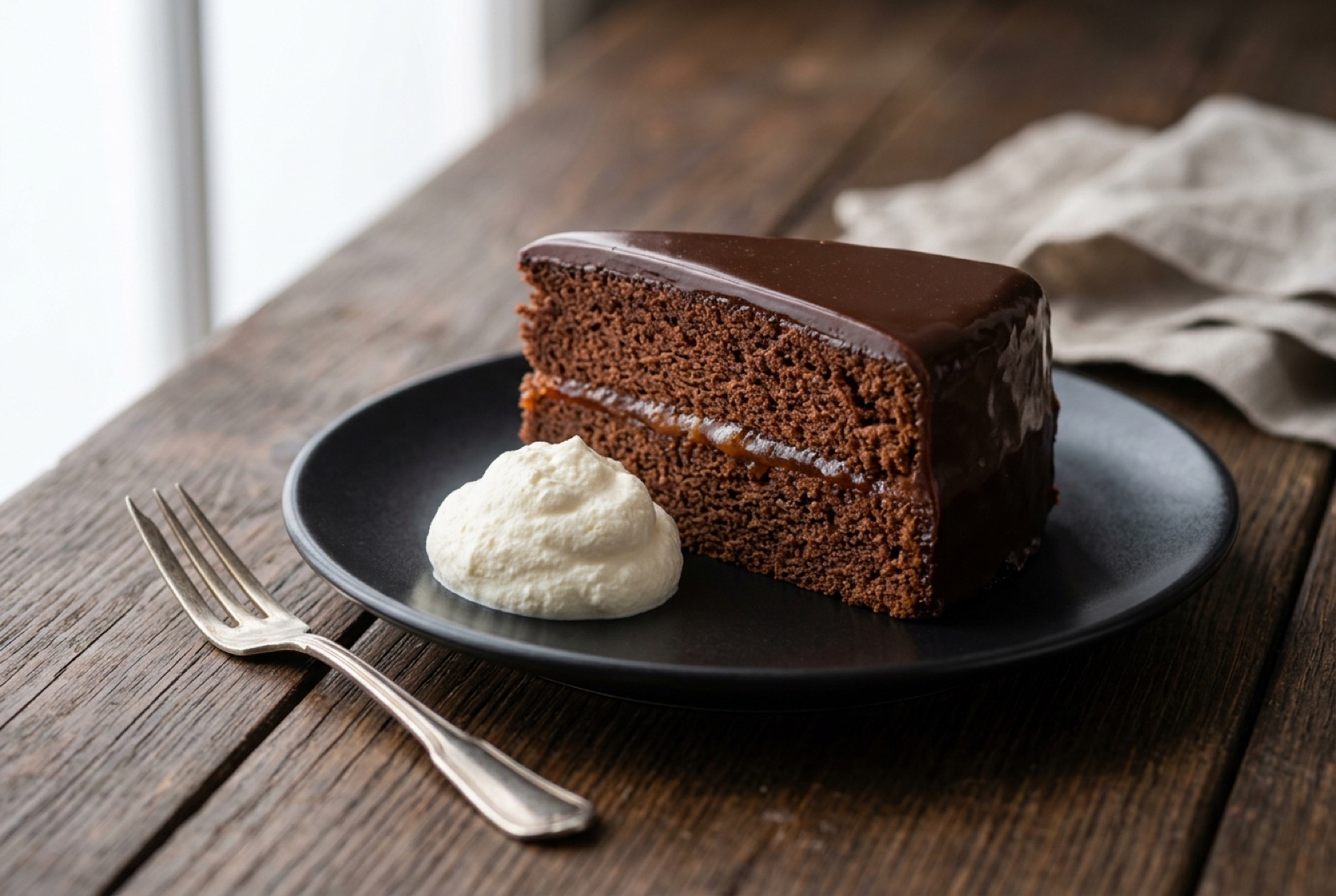
Sachertorte is a firm, deliberately dry chocolate cake with a thin layer of apricot jam through the middle, another brushed over the outside, and a poured glaze that hardens into a smooth matte-gloss shell. It is not a fudgy cake and is not supposed to be: the crumb is close and slightly chewy, the jam supplies the moisture and a sharp fruit note, and the glaze is made from sugar syrup and chocolate rather than cream, so it sets firm enough to cut cleanly. The unsweetened whipped cream served beside it is structural rather than decorative — the cake is dense enough that Viennese cafés consider serving it without cream a mistake.

- Gate
- AustriaVienna
- Prep
- 45 min
- Cook
- 55 min
- Total time
- 5 hr 40 min incl. 4 hr rest
- Serves
- 12
- Status
- Takes skill
- Nutrition / serving · estimated
- Calories 520 kcal
- Protein 7 g
- Carbs 62 g
- Fat 28 g
- Fiber 3 g
- Sugar 48 g
Why this recipe works.
- Uses the sugar-syrup glaze rather than a ganache shortcut, so the surface sets hard and shines properly.
- Warms and sieves the apricot jam into a thin sealing coat that gives the glaze a smooth surface to grip.
- Beats the egg whites separately for the light-but-firm crumb the cake is supposed to have.
- Says plainly that this is a reconstruction, since both Viennese houses keep the real formula secret.
Ingredients.
13 itemsFor the sponge
For the filling
For the glaze
To serve
Equipment
- 22 cm springform tin
- Stand mixer or electric beaters
- Sugar thermometer
- Wire rack and tray
- Long serrated knife
- Small pastry brush
Instructions.
Prepare the tin and oven
Heat the oven to 170°C. Butter a 22 cm springform tin, line the base with baking parchment and dust the sides with flour, tapping out the excess so the sponge can climb the walls.
Cream butter, sugar and chocolate
Beat the soft butter with the icing sugar for 4 minutes until pale and light, then beat in the cooled melted chocolate followed by the egg yolks one at a time, waiting for each to disappear before adding the next.
Tip The melted chocolate must be barely warm. Hot chocolate will melt the butter and the mixture will split.
Whip the whites
In a clean bowl, whisk the egg whites with the salt until foamy, then add the caster sugar in a slow stream and whip to a glossy medium peak that curls over at the tip rather than standing straight.
Fold in whites and flour
Fold a third of the whites into the chocolate mixture to loosen it, then alternate the remaining whites with the sifted flour in two additions, folding gently until just combined with no dry patches.
Bake
Scrape the batter into the tin, level the top and bake for 50–55 minutes. The cake is done when it has domed, come slightly away from the sides, and a skewer comes out with a few dry crumbs but no wet batter.
Cool completely
Rest the cake in the tin for 15 minutes, then release the ring, invert onto a rack and peel off the parchment. Leave it upside down to cool fully, which flattens the domed top into a level surface.
Split and fill with jam
Warm the apricot jam with the rum until fluid and press it through a sieve. Slice the cold cake horizontally in half with a serrated knife, brush the cut face generously with jam, reassemble and coat the top and sides in a thin even layer.
Tip Work fast while the jam is hot and thin — it sets quickly and drags once it cools.
Let the jam set
Move the jam-coated cake to a rack set over a tray and leave for 30 minutes until the surface is tacky-dry to the touch. The glaze needs a sealed, set surface to sit on.
Cook the glaze syrup
Boil the sugar and water in a small pan until the syrup reaches 108°C on a thermometer, about 5 minutes. Take it off the heat, add the chopped chocolate and stir slowly until completely smooth and thickly pourable.
Glaze in one pour
Pour the warm glaze onto the centre of the cake in a single stream and let it flow outwards, helping it over the edges with two or three light passes of a palette knife and no more. Tap the rack once to settle it.
Set and serve
Leave the cake at cool room temperature for at least 3 hours until the glaze is firm and matte-glossy. Slice with a hot dry knife and serve each piece with a spoonful of unsweetened whipped cream.
Tips from our kitchen.
- Use chocolate at 50–55% cocoa solids, not 70%. Very dark chocolate makes both cake and glaze bitter and brittle, and the original is not a high-percentage cake.
- Sieve the apricot jam and boil it briefly with a spoon of rum before brushing. Lumps of fruit under the glaze show as bumps on the finished surface.
- The glaze syrup needs to reach about 108°C. Too cool and it stays sticky forever, too hot and it sets grainy and dull almost instantly.
- Pour the glaze in one continuous stream onto the centre of the cake and let it find its own way to the edges. Every stroke of the palette knife leaves a mark you cannot fix.
- Set the glazed cake on a rack over a tray and leave it alone at room temperature. Refrigerating it to speed setting makes the glaze dull and sweat when it warms up.
- Cut with a thin knife dipped in hot water and wiped dry between slices, or the glaze cracks and drags across the cut face.
Substitutions.
- Apricot jam → Apricot preserve pressed through a sieve, or apricot puree cooked down with sugar
- It must be apricot — the sharp fruit acidity against the dark chocolate is the whole architecture of the cake. Other jams make a different cake entirely.
- Sugar syrup glaze → Chocolate ganache made with cream and a spoon of glucose
- Far easier and far more forgiving, but it stays soft, tastes richer and is not a Sachertorte glaze. Use it if the syrup defeats you twice.
- Dark chocolate, 50–55% → Half 70% chocolate and half milk chocolate
- Gets you to roughly the right cocoa percentage if that is what your cupboard holds. Do not use chocolate chips, which contain stabilisers that prevent a clean glaze.
Variations.
- Demel style
- Jam only under the glaze, with no layer through the middle, and the cake left unsplit — the version at the heart of the trademark case.
- Sachertorte with rum
- The apricot jam loosened with dark rum before brushing, common in Viennese home baking and slightly more aromatic.
- Individual Sacherwürfel
- The same cake baked flat, cut into cubes and glazed on all sides — sold in Vienna as small gift boxes and easier to glaze evenly at home.
Storage & reheating.
Sachertorte keeps far better than most cakes because it is dry by design and sealed under jam and set glaze. Store it at cool room temperature under a cake dome for up to a week — it is arguably better on day two, once the jam has worked into the crumb. Do not refrigerate: the glaze goes dull and sweats condensation when it comes back to room temperature, and cold blunts the chocolate flavour. The unglazed sponge freezes well for 2 months, wrapped tightly; glaze it after thawing rather than before.
Serve with
A large spoonful of unsweetened whipped cream and a strong black coffee or Melange.
The story behind Sachertorte.
The origin story here is unusually well documented, and so is the fight that followed. Franz Sacher, a teenage apprentice cook in the kitchen of Prince Metternich in Vienna, is credited with making the cake in 1832 when the head chef fell ill. His son Eduard refined it during his training at the Demel confectionery and later served it at the Hotel Sacher, which the family opened in 1876. Two Viennese institutions therefore had a genuine claim to the recipe, and for decades both sold it happily.
That ended in court. From 1954 the Hotel Sacher and Demel fought a trademark case over the right to call their cake the Original Sacher-Torte, which ran for years and became a Viennese spectator sport known as the sweet seven-year war. The settlement gave the Hotel Sacher the words Original Sacher-Torte and a round chocolate seal on top, while Demel sells its version as the Eduard-Sacher-Torte with a triangular seal. The recipes differ in one visible way: the hotel version has a layer of apricot jam through the middle of the cake as well as under the glaze, while the Demel version has jam only directly beneath the glaze.
Both houses keep their exact formulas secret, which means every published Sachertorte recipe, including this one, is a reconstruction. What is not secret is the technique. The glaze is the part that separates a good homemade Sachertorte from a disappointing one: it is not ganache but a sugar syrup boiled to a specific concentration, then combined with melted chocolate and poured in one movement over the jam-sealed cake. It must be poured while fluid, spread as little as possible, and left alone to set — and it will show every hesitation. The apricot jam layer, meanwhile, is what makes the cake work at all: without it the dry sponge would be exactly that.
Questions, answered.
Why is my Sachertorte dry?
It is supposed to be firm and fairly dry — that is the defining character of the cake and the reason it is always served with unsweetened whipped cream and coffee. What stops it being merely dry is the apricot jam, so do not skimp on either the middle layer or the coat under the glaze. If it is genuinely crumbly rather than firm, the sponge was overbaked or the whites were beaten too stiff.
Why did my chocolate glaze turn dull or grainy?
The sugar syrup temperature was wrong, or the mixture was stirred too vigorously. Boil the syrup to around 108°C, take it off the heat, add the chopped chocolate and stir slowly and steadily until smooth without whipping air into it. Pour while it is still fluid enough to level itself. Refrigerating the cake to set the glaze also dulls the shine.
What is the difference between the Sacher and Demel versions?
Both descend from Franz Sacher's 1832 cake, and a long Viennese court case in the 1950s and 60s settled who could use which name. The Hotel Sacher version has apricot jam through the middle of the cake as well as under the glaze and carries a round seal; the Demel version has jam only under the glaze and carries a triangular one. The exact recipes remain trade secrets in both houses.
Do I really need to use apricot jam?
Yes. The apricot layer is not a filling choice but part of the cake's structure — its acidity cuts the chocolate and its moisture compensates for a deliberately dry sponge, and it also gives the glaze a smooth, sealed surface to set against. Raspberry or cherry make a perfectly nice cake, but it is no longer a Sachertorte in any meaningful sense.
Can I make Sachertorte in advance?
Yes, and it is the rare cake that improves with a day or two. Bake, fill and glaze it, then keep it under a dome at cool room temperature for up to a week. The unglazed sponge also freezes for two months. Glaze it on the day you plan to serve or the day before, because a set glaze is stable but does not survive freezing.
You might also like.
All recipes →

Keep exploring Austria.
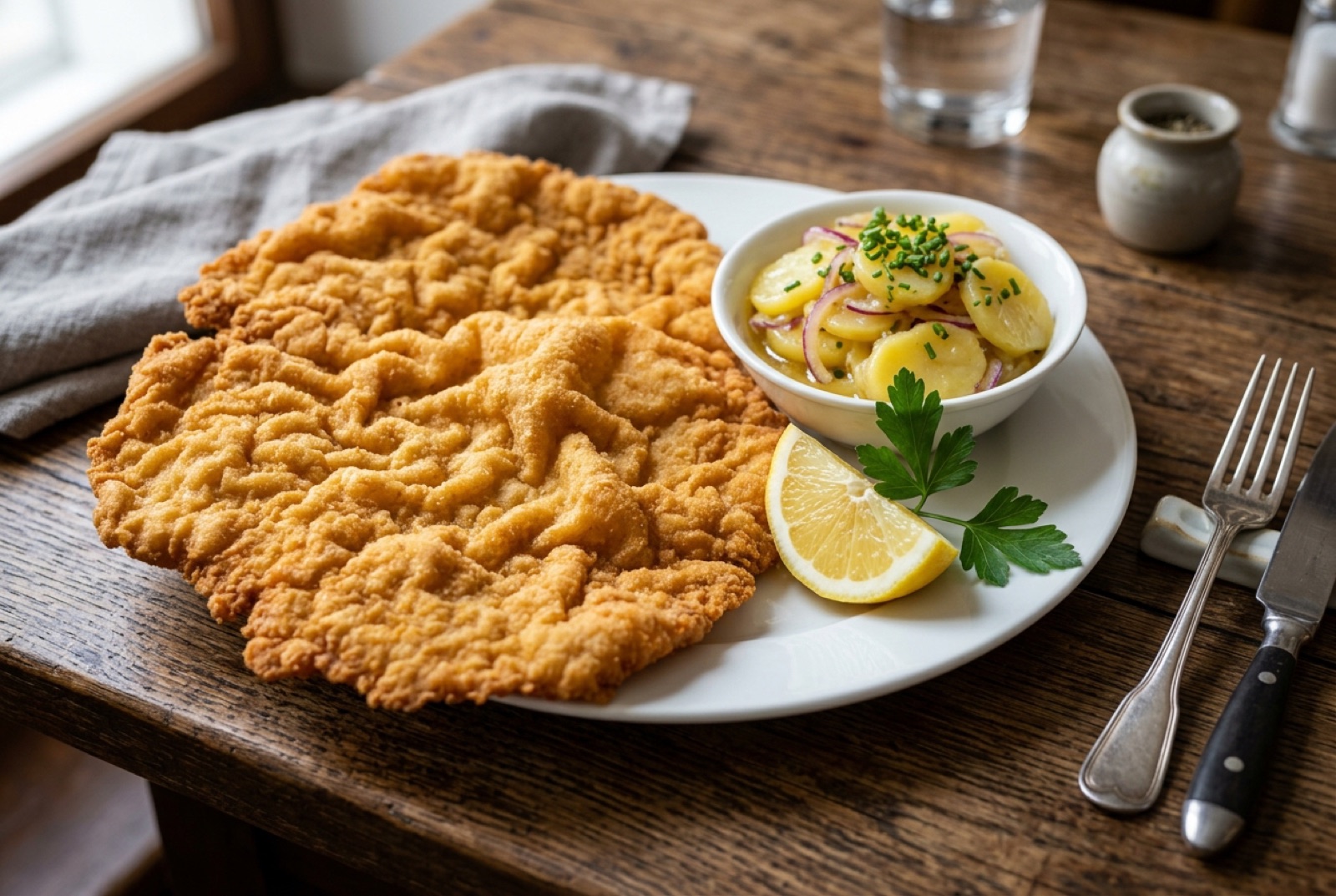
Austria has 9 more dishes in the atlas — Backhendl and Erdäpfelsalat, and 7 more.
Recipe by The DishRoute Kitchen · published August 19, 2026 · updated August 19, 2026