Vol-au-Vent.
Belgian Chicken and Meatball Pastry Case
Videe / koninginnenhapje · say it: vol-oh-VAHN
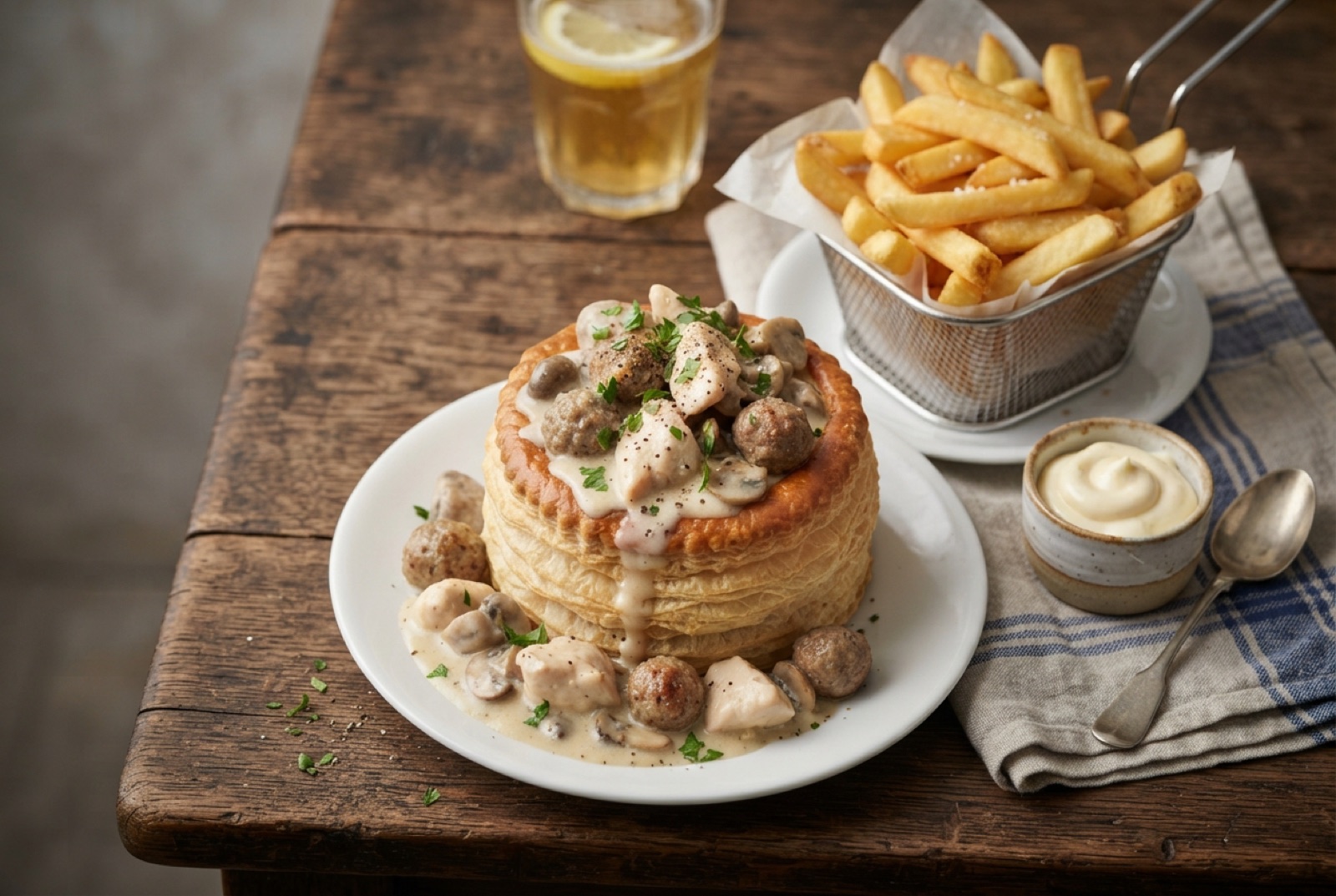
Belgian vol-au-vent is a puff pastry shell filled with poached chicken, marble-sized meatballs and sliced mushrooms bound in a velouté finished with cream and sharpened with lemon. It is pale, rich and unashamedly old-fashioned, and it appears on brasserie menus across the country under three names — vol-au-vent, videe, or koninginnenhapje, "little queen's bite". The sauce is the work: a proper blond roux, chicken poaching liquid whisked in slowly, then cream and enough lemon juice to keep the whole thing from feeling heavy. The meatballs are what make it Belgian rather than French, and they are seasoned with nutmeg and left small so several land in every spoonful. Fries on the side, always.

- Gate
- BelgiumBrussels and Flanders
- Prep
- 35 min
- Cook
- 40 min
- Total time
- 1 hr 15 min
- Serves
- 4
- Status
- Medium
- Nutrition / serving · estimated
- Calories 780 kcal
- Protein 48 g
- Carbs 46 g
- Fat 44 g
- Fiber 3 g
- Sodium 940 mg
Why this recipe works.
- Poaches the chicken and cooks the meatballs in the same broth, so the sauce is built from liquid with real flavour.
- Walks through the blond roux and the ladle-by-ladle velouté, the step that decides whether the sauce is silky or lumpy.
- Keeps the meatballs small and nutmeg-scented, the detail that separates the Belgian version from a French bouchée.
- Balances the richness with lemon and white pepper instead of leaving the sauce heavy.
Ingredients.
16 itemsFor the poaching
For the meatballs
For the sauce
To serve
Equipment
- Wide saucepan
- Balloon whisk
- Slotted spoon
- Baking sheet
Instructions.
Mix and roll the meatballs
Work 300 g of ground pork with the breadcrumbs, egg, nutmeg, a heavy pinch of salt and pepper until it is sticky and holds together. Roll marble-sized balls with wet hands — you want around forty small ones, not a dozen large ones.
Tip Fry a teaspoon of the mix and taste it before rolling the rest; this is your only chance to correct the seasoning.
Poach chicken and meatballs
Bring the stock to a gentle simmer with the bay leaf. Poach the chicken pieces for 8 minutes, lift them out with a slotted spoon, then drop the meatballs into the same broth and poach for 6 minutes, until they float and feel firm. Lift them out too and keep the broth hot.
Cook the mushrooms
Melt 20 g of the butter in a wide saucepan and cook the mushrooms over fairly high heat until they have given up their water, it has evaporated, and they squeak against the pan. Tip them out with the chicken and meatballs.
Make the blond roux
Melt the remaining butter in the same pan, whisk in the flour and cook over medium-low heat for 2 minutes, stirring constantly, until the paste smells of warm biscuit but has taken on no colour beyond pale straw.
Build the velouté
Add the hot poaching broth one ladle at a time, whisking each addition to a completely smooth paste before adding the next. Once about 700 ml is in, simmer for 5 minutes, whisking, until the sauce coats the back of a spoon and a finger drawn through it leaves a clean line.
Tip Keep the remaining broth to hand — you will want it to loosen the filling later.
Finish the filling
Stir in the cream, then return the chicken, meatballs and mushrooms and warm through for 3 minutes without boiling. Season with white pepper, salt and the lemon juice, adding the juice a little at a time until the sauce tastes bright rather than merely rich, and stir through the parsley.
Bake the cases and serve
Warm the puff pastry cases in a 180°C oven for 5–8 minutes until crisp and dry inside, then set one on each plate, spoon the hot filling in so it spills generously over the sides, and cap it with the pastry lid. Serve at once with fries.
Tips from our kitchen.
- Roll the meatballs no bigger than a large marble. Full-size meatballs make the filling clumsy and will not sit inside the pastry case.
- Cook the roux for a full two minutes before adding liquid, until it smells faintly of biscuit. Undercooked flour makes the sauce taste chalky.
- Add the hot broth one ladle at a time, whisking to a smooth paste each time before the next. This is the whole difference between velouté and lumps.
- Bake the pastry cases separately and fill them at the very last moment, or the base turns to wet paper before it reaches the table.
- Season the sauce with white pepper and nutmeg rather than black pepper, so the specks do not show in a deliberately pale sauce.
- If the sauce thickens too far while it sits, loosen it with a splash of the reserved poaching broth, not with water or extra cream.
Substitutions.
- Ground pork for the meatballs → Ground veal, or half pork and half veal
- Veal is the more old-fashioned Belgian choice and gives a finer, paler meatball. Pure beef makes the filling too assertive.
- Shop-bought puff pastry cases → Two sheets of all-butter puff pastry cut into 10 cm discs, stacked with a ring on top and baked at 200°C
- Cutting your own gives a better shell than most frozen cases. Chill the rings hard before baking so they rise straight.
- Button mushrooms → Chestnut mushrooms, or a handful of rehydrated dried mushrooms plus their soaking liquid
- Dried mushrooms deepen the sauce considerably, but they will tint it beige rather than ivory.
Variations.
- Videe with asparagus
- A spring version with poached white asparagus tips folded in at the end alongside the chicken, common during the Flemish asparagus season.
- Fish vol-au-vent
- Built on white fish, shrimp and mussels poached in a light fish broth instead of chicken, with the mussel liquor whisked into the velouté.
- Vol-au-vent with hard-boiled egg
- An older home style where quartered hard-boiled eggs replace some of the meatballs, softening the filling and stretching it further.
Storage & reheating.
The filling keeps 3 days refrigerated and reheats well over low heat with a splash of broth to loosen it; do not let it boil hard or the cream sauce can break. Store the pastry cases separately at room temperature in an airtight tin and re-crisp them for 5 minutes in a 180°C oven before filling. Never refrigerate a filled vol-au-vent — the pastry absorbs sauce and turns to sludge. The filling freezes for 2 months, though the sauce may need a brisk whisk to recombine after thawing.
Serve with
Belgian frites, always — plus a green salad with a sharp vinaigrette to cut the sauce.
The story behind Vol-au-Vent.
The pastry case is French and old: the vol-au-vent, meaning something like "flying in the wind", is credited to the pastry tradition of early nineteenth-century Paris and named for how little the baked shell weighs. The filling of chicken in a white sauce, bouchée à la reine, carries its own French court story that is repeated everywhere and documented nowhere very firmly. What Belgium did was take the format, add small pork or veal meatballs, make it a full-sized main course rather than a canapé, and serve it with fries — a combination no French kitchen would recognise.
It became the sort of dish that marks occasions. Vol-au-vent turns up at Belgian communion lunches, family Sundays and the fixed-price menus of unfashionable brasseries, which has given it a slightly nostalgic reputation without ever pushing it off the menu. Frozen supermarket versions are common and mediocre, which is part of why the homemade one lands so well: the difference between a sauce built from real poaching broth and one built from a packet is enormous, and it is entirely down to the roux and the liquid.
The technique worth taking seriously is the velouté. Butter and flour are cooked together until the mixture smells of biscuit rather than raw flour but has taken on no real colour, then hot broth is added a ladle at a time and whisked smooth before the next goes in. Rushing it gives lumps; skipping the flour-cooking gives a sauce that tastes pasty no matter how much cream goes in. Belgians also insist on the lemon. Without acid, a chicken-cream-mushroom sauce sits flat and cloying on the palate; a good squeeze at the end makes it taste like a dish rather than a filling.
Questions, answered.
What is the difference between vol-au-vent and bouchée à la reine?
They are close relatives. Both are puff pastry cases with a creamy chicken filling, but a bouchée à la reine is French, small and often served as a starter, while the Belgian vol-au-vent is a large main course that adds small pork or veal meatballs, mushrooms, and a side of fries. In Belgium the same dish is also called videe or koninginnenhapje depending on the region.
Why is my sauce lumpy?
The broth went in too quickly. A velouté needs the hot liquid added a ladle at a time, whisked to a completely smooth paste before the next addition, so the flour hydrates evenly. If lumps have already formed, push the sauce through a fine sieve or blitz it briefly with a stick blender, then continue as normal.
Can I use shop-bought puff pastry cases?
Yes, and most Belgian home cooks do. Bake them until deep gold and completely dry inside, then hollow out any soft dough from the middle before filling. Look for all-butter cases if you can find them; the vegetable-fat versions taste noticeably waxy against a rich cream sauce.
Can I make vol-au-vent ahead of time?
Make the filling up to three days ahead and reheat it gently on the day. Bake the pastry cases in advance too, but keep the two apart until the last minute — an assembled vol-au-vent softens within about ten minutes. Reheat the filling to steaming, warm the cases in the oven for five minutes, then fill and serve straight away.
What do Belgians serve with vol-au-vent?
Fries, in a separate dish, which is standard in every brasserie in the country. A simple green salad with a sharp mustard vinaigrette usually comes alongside to cut the richness. Bread is not typical, since the pastry case already plays that role, and the wine of choice is a dry white or a blonde Belgian beer.
You might also like.
All recipes →
Keep exploring Belgium.
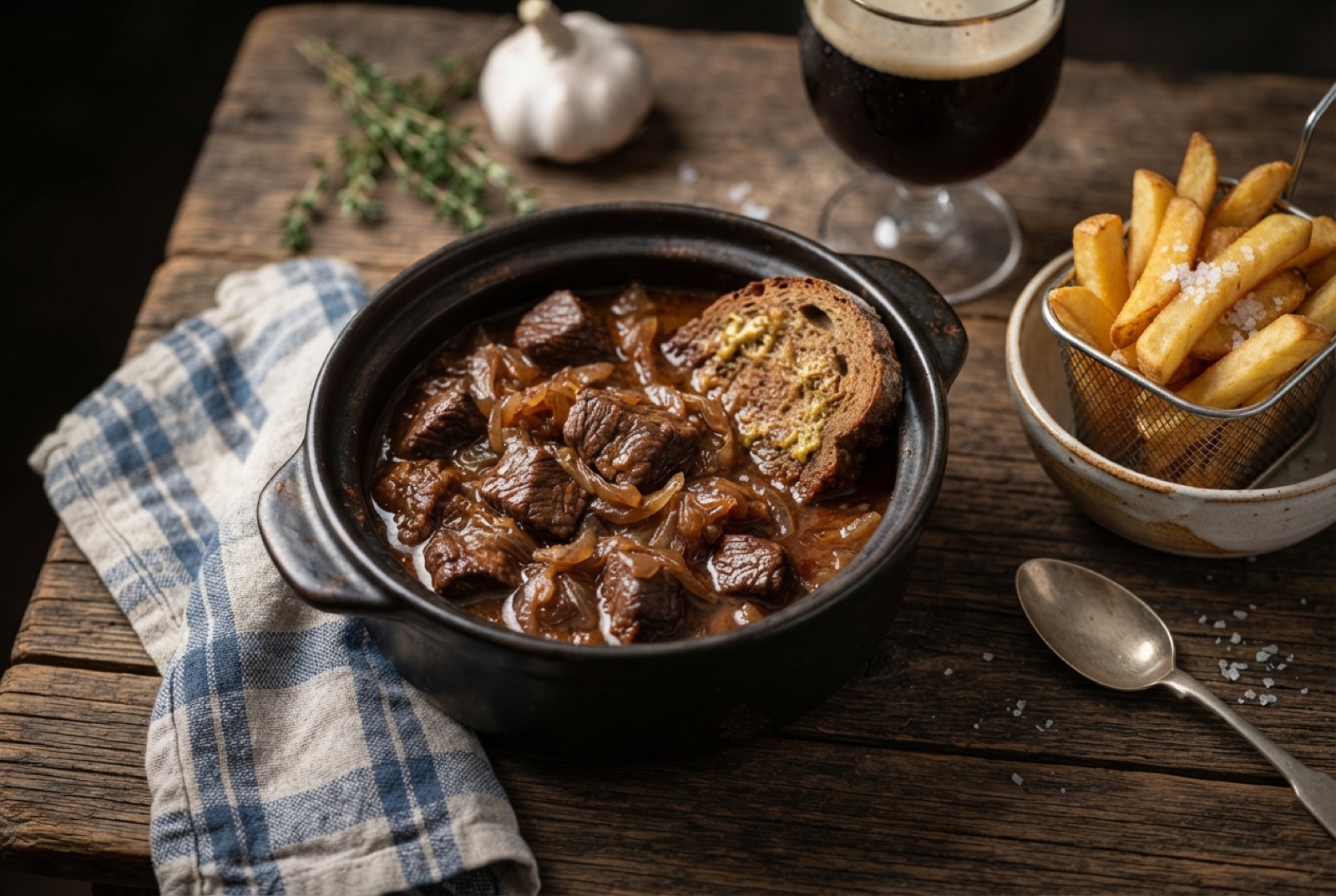
Belgium has 9 more dishes in the atlas — Belgische Frieten and Carbonnade Flamande, and 7 more.
Recipe by The DishRoute Kitchen · published August 19, 2026 · updated August 19, 2026