Bitterballen.
Crisp Dutch Beef Ragout Balls
Bitterballen · say it: BIT-ter-bahl-en
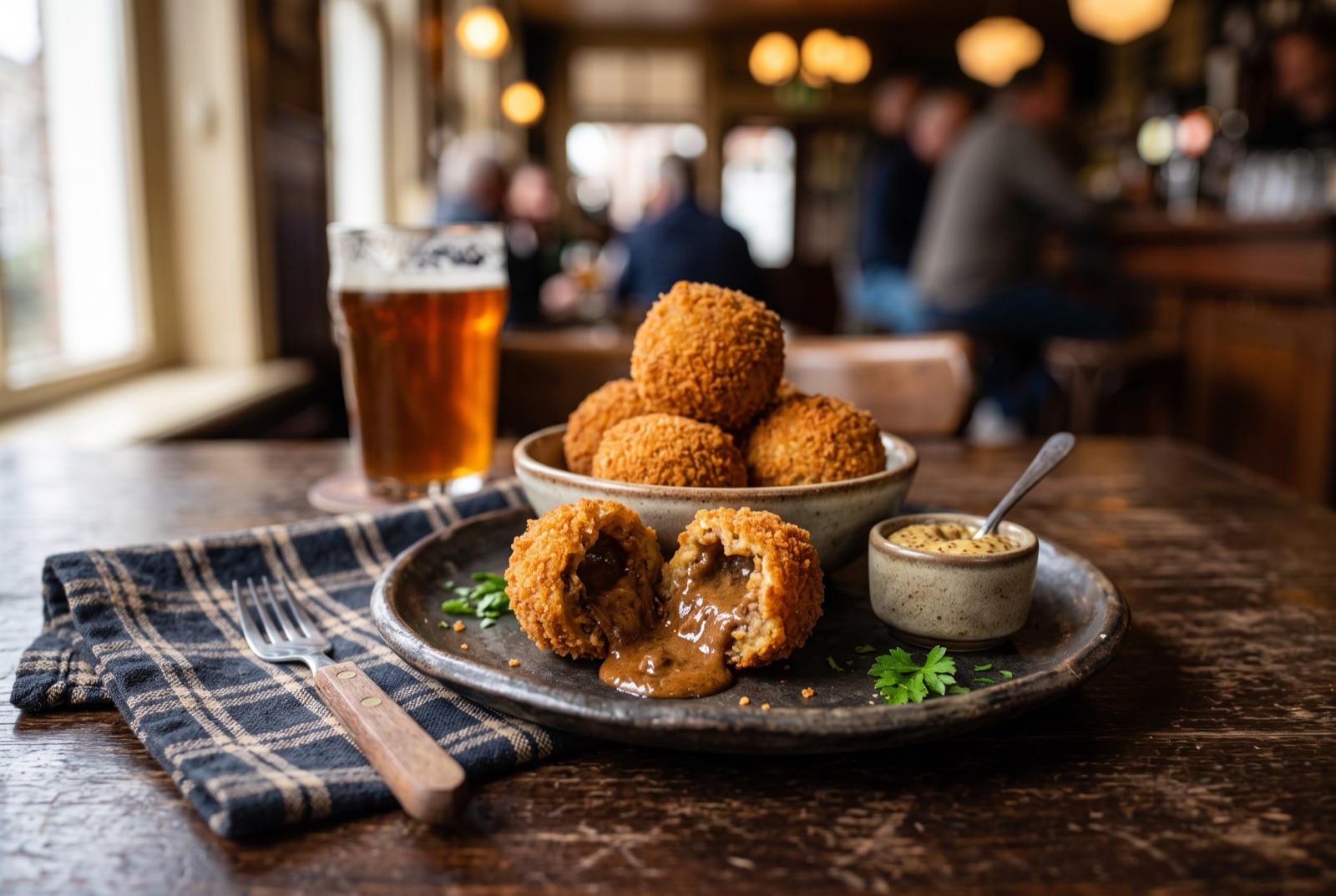
A bitterbal is a small sphere of very thick beef ragout that has been chilled solid, breaded twice and deep-fried, so that the crust turns crisp while the filling melts back into a sauce hot enough to burn your mouth. It comes six or eight to a plate with a blob of sharp mustard, alongside beer, and it is eaten standing up. The flavour is straightforward — braised beef, butter, nutmeg, parsley — but the texture is the entire point: brittle shell, molten centre, no gap between the two. Getting there takes two days of patience and a thermometer, and there is no honest shortcut.

- Gate
- Netherlands
- Prep
- 45 min
- Cook
- 3 hr
- Total time
- 11 hr 45 min incl. 8 hr rest
- Serves
- 4
- Status
- Takes skill
- Nutrition / serving · estimated
- Calories 470 kcal
- Protein 26 g
- Carbs 38 g
- Fat 24 g
- Fiber 2 g
- Sodium 780 mg
Why this recipe works.
- Uses real braised beef and its stock rather than a flour paste, which is the difference between a good bitterbal and a bad one.
- Gives a ragout stiff enough to roll — the single most common failure point — with a clear visual test for when it is thick enough.
- Double-breads the balls and explains why one coat splits in the fryer and two does not.
- Includes precise oil temperature and timing so the shell colours at the same moment the centre goes molten.
Ingredients.
15 itemsFor the braised beef
For the ragout
For the coating
Equipment
- Heavy saucepan
- Shallow tray for chilling
- Deep pan or fryer
- Cooking thermometer
- Slotted spoon
Instructions.
Braise the beef
Put the beef, onion, bay, cloves and stock in a pot, bring to a bare simmer and cook covered for about 2.5 hours, until the meat pulls apart into threads under a fork. Lift out the beef and strain the liquid, keeping 600 ml of it.
Shred the meat finely
Pull the cooled beef into threads with two forks, then chop the threads short — no piece longer than a centimetre. Long strands make the ragout hard to roll and stick out through the crumb coating.
Make a very thick roux
Melt the butter in a heavy saucepan, whisk in the flour and cook over medium heat for 2 minutes, stirring constantly, until it smells like toasted biscuit and turns pale sand-coloured. Do not let it brown.
Build the ragout
Add the reserved stock a ladle at a time, whisking each addition completely smooth before the next. Once all of it is in, cook for 8–10 minutes over low heat, stirring, until dragging the spoon across the base leaves a channel that holds its shape for several seconds.
Tip It should look uncomfortably thick, like stiff mashed potato. This is correct — a pourable sauce will never set firm enough to roll.
Fold in the meat and season
Stir in the chopped beef, nutmeg, parsley and Worcestershire sauce, and season assertively with salt and pepper — cold food tastes blander, so it should be slightly over-seasoned while hot. Spread into a shallow tray in a 2 cm layer.
Chill until solid
Press cling film onto the surface and refrigerate at least 4 hours, preferably overnight. The ragout must be firm enough that a spoon cuts a clean edge and the piece holds its shape in your hand.
Roll and double-bread
With damp hands, roll walnut-sized balls, about 25 g each. Roll each in flour, then egg, then breadcrumbs — then back through the egg and crumbs a second time, pressing firmly to seal any cracks. Chill or briefly freeze the coated balls for 20 minutes.
Fry in batches
Heat the oil to 180°C. Fry six or seven at a time for 3–4 minutes, turning once, until the shells are deep golden brown and blistered and float high in the oil. Drain on a rack, not paper, so the undersides stay crisp.
Tip Let the oil return to 180°C between batches. A drop of 20 degrees is enough to give you greasy, pale bitterballen.
Serve immediately
Pile them onto a plate with a pot of sharp mustard and serve while they are still too hot to eat comfortably — which is the traditional way and the reason everyone bites one in half first.
Tips from our kitchen.
- The ragout must be far thicker than any sauce you would eat. When you drag a spoon across the base of the pan it should leave a clean channel that holds for several seconds.
- Chill the ragout at least 4 hours, ideally overnight, in a shallow tray. A deep bowl chills unevenly and the middle stays soft.
- Wet or lightly oiled hands make rolling possible. Dry hands and cold ragout are a bad combination.
- Bread twice: flour, egg, crumb, then back through egg and crumb again. A single coat almost always splits and leaks in the oil.
- Freeze the crumbed balls for 20 minutes before frying. Cold centres give you the temperature gap that makes the outside crisp before the inside is a puddle.
- Fry at 180°C in small batches. Crowding drops the oil temperature, the shells absorb fat and go pale and greasy instead of crisp.
Substitutions.
- Home-braised beef → 400 g shredded leftover pot roast, brisket or slow-cooked beef
- This is how they were invented — from leftovers. Use a well-flavoured stock in the ragout to make up for the braising liquid you do not have.
- Beef → Shredded slow-cooked chicken or braised mushrooms
- Kalfsvleeskroketten (veal) and garnalenkroketten (shrimp) are both standard in the Netherlands, so varying the filling is entirely traditional. Mushroom versions need extra reduction because they release water.
- Deep frying → Air fryer at 200°C for 10–12 minutes, sprayed with oil
- Honest assessment: they will be crisp and perfectly edible, but the shell is drier and less blistered, and the centre does not go quite as molten. Deep frying is genuinely better here.
Variations.
- Kroketten
- The same ragout shaped into cylinders rather than balls, breaded identically. Eaten as a meal on white bread with mustard — the broodje kroket.
- Kaasbitterballen
- A cheese version made with aged Gouda folded into a thick béchamel base, popular on borrel boards and very quick since there is no braise involved.
- Garnalenkroketten
- The Dutch and Belgian shrimp croquette: small brown shrimp in a shellfish-stock ragout. Considered the luxury end of the family.
Storage & reheating.
Uncooked crumbed bitterballen freeze exceptionally well for 3 months — freeze them spread out on a tray, then bag them, and fry straight from frozen at 175°C for 5–6 minutes. Fried bitterballen do not keep: the shell softens within an hour and reheating gives you a hard, dry ball with a dry centre. The ragout itself keeps 3 days refrigerated before shaping. Never refrigerate fried ones and expect to recover them.
Serve with
A pot of sharp Dutch or Dijon mustard, and cold pilsner. Cheese cubes with mustard alongside make it a proper borrelplank.
The story behind Bitterballen.
Bitterballen belong to the borrel, the Dutch drinking hour that sits somewhere between an aperitif and an early evening out. The name has nothing to do with bitter flavour — it comes from bitter, an old term for the herb-infused jenever that these snacks were served with, in the way that Italian aperitivo names its own snacks. The borrelplank, the wooden board of fried things and cheese cubes with mustard, is a fixed institution in Dutch cafés, and bitterballen sit at the centre of it.
They are the round version of the kroket, the cylindrical Dutch croquette that arrived from French cuisine in the nineteenth century and was then thoroughly nationalised. The Dutch took a French technique — a thick roux-bound meat ragout, chilled and fried — and turned it into a national street and bar food, complete with vending-machine walls where you feed coins into a slot and open a small heated hatch to retrieve a hot kroket. Nothing about that is French any more.
The filling is traditionally made from draadjesvlees, the long-braised beef that shreds into threads, which means bitterballen began as a way of using up Sunday's stew. Serious cafés still make theirs that way and the difference is obvious: filling built from properly braised beef and its own reduced cooking liquid tastes of something, while cheap commercial bitterballen taste mainly of flour and salt. The mustard is not a decoration either — the ragout is rich and the fried shell is fatty, and a sharp Dutch mustard cuts through both.
Questions, answered.
Why did my bitterballen burst open in the oil?
Three usual causes: the ragout was not stiff enough, the coating was single rather than double, or the oil was too hot so the filling expanded before the crust set. Cook the ragout until a spoon leaves a clean channel across the pan, chill it overnight, bread twice, and hold the oil at 180°C. Cracks in the crumb coat before frying will also open up, so seal them by rolling each ball firmly.
Why is the inside not molten?
Usually because the balls went into the oil at room temperature, so the centre had already softened before frying and then simply got hot rather than melting from solid. Chill or briefly freeze the crumbed balls first. Under-reduced ragout can also be the problem — too much liquid means it never sets firm enough to give that dramatic collapse when heated.
Can I make bitterballen ahead for a party?
Yes, and you should. Make the ragout up to three days ahead, or shape and bread the balls and freeze them raw for up to three months. Fry straight from frozen at 175°C for 5–6 minutes rather than thawing. Do not fry them in advance and reheat — the shell goes soft and no oven brings it back properly.
What is the difference between a bitterbal and a kroket?
Only the shape and the context. Bitterballen are small spheres eaten as a bar snack with mustard and beer; kroketten are the same filling shaped into cylinders, larger, and eaten as food — most famously flattened onto a soft white roll with mustard as a broodje kroket. The ragout, the breading and the frying are identical.
Can I bake them instead of frying?
You can, at 220°C for about 15 minutes after spraying them with oil, and an air fryer does a better job than an oven. The result is crisp but noticeably drier and paler than fried, and the interior stays thicker rather than turning liquid. If you only make bitterballen once, fry them; the texture contrast is the whole reason the dish exists.
You might also like.
All recipes →
Keep exploring Netherlands.
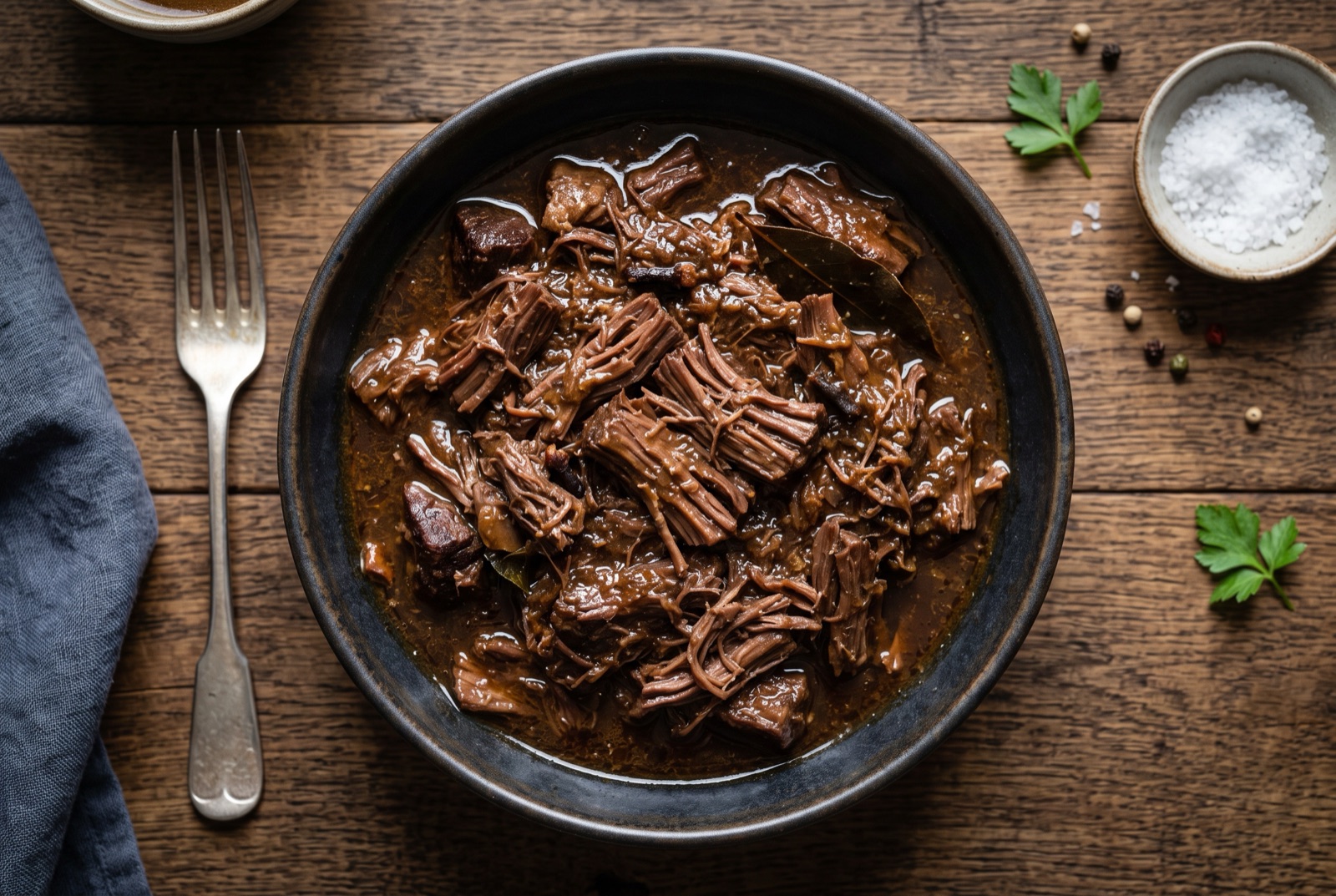
Netherlands has 9 more dishes in the atlas — Draadjesvlees and Erwtensoep, and 7 more.
Recipe by The DishRoute Kitchen · published August 19, 2026 · updated August 19, 2026