Bloody Caesar.
Canadian Clamato and Vodka Cocktail
Caesar · say it: BLUH-dee SEE-zer
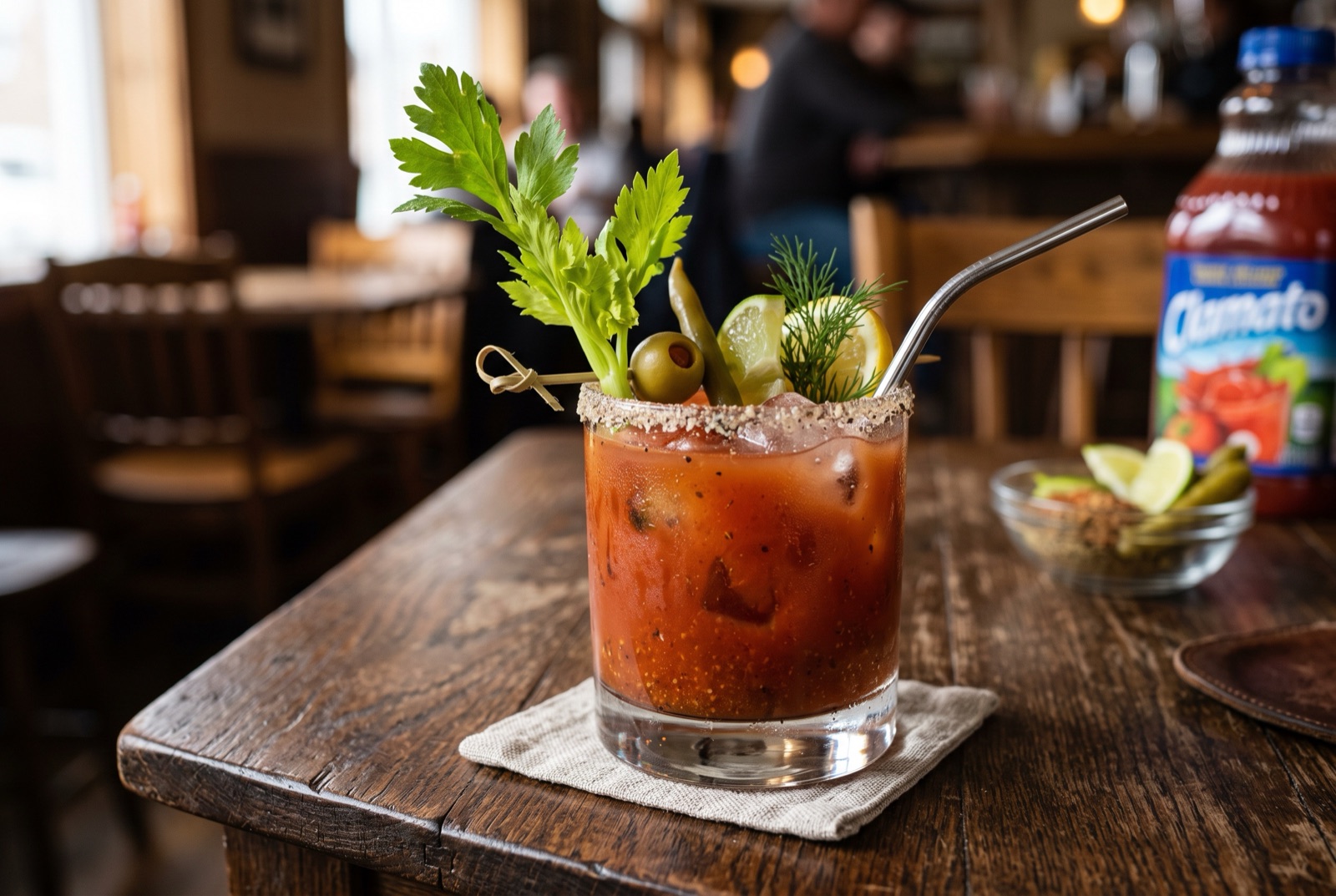
A Caesar is a tall, savoury, faintly briny cocktail built on Clamato — tomato juice cut with clam broth — plus vodka, horseradish, Worcestershire and hot sauce, served over ice in a glass whose rim has been wiped with lime and dipped in celery salt. It tastes like a Bloody Mary that has been to the coast: the same tomato and pepper backbone, but thinner in body, saltier, and with a low savoury hum from the clam that most people cannot identify until they are told. Canadians drink it at brunch, at hockey games and on patios, and the garnish has escalated over the decades from a stick of celery to whatever the bar can balance on the glass. It takes two minutes and every element is adjustable.

- Gate
- CanadaAlberta
- Prep
- 5 min
- Cook
- 0 min
- Total time
- 5 min
- Serves
- 2
- Status
- Easy
- Nutrition / serving · estimated
- Calories 165 kcal
- Protein 2 g
- Carbs 10 g
- Fat 0 g
- Fiber 1 g
- Sugar 7 g
- Sodium 980 mg
Why this recipe works.
- Rims only the outer edge of the glass, so celery salt never falls into the drink and turns it briny halfway down.
- Rolls the cocktail between two glasses instead of shaking, which mixes it thoroughly without whipping the juice into foam.
- Gives a from-scratch clam-tomato mix for anyone who cannot buy Clamato, with honest notes on how close it gets.
- Sets the seasoning as a starting point and explains which direction to push it — heat, salt or acid.
Ingredients.
12 itemsFor the glasses
For the drink
To garnish
Equipment
- Two tall glasses for rolling
- Small plate for the celery salt
- Jigger or measuring spoon
Instructions.
Rim the glasses
Spread the celery salt on a small plate. Run a cut lime wedge around the outside edge of each tall glass, then hold the glass at an angle and roll just that outer edge through the salt, turning it until an even band sticks.
Tip Keep the inside of the rim dry and clean. Salt that falls in makes the last mouthfuls unpleasantly briny.
Fill with ice
Fill each glass to the top with ice cubes, taking care not to knock the salted rim with them. The glass should be packed rather than half full, so the drink stays cold instead of melting its way to balance.
Add spirit and seasonings
Pour 60 ml of vodka into each glass, then divide the horseradish, Worcestershire, hot sauce and black pepper between them along with a good squeeze of lime. Add the seasonings before the juice so they disperse instead of sitting on top.
Top with Clamato and roll
Fill each glass with chilled Clamato, leaving a centimetre at the top. Pour the contents of one glass into an empty glass and back again two or three times until the colour is uniform and no streaks of horseradish remain, keeping the pour low and steady so it does not foam.
Tip If a pink froth builds on the surface you are pouring from too high. Rolling should be gentle.
Taste and adjust
Taste through a straw before garnishing. It should read salty, sour and savoury in that order, with the heat arriving last — push it with lime if it tastes flat, or with hot sauce and pepper if it tastes merely like tomato juice.
Garnish and serve
Stand a leafy celery stalk in each glass, add a lime wedge on the rim and any pickles or bacon you want, and serve at once while the ice is still solid and the salt band intact.
Tips from our kitchen.
- Run the lime wedge around the outside of the rim only, then roll the outer edge through the celery salt. Salt on the inner lip drops into the glass and oversalts the last third.
- Use fresh, wet horseradish rather than creamed. Creamed horseradish adds dairy and dulls the sharp top note the drink needs.
- Build on ice, not into ice-free juice. The dilution as you roll the drink is part of the balance, not an accident.
- Shaking a Caesar aerates the tomato juice into pink foam. Pour it back and forth between two glasses two or three times instead.
- Season the drink, then taste it through a straw before garnishing. Clamato brands vary in salt, so a fixed dash count will not suit every bottle.
- Keep the Clamato properly cold in the fridge. Room-temperature juice over ice melts too fast and the drink arrives already watery.
Substitutions.
- Clamato → 300 ml chilled tomato juice mixed with 60 ml bottled clam juice and a pinch of sugar
- Genuinely close. Clamato is slightly sweeter and thinner than plain tomato juice, so the sugar and the extra liquid both matter.
- Vodka → Gin, tequila, or nothing at all
- Gin makes a botanical version many bars now prefer, tequila gives it a Mexican tilt, and a Virgin Caesar with no spirit is a standard order in Canada.
- Worcestershire sauce → A dash of soy sauce plus a few drops of vinegar and a pinch of sugar
- Covers the salt and umami but not the anchovy depth. Worth keeping the real thing on hand if you make these often.
Variations.
- Bloody Caesar with bacon
- Rim with celery salt mixed with smoked paprika and hang a strip of crisp peppered bacon over the glass. Ubiquitous at Canadian brunch and better than it sounds.
- Spicy pickled Caesar
- Add a tablespoon of pickle brine or the liquid from pickled jalapeños and garnish with a pickled bean and an olive. Sharper and considerably more savoury.
- Virgin Caesar
- The same build with the vodka left out and an extra squeeze of lime to compensate for the missing bite. Ordered often enough in Canada to be entirely unremarkable.
Storage & reheating.
Mix the seasoned Clamato base ahead and it keeps 3 days in a sealed jug in the fridge, which is the sensible way to serve a crowd; the horseradish actually mellows and integrates overnight. Do not add vodka, ice or lime until serving, since the alcohol dulls the seasoning over time and the diluted drink goes flat and separated. Give the jug a stir before pouring, as the tomato solids settle. A finished Caesar does not keep at all and should be drunk while the glass is still cold.
Serve with
Brunch food — eggs, hash browns, smoked fish — or on its own on a patio with a bowl of chips.
The story behind Bloody Caesar.
The Caesar was created in Calgary in 1969 by Walter Chell, a bartender at what was then the Calgary Inn, who was asked to invent a drink for a new Italian restaurant opening in the hotel. His reference point was spaghetti alle vongole, and his first version reportedly involved mashing clams by hand to get their liquor into tomato juice — a laborious step that stopped being necessary once commercially bottled clam-and-tomato juice arrived on the market the same year. The two things met, the drink caught on locally, and it spread outward from Alberta.
What is striking is how completely it stayed home. The Caesar is drunk in enormous volumes in Canada and is almost unknown a few hours south of the border, where ordering one usually produces a Bloody Mary and a confused look. The reason is largely supply: Clamato is a Canadian bar staple stocked as a matter of course, and without it the drink cannot be made properly. Canadian bartenders will insist, correctly, that a Caesar is not a Bloody Mary variant but a different drink, and Parliament has taken the distinction seriously enough to formally acknowledge the Caesar as the country's cocktail and to mark an annual Caesar month.
The garnish has become its own competition. The traditional finish is a celery stalk and a wedge of lime, but Canadian bars have spent years escalating: pickled beans, pickled asparagus, cocktail onions, olives, a strip of peppered bacon, whole shrimp, and in a handful of well-photographed cases entire fried chickens and cheeseburgers spiked on the rim. Most Canadians regard the arms race with mild embarrassment and order theirs plain. What actually matters is the celery salt rim, which is not decoration — it seasons every sip as the drink passes over it, and a Caesar without it tastes flat and unfinished.
Questions, answered.
What is Clamato and does the drink taste of clams?
Clamato is a bottled blend of tomato juice and clam broth, sold widely in Canada and used as the base for every Caesar. On its own it tastes mostly of thin, lightly sweetened tomato juice with a saline finish. In the finished cocktail, with horseradish, Worcestershire and celery salt on top, the clam reads as a general savoury depth rather than anything identifiably shellfish, and most first-time drinkers do not pick it out unless told.
What is the difference between a Caesar and a Bloody Mary?
The base. A Bloody Mary uses straight tomato juice, which makes it thicker and rounder; a Caesar uses clam-and-tomato juice, which is thinner, saltier and more savoury. The Caesar is also defined by its celery salt rim, which a Bloody Mary usually does without. They share the vodka, horseradish and Worcestershire, but Canadians treat them as separate drinks and will correct you.
Why roll the drink instead of shaking it?
Shaking beats air into tomato juice and turns it into a pale pink foam that ruins both the look and the texture. Rolling means pouring the drink from one glass into another two or three times, which mixes the seasonings through evenly and chills it without aerating it. This is standard practice for any tomato-based cocktail and takes about ten seconds.
Can I make a Caesar without Clamato?
Yes. Mix chilled tomato juice with bottled clam juice at roughly five parts to one and add a small pinch of sugar, since Clamato is slightly sweeter and thinner than plain tomato juice. Fish stock is not a substitute — it is too cooked-tasting. If you want to skip shellfish entirely, use tomato juice thinned with a splash of water and add extra Worcestershire for savoury depth, though at that point you are drinking a Bloody Mary.
Why does my drink get too salty near the bottom?
Celery salt has fallen in from the rim. Wipe the lime wedge only around the outside of the glass and dip only the outer edge into the salt, holding the glass at an angle so the inner lip stays clean. Some of it will still slide in as the drink is finished, which is why the base itself should be seasoned lightly before the rim is taken into account.
You might also like.
All recipes →
Keep exploring Canada.
Canada has 9 more dishes in the atlas — Bannock and Butter Tarts, and 7 more.
Recipe by The DishRoute Kitchen · published August 20, 2026 · updated August 20, 2026