Montreal Smoked Meat Sandwich.
Cured Brisket on Rye
Viande fumée · say it: vee-AND foo-MAY
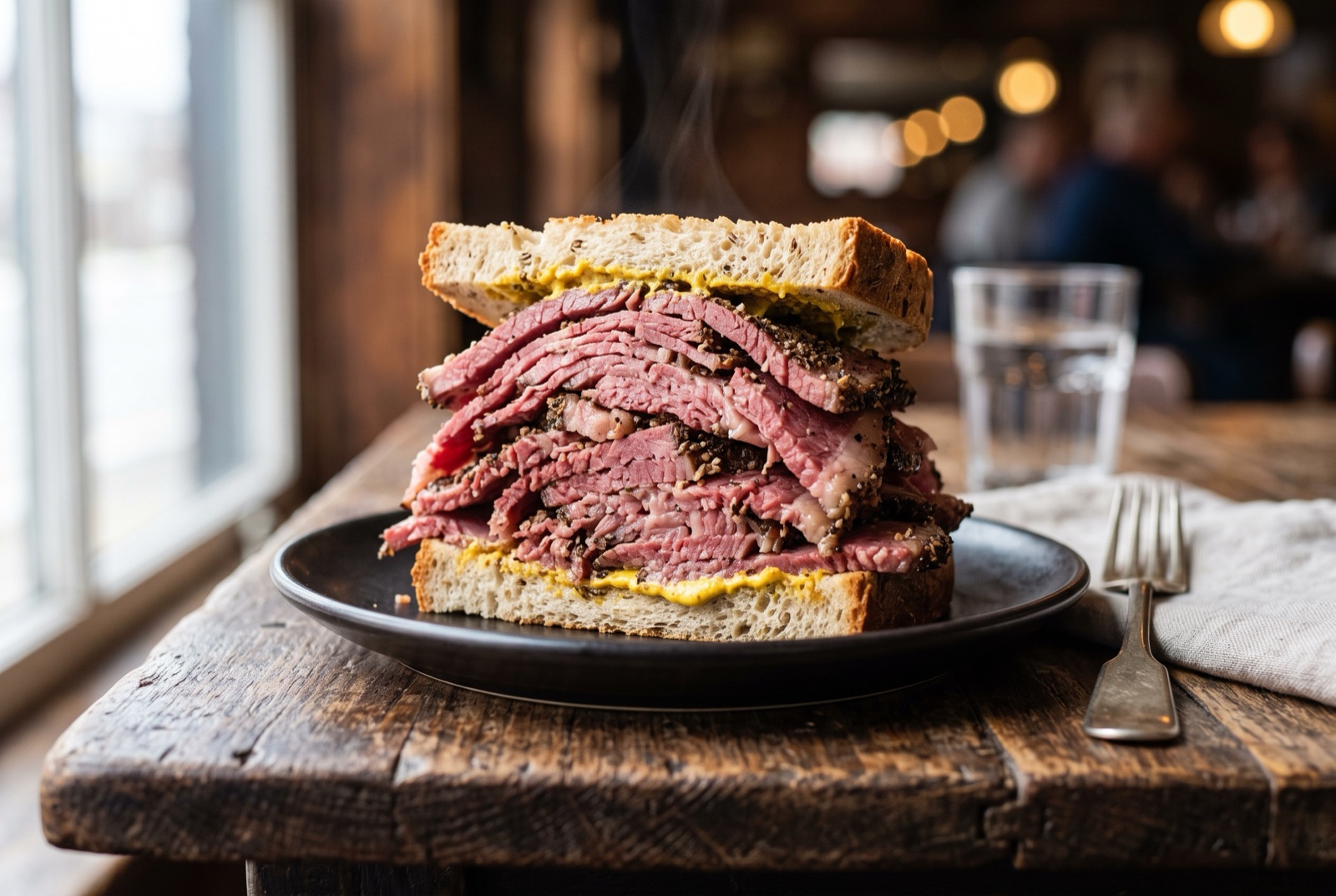
Montreal smoked meat is beef brisket that has been dry-cured for about a week, coated in a coarse rub heavy with cracked pepper and coriander, cold-smoked or smoked low, and then steamed for hours until it is soft enough to pull apart between your fingers. Sliced thick by hand and stacked hot on rye with yellow mustard, it tastes salty and beefy up front with a slow peppery-coriander heat that builds at the back of the throat, and the fat should be so soft it disappears rather than chews. It is not pastrami, and Montrealers will tell you so: less sugar, more pepper and coriander, a longer cure, and always steamed to order. This is a genuinely long project — a week of curing, hours of smoking and steaming — but almost all of that time is waiting.

- Gate
- CanadaMontréal
- Prep
- 45 min
- Cook
- 8 hr
- Total time
- 176 hr 45 min incl. 168 hr rest
- Serves
- 8
- Status
- Takes skill
- Nutrition / serving · estimated
- Calories 610 kcal
- Protein 45 g
- Carbs 34 g
- Fat 32 g
- Fiber 3 g
- Sodium 1650 mg
Why this recipe works.
- A true dry cure with curing salt, not a wet brine shortcut, which is what gives the meat its colour, texture and keeping quality.
- The rub is built the Montreal way — coriander and cracked pepper forward, barely any sugar — so it does not drift into pastrami.
- The steaming stage is treated as essential and given a real doneness test, because that is where most home attempts fall short.
- Includes an honest oven-only route for cooks with no smoker, with a clear account of what you lose.
Ingredients.
15 itemsFor the cure
For the outer rub
To serve
Equipment
- Large non-reactive container or heavy zip bag for curing
- Kitchen scale accurate to 1 g
- Smoker or oven with a wood-chip tray
- Large pot with a rack and a tight lid, or a steamer
- Long slicing knife
Instructions.
Mix the cure and coat the brisket
Weigh the kosher salt and curing salt precisely and combine them with the sugar, cracked coriander, pepper, mustard seed, garlic paste, bay and cloves. Rub the mixture over every surface of the brisket, pressing it into the meat and working it into any seams of fat.
Tip Weigh the curing salt on a scale that reads to 1 gram. This is the one step in the recipe with no margin.
Cure for a week
Seal the brisket in a heavy bag or a covered non-reactive container and refrigerate for 6 to 8 days, turning it once a day and redistributing the liquid that draws out. By the end the meat should feel firm and dense all the way through, not squashy in the middle.
Tip Press the thickest part daily. When it stops feeling soft in the centre, the cure has reached the core.
Soak and test for salt
Rinse off the cure and soak the brisket in a bowl of cold water for 2 hours, changing the water twice. Fry a thin slice from the edge and taste it: it should be well seasoned but pleasant to eat plain. If it stings with salt, soak for another hour.
Apply the outer rub
Pat the brisket completely dry and press on the coriander, pepper and paprika rub in a thick, even coat over the whole surface. Leave it uncovered on a rack in the fridge for a few hours or overnight so the surface dries and turns tacky — smoke sticks to a tacky surface, not a wet one.
Smoke low and slow
Smoke at 105–120°C over maple, oak or cherry wood for 4 to 6 hours, until a dark, dry crust has formed and the internal temperature reaches about 75°C. The meat will still be firm at this stage, which is correct — it is not finished cooking.
Tip No smoker: bake at 120°C on a rack with a foil tray of soaked chips beneath, tented loosely with foil.
Steam until it surrenders
Set the brisket on a rack over 3 cm of simmering water in a large pot, cover tightly, and steam for 2½ to 3½ hours. It is done when a skewer meets no resistance and a corner tears away under light finger pressure — around 95°C internally. Top the water up as it evaporates.
Tip Keep the meat above the water. Sitting in liquid washes the crust off and turns the surface grey.
Slice and build
Rest the meat 15 minutes, then carve thick 5 mm slices across the grain with a long knife while it is still hot. Pile 150 g of meat onto a slice of rye spread with yellow mustard, top with a second slice, and press down once with your palm. Serve immediately, with pickles.
Tip Mustard goes on the bread, never on the meat, and nothing else goes in the sandwich.
Tips from our kitchen.
- Curing salt (sodium nitrite, sold as Prague Powder #1 or pink curing salt) is not optional for a week-long cure. It is what keeps the meat safe and pink. Weigh it precisely — it is not interchangeable with table salt and must never be eyeballed.
- Buy a whole packer brisket point if you can, or a fatty flat. Trimmed lean brisket dries out over the long cook and gives you the sandwich nobody in Montreal orders.
- Crack the peppercorns and coriander coarsely in a mortar or under a pan, not in a spice grinder. You want gravelly fragments that form a crust, not powder that turns to paste.
- After curing, soak the brisket in cold water for two hours, changing the water twice, and fry a thin test slice. If it is too salty to eat on its own, soak another hour.
- The meat is done steaming when a skewer slides in with no resistance and a corner tears away under gentle finger pressure. Internal temperature around 95°C is the guide, but the feel is the real test.
- Slice thick — about 5 mm — against the grain, by hand with a long knife. Thin machine slices fall apart and the sandwich turns to shreds.
Substitutions.
- Smoker → Oven at 120°C with a tray of soaked wood chips under a foil tent, or 2 tsp liquid smoke rubbed on before cooking
- You lose real smoke penetration and some of the bark, but the cure, spice crust and steaming carry most of the character. Say what it is: excellent home smoked meat, not deli smoked meat.
- Whole brisket → Beef navel or plate, or a boneless beef chuck roast
- Navel is what several Montreal delis traditionally used and is fattier and arguably better. Chuck works but has a looser grain and slices less neatly.
- Rye bread → Any dense sourdough or a light caraway rye
- Montreal rye is a soft, lightly sour loaf without heavy caraway. Avoid dark pumpernickel — it overwhelms the coriander in the crust.
Variations.
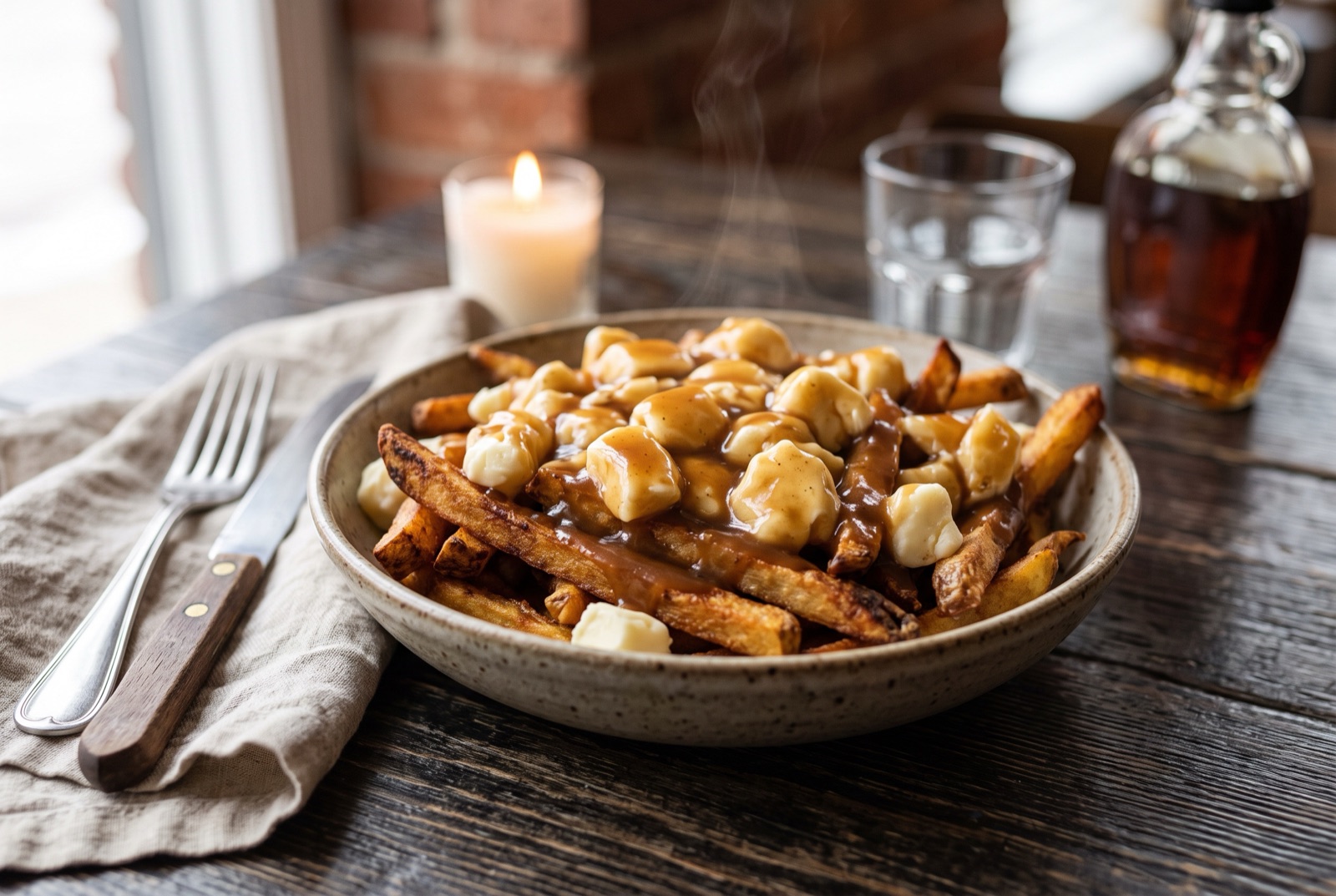
- Smoked meat poutine
- Hand-cut smoked meat piled over fries, curds and gravy — a Montreal crossover that appears on menus across the city.
- Old-fashioned (fatty) cut
- Slices taken from the point end where the fat is heaviest. Softer, richer and the traditional order of anyone who is not counting anything.
- Smoked meat platter
- Skip the bread: meat served on a plate with rye on the side, half-sour pickles, coleslaw and fries, so the fat is not soaking into anything.
Storage & reheating.
Cooked smoked meat keeps 5 days refrigerated wrapped tightly, and freezes well for 3 months in slabs rather than slices. Always reheat by steaming, never in a microwave or a dry oven: 15 to 20 minutes in a covered steamer brings it back to the soft, glistening state it should be in. Slice only what you are about to eat, since cut surfaces dry quickly. The cured, uncooked brisket can also be frozen after its rinse and soak, and smoked later.
Serve with
Half-sour dill pickles, French fries, coleslaw, and a black cherry soda — the standard Montreal deli plate.
The story behind Montreal Smoked Meat Sandwich.
Smoked meat arrived in Montreal with Jewish immigrants from Eastern Europe and Romania at the turn of the twentieth century, part of the same wave that gave New York pastrami and London salt beef. The technique came from a world without refrigeration, where beef was cured in salt and spice to survive, and it landed in a city where cheap brisket and a large Yiddish-speaking community around Boulevard Saint-Laurent made a delicatessen trade possible. Several delis claim to have been first, dates get moved around in the retelling, and the honest answer is that no single founder can be established — the food grew out of a neighbourhood rather than a person.
What is clear is the shape of the tradition that stuck: a longer cure than pastrami, a rub that leans hard on black pepper, coriander and garlic instead of sugar, and a final steaming that is done in-house all day, so meat is served hot and slicked rather than cold. Sandwiches are ordered by fat content — lean, medium, medium-fat, old-fashioned or fatty — and the counter men slice by hand, because a machine crushes meat that soft. Rye bread, yellow mustard, and that is the entire sandwich; asking for lettuce, tomato or mayonnaise is a widely enjoyed way to identify yourself as a tourist.
The smoked meat deli is one of the very few institutions in Montreal that sits outside the city's linguistic and cultural divisions. The counters are staffed and visited by anglophones, francophones, Jewish families, and everyone else, and the standard order — sandwich, fries, a pickle, black cherry soda — has not meaningfully changed in decades. In Québec the food is called viande fumée and it is as much a part of the local diet as poutine, which is why the two ended up meeting in a bowl. Making it at home will not reproduce a deli's fifty-year-old smoker, but the method below produces something recognisably in the tradition, and it is worth doing once.
Questions, answered.
What is the difference between Montreal smoked meat and pastrami?
They are close relatives with real differences. Montreal smoked meat is dry-cured for longer, uses a rub dominated by black pepper, coriander and garlic with very little sugar, and is always finished by steaming for hours before serving. New York pastrami is typically wet-brined, seasoned with more sugar and paprika, and often served after a shorter steam. The result is that smoked meat tastes peppery and savoury where pastrami tastes slightly sweeter and smokier.
Do I really need curing salt?
For a cure lasting days at refrigerator temperature, yes. Curing salt containing sodium nitrite prevents the growth of dangerous bacteria over a long, low-temperature cure and is also what produces the characteristic pink colour and cured flavour. Use exactly the weight given and no more. If you would rather not use it, do not extend the cure — season the brisket and cook it as a plain smoked or braised brisket instead, and accept that it will be a different dish.
Why does the meat have to be steamed after smoking?
Because smoking alone leaves brisket firm and dense. The long steam finishes rendering the connective tissue and fat while adding moisture back, which is what makes the slices soft enough to fall apart in your hand. Montreal delis steam their meat all day and slice to order for exactly this reason. Skipping this step produces something closer to sliced barbecue brisket, which is good but is not smoked meat.
How long does the whole process take?
About eight days, of which perhaps five hours is actual work. Plan on six to eight days of curing in the fridge with a daily turn, two hours of soaking, four to six hours of smoking, and three hours of steaming. The cure is completely passive and the smoking and steaming can be split across two days — smoke one day, refrigerate overnight, steam and serve the next.
Can I use a slow cooker instead of steaming?
Yes, with one adjustment: put a rack or a folded bed of foil in the bottom and add just 2 cm of water so the brisket sits above the liquid and steams rather than boils. Cook on low for about six hours. If the meat sits in water it leaches salt and spice out of the crust and the surface turns grey and slippery, so keep it clear of the liquid.
You might also like.
All recipes →
Keep exploring Canada.
Canada has 9 more dishes in the atlas — Bannock and Bloody Caesar, and 7 more.
Recipe by The DishRoute Kitchen · published August 20, 2026 · updated August 20, 2026