Poutine.
Fries with Cheese Curds and Gravy
Poutine · say it: poo-TSIN (Québécois) / poo-TEEN
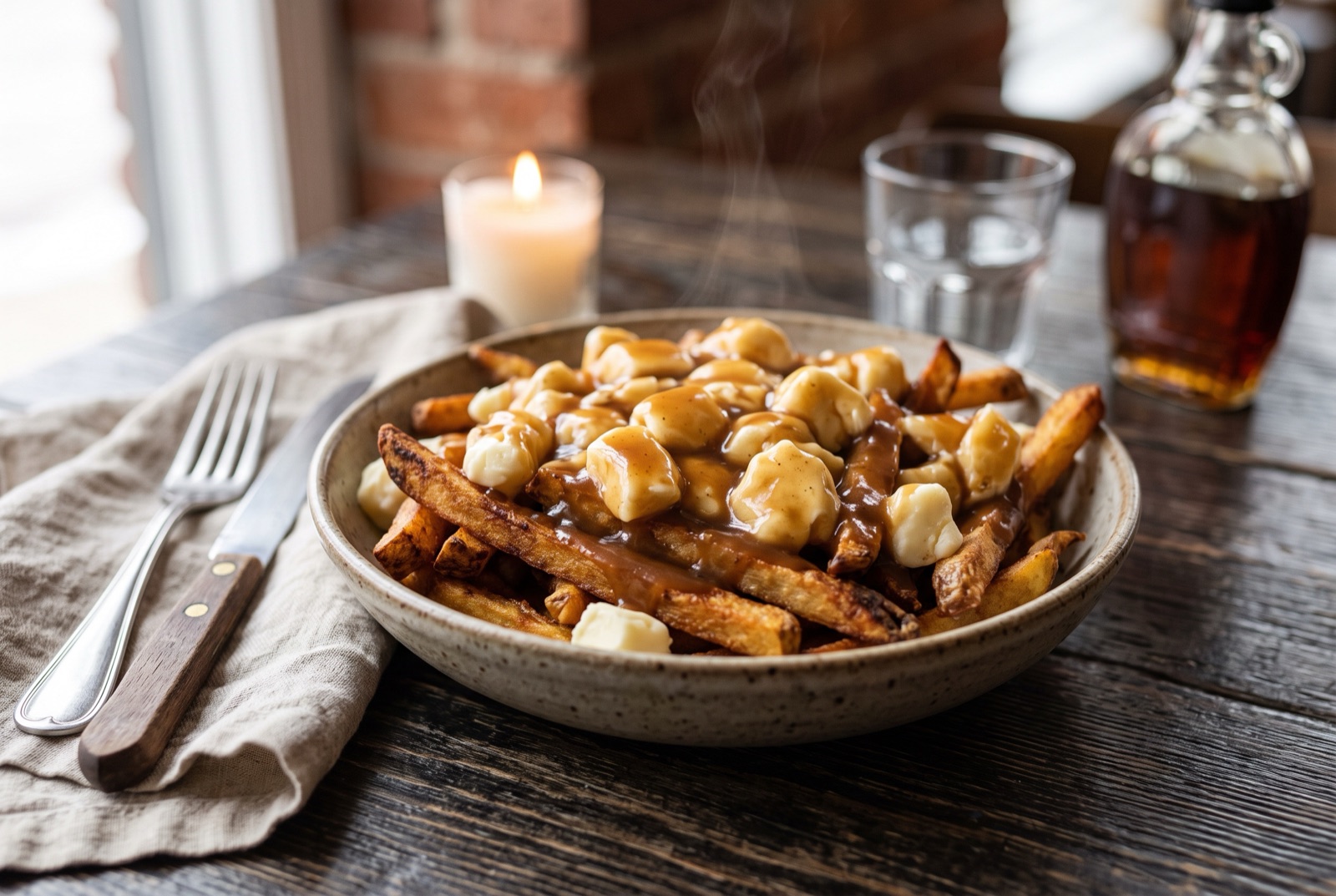
Poutine is a bowl of hot double-fried potatoes topped with fresh cheese curds and covered in a thin, glossy brown gravy. It tastes of salt, beef and hot fat, with the curds giving short elastic bites of mild fresh cheese between the fries. The whole point is temperature and timing: the gravy has to be hot enough to warm the curds into softness in about a minute, but the curds must never fully melt, and the fries have to be crisp enough to survive being drowned. Get those three things right and it is one of the most satisfying things you can put in a bowl; get them wrong and you have soggy chips with cheese sauce. It is late-night food, ski-hill food and diner food, and Québec takes it far more seriously than outsiders expect.

- Gate
- CanadaQuébec
- Prep
- 20 min
- Cook
- 30 min
- Total time
- 1 hr 20 min incl. 30 min rest
- Serves
- 4
- Status
- Easy
- Nutrition / serving · estimated
- Calories 720 kcal
- Protein 25 g
- Carbs 62 g
- Fat 42 g
- Fiber 5 g
- Sodium 1180 mg
Why this recipe works.
- Double-frying at two temperatures gives fries that stay crisp under gravy instead of turning to mush in thirty seconds.
- The gravy is built the Québec way — chicken and beef stock together, lightly thickened — not a heavy roast-dinner gravy.
- Assembly is treated as a technique with a timing rule, because that is what separates real poutine from chips with sauce.
- Honest about curds: what to look for, what happens without them, and which substitutes actually behave the same way.
Ingredients.
11 itemsFor the fries
For the gravy
To assemble
Equipment
- Heavy pot or deep fryer with at least 8 cm depth
- Kitchen thermometer
- Spider or slotted spoon
- Small saucepan for the gravy
Instructions.
Cut and soak the potatoes
Cut 1.2 kg of peeled potatoes into batons about 1 cm thick and drop them straight into a bowl of cold water. Soak for 30 minutes, until the water goes cloudy, then drain and dry them thoroughly on a towel — they should feel dry and slightly tacky, with no visible moisture.
Tip Any surface water will spit violently in hot oil. Take the drying seriously.
Make the gravy base
Melt the butter in a saucepan over medium heat and whisk in the flour. Cook for 3 to 4 minutes, whisking constantly, until the roux smells nutty and turns the colour of wet sand — you want it past raw flour but well short of dark.
Tip If it starts to smell sharp or toasty rather than nutty, pull it off the heat immediately.
Finish the gravy
Pour in the chicken and beef stock a splash at a time, whisking smooth after each addition, then add the Worcestershire, vinegar and pepper. Simmer for 8 to 10 minutes until it coats a spoon in a thin layer that still runs off freely. Taste and salt carefully — the curds and fries are both salty. Keep it hot, covered, over the lowest heat.
First fry
Heat the oil to 150°C. Fry the potatoes in three batches for 5 to 6 minutes each, until they are floppy, pale and cooked through but with no colour at all. Lift them out onto a rack and let them cool for at least 15 minutes.
Tip Crowding the pot drops the oil temperature and the fries absorb grease instead of cooking. Batches matter.
Second fry
Raise the oil to 190°C and fry the cooled potatoes again, in batches, for 2 to 3 minutes each, until they are deep gold and rattle against the spider like something rigid. Drain on a rack — never on paper, which traps steam — and salt immediately while they glisten.
Tip Listen for the sound change: the loud hiss quiets down when the surface water is gone and the crust is setting.
Assemble and serve at once
Pile the hot fries into warmed shallow bowls, scatter the room-temperature curds over the top, then ladle the near-boiling gravy across everything. Wait about one minute — the curds should slump and go glossy at the edges without losing their shape — and eat immediately.
Tip Do not stir. Poutine is built in layers and eaten in layers.
Tips from our kitchen.
- Cheese curds must be at room temperature and no more than a few days old. Cold curds do not soften properly and refrigeration kills the squeak — leave them on the counter for an hour first.
- Use starchy potatoes such as russet or Idaho. Waxy potatoes never develop the fluffy interior that makes the fry hold up under liquid.
- Soak the cut fries in cold water for at least 30 minutes to wash off surface starch, then dry them completely — wet potatoes steam instead of frying and spit dangerously in hot oil.
- The gravy should coat a spoon thinly and run off it, not cling like a paste. If it stands up on the fries it is too thick.
- Assemble in a warmed shallow bowl, in this order: fries, curds, gravy over the top. Never mix, and never let the assembled bowl sit — poutine is served the minute it is built.
- Salt the fries the second they leave the oil, before the surface dries; salt slides straight off a cooled fry.
Substitutions.
- Fresh cheese curds → Torn low-moisture mozzarella, or young mild cheddar cut into 2 cm chunks
- Neither squeaks and both melt faster, so add them at the last possible second. Do not use shredded cheese — it dissolves into the gravy and turns it stringy and cloudy.
- Homemade fries → Good-quality frozen fries, baked hot and crisp
- A real shortcut that works if you cook them past the point on the packet until they are properly brown and rigid. Pale, bendy fries collapse instantly under gravy.
- Beef and chicken stock → All vegetable stock plus 1 tsp soy sauce and 1 tsp tomato paste
- Makes the dish vegetarian and gives the gravy the savoury depth and colour it would otherwise get from meat stock.
Variations.
- Poutine galvaude
- The classic diner upgrade: shredded roast chicken and green peas scattered over the assembled bowl. Common across Québec snack bars and better than it sounds.
- Poutine au smoked meat
- A Montreal crossover — hand-cut Montreal smoked meat piled on top so the fat softens into the gravy.
- Italian poutine
- Sauce à spaghetti instead of brown gravy, an old Québec snack-bar habit that predates most of the gourmet versions.
Storage & reheating.
Poutine does not keep. Assembled, it is finished within ten minutes and cannot be reheated into anything good. The components store separately: the gravy holds 4 days refrigerated and reheats well with a splash of stock to loosen it, and the blanched first-fry potatoes can sit covered in the fridge for a day before their second fry, which actually improves them. Curds are best the day you buy them and should be kept out of the fridge for the last hour before serving.
Serve with
Nothing, honestly — poutine is a full plate. If you must, a cold lager and something sharply pickled to cut the fat.
The story behind Poutine.
Poutine came out of rural Québec in the late 1950s, in the dairy belt of the Centre-du-Québec region, and at least three towns — Warwick, Drummondville and Princeville — have claimed the invention with competing stories and rival plaques. The common thread in all of them is a snack bar owner, a customer who asked for curds in the bag of fries, and the gravy arriving later as a fix for the fact that everything went cold. Whether any single origin story is true is genuinely unsettled, and the towns are still happy to argue about it. What is certain is that curds were everywhere: small local cheese dairies sold them fresh, in bags, hours old, because that is the only state in which they squeak.
For decades poutine was a strictly Québécois food, and often a mocked one — shorthand outside the province for something greasy and unserious. That flipped in the 2000s. Montreal restaurants started making versions with duck confit, foie gras and braised beef; poutine appeared on menus across Canada and then abroad; and Québec, having spent years hearing the dish used as a punchline, ended up watching it become the single most recognisable Canadian food in the world. Not everyone in the province is thrilled about that framing, since poutine is Québécois rather than generically Canadian, and the distinction matters to a lot of people.
The traditional version is unchanged and still the best argument for the dish: hand-cut potatoes fried twice, plain white cheddar curds from a bag on the counter, and a light brown gravy that is more chicken than beef — Québec sauce brune is closer to a thin poultry velouté with beef depth than to a heavy roast gravy. Casse-croûtes across the province serve it in a shallow paper tray with a plastic fork, and the correct way to eat it is quickly, before the structure collapses.
Questions, answered.
What are cheese curds and why do they squeak?
Cheese curds are fresh, unaged cheddar caught right after the curd is cut and drained, before it is pressed into a block. The protein structure is still elastic and intact, which rubs against tooth enamel and makes the squeak. That structure breaks down within a few days and disappears entirely once the curds are refrigerated for long, which is why Québec dairies sell them in bags at room temperature and locals check the date.
Can I make poutine without cheese curds?
You can make something good, but not authentic poutine. Torn low-moisture mozzarella or chunks of mild young cheddar are the closest behaviour — cut them large, about 2 cm, so they soften rather than dissolve. Avoid shredded cheese and anything aged: aged cheese splits into oil and strings in hot gravy, and shredded cheese vanishes into the sauce and thickens it into glue.
Why did my fries go soggy?
Almost always one of three things: the fries were not fried twice, the gravy was too thick, or the bowl sat for more than a few minutes. The first fry at 150°C cooks the inside, the second at 190°C builds the crisp shell that holds up to liquid. A thin gravy runs off; a thick one sits on the fries and steams them. And poutine genuinely does have a shelf life of minutes.
Is poutine gravy beef gravy?
Not exactly. Traditional Québec sauce brune for poutine is lighter than roast beef gravy and usually built on a mix of chicken and beef stock, thickened only lightly, with a savoury-peppery finish. Commercial versions in Québec often lean poultry-forward. If you use a dark, heavy beef gravy the dish becomes muddy and the delicate flavour of the fresh curds is lost.
Can I bake the fries instead of deep-frying?
Yes, and an air fryer works too, but you need to push them further than you normally would — until they are deep gold and rigid, not just cooked through. Toss the dried, cut potatoes in a tablespoon of oil, spread them in a single layer with space between them, and roast at 220°C for 30 to 35 minutes, turning once. The texture is different from deep-fried, but it survives gravy.
You might also like.
All recipes →
Keep exploring Canada.
Canada has 9 more dishes in the atlas — Bannock and Bloody Caesar, and 7 more.
Recipe by The DishRoute Kitchen · published August 20, 2026 · updated August 20, 2026