Halifax Donair.
Spiced Beef with Sweet Garlic Sauce
Halifax donair · say it: DOE-nair
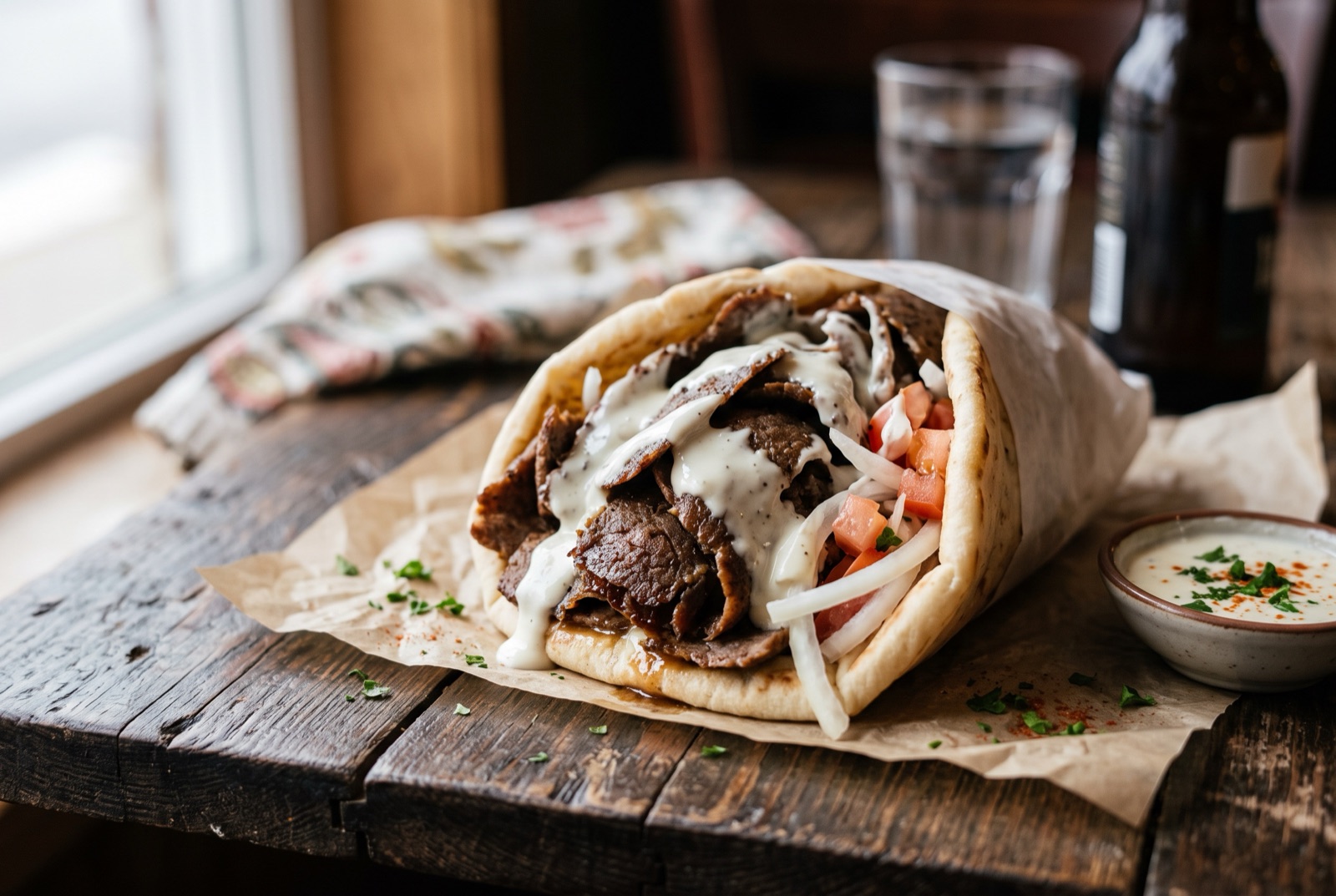
A Halifax donair is spiced ground beef kneaded until it turns dense and springy, baked into a loaf, sliced thin, crisped on a griddle and rolled into a warm pita with diced onion and tomato — then drenched in a sauce made from evaporated milk, sugar, garlic powder and vinegar that is sweet, sharp and faintly creamy all at once. That sauce is the thing that makes people either devoted or bewildered: it is essentially a sweetened garlic glaze on meat, and it should not work, and in Halifax at two in the morning it absolutely does. The beef itself is peppery and oregano-heavy with a texture closer to bologna than to burger, which is deliberate — the kneading is what lets you slice it thin without it crumbling.

- Gate
- CanadaNova Scotia
- Prep
- 30 min
- Cook
- 1 hr
- Total time
- 5 hr 30 min incl. 4 hr rest
- Serves
- 4
- Status
- Medium
- Nutrition / serving · estimated
- Calories 780 kcal
- Protein 42 g
- Carbs 66 g
- Fat 38 g
- Fiber 3 g
- Sugar 34 g
- Sodium 1320 mg
Why this recipe works.
- The meat is kneaded and rested the way donair shops do it, which is the only way to get slices that hold together instead of crumbling.
- Slices are seared hard in a dry pan to replace the crisped edges a vertical spit would give you at home.
- The sauce is given a proper thickening method and a warning about the one mistake that makes it split.
- Straightforward about what a home version can and cannot copy from a shop donair, instead of overselling it.
Ingredients.
16 itemsFor the meat
For the donair sauce
To assemble
Equipment
- Stand mixer with paddle, or strong hands
- Loaf tin or small roasting tray
- Sharp long knife
- Heavy dry frying pan or griddle
Instructions.
Season and knead the meat
Combine the beef with the oregano, black pepper, paprika, garlic and onion powders, flour, salt and cayenne. Knead hard for 8 to 10 minutes by hand, or 5 minutes with a mixer paddle, until the mixture changes from crumbly to smooth, sticky and slightly glossy and a pinch of it stretches without tearing.
Tip This is the step that makes or breaks the dish. If it still looks like burger mince, keep going.
Shape and chill
Pack the mixture tightly into a loaf tin, pressing out every air pocket, and smooth the top. Cover and refrigerate for at least an hour so it firms up and the spices settle into the meat.
Bake the loaf
Bake at 175°C for 55 to 60 minutes, until the loaf is firm to the press and cooked through — around 75°C in the centre. It will have shrunk from the sides and released a good amount of fat; pour that off.
Chill completely, then slice
Cool the loaf to room temperature and refrigerate for at least 3 hours or overnight. Slice it as thinly as you can manage, about 3 mm, with a long sharp knife — cold meat should give clean slices with smooth faces.
Tip Do not rush this. Warm loaf will tear no matter how sharp the knife is.
Whisk the sauce
Whisk the evaporated milk, sugar and garlic powder in a bowl until the sugar has dissolved and no grain remains on the back of a spoon. Now add the vinegar a few drops at a time, whisking constantly — the sauce will thicken noticeably to the consistency of pouring cream. Chill until needed.
Tip Add the vinegar all at once and it curdles. There is no fixing it; you start again.
Sear the slices
Heat a heavy dry pan over high heat and sear the slices in batches for about 90 seconds a side, until the edges are deeply browned and beginning to curl and the surface looks lacquered. They should sizzle loudly the moment they hit the pan.
Tip No oil needed — enough fat renders out of the meat within seconds.
Build the donair
Warm the pitas until soft and floppy, spread each with a spoonful of sauce, then pile on the hot meat, the diced onion and tomato, and pour over more sauce than seems sensible. Fold tightly, wrap the base in foil or paper, and eat over a plate.
Tip It is meant to be messy. Anyone who hands you a fork has missed the point.
Tips from our kitchen.
- Knead the meat far longer than feels reasonable — a full 8 to 10 minutes by hand or 5 in a stand mixer. It should go from crumbly to sticky to smooth and slightly shiny, like sausage forcemeat. Undermixed meat falls apart on the griddle.
- Use beef with at least 15% fat. Lean mince bakes into a dry, grainy loaf that will not slice cleanly.
- Chill the baked loaf completely, ideally overnight, before slicing. A warm loaf tears; a cold one gives you clean 3 mm slices.
- Never boil the sauce or add the vinegar quickly. Whisk it in drop by drop at the end, off the heat, or the evaporated milk curdles and the sauce goes grainy.
- Warm the pita until it is soft and pliable, not toasted. A crisp pita cracks the moment you fold it and the sauce runs straight out.
- Build in this order: sauce on the bread, then meat, then onion and tomato, then more sauce. Sauce under the meat stops the bread going through at the first bite.
Substitutions.
- Evaporated milk → Sweetened condensed milk with the sugar reduced to 2 tbsp and 2 tbsp water added
- Both are used in Halifax shops and both are traditional. Condensed milk gives a thicker, sweeter sauce, so cut the added sugar or it becomes cloying.
- Ground beef loaf → Sliced deli-style beef gyro meat, seared hard
- A real shortcut if you can find it, though commercial gyro meat is usually lamb-forward and less peppery than donair beef.
- Pita bread → Thick Greek-style flatbread or a soft naan
- You want a pocketless, foldable bread. Thin pocket pita splits under the weight of the sauce.
Variations.
- Donair pizza
- A Halifax institution in its own right: donair meat and onion on a pizza base, with the sweet sauce drizzled over the mozzarella after baking.
- Donair egg roll
- Meat, sauce and cheese wrapped in an egg roll wrapper and deep-fried — a modern Halifax bar snack served with extra sauce for dipping.
- Alberta-style donair
- The version that travelled west with Maritime workers, often built with lettuce and hot sauce alongside the sweet sauce. Haligonians consider this an error.
Storage & reheating.
The baked loaf keeps 4 days refrigerated and freezes well for 3 months — freeze it whole or in thick slabs and slice from frozen for the cleanest cuts. The sauce keeps 2 weeks in a sealed jar in the fridge and thickens as it sits; loosen it with a teaspoon of water and a quick whisk. Assembled donairs do not keep at all, since the sauce soaks through the pita within minutes. Reheat slices in a dry hot pan rather than a microwave, which turns them rubbery.
Serve with
Fries with extra donair sauce for dipping, and something ice cold. This is not a dish that wants a side salad.
The story behind Halifax Donair.
The donair is a Greek-Canadian invention and its origin is unusually well documented for a street food. It grew out of the Halifax restaurant scene in the early 1970s, when Greek immigrant restaurateurs adapted the gyro for a local market that did not take to lamb or to the tangy yogurt-cucumber sauce. Beef replaced the lamb, and a sweet garlic sauce built on evaporated milk and sugar replaced the tzatziki. The sweet-sauce swap was the crucial move: it turned an imported dish into a distinctly Maritime one, and within a decade donair shops had spread across the city.
From Halifax the donair travelled west with Maritimers looking for work, especially to Alberta, which is why Edmonton and Calgary both have serious donair scenes — with their own local variations that Haligonians regard with suspicion. In 2015 Halifax city council formally declared the donair the official food of the city, an act that was partly a joke and entirely sincere, and Nova Scotia later followed. It sits alongside the province's lobster and scallops as a point of genuine local pride, which says something useful about how food identity actually forms: not from what a place produces, but from what its people eat at the end of a night out.
Authentic shop donairs are built on a vertical spit, with a cone of seasoned beef turning against an element and the cook shaving off crisp-edged slices as the outside cooks. No home kitchen has that, and pretending otherwise is pointless. What a home cook can do is reproduce the meat itself — the long kneading that gives donair beef its characteristic bounce is the actual technique, not the spit — bake it as a loaf, then slice and sear those slices hard in a dry pan to get the crisped edges the spit would have given you. The sauce, meanwhile, is exactly the same at home as in the shop, because it was always just four ingredients whisked in a jug.
Questions, answered.
What is donair sauce made of?
Evaporated or sweetened condensed milk, sugar, garlic powder and white vinegar, whisked until thick. That is the whole recipe. It is sweet, sharp and pourable rather than creamy in the way a mayonnaise-based sauce is. The vinegar has to go in slowly at the end, because acid added fast to milk causes it to curdle and the sauce turns grainy instead of glossy.
How is a donair different from a gyro or a doner kebab?
The donair is a Halifax adaptation of the Greek gyro made for local tastes in the early 1970s. Beef replaces lamb, the spicing is heavier on oregano and black pepper, and — the decisive difference — the tangy yogurt tzatziki is replaced by a sweet condensed-milk garlic sauce. A Turkish döner or a Greek gyro will never be sweet; a donair always is.
Why did my donair meat fall apart?
It was not kneaded enough, or it was sliced warm. The long kneading develops the meat proteins into a bouncy, emulsified texture that holds together in thin slices — you should be able to stretch a pinch of the mixture without it breaking. Slicing before the loaf is fully chilled is the other common cause, since warm loaf meat tears along the grain instead of cutting.
Can I make donair meat without a vertical spit?
Yes, and it is how nearly everyone makes it at home. Bake the kneaded mixture as a compact loaf, chill it, slice it thin and then sear the slices in a very hot dry pan until the edges brown and curl. That searing step is doing the same job as the outside of a spinning cone — you are just doing it slice by slice after the fact rather than shaving it off as it cooks.
Is donair sauce supposed to be that sweet?
Yes. First-timers often assume a mistake has been made, but the sweetness is the defining feature of the Halifax donair and the reason it exists as a separate dish rather than a gyro variant. If it is too much for your table, cut the sugar by a third and add an extra teaspoon of vinegar — it moves toward tangy without losing the character entirely.
You might also like.
All recipes →
Keep exploring Canada.
Canada has 9 more dishes in the atlas — Bannock and Bloody Caesar, and 7 more.
Recipe by The DishRoute Kitchen · published August 20, 2026 · updated August 20, 2026