Paprikás Csirke.
Hungarian Chicken Paprikash
Paprikás csirke · say it: PAP-ree-kash CHEER-keh
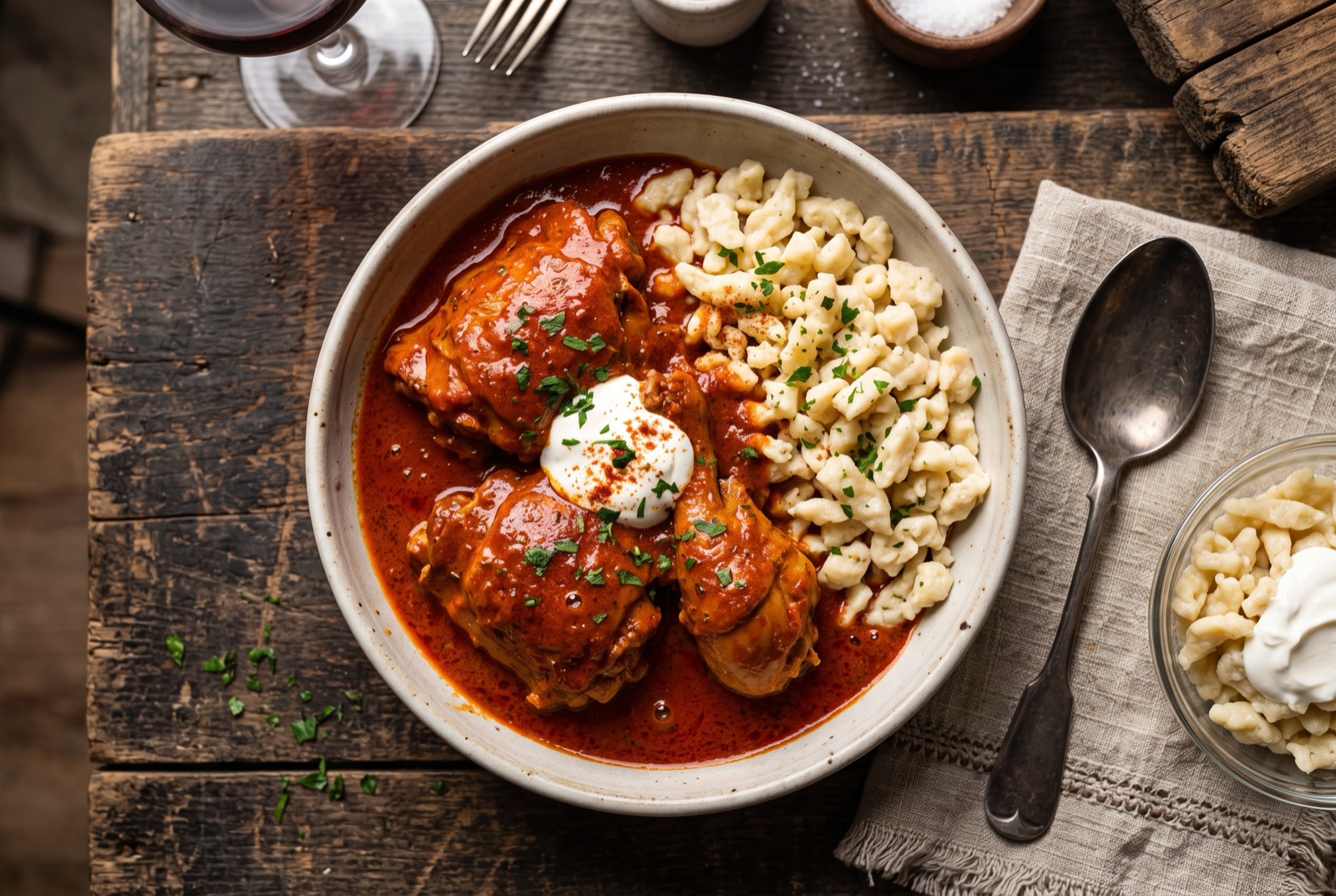
Paprikás csirke is chicken cooked down in onions and sweet paprika until the sauce is brick red and clinging, then enriched at the very end with sour cream. It tastes rounder and gentler than gulyás — the paprika is still front and centre, but the dairy softens its edges and the chicken fat gives the sauce a silkiness that beef never does. The whole thing takes under an hour, uses one pan, and hangs on a single technique: the sour cream is whisked with a little flour and tempered with hot sauce before it goes anywhere near the pot, which is what stops it curdling into grainy white flecks. It is served with nokedli, soft egg dumplings pressed into boiling water, which exist mainly as a delivery mechanism for the sauce.

- Gate
- HungaryNationwide
- Prep
- 20 min
- Cook
- 50 min
- Total time
- 1 hr 10 min
- Serves
- 4
- Status
- Easy
- Nutrition / serving · estimated
- Calories 720 kcal
- Protein 44 g
- Carbs 62 g
- Fat 32 g
- Fiber 4 g
- Sodium 820 mg
Why this recipe works.
- The sour cream is tempered with flour and hot sauce, so it thickens the pot instead of splitting in it.
- Bone-in, skin-on chicken renders enough fat to carry the paprika, which skinless breast simply cannot do.
- Includes the nokedli dumplings in the same recipe, because the sauce needs something to sit on.
- One pan, under an hour, and the technique is identical whether you scale it for two or for ten.
Ingredients.
15 itemsFor the paprikás
To finish
For the nokedli
Equipment
- Wide heavy sauté pan or shallow casserole with a lid
- Whisk
- Nokedli press, large-holed colander or a chopping board and knife
Instructions.
Render the chicken skin
Season the chicken pieces with salt. Heat the lard in a wide pan over medium-high heat and lay the pieces in skin side down. Cook for 6 to 8 minutes without moving them, until the skin is deep gold and releases from the pan on its own, then turn briefly and lift out onto a plate.
Tip If the skin sticks, it is not ready. It will let go by itself once it has browned properly.
Soften the onions in the chicken fat
Lower the heat to medium-low and add the chopped onions to the fat left in the pan with a pinch of salt. Cook for 12 to 15 minutes, scraping up the browned bits, until the onions have collapsed to a soft pale-gold mass with no crunch left.
Bloom the paprika
Stir in the garlic and cook for 30 seconds. Take the pan completely off the heat, count to five, then stir in the sweet paprika until the fat turns deep red and smells sweet. Immediately pour in the stock before the powder can catch.
Tip Measure the stock out before you start this step — the safe window is only a few seconds long.
Braise the chicken
Return the chicken and any resting juices to the pan, add the pepper strips and chopped tomato, and bring to a gentle simmer. Cover and cook for 30 to 35 minutes, turning the pieces once, until the meat pulls easily from the bone and the sauce has reduced enough to coat a spoon.
Make the nokedli dough
While the chicken braises, beat the flour, eggs, water and a teaspoon of salt into a thick, sticky batter that falls slowly off a spoon in ribbons. Let it stand for 10 minutes and bring a large pot of well-salted water to a rolling boil.
Cook the nokedli
Press the batter through a nokedli press or a large-holed colander into the boiling water, working in two batches. The dumplings are done about 2 minutes after they bob to the surface — scoop them out, drain, and toss with the butter so they do not stick.
Temper the sour cream
Whisk the sour cream and the tablespoon of flour together in a bowl until completely smooth. Ladle in about 150 ml of the hot cooking liquid a little at a time, whisking constantly, until the mixture is warm, loose and pourable.
Tip This is habarás. Skipping it is the single most common reason paprikás splits.
Finish off the heat and rest
Take the pan off the heat, wait a minute so it stops bubbling, then pour in the tempered sour cream and swirl it through the sauce. Return it to the lowest heat for 2 to 3 minutes to thicken, without ever letting it boil. Taste, correct the salt, rest for 5 minutes and serve over the nokedli.
Tips from our kitchen.
- Use bone-in thighs and drumsticks. Breast meat dries out over a 35-minute braise and gives the sauce far less body.
- Render the chicken skin in the pan first and cook the onions in that fat — it is free flavour and takes no extra time.
- Never let the pot boil after the sour cream goes in. Above a bare shiver the dairy tightens and turns grainy.
- If your sauce still splits, blitz it briefly with a stick blender off the heat; it will usually come back together smoothly.
- Full-fat sour cream only, ideally 20 percent. Low-fat versions split far more readily and taste thin against the paprika.
- Let the finished pot stand for five minutes before serving so the fat rises and the sauce settles into a clinging consistency.
Substitutions.
- Sour cream (tejföl) → Crème fraîche, or full-fat Greek yogurt with an extra teaspoon of flour
- Crème fraîche is more stable and splits less, but it is milder — add a squeeze of lemon to get back the sourness. Yogurt needs careful tempering and must never boil.
- Hungarian sweet paprika → Spanish sweet pimentón dulce
- Workable, though slightly earthier. Avoid smoked paprika, which overwhelms the sour cream and makes the dish taste Spanish rather than Hungarian.
- Nokedli → Wide egg noodles, boiled potatoes or plain rice
- Nokedli take ten minutes and are worth it, but any of these carry the sauce well. Egg noodles are the standard substitute in Hungarian-American kitchens.
- Chicken → Veal shoulder, lamb shoulder or firm freshwater fish
- All are traditional paprikás meats. Veal and lamb need about 90 minutes of braising; fish goes in for the last 8 minutes only.
Variations.
- Borjúpaprikás
- Veal paprikash: cubed veal shoulder braised for an hour and a half before the sour cream goes in. Richer and the classic restaurant version.
- Halpaprikás
- Made with carp or catfish from the Tisza, with the fish added only at the end. Sharper and lighter, and a river-town speciality.
- Gombapaprikás
- A meatless version built on mushrooms, which give up enough liquid and savoury depth to hold the sauce together on their own.
Storage & reheating.
Keeps 3 days refrigerated. Reheat very gently in a covered pan over low heat — a hard reheat will split the sour cream even if the sauce was perfect the day before. Freezing is not recommended once the dairy is in, as it separates on thawing; if you want to freeze it, stop before the sour cream, freeze the paprika braise, and add the tempered cream after reheating. Cook nokedli fresh, or refresh cold ones in a hot buttered pan.
Serve with
Nokedli dumplings, a cucumber salad dressed with vinegar and a little sugar, and pickled peppers.
The story behind Paprikás Csirke.
Paprikás is one of the four members of the Hungarian red-dish family, and it is defined by exactly one thing: the sour cream at the end. Take a pörkölt, stir tejföl through it, and you have a paprikás. That rule also explains why you rarely meet beef paprikás — the dairy sits better with lighter meats, so the classics are chicken, veal, lamb and freshwater fish, while beef stays in pörkölt territory. Hungarians take the taxonomy seriously enough that menus are precise about which one you are ordering.
The dish spread far beyond Hungary. Waves of emigration in the late nineteenth and twentieth centuries carried it into Austrian, Czech, Slovak, Romanian, Serbian and Croatian kitchens, and then across the Atlantic, where "chicken paprikash" became a fixture in Central European immigrant communities in American cities and eventually a diner and family-restaurant staple. The versions diverge honestly: some add tomato, some skip it, some finish with heavy cream instead of sour cream, and some thicken with a roux from the start. None of those are wrong so much as differently descended.
What holds it together across all those kitchens is the sequence at the start — onions cooked slowly in fat until they slump, paprika stirred in off the heat, liquid added immediately — and the discipline at the end. Boiling sour cream splits. Hungarian home cooks solve this with habarás, a named technique in which sour cream is loosened with flour and a ladle of hot liquid before being stirred back into a pot that is no longer bubbling. It is a thirty-second step that separates a sauce with a sheen from a sauce with curds in it, and it is the only genuinely fiddly part of an otherwise very easy dinner.
Questions, answered.
Why did my sour cream curdle in the sauce?
Either it went into a boiling pot, or it went in straight from the fridge. Sour cream splits when hit by high heat or a sharp temperature jump. Whisk it with a spoonful of flour first, stir in a ladle of the hot cooking liquid to bring it up to temperature gradually, then pour it back into a pot that has been off the heat for a minute and never let it boil afterwards.
What is the difference between paprikash and goulash?
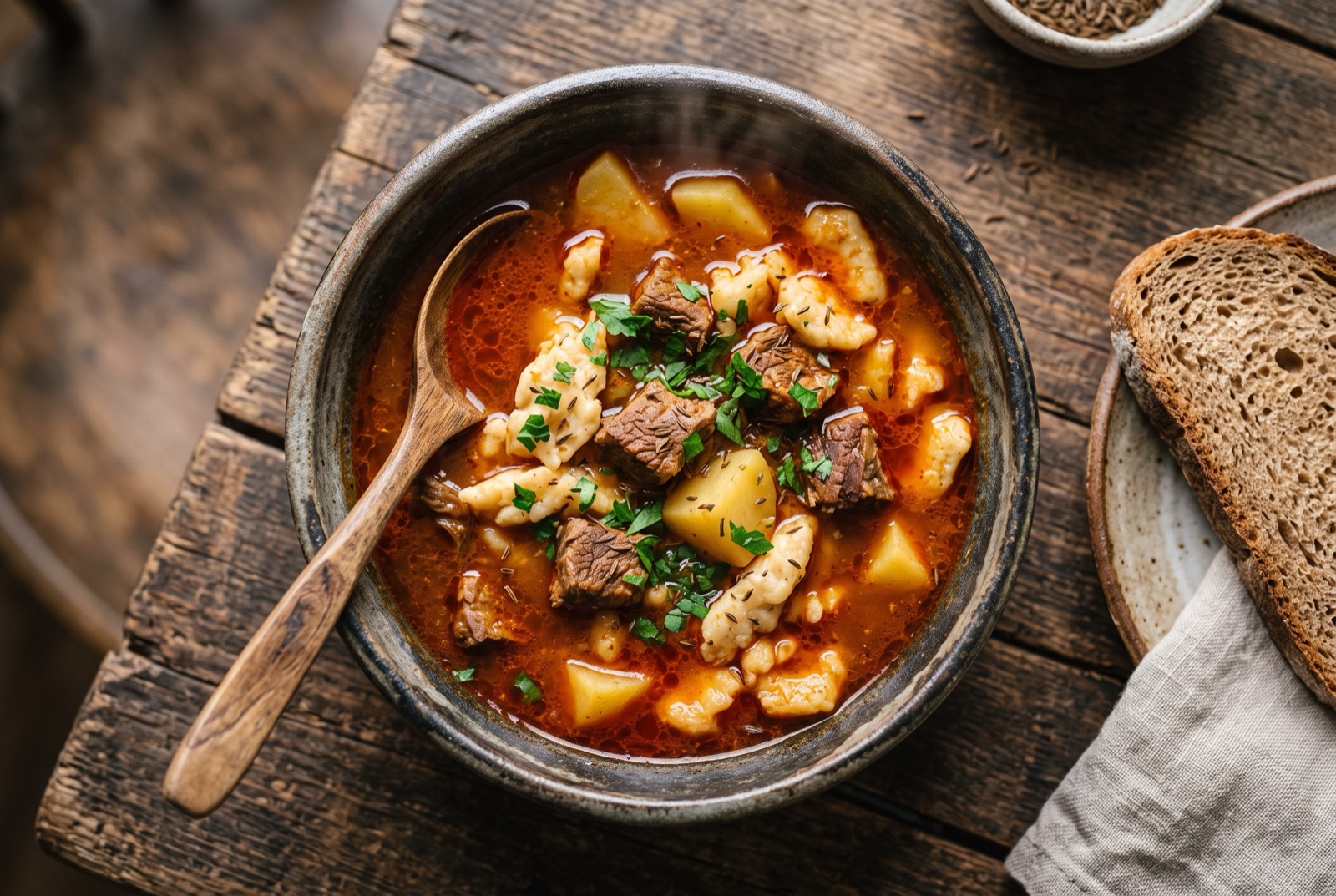
Both start from onions cooked in fat with sweet paprika. Gulyás is a soup with lots of thin broth, potatoes and root vegetables. Paprikás is a braise with a thick clinging sauce that is finished with sour cream — that dairy is what makes it a paprikás rather than a pörkölt, which is the same braise without cream.
Can I use chicken breast instead of thighs?
You can, but reduce the braising time to about 15 minutes and expect a thinner sauce. Bone-in, skin-on thighs and drumsticks release collagen and fat that give the sauce its body and gloss, and they stay juicy through a longer simmer. If you only have breast, brown it, remove it, build the sauce, and return it at the end.
What are nokedli and do I need a special tool?
Nokedli, also called galuska, are soft Hungarian egg dumplings made from a loose flour-and-egg batter dropped into boiling salted water. A nokedli press or a colander with large holes makes it faster, but you can simply scrape small pieces off the edge of a wet chopping board with a knife straight into the water, which is the traditional method.
Is chicken paprikash spicy?
No. It uses sweet paprika, so it is warm and mildly fruity rather than hot, and the sour cream softens it further. Hungarians who want heat add it at the table with a shaker of hot paprika or a dab of paprika paste, or eat a pickled cherry pepper alongside, rather than making the whole pot spicy.
You might also like.
All recipes →
Keep exploring Hungary.
Hungary has 9 more dishes in the atlas — Dobos Torta and Gulyás, and 7 more.
Recipe by The DishRoute Kitchen · published August 20, 2026 · updated August 20, 2026