Cong You Bing.
Flaky Chinese Scallion Pancakes
葱油饼 · Cōng yóu bǐng · say it: tsong-yo-BING
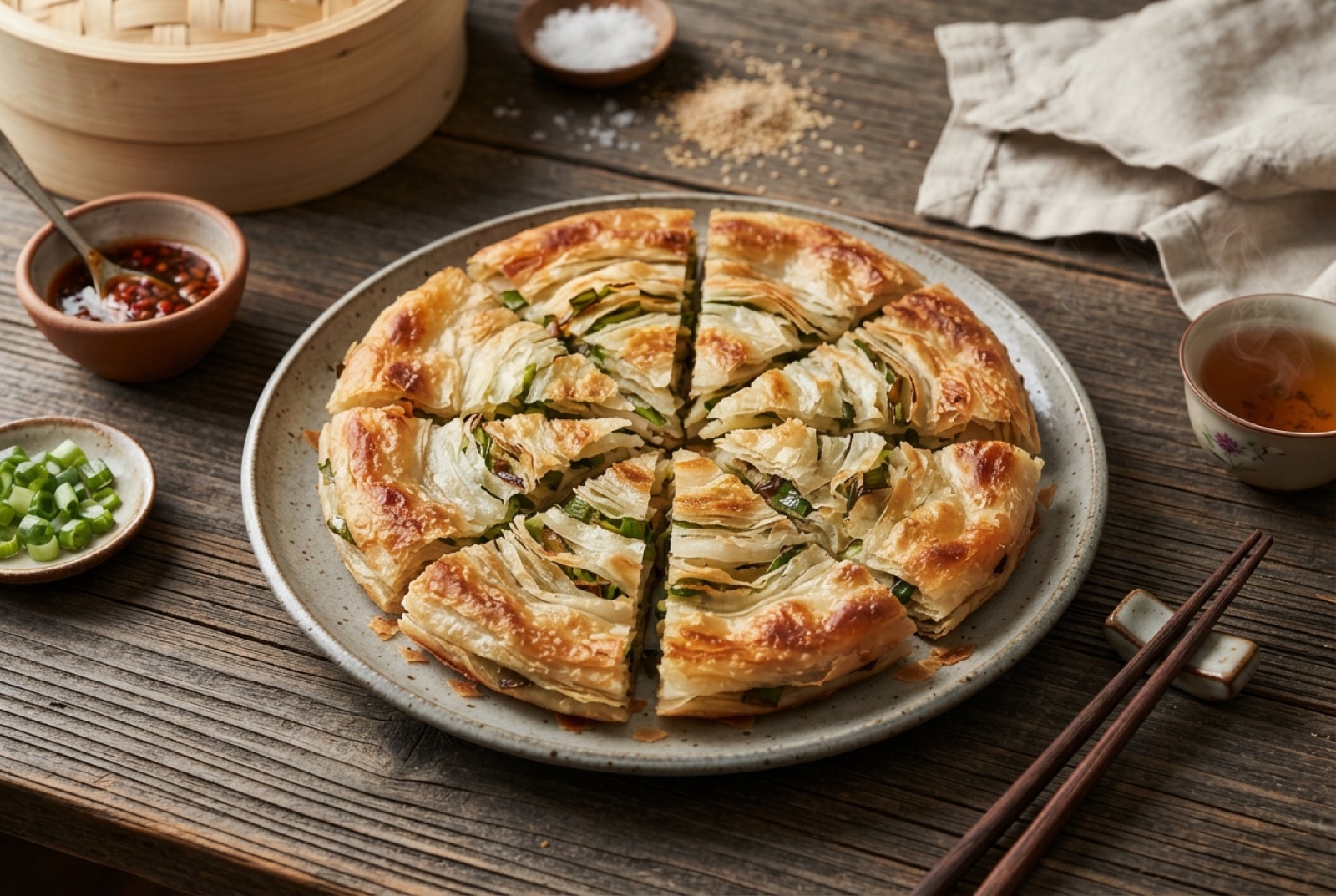
Cong you bing is a pan-fried flatbread whose entire architecture comes from one move: the dough is rolled thin, painted with fat and scallions, rolled up like a carpet, coiled into a snail, then flattened again — so what was one sheet becomes many, and steam prises them apart in the pan. Done right it is crunchy and blistered outside, soft and layered inside, and it shatters into flakes when you tear it. The flavor is simple and hard to stop eating: wheat, hot oil, and scallions that go sweet and mellow as they cook. It uses four cheap ingredients and rewards technique rather than shopping.

- Gate
- ChinaNorthern China & Shanghai
- Prep
- 30 min
- Cook
- 20 min
- Total time
- 1 hr 35 min incl. 45 min rest
- Serves
- 4
- Status
- Easy
- Nutrition / serving · estimated
- Calories 400 kcal
- Protein 8 g
- Carbs 48 g
- Fat 19 g
- Fiber 2 g
- Sodium 780 mg
Why this recipe works.
- A hot-water dough, which is what makes the pancake tender rather than chewy and keeps it soft even once it cools.
- Uses a flour-and-hot-oil paste rather than plain oil, so the fat stays in a defined layer instead of soaking into the dough and going greasy.
- The scallions go on raw and get salted only at the last moment, so they do not weep water and tear the dough during rolling.
- Pan-fried under a lid for part of the cooking, which steams the inside layers apart while the outside crisps.
Ingredients.
12 itemsFor the dough
For the fat paste
For the filling
To fry
For the dip
Equipment
- Rolling pin
- Heavy frying pan or cast-iron skillet with a lid
- Pastry brush
Instructions.
Mix the hot-water dough
Stir the salt into 300 g of flour, pour in the near-boiling water while mixing with chopsticks until it looks shaggy, then knead 5 minutes once it is cool enough to handle. The dough should end up smooth, soft and slightly tacky rather than firm.
Rest the dough
Cover the dough and leave it 30 minutes at room temperature. It will slacken noticeably and stop springing back when you press it, which is exactly what you need for rolling thin.
Make the fat paste
Heat the lard or oil until it shimmers and just begins to smell toasted, then pour it over the 3 tablespoons of flour and stir into a smooth, pourable paste. Season it with the salt and white pepper and let it cool to lukewarm.
Tip The paste should be the consistency of thin peanut butter. If it is stiff, add a teaspoon more hot oil.
Roll, spread and coil
Divide the dough in four and roll each piece into a thin rectangle about 2 mm thick. Brush with the fat paste right to the edges, scatter over a quarter of the scallions, then roll up tightly into a rope, stretch it gently and wind it into a flat coil, tucking the end underneath.
Rest the coils
Cover the four coils and rest them 15 minutes. The dough relaxes again, so the final roll spreads them out instead of fighting back and squashing the layers together.
Flatten gently
Working from the center outward, roll each coil into a round about 18 cm across and 5 mm thick. Use light pressure — you should still see the spiral through the surface, and a little scallion poking out is fine.
Fry crisp, then steam
Heat a tablespoon of oil in a heavy pan over medium heat and fry a pancake for 2 minutes until golden and blistered underneath. Flip, cover the pan, and cook 2 minutes more so the trapped steam pushes the layers apart, then uncover and give it another minute a side for crunch.
Tear and serve
Slide each pancake onto a board and, while still hot, squash it once between your palms or push the edges inward — this loosens the layers so it tears in flakes. Cut into wedges and serve with the vinegar, soy and chili oil dip.
Tips from our kitchen.
- Use water just off the boil for the dough. Hot water partly denatures the gluten, which is why the pancake stays tender instead of springing back like bread dough.
- The dough should feel soft and slightly tacky, closer to an earlobe than to bread dough. A stiff dough will not roll thin enough for real layers.
- Rest the dough at least 30 minutes before rolling and again after coiling. Skipping the rest means it shrinks back the moment you let go.
- Salt the scallions only right before assembling, and use mostly green parts. Salted early they release water, which turns the fat layer into a wet smear.
- Roll the coiled spiral gently and from the center outward. Pressing hard squeezes the layers into one another and the pancake comes out solid.
- Fry over medium heat, not high. Too hot and the outside browns before the inside layers have had time to steam apart and set.
Substitutions.
- Lard for the fat paste → Neutral oil heated until shimmering and stirred into flour
- The standard vegetarian version and only slightly less flaky. Do not use cold oil straight from the bottle — heating it is what makes the paste hold as a layer.
- Scallions → Chinese chives, or the green tops of spring onions plus a little chopped garlic chive
- Chives give a stronger, more garlicky pancake that is common in the north. Whatever you use, chop it fine so it does not puncture the thin dough.
- Plain wheat flour → Half plain flour, half bread flour
- A little extra gluten helps if you struggle to roll the dough thin without tearing, at the cost of a slightly chewier pancake.
Variations.
- Shanghai oven-baked style
- Brush the shaped rounds with syrup, press sesame seeds on top and bake at 220°C until deep gold. Crisper and drier than the pan-fried version, closer to what a Shanghai breakfast stall sells.
- Egg pancake roll
- Fry the pancake, slide a beaten egg into the pan and press the pancake onto it, then roll it around lettuce, sauce and ham. The Taiwanese street-food treatment.
- Sichuan peppercorn version
- Stir a teaspoon of ground toasted Sichuan peppercorn into the fat paste. It gives the layers a citrusy tingle and is common wherever the pancake is sold in the southwest.
Storage & reheating.
Uncooked shaped rounds freeze beautifully — stack them with parchment between and fry from frozen over slightly lower heat, adding 2 minutes. Cooked pancakes keep a day at room temperature and reheat crisp in a dry pan or oven; the microwave turns them leathery. The dough itself can rest in the fridge overnight, which actually improves how easily it rolls, but let it come back to room temperature first or it will fight you.
Serve with
A dipping sauce of black vinegar, light soy sauce, chili oil and a little grated garlic, with hot soy milk alongside for a proper northern breakfast.
The story behind Cong You Bing.
Scallion pancakes are wheat-belt food, from the northern half of China where noodles, dumplings and griddled breads take the place rice holds in the south. They are sold from breakfast carts and hole-in-the-wall shops, cooked on a flat iron plate and handed over folded in paper, and they are also standard home cooking — the kind of thing made from a bowl of flour when there is nothing much in the house. Shanghai has its own beloved version, cong you bing baked against the wall of a drum oven until the outside goes biscuit-crisp, which locals will argue is the real one; the pan-fried version below is the more common household style.
The technique is a laminated dough by a different route than the European one. Instead of folding a slab of butter into dough and chilling it, the cook spreads soft fat — traditionally lard, or a paste of hot oil and flour called you su — over rolled dough and creates layers by rolling and coiling. It costs nothing and needs no rest in the fridge, and it is the same logic that underlies a whole family of Chinese pastries. Lard gives the best flakiness and a distinct savory flavor; a hot-oil-and-flour paste is the usual vegetarian answer and works very nearly as well because it keeps the fat from soaking into the dough.
They are eaten at any time of day, most often for breakfast with soy milk, cut into wedges and dipped in a sauce of black vinegar, soy and chili oil. In Taiwan and across the diaspora, the same pancake gets an egg fried onto it and folded around fillings as a street sandwich, and the frozen pancakes sold in Asian supermarkets are one of the few convenience products that home cooks buy without embarrassment. The homemade ones are still better, mostly because you can be generous with the scallions.
Questions, answered.
Why did my scallion pancake come out dense with no layers?
Usually one of three things: the dough was too stiff to roll thin, the coil was flattened too aggressively, or there was not enough fat between the layers. The fat is what stops the sheets fusing, so spread it right to the edges, roll the final round gently, and stop when it is about 5 mm thick rather than paper-thin.
Why use hot water in the dough instead of cold?
Hot water partially breaks down the gluten structure and gelatinizes some of the starch, giving a dough that is soft, easy to roll and tender when cooked. Cold-water dough develops more gluten and produces a chewier, springier pancake that resists rolling and tightens in the pan.
Can I make the dough ahead?
Yes, and it helps. The dough can rest covered in the fridge overnight, which relaxes it further and makes rolling much easier. Shaped, uncooked pancakes also freeze well for a month and go straight into the pan from frozen, so it is worth making a double batch.
What do you eat scallion pancakes with?
Most often on their own as breakfast or a snack, cut in wedges and dipped in black vinegar mixed with soy sauce and chili oil. They also work as a starch alongside stir-fries and braises, and folded around a fried egg or leftover roast meat they make an excellent sandwich.
Do I need lard, or is oil fine?
Oil is fine and is what most vegetarian versions use, but heat it first and stir it into a spoonful of flour to make a paste. That paste holds its position between the dough layers, while cold liquid oil soaks in and leaves you with a greasy, single-layer pancake.
You might also like.
All recipes →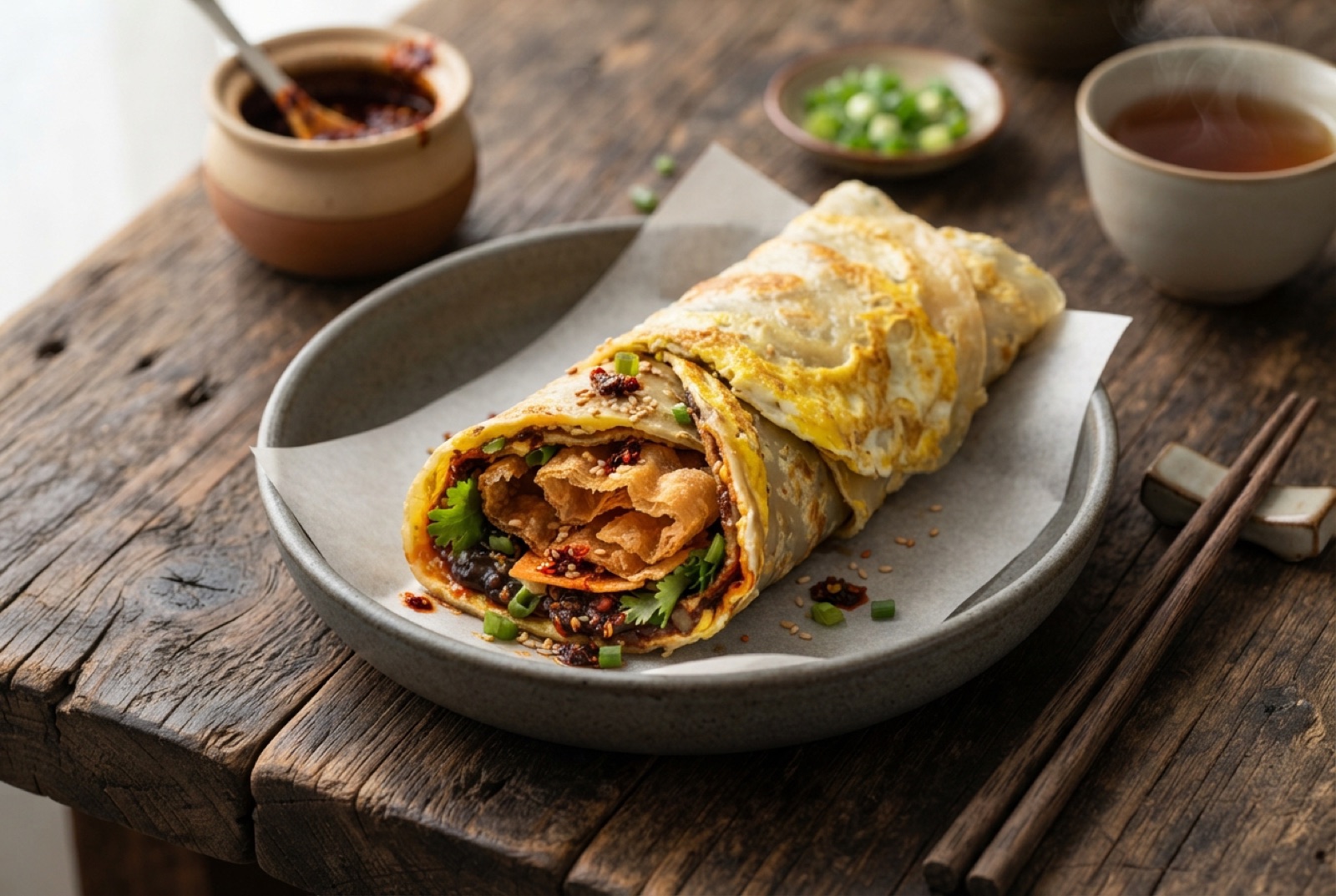
Keep exploring China.
China has 9 more dishes in the atlas — Char Siu and Dan Dan Mian, and 7 more.
Recipe by The DishRoute Kitchen · published August 19, 2026 · updated August 19, 2026