Erwtensoep.
Dutch Thick Split Pea Soup
Erwtensoep / snert · say it: AIRT-en-soop
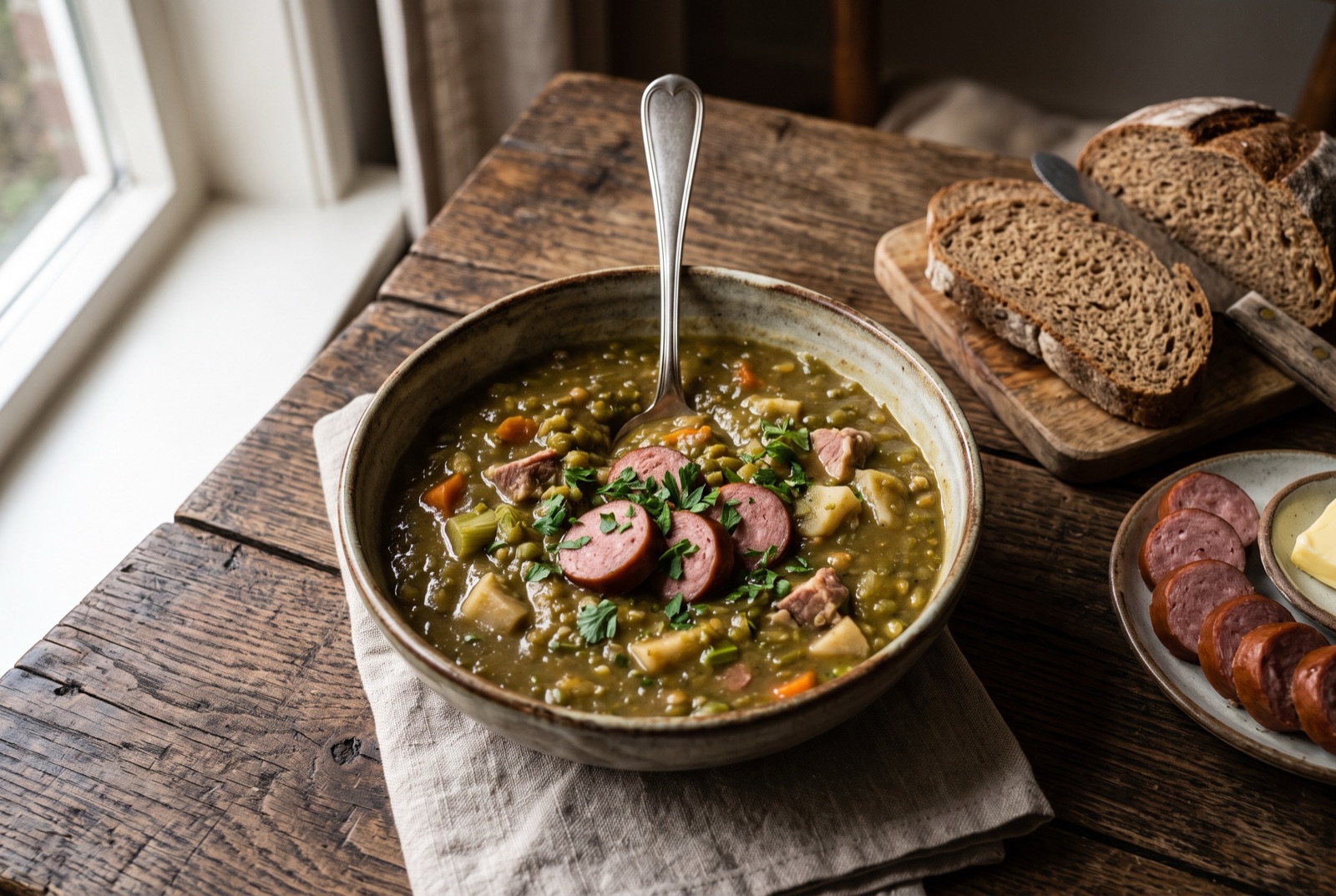
Erwtensoep is less a soup than a green pea porridge, and Dutch cooks are entirely serious about the test: a spoon stood upright in the pot should stay standing. Green split peas are simmered with pork ribs or a hock, celeriac, leek and celery until the peas dissolve completely and the whole thing turns thick, smoky and savoury. Slices of smoked sausage go in at the end, and it is eaten with dark rye bread spread with butter and topped with katenspek, a cured smoked bacon. Made properly it needs a night in the fridge before it is at its best, which is why nobody in the Netherlands eats erwtensoep on the day they cook it.

- Gate
- Netherlands
- Prep
- 25 min
- Cook
- 2 hr
- Total time
- 2 hr 25 min
- Serves
- 6
- Status
- Medium
- Nutrition / serving · estimated
- Calories 520 kcal
- Protein 35 g
- Carbs 48 g
- Fat 20 g
- Fiber 17 g
- Sodium 1250 mg
Why this recipe works.
- Builds the stock from pork ribs and a hock, so the smoke and body come from meat rather than from a stock cube.
- Gets the pea-to-liquid ratio right for a soup that actually holds a spoon upright without turning to cement.
- Adds the sausage at the end so it stays juicy instead of leaching out and going rubbery.
- Tells you honestly that this dish is better the next day, and how to reheat it without scorching the base.
Ingredients.
13 itemsFor the soup
To finish
Equipment
- Large heavy pot with lid
- Ladle
- Tongs
Instructions.
Start the peas and pork
Put the rinsed split peas, the water and the smoked ribs or hock into a large heavy pot. Bring slowly to the boil, then skim off the grey foam that rises in the first 15 minutes until the surface stays clear.
Tip Bring it up slowly and uncovered — a hard boil from cold throws foam over the sides and clouds the finished soup.
Simmer until the peas break down
Lower the heat, half-cover and simmer for 60 minutes, stirring along the base every 15 minutes. By the end the peas should have lost their shape entirely and the liquid should look like a loose green purée.
Add the vegetables
Stir in the celeriac, leek, celery with its leaves, onion, potato and bay leaves. Simmer a further 30–40 minutes, stirring often, until the potato has begun to fall apart and the soup is thick enough to hold the mark of the spoon.
Tip This is where it catches. Keep the heat low and scrape the base of the pot, not just the middle.
Shred the meat
Lift out the pork, discard the bones, skin and bay leaves, and pull the meat into bite-sized pieces. Return the meat to the pot and stir it through.
Add the sausage
Drop in the sliced rookworst and simmer gently for 10 minutes, just until the slices are heated through and have released a little fat that sits in bright pools on the surface.
Season and rest
Season now and not before, with salt and plenty of black pepper — smoked pork varies wildly in saltiness. Stir in the parsley. If you can, cool the soup and refrigerate it overnight; reheat with a splash of water the next day.
Serve
Ladle into deep bowls and serve with buttered rye bread topped with smoked bacon, and mustard on the table for those who want it.
Tips from our kitchen.
- Do not soak the split peas. Unlike whole dried peas, they break down fine from dry and soaking only makes the timing harder to judge.
- Skim the grey foam in the first 15 minutes. Skipping it leaves a slightly muddy flavour and a scummy edge on the pot.
- Stir along the bottom of the pot every 15 minutes once the peas start to break down — this soup catches and scorches very easily.
- Celeriac and celery leaf are not optional flavourings here; they are what makes it taste Dutch rather than generically pea-and-ham.
- Add the smoked sausage in the last 10 minutes only. Long cooking makes it dry and tough and greys the soup.
- Season at the very end. Smoked pork varies enormously in salt, and a soup salted early can be inedible by the time it has reduced.
Substitutions.
- Pork ribs and hock → A smoked ham hock alone, or a smoked pork shoulder piece
- You want both fat and bone if possible — bone gives body, fat gives flavour. A single hock works but the soup will be slightly lighter.
- Rookworst → Kielbasa or any coarse smoked pork sausage
- Avoid heavily spiced or chorizo-style sausages; the paprika takes over completely and the soup stops tasting of peas.
- Celeriac → Two extra celery stalks plus a small parsnip
- Not identical — celeriac has a nuttier, rounder flavour — but the combination gets close enough that most people would not notice.
- Pork entirely → Vegetable stock, smoked paprika and a smoked vegetarian sausage
- A vegetarian snert is not traditional but works well; the challenge is replacing the smoke, so use smoked paprika and a little soy sauce for depth.
Variations.
- Snert with pork belly
- A piece of salted pork belly cooked in the soup, then sliced and served on the rye bread instead of katenspek. Richer, and very traditional in the north.
- Thinner erwtensoep
- Some households prefer it looser, as a first course rather than a meal. Use 25% more liquid and stop cooking once the peas have just broken down.
- With a hint of mustard
- A teaspoon of Dutch mustard stirred through each bowl at the table cuts the richness and is a common personal addition.
Storage & reheating.
Erwtensoep keeps 4 days refrigerated and is better on days two and three than on day one. It sets very firm when cold — expect to cut it with a spoon — so reheat it slowly over low heat with 100–200 ml of water stirred in, scraping the base constantly until it loosens and steams. It freezes for 3 months; freeze it without the sausage and add fresh slices when you reheat, since sausage goes grainy after a freeze-thaw cycle.
Serve with
Roggebrood (dense rye bread) with butter and katenspek or smoked bacon, and Dutch mustard on the table.
The story behind Erwtensoep.
Snert — the colloquial name, and the one most people actually use — is winter and outdoors food. It belongs to the Elfstedentocht, the two-hundred-kilometre skating race across the frozen canals of Friesland that has only been held fifteen times since 1909 because the ice is so rarely thick enough, and to the ordinary skating days that occasionally follow a hard frost. Roadside stalls and cafés along the canals sell it in paper cups, and it appears at Christmas markets and after long winter walks. There is a widely repeated rule that snert should not be served before the first frost, which is less a law than an expression of how firmly the dish is filed under cold weather.
The soup is genuinely old. Split peas store indefinitely, grow well in Dutch soil and were a staple long before the potato arrived; a thick pea pottage with salted pork is documented across northern Europe for centuries. What makes the Dutch version specific is the vegetable base — celeriac and celery leaf give it a distinct aromatic backbone that pea soups elsewhere often skip — and the insistence on rookworst sliced in at the end rather than cooked from the start.
The overnight rest is the part outsiders skip and Dutch cooks never do. Freshly cooked, the soup is loose and the flavours sit separately; after a night in the fridge it sets almost solid and needs loosening with water when reheated, and the smoke, pea and celeriac have merged into one thing. Restaurants and stalls cook it a day or two ahead as a matter of course. The traditional accompaniment — roggebrood, a dense sour rye, with butter and katenspek — is not a garnish either. It is the salt and chew the soup needs to keep it from being one uniform soft mouthful.
Questions, answered.
Do I need to soak split peas first?
No. Split peas have had their skins removed and split along the seam, so they hydrate and break down without soaking — typically in 60 to 90 minutes of simmering. Soaking them mostly makes the cooking time unpredictable. Whole dried peas are different and do need an overnight soak, so check what you have bought.
How thick should erwtensoep actually be?
Thick enough that a spoon stood upright in the pot stays standing, at least briefly. The peas should have disintegrated entirely so there is no visible pea shape left, only a coarse green purée with meat and vegetables in it. If yours is soup-thin, simmer uncovered for another 20 minutes; if it is solid, loosen with hot water.
Why did my soup burn on the bottom?
Split peas settle and stick as they thicken, and the last 30 minutes are when it happens. Use a heavy pot, keep the heat low once the peas have broken down, and stir along the base — not just the surface — every 15 minutes. A scorched base cannot be rescued; the burnt flavour goes through the whole pot, so pour the unburnt soup into a clean pan the moment you smell it.
Can I make erwtensoep in a pressure cooker?
Yes. Cook the peas, pork and vegetables at high pressure for 25 minutes, release naturally, then simmer uncovered to reach the right thickness and add the sausage. The flavour will be slightly less developed than a slow simmer, but an overnight rest in the fridge closes most of that gap.
Is it really better the next day?
Yes, and Dutch cooks treat this as a rule rather than a preference. Overnight the starches continue to absorb liquid, the smoke from the pork spreads evenly through the peas, and the celeriac and celery flavours merge instead of sitting apart. Plan to cook it a day before you want to eat it, and simply loosen it with water on reheating.
You might also like.
All recipes →

Keep exploring Netherlands.
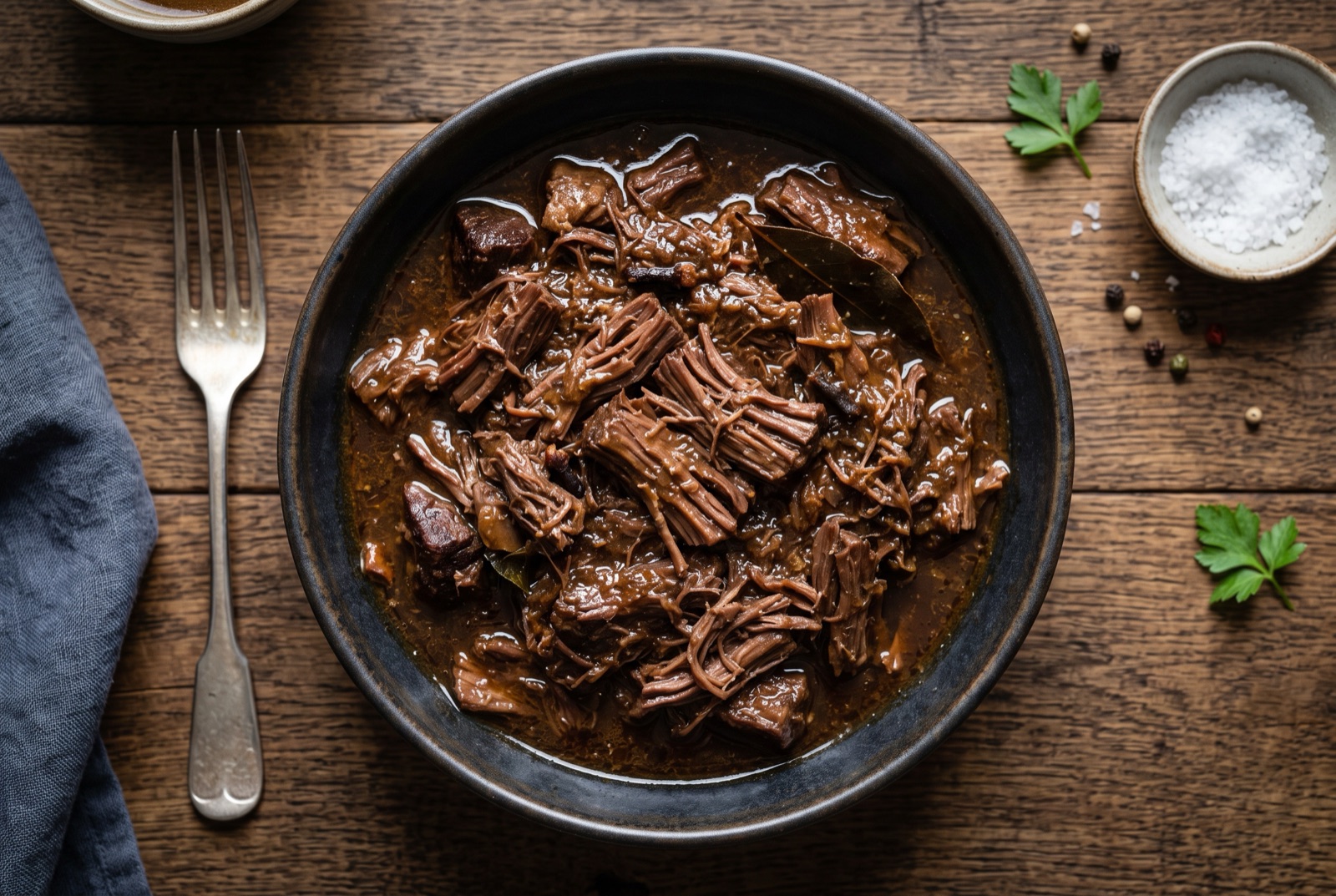
Netherlands has 9 more dishes in the atlas — Bitterballen and Draadjesvlees, and 7 more.
Recipe by The DishRoute Kitchen · published August 19, 2026 · updated August 19, 2026