Garash Torta.
Bulgarian Flourless Walnut Chocolate Cake
Гараш торта · say it: gah-RASH TOR-tah
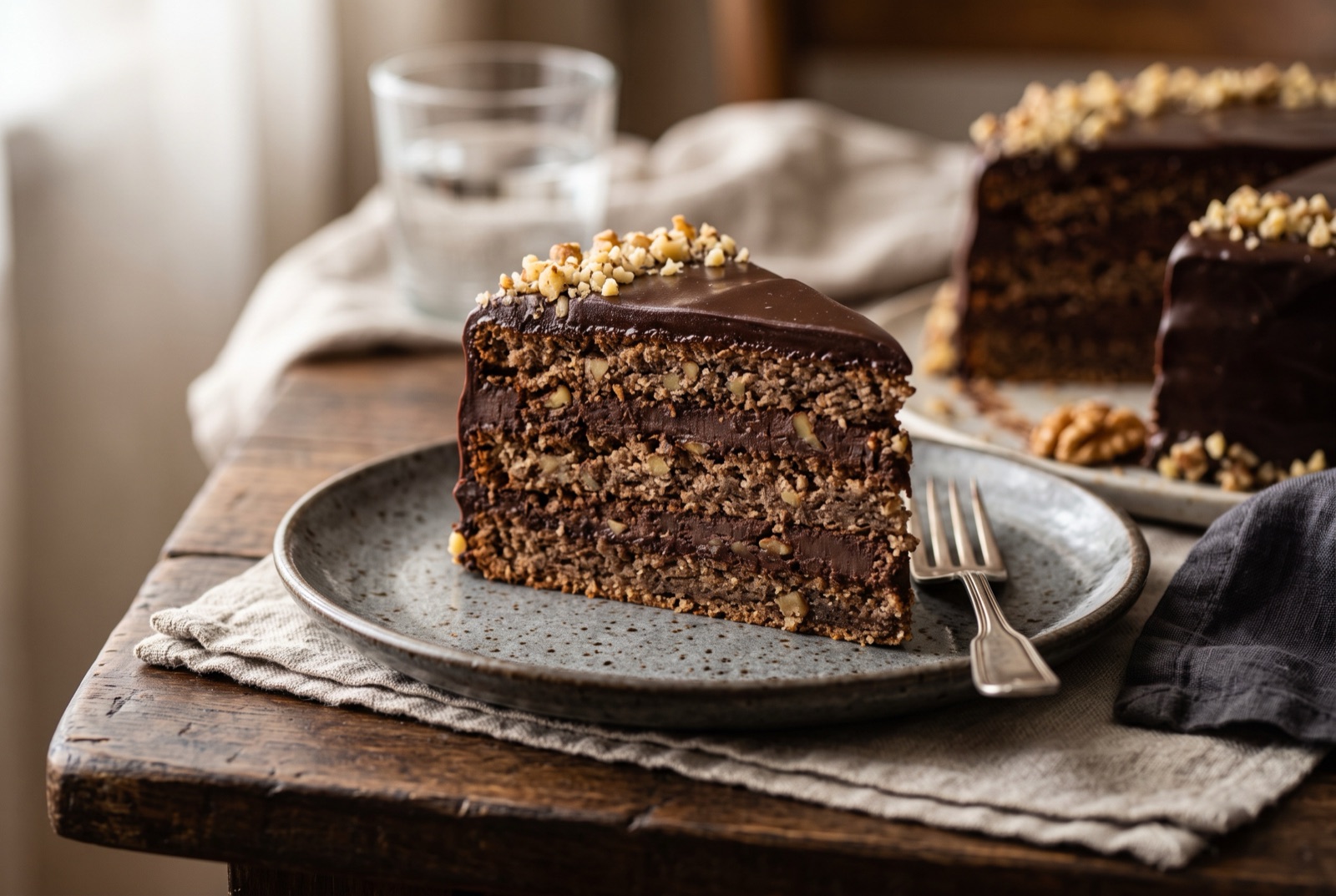
Garash torta is a flourless chocolate and walnut cake: thin layers of ground-walnut meringue, baked until dry and slightly chewy, stacked with a dark chocolate cream and covered in a poured chocolate glaze that sets to a smooth, matte-dark finish. There is no flour anywhere in it, which makes the texture unlike a sponge cake — denser, shorter, faintly sandy from the nuts, and the crumb dissolves rather than crumbles. It is unapologetically rich and not very sweet; the walnuts and dark chocolate do most of the talking. Bulgarians serve it in small slices with black coffee, and it is the standard celebration cake for people who find buttercream sponges childish.

- Gate
- BulgariaRuse
- Prep
- 1 hr
- Cook
- 1 hr
- Total time
- 14 hr incl. 12 hr rest
- Serves
- 12
- Status
- Takes skill
- Nutrition / serving · estimated
- Calories 620 kcal
- Protein 10 g
- Carbs 42 g
- Fat 47 g
- Fiber 3 g
- Sugar 36 g
- Sodium 90 mg
Why this recipe works.
- Bakes the walnut meringue layers low and slow so they dry through without colouring or turning bitter.
- Uses a stable chocolate buttercream built on egg yolks, which holds up between layers instead of squeezing out.
- Gives a glaze temperature and a pouring cue, the two things that decide whether the top sets smooth or streaky.
- Sets out the two-day timeline honestly rather than pretending this is an afternoon bake.
Ingredients.
15 itemsFor the layers
For the chocolate cream
For the glaze
Equipment
- Stand mixer or electric hand whisk
- Food processor
- Two baking sheets
- Baking paper
- Palette knife
- Cooling rack
Instructions.
Grind the walnuts and mark the tins
Blitz the walnuts with two tablespoons of the caster sugar until they are the texture of coarse sand — stop before they go oily and clump. Draw four 22 cm circles on baking paper, then flip the sheets pencil side down onto two baking trays.
Tip Pulse in short bursts and shake the bowl between them. Continuous grinding heats the nuts and turns them to butter.
Whip the meringue
Whisk the egg whites with the salt and vinegar until foamy, then add the remaining sugar a spoonful at a time, whisking until the meringue is thick, glossy and holds a peak that curls over only slightly at the tip. Fold in the ground walnuts in three additions with a spatula, keeping as much air as you can.
Spread and bake the layers
Divide the mixture between the four marked circles and spread each to an even 5 mm thickness right to the pencil line. Bake at 160°C for 25 minutes, until the layers are dry to the touch, pale gold and lift away from the paper at the edges.
Tip Bake two trays at a time and swap their positions halfway, or the lower one stays damp in the middle.
Peel and cool
Slide the layers, still on their paper, onto a rack and peel the paper away while they are just warm. Leave them to cool completely and flat — stacked warm layers trap steam and go soft.
Make the chocolate cream
Whisk the yolks with the sugar until pale, whisk in the warm milk, then cook over low heat, stirring constantly, until the custard thickens enough to coat the back of a spoon at about 80°C. Off the heat, stir in the chopped chocolate and cocoa until smooth, and let it cool to room temperature.
Tip Do not let it boil. If it looks grainy, push it through a sieve and carry on.
Beat in the butter
Beat the soft butter until pale and creamy, then add the cooled chocolate custard a spoonful at a time, beating until each addition disappears. The finished cream should be thick, matte and hold a soft peak. If it splits, warm the bowl briefly over hot water and beat again.
Assemble the cake
Put the first walnut layer on a board, spread a quarter of the cream to the edges with a palette knife, and repeat with the remaining layers. Use the last of the cream to skim the top and sides smooth, then refrigerate for at least 2 hours until firm to a fingertip.
Glaze and rest overnight
Heat the cream to just below boiling, pour it over the chopped chocolate and butter, and stir from the centre outwards until glossy. Let it cool to about 32°C, then pour it over the chilled cake in one movement and tilt the cake to guide it over the edges. Press walnut halves around the rim and refrigerate overnight before slicing.
Tips from our kitchen.
- Grind the walnuts with a spoonful of the sugar. The sugar stops them turning to oily paste in the processor, which is the fastest way to ruin the layers.
- Draw the circles on baking paper and turn it pencil side down. The meringue mixture spreads unevenly otherwise and the layers will not stack flat.
- Bake the layers at 160°C until they are dry and firm to a light press but still pale gold. Browning past that point makes the walnuts taste bitter.
- Peel the paper off while the layers are still slightly warm. Once fully cold they stick and shatter, and a broken layer belongs in the middle of the stack.
- The buttercream and the layers must be at the same room temperature. Cold butter on a warm layer weeps, and warm butter on a cold layer slides.
- Pour the glaze in one continuous movement at about 32°C, when it coats a spoon and falls in a smooth ribbon. Spreading it with a knife leaves marks that never smooth out.
Substitutions.
- Walnuts → Hazelnuts, or half walnuts and half almonds
- Hazelnuts make a rounder, sweeter cake much closer to a Viennese torte. It is very good but it is no longer really a Garash.
- Dark chocolate at 60–70% → Chocolate at 50–55% with a tablespoon less sugar in the cream
- Milder chocolate makes a sweeter cake. Do not go below 50 percent — the cake relies on bitterness to balance the butter.
- Egg-yolk buttercream → A simple ganache of equal parts cream and dark chocolate, whipped once cool
- Far easier and almost as good between the layers, though softer, so chill the cake longer before glazing.
Variations.
- Garash with rum
- A tablespoon of dark rum beaten into the buttercream, which is common in Bulgarian pastry shops and cuts through the richness.
- Five-layer Garash
- The pastry-shop format, with five thinner meringue layers instead of four, giving a higher cake and a much better cream-to-layer ratio in each slice.
- Garash cups
- A modern deconstruction served in glasses — crumbled walnut meringue layered with the chocolate cream and glaze, and no assembly to get wrong.
Storage & reheating.
Garash keeps 5 days refrigerated under a cover and genuinely needs at least one night in the fridge before it is cut — the layers soften into the cream and the whole cake changes texture. Take it out 40 minutes before serving, because the buttercream is waxy and mute straight from the fridge. Cut with a knife dipped in hot water and wiped between slices, or the glaze cracks. It freezes for 2 months without the glaze; glaze it after thawing, since a frozen glaze condenses and goes dull.
Serve with
Strong black coffee and nothing else. Cream or ice cream buries the walnut flavour the cake is built on.
The story behind Garash Torta.
The cake is named after Kosta Garash, a pastry chef working in Ruse — the Danube port that was Bulgaria's most cosmopolitan city in the late nineteenth century, full of Austrian, Hungarian and Romanian trade. Ruse is where Central European patisserie entered Bulgaria, and the Garash cake belongs to that moment: a Torte in the Viennese sense, built in thin layers with buttercream, but made with the walnuts that grow everywhere in Bulgaria rather than the almonds or hazelnuts a Viennese chef would reach for. Whether Garash himself was Hungarian, as is often repeated, is not firmly established, and Bulgarian sources disagree.
What is not in doubt is what happened to the cake afterwards. It became the formal celebration cake of Bulgaria — the thing ordered for name days, anniversaries and graduations, and the thing sold in every serious pastry shop in the country under its own name rather than as a generic chocolate cake. Under socialism it survived as one of the few sweets with a real identity, and the state confectionery combines produced a standardised version with a mirror-shiny glaze that many Bulgarians still consider the correct one.
Making it at home is a real project, and it is worth being honest about that. Four separate meringue layers have to be baked and cooled, the buttercream has to be built without splitting, and the glaze has to be poured at the right temperature or it sets streaky. None of the individual steps is difficult; there are just a lot of them, and the cake improves after a night in the fridge, so it cannot be made in an afternoon and served the same evening. The reward is a cake that tastes distinctly of walnuts and dark chocolate rather than of sugar.
Questions, answered.
Why did my walnut layers come out chewy instead of dry?
They were underbaked or the meringue was underwhipped. The egg whites need to hold firm, glossy peaks before the nuts go in, and the layers need long enough at a moderate oven — around 25 minutes at 160°C — to dry through rather than just set on top. A slightly chewy layer is not a disaster in this cake, since it softens overnight anyway, but a wet centre will collapse under the buttercream.
Why is my chocolate glaze streaky or dull?
Temperature. Poured too hot, the glaze runs thin and picks up buttercream; poured too cool, it drags and sets with visible marks. Aim for around 32°C, when it falls off a spoon in a smooth unbroken ribbon, and pour it in one movement into the centre of a well-chilled cake, tilting the cake rather than spreading with a knife. A little glycerine or a spoonful of glucose syrup also helps it stay glossy.
Can I make Garash torta in one day?
You can assemble it in one day, but it should not be eaten that day. The layers need to sit overnight with the buttercream so they absorb moisture and soften into the cake — cut too early, the meringue is still crisp and the slices shatter rather than yield. Bake the layers on day one, assemble and glaze the same evening, and serve on day two.
Is there really no flour in it?
None at all. The structure comes entirely from whipped egg whites and finely ground walnuts, which is what makes the texture short and dense rather than springy. That also makes the cake naturally gluten-free, provided your chocolate and any glucose syrup are certified gluten-free, which is worth checking if you are baking for someone coeliac.
My buttercream split — can I save it?
Usually yes. Splitting almost always means a temperature mismatch: butter too cold for the chocolate mixture, or the mixture too warm for the butter. Warm the bowl briefly over a pan of hot water while beating and it will normally come back together in under a minute. If it is too warm and soupy instead, chill it for fifteen minutes and beat again.
You might also like.
All recipes →
Keep exploring Bulgaria.
Bulgaria has 9 more dishes in the atlas — Banitsa and Bob Chorba, and 7 more.
Recipe by The DishRoute Kitchen · published August 20, 2026 · updated August 20, 2026