Waakye.
Ghanaian Rice and Beans Cooked with Sorghum Leaves
Waakye · say it: WAA-chay
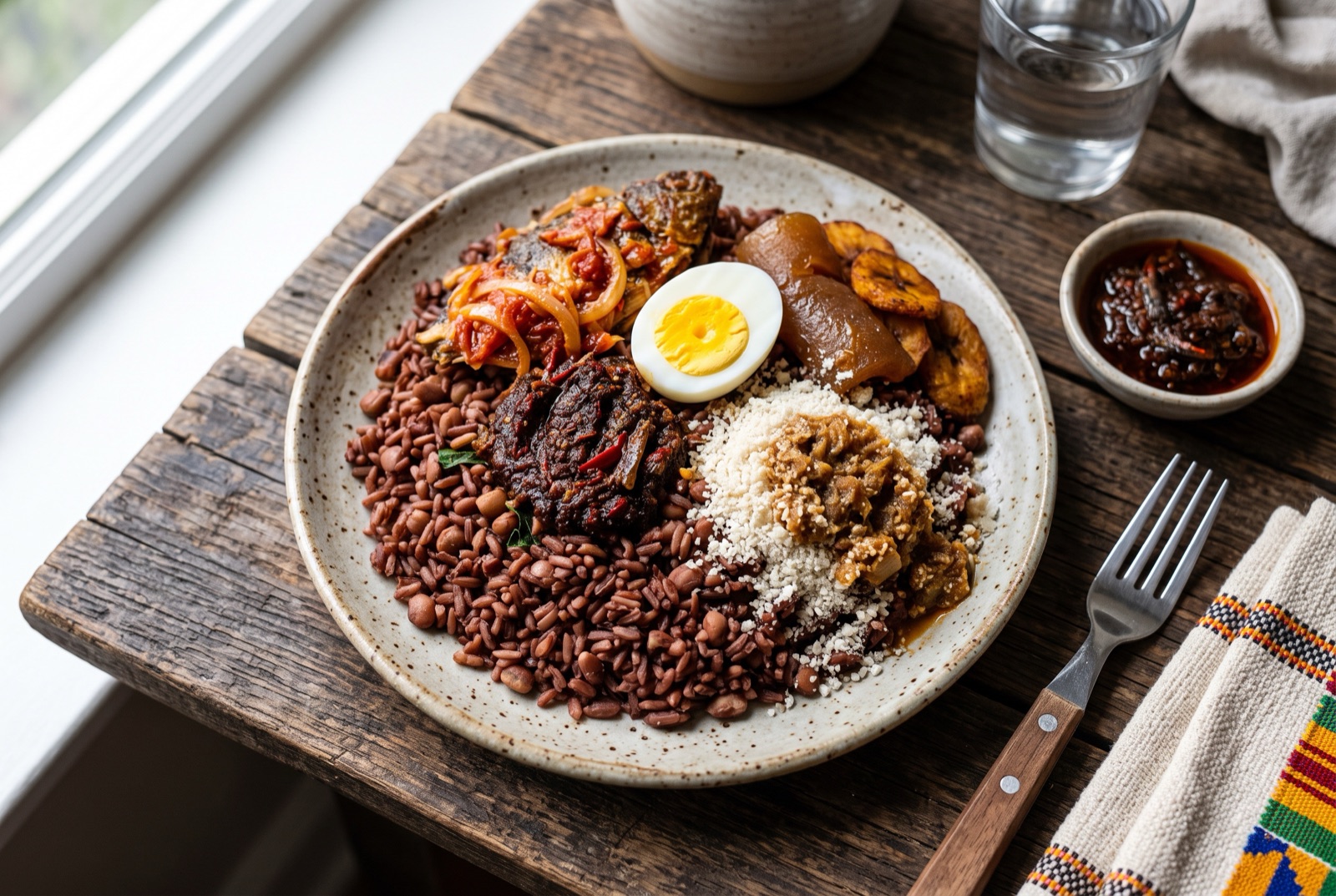
Waakye is rice and beans, but the colour tells you it is not any rice and beans: the pot is cooked with dried red sorghum leaf sheaths, which bleed a russet dye into the grains and give the finished plate its reddish-brown look and a faint mineral edge. On its own the rice tastes gentle and slightly earthy, softly starchy from the cowpeas that cook into it. It is never served on its own. A waakye plate is built up in layers at the seller's table — a spoon of shito, a shower of gari, a boiled egg, spaghetti, fried plantain, stew, sometimes wele — so every forkful mixes something soft, something crunchy and something fiercely hot.

- Gate
- GhanaGreater Accra
- Prep
- 15 min
- Cook
- 1 hr 10 min
- Total time
- 1 hr 35 min incl. 10 min rest
- Serves
- 6
- Status
- Medium
- Nutrition / serving · estimated
- Calories 470 kcal
- Protein 16 g
- Carbs 82 g
- Fat 7 g
- Fiber 9 g
- Sodium 620 mg
Why this recipe works.
- Uses the real sorghum leaves for colour and gives a workable substitute rather than pretending food colouring is equivalent.
- Cooks the beans first and the rice in the same coloured liquid, so the grains take the dye all the way through instead of sitting on a stained bottom layer.
- Gets the baking soda quantity right — enough to soften the cowpeas and deepen the colour, not enough to turn the pot slippery.
- Treats the accompaniments as part of the recipe, because a plate of plain waakye rice is not the dish anyone in Ghana is thinking of.
Ingredients.
11 itemsFor the pot
To serve
Equipment
- Large heavy pot with a tight lid
- Sieve
- Small pan for the eggs
Instructions.
Start the beans and the colour
Drain the soaked cowpeas and put them in a large pot with the rinsed sorghum leaves, the bicarbonate of soda and 1.5 litres of water. Bring to a boil, then simmer uncovered for about 35 minutes, until the water has gone dark red-brown and a bean squashes easily between two fingers but still holds its shape.
Tip Skim off any grey foam in the first ten minutes — it carries the dusty taste from the dried leaves.
Pull out the leaves
Lift out every piece of sorghum leaf with tongs and discard it. Leave any leaf in and the pot keeps drawing tannin, which reads as a bitter, over-stewed tea note under the rice.
Measure what is left
Pour the beans and their liquid into a measuring jug, then return them to the pot and top up with hot water so there is 1 litre of liquid in total for 500 g of rice. Stir in the salt.
Tip This is the step people skip. The beans have already taken up some water, so trusting the packet ratio gives you either a crust or a porridge.
Cook the rice into the beans
Add the rinsed rice, bring back to a boil, then turn the heat as low as it will go and clamp on a tight lid. Cook undisturbed for 20 minutes, until the liquid has gone and small craters appear across the surface.
Boil the eggs while it steams
Lower the eggs into simmering water and cook for 8 minutes for a set but still bright yolk, then cool them under running water and peel. Halve them just before serving so the yolks stay glossy.
Rest and fluff
Take the pot off the heat and leave it covered for 10 minutes, then run a fork through from the bottom up. The grains should separate cleanly and be evenly reddish-brown, with the beans scattered through rather than sunk in a layer.
Build the plate
Spoon a generous mound of waakye onto each plate and let everyone add their own: shito first, then gari scattered over, half an egg, fried plantain and avocado. Serve stew or salad alongside so the rice never eats the same way twice.
Tips from our kitchen.
- Soak the cowpeas overnight. Unsoaked beans need so much extra boiling that the rice added later turns to porridge before they are ready.
- Rinse the dried sorghum leaves under the tap first. They are field-dried and usually carry dust and grit that will otherwise end up in the pot.
- Add the baking soda with a light hand — a quarter teaspoon for this quantity. More gives a stronger red but leaves a soapy, slippery texture that is a common giveaway of a rushed pot.
- Fish the leaves out before the rice goes in. Left in, they keep releasing tannin and the rice takes on a bitter tea note.
- Judge the water for the rice against what is already in the pot, not against the packet instructions — the beans will have absorbed and released liquid, so measure what remains before topping up.
- Boil the eggs while the rice steams and peel them warm; a waakye plate wants the egg soft-centred, not chalky.
Substitutions.
- Dried sorghum leaf sheaths (waakye leaves) → A large handful of dried hibiscus (sorrel/bissap) petals, tied in muslin
- Hibiscus gives a comparable red-brown dye with only a faint tartness, which is the closest honest swap. It is not identical — sorghum leaves are more earthy than sour — but it beats the alternative, which is a pot of pink food colouring.
- Cowpeas (black-eyed peas) → Dried red kidney beans or pinto beans
- Ghanaian cooks use cowpeas, but red beans appear often enough that nobody will call it wrong. Red beans need roughly 15 minutes longer, so start them earlier.
- Wele (cow skin) → Extra boiled egg, fried plantain or avocado
- Wele is boiled until gelatinous and is an acquired texture even in Ghana. Nothing about the plate suffers if you leave it out; the sellers assume some customers will.
Variations.
- Waakye with talia
- The standard Accra plate: a nest of plain boiled spaghetti laid over the rice before the stew goes on. It sounds like a mistake and works completely.
- Waakye and fish
- Fried tilapia or salted koobi in place of the egg, with more stew ladled over so the fish is not left dry.
- Gari foto plate
- Waakye served with gari foto — gari fried up with onion, tomato and egg — instead of loose dry gari, giving a softer, richer texture on the plate.
Storage & reheating.
Cooked waakye keeps 3 days refrigerated and reheats better than most rice: sprinkle over a tablespoon of water, cover, and steam it in a pan over low heat until it loosens. Keep the accompaniments separate — gari turns to paste and fried plantain goes leathery once they sit in the rice. It freezes in portions for a month, though the beans soften noticeably. Eggs should be boiled fresh on the day rather than stored peeled.
Serve with
Shito, a heap of gari, boiled eggs, fried ripe plantain, a tomato-based stew and salad — put all of it on the table and let people build their own plate.
The story behind Waakye.
The name comes from Hausa: shinkafa da wake, rice and beans, shortened over time to waakye. That origin points north, and the dish is generally understood to have travelled south with Hausa traders and migrants into the towns of southern Ghana, where it settled into the street-food economy of Accra and Kumasi and became something close to a national breakfast. The northern Ghanaian and wider Sahelian habit of cooking grains with sorghum leaves for colour came along with it.
What makes waakye particular is that it is barely a recipe and almost entirely an assembly. The rice itself is deliberately plain. Everything that gives the plate its character is added on top by the waakye seller, working from a row of basins: gari for grit, shito for heat and smoke, talia — boiled spaghetti, an accepted and much-loved part of the plate rather than a filler — a hard-boiled egg, avocado slices, salad, a ladle of tomato stew, and wele, boiled and softened cow skin, for the people who came for it. Regulars order by naming their combination, and no two plates on the same bench look the same.
It is also a dish measured by the clock. Waakye is morning food, wrapped in a leaf or a plastic sheet and eaten from about six in the morning; a well-known seller will be out of rice before lunchtime, and arriving late is a familiar Accra disappointment. Some vendors have been at the same corner for decades and are known by name across a whole neighbourhood. Making it at home is straightforward — the pot is easy — but a home cook has to do the sellers' other job as well, which is to put enough different things on the plate that the rice never eats the same way twice.
Questions, answered.
What are waakye leaves and do I really need them?
They are the dried leaf sheaths of red sorghum, sold in bundles at African and Caribbean grocers and online. They are what turns the rice red-brown and add a mild earthy note; without them you have plain rice and beans, which is a decent meal but not waakye. Dried hibiscus petals are the closest substitute if you cannot get the real thing.
Why does waakye sometimes taste soapy?
Too much baking soda. Ghanaian cooks add a small amount to soften the cowpeas and pull a deeper colour from the leaves, but past about a quarter teaspoon per half kilo of rice it leaves a slippery mouthfeel and a metallic aftertaste. If it has already happened, there is no rescue — the only fix is less next time.
Is waakye eaten for breakfast or lunch?
Both, but it starts as breakfast. Sellers set up early in the morning and popular ones sell out before midday, so in practice it is a morning and early-afternoon food. Ghanaians eat it at any hour they can get it, but a waakye seller still trading at six in the evening would be unusual.
Can I make waakye without soaking the beans overnight?
You can, but cook the beans separately and for much longer before the rice goes anywhere near the pot. Unsoaked cowpeas can take over an hour, and by the time they yield the rice would be sludge. A quick alternative is to boil unsoaked beans for two minutes, cover and leave them off the heat for an hour, then proceed.
What is the spaghetti doing on the plate?
It belongs there. Boiled plain spaghetti, called talia, has been a standard waakye accompaniment in Ghana for decades and is ordered as often as the egg. It soaks up stew and shito and adds a soft texture against the gari. Leaving it off is a choice, not the default.
You might also like.
All recipes →
Keep exploring Ghana.
Ghana has 9 more dishes in the atlas — Banku and Fufu, and 7 more.
Recipe by The DishRoute Kitchen · published August 20, 2026 · updated August 20, 2026