Gomen.
Ethiopian Braised Collard Greens
ጎመን · Gomen · say it: GOH-men
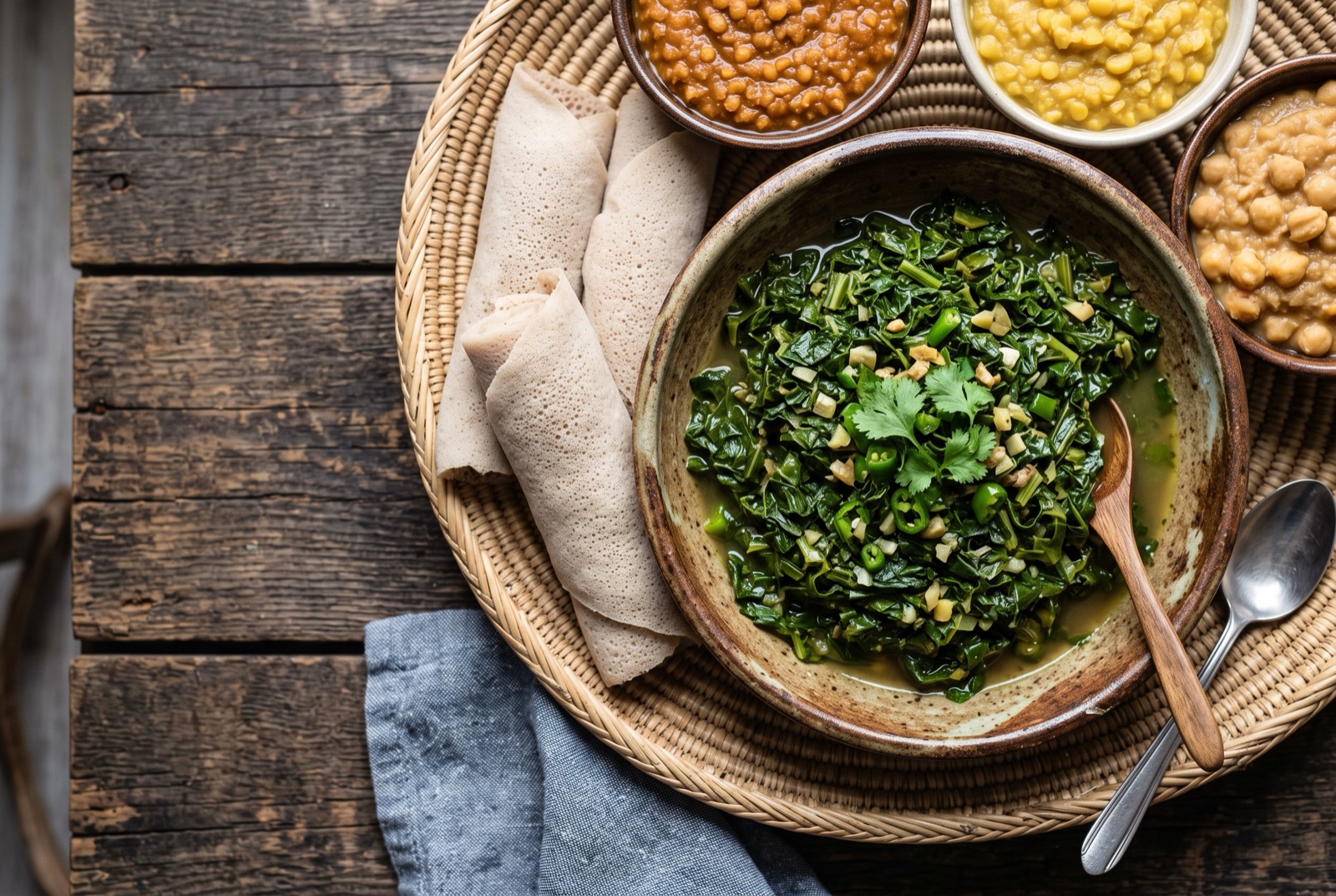
Gomen is collard greens cooked slowly with onion, garlic, ginger and green chilli until the leaves lose all their raw bitterness and turn soft, dark and faintly sweet. There is no chilli powder in it and no acid at the finish, which is deliberate: on a platter crowded with berbere-heavy stews, gomen is the mild, green thing that resets the palate between bites. The flavour is mostly garlic and ginger carried on the greens themselves, with a slow warmth from the whole chillies that never turns into heat. It takes almost no attention once the pot is going, and it is one of the few dishes here that improves if you forget about it for ten minutes.

- Gate
- Ethiopia
- Prep
- 15 min
- Cook
- 50 min
- Total time
- 1 hr 5 min
- Serves
- 4
- Status
- Easy
- Nutrition / serving · estimated
- Calories 190 kcal
- Protein 6 g
- Carbs 14 g
- Fat 14 g
- Fiber 8 g
- Sodium 380 mg
Why this recipe works.
- Cooks the greens to the point Ethiopian kitchens actually aim for, not to a bright wilted crunch.
- Garlic and ginger go in twice, at different stages, so both the deep and fresh notes survive the long braise.
- Almost entirely hands-off after the first ten minutes, and forgiving about exact timing.
- Vegan as written, with an honest note on where the buttered version differs.
Ingredients.
8 itemsEquipment
- Wide heavy pan or shallow casserole with a lid
- Sharp knife
- Fine grater
Instructions.
Prepare the greens
Fold each collard leaf along its central rib and cut the rib away, then stack the leaves, roll them tightly and slice across into short shreds no wider than a finger. Wash and drain them, leaving a little water clinging on.
Tip Short shreds matter more than they sound like they should — long ribbons tangle and cook unevenly.
Start the base
Cook the chopped onion in the oil over medium heat for 8 minutes until soft and translucent with no colour, then add the chopped garlic and the ginger and stir for a minute until the pan smells strongly of both.
Wilt the greens
Add the shredded collards in two or three handfuls, stirring each batch until it slumps and makes room for the next. Tuck in the whole slit chillies, pour in the water and bring to a simmer — the pan should look barely wet, not soupy.
Braise slowly
Cover and cook over low heat for 35–45 minutes, stirring every ten minutes. The greens are ready when they have darkened, lost all springiness, and taste sweet rather than bitter or mineral on the tongue. Add a splash of water any time the pan looks dry.
Tip Aim well past the bright-green stage. In this dish, wilted-but-crunchy is undercooked.
Cook off the liquid
Uncover, raise the heat slightly and cook for a final 5 minutes, stirring, until the pan is nearly dry and the greens hold together in glossy clumps rather than sitting in liquid. Season with salt.
Finish with raw garlic
Off the heat, grate in the two reserved garlic cloves and stir them through. Serve warm as one section of an injera platter, or alongside kitfo with fresh cheese.
Tips from our kitchen.
- Strip the leaves off the thick central ribs and discard them. Ribs never soften at the same rate as the leaf and leave stringy pieces in an otherwise silky dish.
- Stack the leaves, roll them into a cigar and slice across — you want short shreds, not long ribbons that tangle on the spoon.
- Start with only a splash of water. Greens release a surprising amount of their own liquid, and a wet pot at the start means a watery dish at the end.
- Leave the green chillies whole or merely slit. They are there for perfume and slow warmth, and chopping them turns a mild side dish into a hot one.
- Taste at 30 minutes and again at 45. The moment gomen stops tasting faintly bitter and starts tasting sweet is the moment it is done, and that varies with the age of the greens.
Substitutions.
- Collard greens → Curly kale, cavolo nero or Swiss chard leaves
- All work and all are used in Ethiopia depending on the market. Chard cooks fastest and is the mildest; cavolo nero holds its structure longest and stays a darker green.
- Neutral oil → Niter kibbeh
- The richer non-fasting-day version, and very good. It stops being vegan and dairy-free, so cook it in oil if the greens are going onto a shared fasting platter.
- Fresh green chilli → A pinch of chilli flakes added with the garlic
- Acceptable but different — dried chilli gives heat without the vegetal, grassy top note that makes gomen taste green rather than merely hot.
Variations.
- Gomen be siga
- Cubed beef browned first, then the greens braised in the meat juices until both are tender. Substantial enough to be the main dish rather than the side.
- Gomen kitfo
- A Gurage preparation: the greens chopped very fine, cooked only briefly, then dressed with niter kibbeh and crumbled ayib. Served warm alongside kitfo, or on its own with kocho.
- Gomen with potato and carrot
- A common household stretch — chunks of potato and carrot added halfway so they cook in the greens and turn the dish into a fuller fasting-day plate.
Storage & reheating.
Gomen keeps 4 days refrigerated and is one of the rare vegetable dishes that genuinely tastes better the next day, once the garlic has settled into the greens. Reheat gently in a covered pan with a spoonful of water; it needs nothing else. It freezes for 3 months without much loss, since the leaves are already fully softened and have nothing left to lose texturally. Do not add the finishing raw garlic before freezing — grate it in fresh after reheating so the dish still smells alive.
Serve with
Any berbere stew on injera — its job on the platter is to sit next to something hot and take the edge off it.
The story behind Gomen.
Leafy greens are the constant in Ethiopian eating that nobody makes a fuss about. Gomen appears on fasting-day platters, next to meat stews, at roadside canteens and at weddings, and its job is always the same — to be the mild counterweight. In practice the greens used vary with the season and the market: collards are standard, but kale, chard and the local variety known as gomen kitfo greens all end up in the pot under the same name. The dish is defined by the treatment, not by the botany.
The treatment is unusual for a green vegetable in that it involves no browning and very little fat. The leaves are stripped from their stems, stacked, rolled and shredded finely, then cooked with a small amount of water and oil until they collapse. Ethiopian cooks are not aiming for the bright, just-wilted greens that most European and American recipes chase; they want them cooked well past that point, to the stage where the leaf structure has broken down and the greens taste sweet rather than mineral. Undercooked gomen tastes like a different dish, sharp and slightly bitter, and reads as a mistake rather than a choice.
There are two important siblings. Gomen be siga adds cubed beef and simmers the greens in the meat's liquid, turning the side dish into a main. Gomen kitfo, a Gurage speciality, chops the greens very fine, cooks them briefly and dresses them with niter kibbeh and fresh cheese, so the greens play the role that mince plays in kitfo itself. The plain fasting version is the one you meet most often, cooked in oil with no dairy, and the one worth learning first because everything else is built on it.
Questions, answered.
Which greens can I use if I cannot find collards?
Curly kale, cavolo nero, Swiss chard leaves or even spring greens all work, and Ethiopian cooks swap between whatever the market has under the same name. The main adjustment is timing: chard leaves collapse in about 20 minutes, kale takes 35 to 40, and collards can want a full 45. Judge by taste rather than the clock.
Why are my greens still bitter after 40 minutes?
Either they need longer or the ribs went in with the leaves. Thick central stems hold most of the bitterness and never soften at the same rate, so they should be stripped out before shredding. Older, larger leaves are also more bitter than young ones and simply need more time — add a splash of water, put the lid back on, and give them another 15 minutes.
Is gomen supposed to be spicy?
No. It is the mild dish on the platter by design, which is exactly why it works next to doro wat and misir wat. The whole green chillies contribute aroma and a very slow warmth rather than heat, and there is no berbere in it at all. If you want heat, that belongs in the stew it is served with, not here.
Can I cook it with less oil?
Yes, down to about half. The oil carries the garlic and ginger flavour into the leaves and gives the finished dish its gloss, so cutting it entirely leaves the greens tasting steamed and slightly flat. If you reduce it, compensate by cooking with the lid on and finishing with the raw grated garlic, which restores some of the aroma the fat was carrying.
Can I make it ahead for a dinner?
It is one of the best make-ahead dishes in Ethiopian cooking. Cook it entirely the day before, refrigerate, and reheat in a covered pan with a splash of water while the rest of the meal comes together. Grate the finishing garlic in after reheating rather than before, so the fresh top note is not lost overnight.
You might also like.
All recipes →
Keep exploring Ethiopia.
Ethiopia has 9 more dishes in the atlas — Berbere and Doro Wat, and 7 more.
All Ethiopia recipes Garlic recipes Ginger recipes Onion recipes sideveganvegetariandairy freegluten freenut freeRecipe by The DishRoute Kitchen · published August 20, 2026 · updated August 20, 2026